

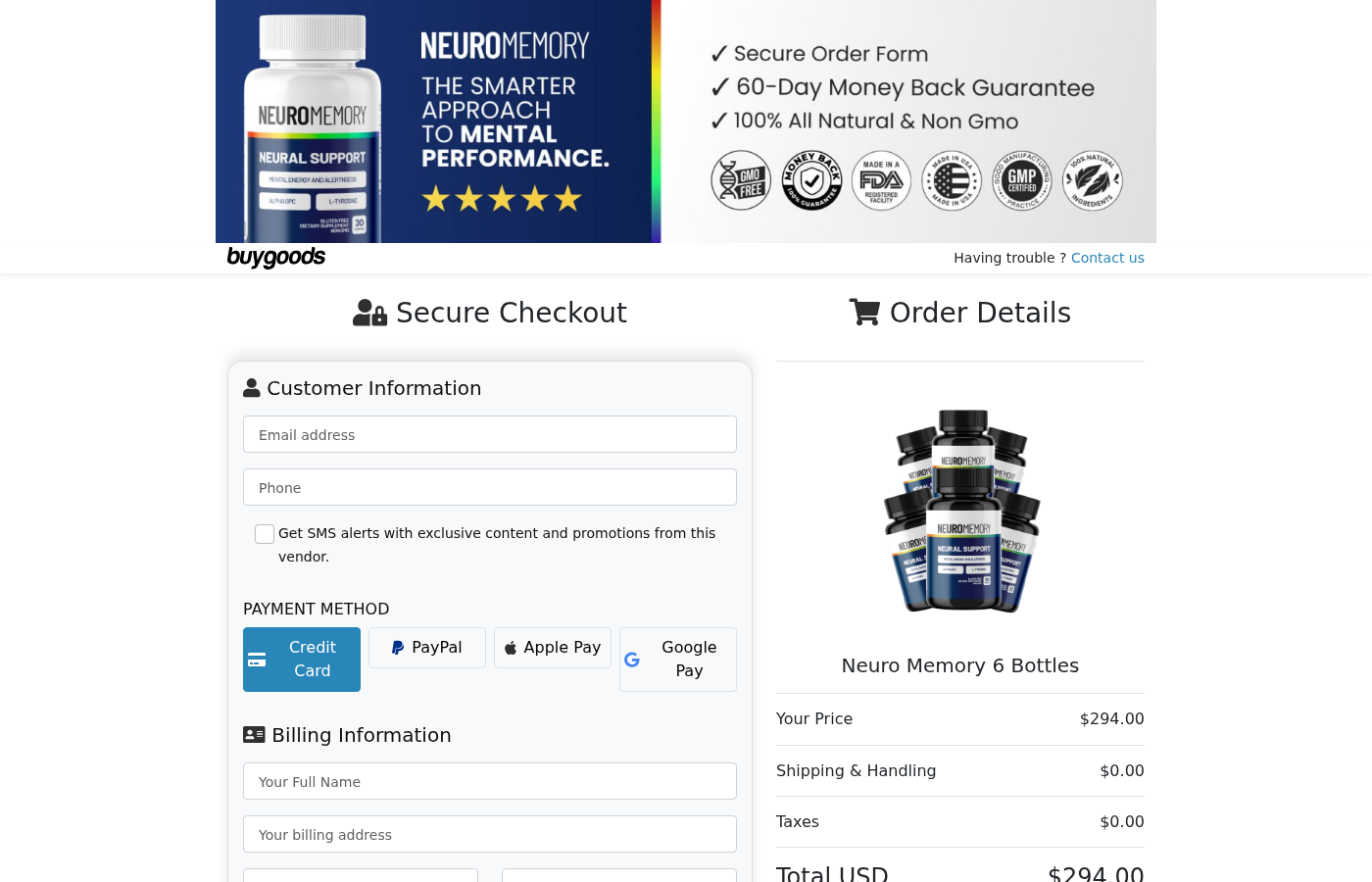
NeuroMemory is sold through a professional checkout with familiar payment options, clear package totals, and a prominent money-back badge.
The real difficulty is not visible in that first glance. It sits inside the return rules that determine whether the promise works.
Overview
What NeuroMemory advertises
NeuroMemory is a dietary supplement promoted for memory, concentration, mental energy, and general cognitive performance.
The marketing presents capsules in several package sizes and describes the formula with phrases such as “science backed” and “all natural.”
At checkout, six bottles cost $294 with free shipping. Smaller packages raise the effective price per bottle.
The transaction is processed through BuyGoods, an online retail and payment platform used by many direct-response offers.
Why the refund promise may be difficult to use
A 60-day guarantee appears prominently, but the detailed return page adds several conditions that deserve attention before payment.
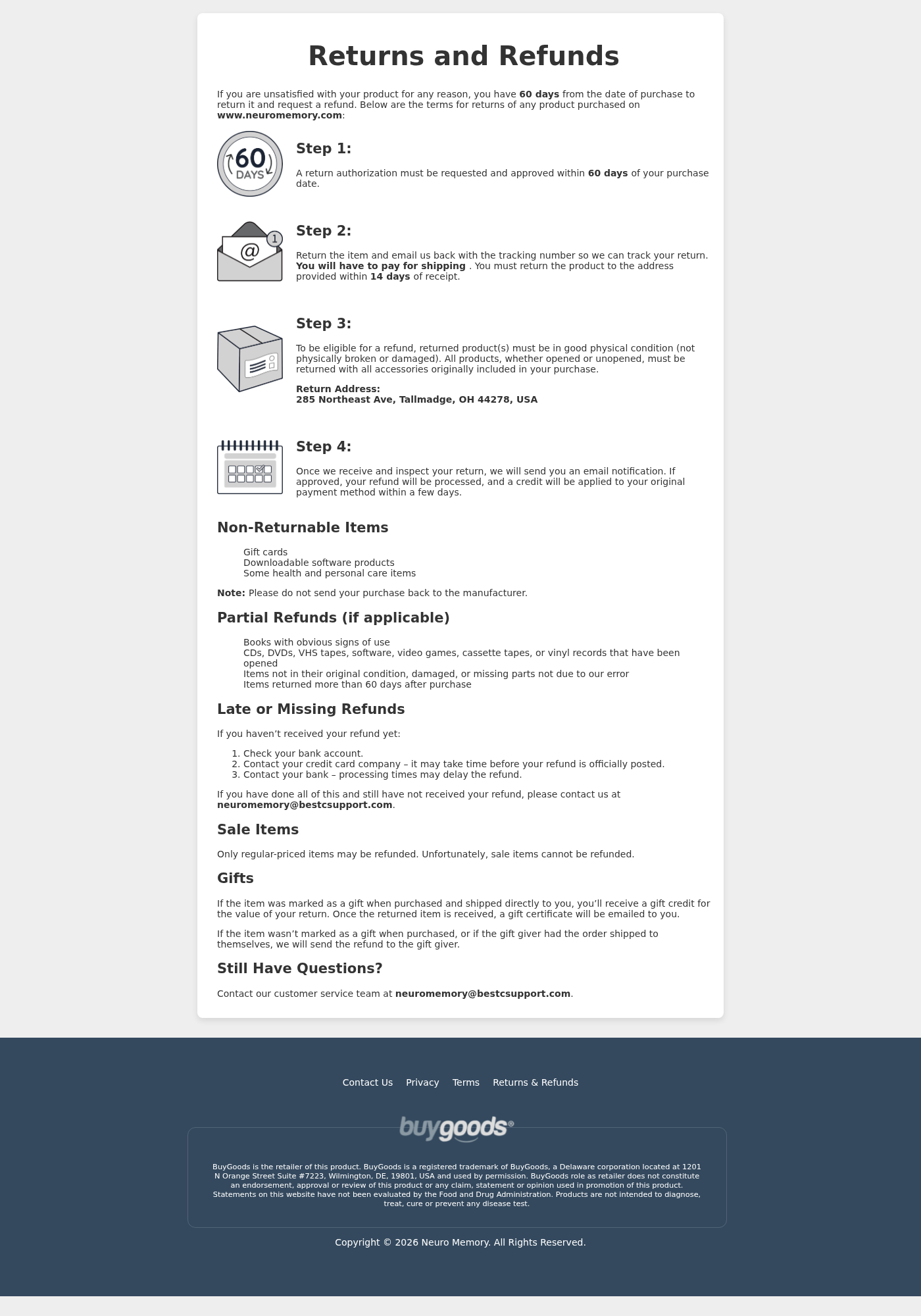
Customers must request authorization, return all products, pay return postage, and ensure the package reaches the specified address within a limited period.
The policy also says sale items cannot be refunded. NeuroMemory packages are displayed with crossed-out reference prices and large savings.
That language creates an obvious question: if the advertised packages are “sale items,” what exactly remains eligible for the guarantee?
Our investigation in brief
NeuroMemory appears to be a purchasable supplement offer, not a nonexistent page. The commercial terms still carry significant risk.
- The domain was registered on August 28, 2025.
- A six-bottle order is displayed at $294.
- The refund window runs for 60 days from purchase.
- Return authorization is required before mailing anything.
- Customers pay nonrefundable return shipping.
- The policy asks for every product, opened or unopened.
- It also says ordinary sale items cannot be refunded.
- The return address appears to be a fulfillment location in Tallmadge, Ohio.
We found no basis to say every NeuroMemory order is fraudulent. We did find terms capable of undermining the reassuring guarantee headline.
This review covers the sales structure and disclosures. We did not conduct laboratory testing or a controlled clinical trial.
Is NeuroMemory Legit or a Scam?
NeuroMemory is better described as a high-risk direct-response supplement offer than as a proven scam.
The checkout is operational, identifies the package, shows a total, and routes payment through an established retailer.
Those facts do not prove the supplement delivers its promised benefits. They also do not erase conflicting or unusually restrictive refund language.
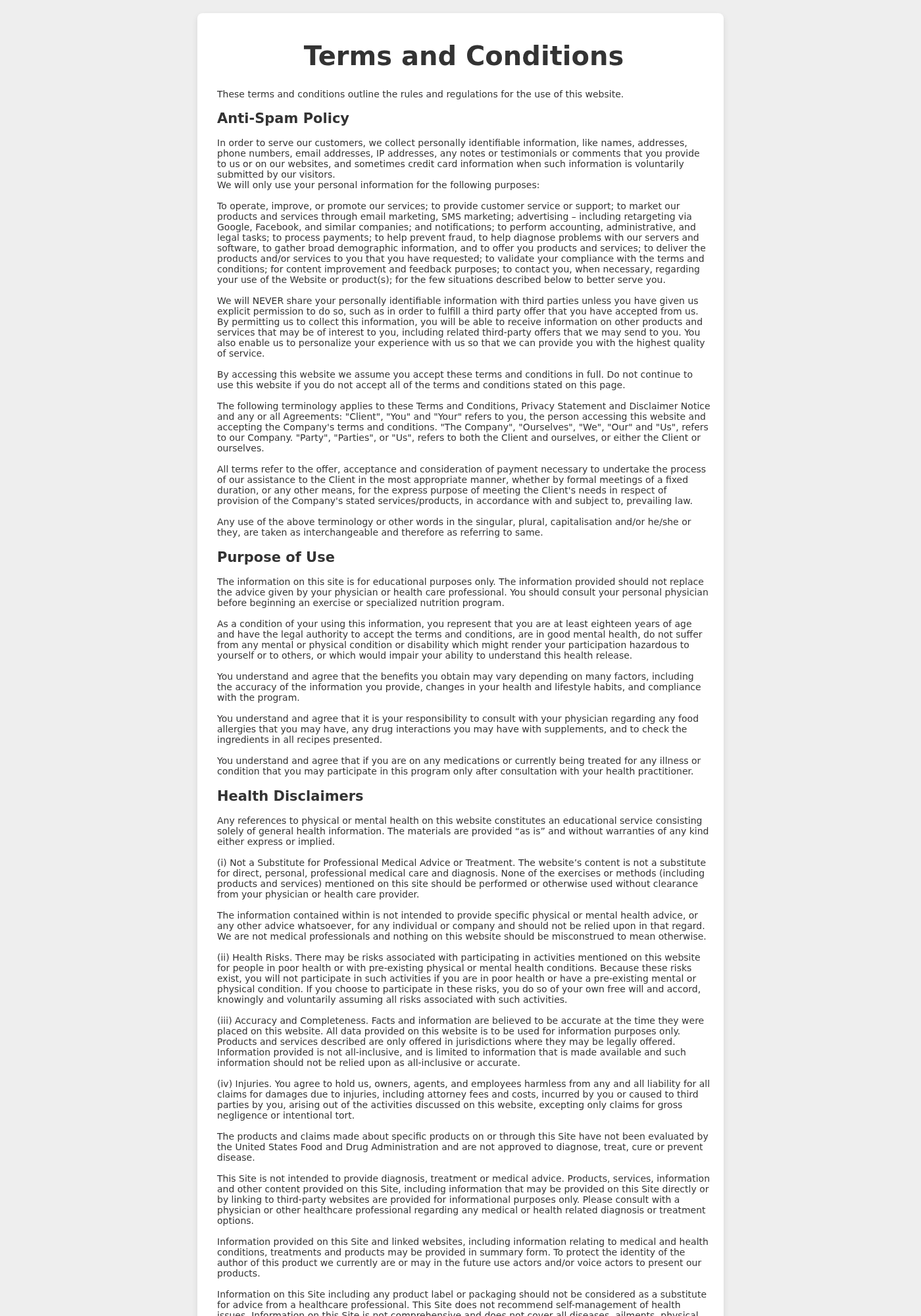
BuyGoods acts as the retailer for the transaction. Its presence should not be mistaken for a scientific endorsement of NeuroMemory.
The seller still needs credible formula evidence, clear company accountability, and a refund policy that agrees with the marketing.
The “sale items” exclusion is particularly concerning because the live offers visually resemble discounted packages.
Until the seller clarifies that contradiction in writing, shoppers should assume the guarantee may be harder to use than the badge suggests.
The 60-Day Guarantee Has Important Conditions
The clock begins on the purchase date
The policy says customers have 60 days from purchase, not 60 days from delivery.
Order processing and shipping can consume part of that period before the first capsule is taken.
A customer trying several weeks of product may have little time remaining for authorization and return transit.
Write the purchase date and deadline on the confirmation. Do not wait until day 59 to ask what must be returned.
Authorization is required first
The instructions tell customers to contact support before shipping a package back.
That step likely produces a return authorization or directions needed to associate the parcel with the correct order.
An unapproved parcel can be delayed, rejected, or separated from the refund request.
Ask support to reply in writing and keep the entire email thread.
Every bottle may need to be returned
The policy calls for all products, whether opened or unopened, along with accessories and relevant paperwork.
Discarding an empty bottle could therefore jeopardize the refund. This requirement is easy to miss when a guarantee sounds satisfaction-based.
Keep every container, cap, label, packing slip, and package until the guarantee period has ended and any refund is complete.
The customer pays the return cost
Return postage is the buyer’s responsibility and is described as nonrefundable.
A six-bottle parcel with tracking and insurance may cost enough to reduce the practical value of the promise.
Original shipping and handling may also be excluded, depending on the transaction and reason for return.
The Sale-Item Exclusion Creates a Major Conflict
The packages are presented as discounted
NeuroMemory uses reference prices, savings language, and bundle discounts to increase the appeal of larger orders.
A reasonable shopper could interpret these as sale packages rather than regular-price purchases.
The six-bottle checkout, for example, presents $294 as a favorable bundle total.
The written policy excludes sale items
The return page states that only regular-priced items may be refunded and that sale items cannot be refunded.
If applied literally, that exclusion could conflict with the broad 60-day guarantee displayed beside discounted offers.
A guarantee should not depend on shoppers guessing how the seller internally classifies a package.
Get eligibility confirmed before ordering
Ask one precise question: “Is the exact package in my cart eligible for a full product-price refund under the 60-day guarantee?”
Request the answer by email, including the product code and quantity. A generic response about customer satisfaction is not enough.
If support will not confirm eligibility, assume the exclusion can be used against the return.
The Return Policy Looks Reused
It mentions unrelated media products
The page lists books, CDs, DVDs, VHS tapes, software, video games, cassette tapes, and vinyl records among non-returnable items.
Those categories have no meaningful connection to a capsule supplement.
The language resembles a generic ecommerce template that was not carefully adapted to NeuroMemory.
Generic text can hide product-specific gaps
A reused policy may omit the exact bottle conditions, restocking rules, damaged-package procedure, or guarantee exceptions actually used by support.
It can also introduce contradictions, such as the sale-item exclusion, that collide with the visible promotion.
For a health product, policy accuracy is not cosmetic. It determines what happens when a customer needs to stop and recover money.
The manufacturer is not the return destination
The page specifically warns customers not to send purchases back to the manufacturer.
That separation suggests manufacturing, retailing, and fulfillment may involve different organizations.
Consumers should understand which company handles each role instead of treating a single brand name as the entire supply chain.
How the NeuroMemory Offer Works
Step 1: Broad cognitive goals draw a wide audience
The advertising speaks to focus, recall, alertness, and mental performance rather than one narrowly measurable problem.
Broad wording allows many readers to recognize a concern and imagine the product fits their situation.
Step 2: Science language raises perceived authority
Ingredient explanations and “science backed” phrasing make the formula appear research-driven.
Research on isolated ingredients does not prove that a finished NeuroMemory capsule achieves every advertised outcome.
Step 3: Package pricing favors a large first order
The best effective price requires several bottles. The six-bottle package turns an initial experiment into a $294 commitment.
Larger bundles improve seller revenue while leaving the customer with more product to store, evaluate, and potentially return.
Step 4: A guarantee makes the commitment feel reversible
The checkout displays the 60-day promise near security and quality badges.
Most customers see the simple badge before reading the detailed page. The headline reduces hesitation; the conditions appear later.
Step 5: The retailer processes payment
BuyGoods collects customer and payment information and records the NeuroMemory package.
Its checkout may add legitimate structure, but product claims remain the seller’s responsibility.
Step 6: The return burden shifts to the buyer
A dissatisfied customer must contact support, preserve all bottles, pay postage, meet deadlines, and document delivery.
The process is substantially more demanding than clicking the original Buy button.
Step 7: Ambiguous exclusions may decide the outcome
If support treats the bundle as a sale item, the customer may confront language saying it is nonrefundable.
That possibility should be resolved before the card is charged, not after bottles are opened.
Claims, Ingredients, and Evidence
A finished formula needs finished-product research
NeuroMemory combines ingredients associated with cognition, energy, or alertness in supplement marketing.
To substantiate the product itself, evidence should test this formula, these doses, and the population addressed by the claims.
We did not find an accessible randomized trial demonstrating that the marketed NeuroMemory product produces the promised results.
A badge is not a certificate of analysis
Checkout graphics mention natural ingredients, GMP practices, and an FDA-registered facility.
These statements do not show the contents of a particular bottle or establish FDA approval.
A useful laboratory report should identify the lot, methods, potency findings, contaminant results, laboratory, and test date.
Health symptoms deserve proper evaluation
Memory changes can result from sleep problems, stress, depression, medication effects, thyroid disorders, nutritional deficiencies, or neurological disease.
A supplement advertisement cannot determine the cause. Sudden or worsening symptoms require timely professional assessment.
Do not let a guarantee period delay medical care.
How to Read the Checkout Before Paying
Confirm the package rather than the per-bottle figure
The cart should show six units, a $294 product total, shipping, taxes, and the final amount before payment authorization.
Take a screenshot after selecting the package and again after any optional offer appears.
Inspect every consent control
The checkout includes fields for contact and billing information, plus optional promotional communications.
Leave unwanted marketing permissions unchecked and read whether any box changes the purchase from one-time billing to recurring delivery.
Record the statement descriptor
Ask what name will appear on the card statement. A recognizable descriptor helps distinguish the order from an unauthorized charge.
After payment, compare the confirmation total with the pending bank transaction while cancellation may still be possible.
These steps do not validate NeuroMemory’s benefits. They reduce avoidable confusion surrounding the commercial transaction.
Company, Address, and Fulfillment Checks
The retailer and product marketer have different roles
BuyGoods appears in checkout as the retailer. That means it processes the purchase under its platform arrangements.
It does not automatically formulate NeuroMemory or independently verify every benefit claim.
The Tallmadge location appears operational
The return policy lists 285 Northeast Avenue, Tallmadge, Ohio 44278.
This address is associated with fulfillment activity for multiple offers. It should not be described as NeuroMemory’s corporate headquarters without proof.
Support must provide the authorization
Because the policy requires prior contact, the support channel becomes a gatekeeper for successful returns.
Test responsiveness before buying. Ask a product-specific question and see whether a complete answer arrives from a consistent domain.
Manufacturing transparency remains limited
The reviewed material does not give consumers a simple way to confirm the finished-product manufacturer and inspect current lot testing.
Mass-produced private-label supplements can look unique while sharing factories and fulfillment systems with unrelated brands.
The risk comes from opacity, not geography. A seller should document quality regardless of where ingredients or bottles originate.
What to Do if You Bought NeuroMemory
- Calculate the deadline now. Count 60 days from the purchase date and leave enough time for authorization and tracked delivery.
- Keep every bottle and document. Preserve opened containers, unused products, caps, labels, packing slips, invoices, and the original parcel.
- Ask whether your package is refundable. Cite the sale-item exclusion and request written confirmation covering your exact product code.
- Obtain authorization before shipping. Follow the order receipt’s support path and insist on a return number, approved address, and item checklist.
- Document the parcel. Photograph the contents and sealed box, then purchase tracking. Insurance may be sensible for a $294 order.
- Monitor the refund. Keep delivery proof and follow up within the stated processing period. Record dates, names, and ticket numbers.
- Escalate unresolved cases. If the seller rejects a properly documented guarantee claim, ask BuyGoods and your card issuer about formal dispute procedures.
- Address health or security concerns. Seek medical advice for symptoms. Use Malwarebytes for suspicious downloads and AdGuard against deceptive advertising routes.
Frequently Asked Questions
Is NeuroMemory definitely a scam?
We did not establish that every sale is fraudulent. The offer has material refund ambiguities and unproven benefit claims that justify caution.
How much is the six-bottle package?
The checkout we reviewed listed six bottles at $294 with $0 shipping and handling before any applicable tax.
Does the 60-day guarantee cover sale packages?
The policy’s sale-item exclusion makes that unclear. Get written confirmation for the exact package before paying.
Must empty NeuroMemory bottles be returned?
The return page says all products should be sent back, opened or unopened. Keep empty containers until the case is closed.
Who pays return shipping?
The customer is responsible, and the policy says those shipping fees are nonrefundable.
Is BuyGoods the NeuroMemory manufacturer?
The checkout describes BuyGoods as the retailer. That does not establish it as the product’s formulator or manufacturer.
The Bottom Line
NeuroMemory’s checkout looks orderly, but its 60-day guarantee comes with deadlines, shipping costs, bottle requirements, and a troubling sale-item exclusion.
The offer is not transparent enough to justify a large first order, especially without finished-product clinical evidence.
If you still consider buying, obtain refund eligibility in writing and choose the smallest quantity. The safest decision is to wait for clearer terms.








