

Synaptril does something many supplement pages avoid. It acknowledges limits, interactions, and unanswered questions while still making a confident sales pitch.
That makes the offer more interesting to investigate, not automatically trustworthy. The important details sit between the responsible warnings and aggressive package pricing.
Overview
What Synaptril is marketed to do
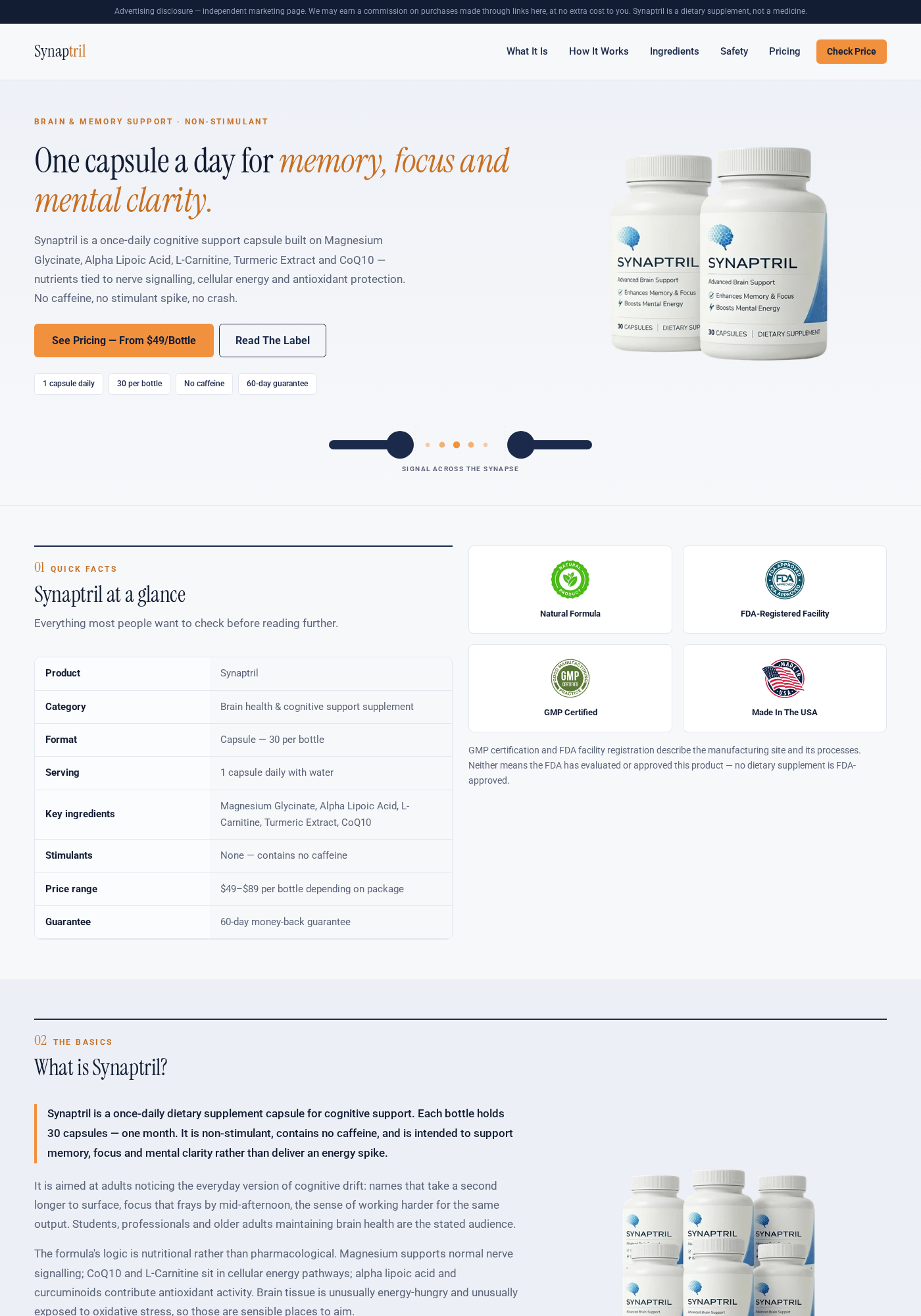
Synaptril is a once-daily capsule promoted for memory, focus, mental clarity, cellular energy, and antioxidant support.
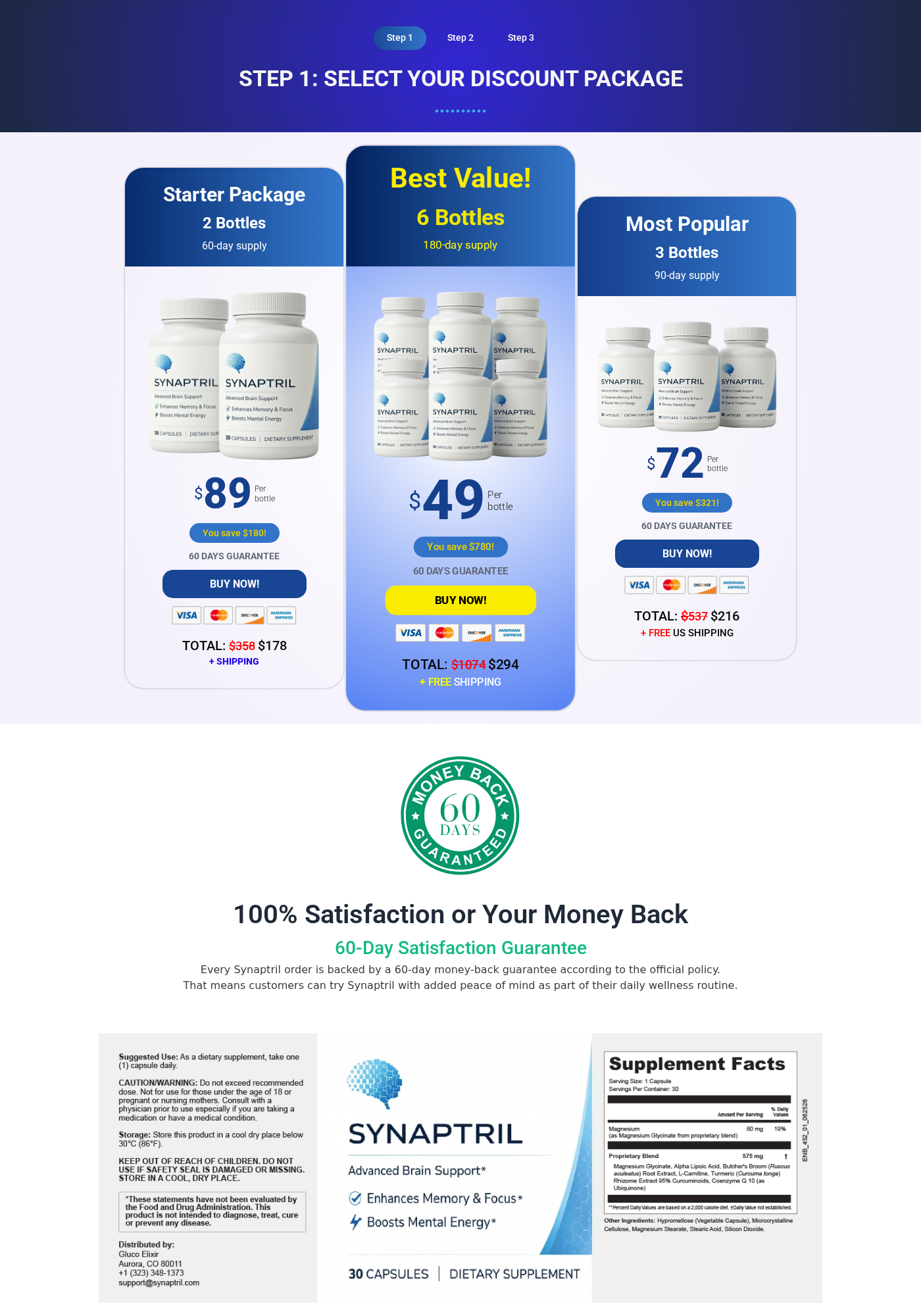
Each bottle contains 30 capsules. The label lists 80 mg of magnesium and a 575 mg proprietary blend shared by six additional ingredients.
Those ingredients include magnesium glycinate, alpha-lipoic acid, L-carnitine, turmeric extract, Rhodiola extract, and coenzyme Q10.
The page emphasizes that the formula contains no caffeine and is intended for ongoing cognitive support rather than an immediate stimulant effect.
What the sales page gets right
Unlike many promotions, the page says an FDA-registered facility does not mean the product is FDA approved.
It also notes that ingredient evidence does not prove the complete Synaptril formula works.
The site discusses potential interactions and acknowledges that proprietary-blend labeling prevents buyers from seeing every individual amount.
Those disclosures are useful. They show more care than a typical miracle-memory landing page.
Why the purchase still carries meaningful risk
Transparency in one part of a website does not eliminate commercial or evidence gaps elsewhere.
- Synnaptril.com was registered on July 26, 2026.
- The finished Synaptril formula has no accessible clinical trial.
- Six ingredients share a 575 mg proprietary blend.
- The lowest $49 price requires a six-bottle, $294 purchase.
- The guarantee lasts 60 days from purchase.
- All bottles must be returned, including empty containers.
- The buyer pays nonrefundable return postage.
- Returns go to a shared fulfillment business, not a disclosed manufacturer.
The available evidence does not justify calling Synaptril a proven scam. It also does not justify treating the supplement as clinically proven.
The sensible evaluation falls between those extremes: a real-looking offer with unproven benefits, opaque doses, and return friction.
Is Synaptril Legit or a Scam?
Synaptril appears to be an active commercial supplement offer with a working checkout, visible label, support email, and return process.
We did not find evidence establishing that every order is fraudulent or that the bottles contain something other than the label states.
We also found no completed product trial demonstrating that Synaptril improves memory or focus in the people targeted by its advertising.
The offer should therefore be judged as an unproven supplement, not a verified medical treatment.
Its clearest commercial concern is the mismatch between a generous-sounding guarantee and the work required to use it.
A six-bottle order costs $294. Returning every container with tracking can add cost and complexity if the customer is dissatisfied.
Buyers who expect a simple, no-questions refund may discover that the process is more conditional than the sales badge implies.
The Proprietary Blend Limits Meaningful Evaluation
Six ingredients share 575 mg
The Supplement Facts panel discloses 80 mg of magnesium separately. The remaining six active ingredients occupy one 575 mg proprietary blend.
Consumers can see which ingredients appear, but not how much of each one is present.
The first ingredient in a blend is generally present in the greatest amount by weight. Exact values remain undisclosed.
That prevents a direct comparison between Synaptril doses and quantities used in published research.
The total leaves limited room for research-level amounts
Alpha-lipoic acid, L-carnitine, turmeric, Rhodiola, and CoQ10 can each appear in studies at substantial doses.
All six listed ingredients must fit within 575 mg per capsule.
That arithmetic does not prove the formula is ineffective. It shows why ingredient-name marketing can exaggerate what a label actually reveals.
A tiny inclusion allows a name on the panel without showing that the amount is likely to influence an outcome.
The website admits this limitation
Synaptril’s own explanatory material notes that individual quantities cannot be determined from the proprietary blend.
It also recognizes that research involving CoQ10 or curcumin may use doses difficult to reconcile with one shared 575 mg blend.
That is a fair disclosure. It should carry more weight than broad phrases about memory and mental energy.
Ingredient Research Is Not Product Proof
Biological plausibility is only the beginning
Magnesium supports normal nerve function. CoQ10 and L-carnitine participate in cellular energy processes.
Turmeric and alpha-lipoic acid are commonly discussed for antioxidant activity, while Rhodiola is promoted for stress and fatigue.
Those general facts help explain why the ingredients were chosen. They do not establish a measurable memory benefit from one Synaptril capsule.
The finished formula has not been clinically demonstrated
A persuasive product trial would test the marketed capsules against a suitable control under predefined conditions.
It would report participant characteristics, dosing, outcomes, adverse events, statistical analysis, funding, and full results.
We found no accessible peer-reviewed trial meeting that standard for Synaptril itself.
Manufacturing standards answer a different question
GMP and facility-registration claims concern production systems and regulatory listing.
They do not prove that Synaptril improves cognition. They also do not show what a particular lot contained without corresponding test results.
Ask for a current certificate of analysis that identifies the laboratory, lot number, potency, heavy metals, microbes, and methods.
Pricing Makes the First Decision Expensive
The headline price belongs to six bottles
Synaptril advertises pricing “from $49 per bottle.” Reaching that figure requires buying six bottles for $294.
Three bottles cost $216, or $72 each. Two bottles cost $178, or $89 each.
There is no single-bottle starter option on the package screen we reviewed.
The displayed savings are unusually large
The six-bottle card claims a $780 saving against a crossed-out reference total of $1,074.
Reference prices only provide useful context when the product was genuinely offered at that higher price for a meaningful period.
A young domain and a brand-new offer make such comparisons difficult to verify.
A multi-bottle order outlasts the guarantee
Six bottles represent roughly 180 days at one capsule daily. The refund period is only 60 days from purchase.
Most of the supply therefore sits outside the advertised evaluation window.
Customers must decide whether to continue long before the largest package is close to finished.
How the Synaptril Offer Works
Step 1: The promotion starts with everyday cognitive frustration
The copy describes names taking longer to surface, afternoon mental fatigue, and focus becoming harder to maintain.
These relatable experiences let readers see themselves in the page without requiring a medical diagnosis.
Step 2: Ingredient explanations create a coherent story
The formula is organized around nerve signaling, cellular energy, stress response, and antioxidant support.
That narrative sounds scientifically tidy even though the product-level outcome remains untested.
Step 3: Balanced warnings increase credibility
The website includes caveats about approval, interactions, and proprietary-blend limits.
Those statements can make the entire page feel objective. Readers may extend that trust to promotional conclusions that remain uncertain.
Step 4: Package design removes a low-cost trial
The minimum displayed purchase is two bottles for $178. The offer quickly steers attention toward six bottles for $294.
Without a single-bottle option, even a cautious customer must make a sizable first commitment.
Step 5: The guarantee counters price hesitation
A 60-day money-back badge appears below the packages, suggesting the decision can be reversed.
The concise message does not immediately convey every condition found on the dedicated return page.
Step 6: Payment moves through an outside retailer
The order route uses BuyGoods infrastructure. The platform handles the retail transaction under the terms shown during checkout.
Read post-purchase upsells carefully and confirm the final quantity before authorizing payment.
Step 7: A return requires coordinated evidence
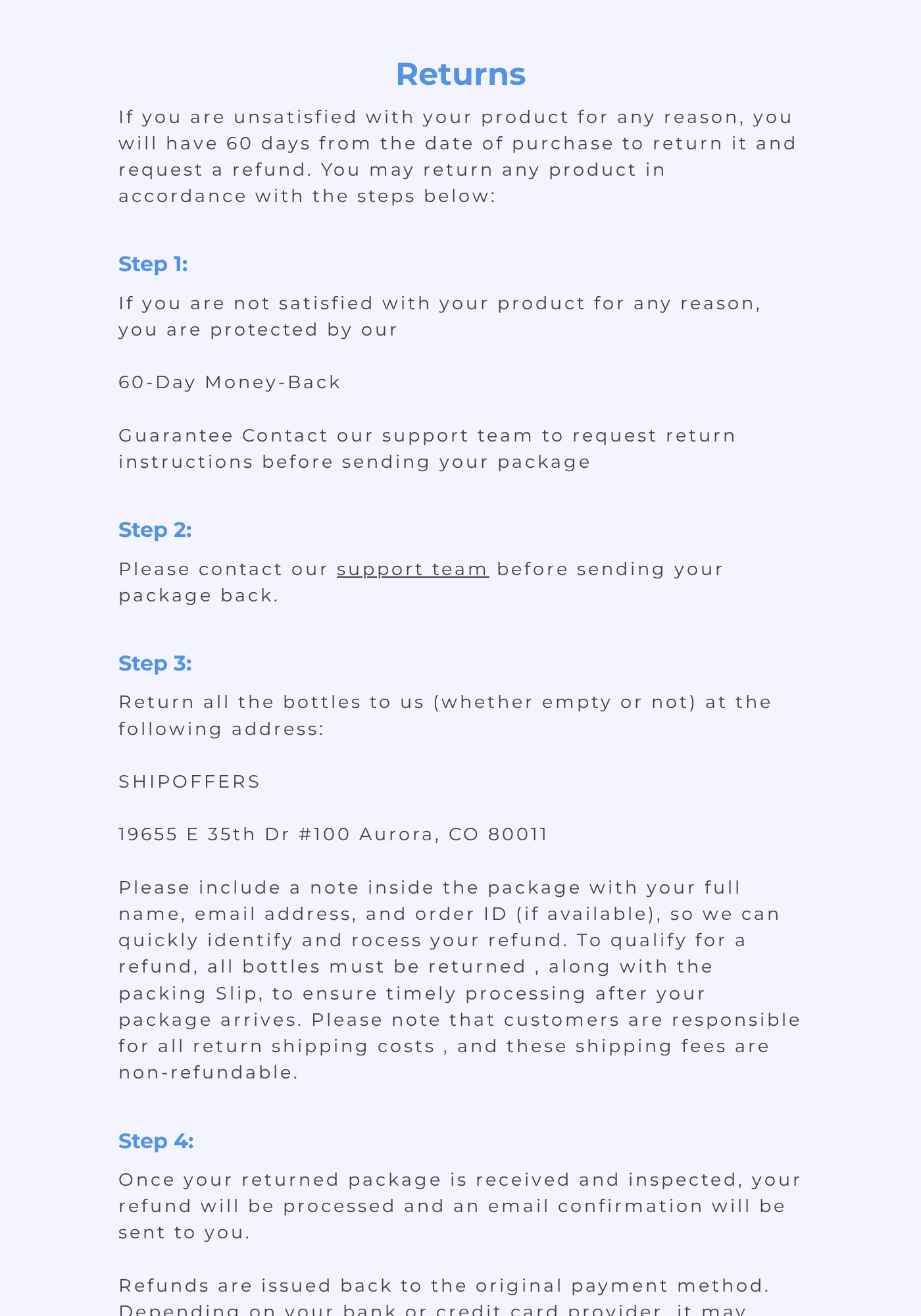
Dissatisfied buyers must contact support, keep all bottles, prepare identifying information, and pay to ship the parcel.
The fulfillment center then receives and inspects it before the refund is issued.
The Return Process Is More Demanding Than the Badge
All bottles must go back
The returns page instructs customers to send every bottle, whether empty or not.
It also requests a note containing the customer’s name, email, and order number, plus the packing slip.
Throwing away a container or paperwork can create an avoidable obstacle.
Return shipping is not reimbursed
The buyer pays the carrier and does not recover that cost.
For a heavy multi-bottle parcel, use a service with tracking and consider insurance proportional to the order value.
A screenshot of the label is not proof that the warehouse received the package. Keep delivery confirmation.
The 60 days begin at purchase
The policy ties eligibility to the purchase date. It does not grant a fresh 60 days after delivery.
Request instructions well before the deadline and ask whether the package must be mailed or received by that date.
The current page does not explain every timing detail with enough precision.
Safety and Interaction Questions
Multiple active ingredients increase complexity
Alpha-lipoic acid may influence blood sugar. Rhodiola can affect stimulation, mood, or sleep in some people.
Turmeric extracts can matter for people taking anticoagulants, while magnesium can interfere with absorption of certain medicines.
CoQ10 and L-carnitine also warrant individualized consideration in some medical contexts.
The undisclosed doses complicate medical review
A clinician can see the total blend amount but cannot determine the quantity of each active ingredient.
That makes interaction assessment less precise, especially for people taking several medicines or managing chronic conditions.
Bring the complete label to a pharmacist before use.
Cognitive changes should not be self-diagnosed
Persistent memory problems can reflect medication effects, depression, poor sleep, nutritional deficiency, infection, endocrine disease, or neurological illness.
A commercial supplement page cannot separate those causes.
Seek prompt evaluation for rapid changes, confusion, safety concerns, or symptoms interfering with daily life.
Company, Address, and Fulfillment Checks
The marketing page discloses its affiliate role
A banner describes the website as an independent marketing page that may earn commissions.
That disclosure is useful because it clarifies that promotional content may be financially motivated.
The label names a distributor, not necessarily a manufacturer
The displayed bottle information says the product is distributed by Gluco Elixir in Aurora, Colorado.
Distribution describes a commercial role. It does not identify the facility that produced the capsules or tested the finished lot.
Returns go to a shared fulfillment company
The policy directs parcels to SHIPOFFERS at 19655 East 35th Drive, Suite 100, Aurora, Colorado 80011.
SHIPOFFERS handles logistics for multiple wellness brands. Its address should not be mistaken for proof that it owns or formulated Synaptril.
The support trail is identifiable but limited
The label provides support@synaptril.com and a telephone number. Test both before purchasing a large bundle.
Ask for the legal seller, manufacturing site, current laboratory report, refund timing, and statement descriptor.
Useful support should answer those questions directly rather than returning generic sales language.
What Would Make the Offer Easier to Trust?
Full ingredient quantities
Replacing the proprietary blend with individual amounts would let clinicians and consumers compare the label with published evidence.
Lot-linked laboratory results
Current reports for identity, potency, microbes, and heavy metals would turn broad quality assurances into evidence tied to shipped bottles.
A smaller first-purchase option
One bottle would let customers evaluate tolerance without committing $178 or $294 before knowing whether the formula suits them.
None of these improvements would prove a memory benefit. They would make the commercial and safety evaluation considerably more informed.
What to Do if You Bought Synaptril
- Save the purchase evidence. Keep the package screen, checkout total, guarantee, receipt, label, terms, and all correspondence in one folder.
- Keep every container. Do not discard empty bottles, unused bottles, the packing slip, or the original parcel while refund eligibility remains open.
- Mark the 60-day deadline. Count from the payment date and contact support early enough to obtain instructions without last-minute uncertainty.
- Ask for authorization in writing. Confirm the exact return address, required note, eligible amount, processing time, and whether original shipping is excluded.
- Use tracked return delivery. Photograph everything inside the box and retain the carrier receipt until money is back on the original payment method.
- Review the formula medically. Show the label to a pharmacist, particularly if you use blood-thinning, diabetes, thyroid, psychiatric, or cardiovascular medicines.
- Escalate with a clear timeline. If a qualifying refund is not processed, contact the retailer and card issuer with order and delivery documentation.
- Reduce further online risk. Malwarebytes can detect unwanted programs. AdGuard can block many aggressive ads and redirect chains promoting similar supplement offers.
Frequently Asked Questions
Is Synaptril a confirmed scam?
No. We found an active offer and a defined return process, but benefits remain unproven and the terms deserve careful review.
Has Synaptril been clinically tested?
We found no accessible clinical trial testing the complete marketed formula for the advertised memory and focus outcomes.
How much of each ingredient is present?
Magnesium is listed at 80 mg. Six other ingredients share a 575 mg proprietary blend, so their individual quantities are undisclosed.
Can I buy one bottle?
The package page we reviewed began with two bottles for $178. The advertised $49 rate required six bottles costing $294.
Where are Synaptril returns sent?
The policy lists SHIPOFFERS in Aurora, Colorado. This appears to be a fulfillment destination, not proof of product ownership or manufacturing.
Does the guarantee cover return shipping?
No. The policy says customers pay return shipping and those charges are nonrefundable.
The Bottom Line
Synaptril is more candid than many supplement pages, but candor does not supply missing doses or prove the finished formula works.
The $294 bundle, 60-day deadline, all-bottle return rule, and buyer-paid postage make the “risk-free” impression incomplete.
Approach Synaptril as an unproven commercial supplement. Verify medical suitability and return eligibility before committing to multiple bottles.








