

A GTAGlow projector promises to turn an ordinary bedroom into Vice City. Neon scenery, familiar game imagery, and bundle discounts make the little gadget look irresistible.
Before making room for it on your desk, look beyond the glowing pictures. Several details deserve a closer look before this becomes your next setup upgrade.
Overview
What GTAGlow actually says you are buying
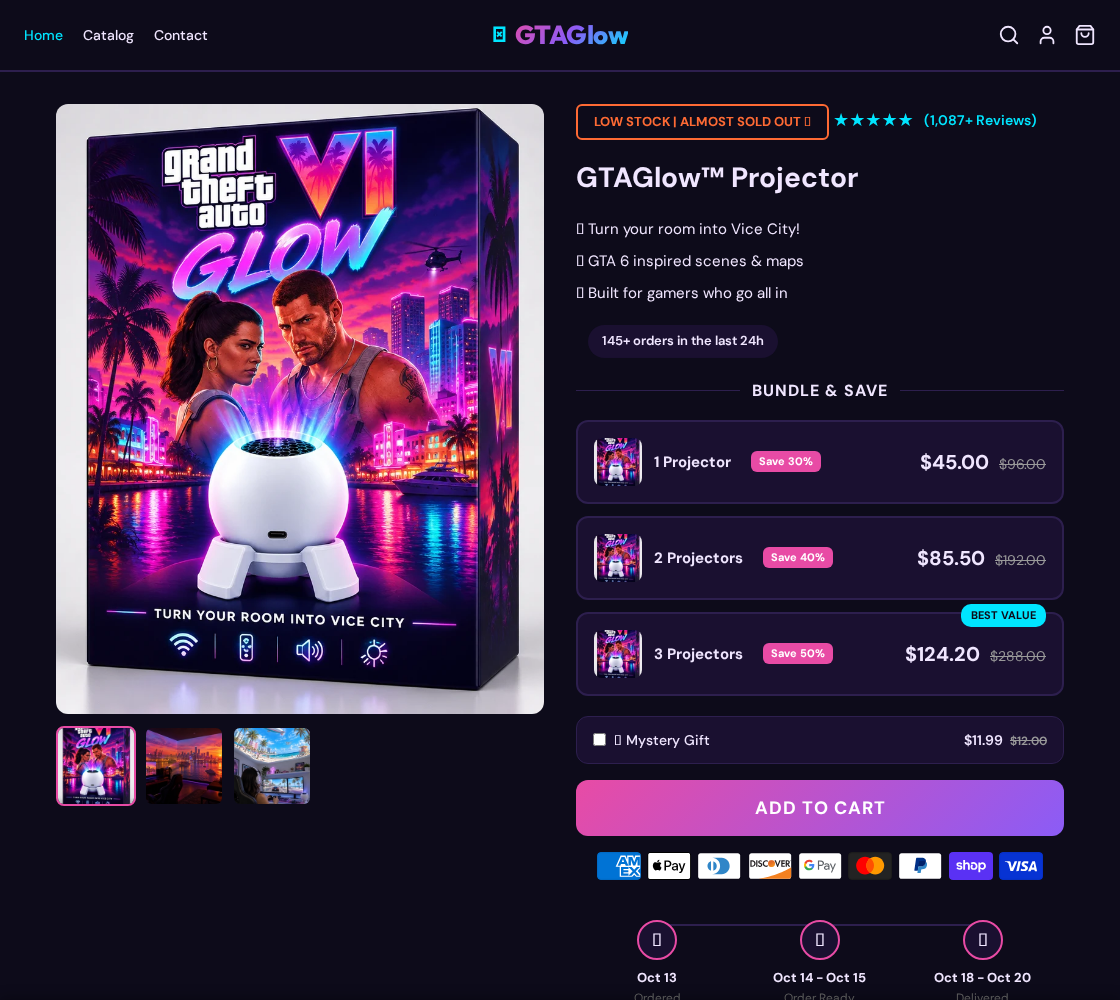
GTAGlow is advertised as a USB-powered decorative projector. Its description lists three film slides depicting a Vice City skyline, Ocean Beach, and a night-drive scene.
That matters because a slide projector is not a gaming console, streaming device, or video projector. The game-themed presentation should not blur those very different products.
The offer displays one projector for $45, two for $85.50, and three for $124.20. A separate mystery gift costs $11.99.
Those are advertised package prices, not a verified final charge. Taxes, shipping eligibility, optional extras, and the selected quantity still need checking before payment.
The biggest problems are in the small print
The GTAGlow branding does not follow you consistently through the store. Its contact information names WickFern, while the footer displays princessglow.us.
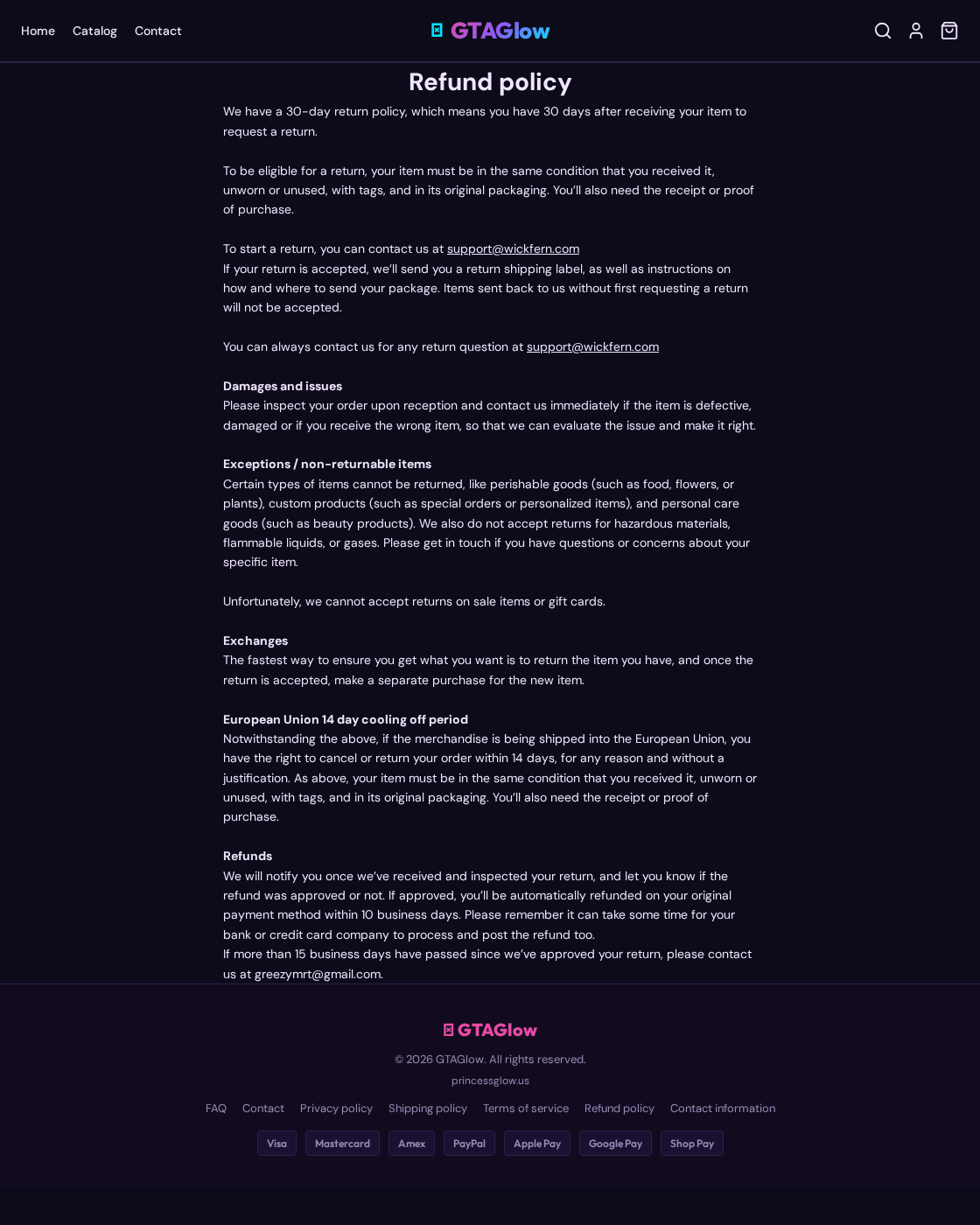
The refund page directs initial requests to support@wickfern.com. A later refund follow-up instruction instead names greezymrt@gmail.com.
There is also a direct purchase risk: the projector is advertised with discounted pricing, but the refund policy excludes sale items from returns.
A one-year replacement promise on the sales page does not answer whether you can return a disappointing projector. Replacement and refund are different remedies.
- The seller identity changes between the storefront and its policies.
- Displayed savings do not match the crossed-out prices consistently.
- Delivery estimates vary depending on which page you read.
- The sale-item exclusion may affect the exact offer being promoted.
What the evidence does and does not show
These are documented reasons to avoid the current offer, not proof that every projector shipped under this name is nonexistent or dangerous.
No purchase or physical performance test was conducted. The reviewed pages do not establish hidden subscription enrollment, shipment origin, or an actual unauthorized bundle charge.
The right question is therefore specific: does this offer identify a responsible seller and give you a usable remedy if its room-transforming promise disappoints?
At present, the conflicting names, discount labels, and return restrictions leave too much of that answer to be discovered after you pay.
The Projector Promise Versus the Hardware Description
A darkened room can make a modest light effect look dramatic. That does not tell you how sharply a slide will appear across your own walls.
Wall color, projection distance, ambient light, and the size of the projected image can all affect the result. The listing supplies no useful measurements for those conditions.
The offer says the viewing angle adjusts through 360 degrees. That describes where the device can point, not its brightness or image resolution.
It also says the projector fills an entire room. Before relying on that claim, ask for a measured projection area and an ordinary, unedited demonstration.
Packaging graphics show entertainment-style icons, but the written package contents list slides, a USB cable, and a guide. Icons should not replace actual specifications.
If you expect sound, wireless connectivity, moving video, or control from a phone, get those features confirmed for the exact model in writing.
The wording describes GTA-inspired scenes. That alone does not demonstrate an official Rockstar Games license or approval, and this article makes no such licensing determination.
Someone can enjoy decorative gaming imagery without buying this particular offer. The appeal of the theme should not carry an unclear seller across the finish line.
How the GTAGlow Sales Funnel Works
Step 1: The gaming theme makes the purchase feel familiar
The landing page centers the projector beneath recognizable game-style scenery. It invites you to imagine your own bedroom transformed rather than compare technical specifications.
A review count above 1,000, an almost-sold-out message, and a claim of 145 recent orders surround the buying area.
Those figures are seller-controlled claims. The page does not give the underlying order records or independent review trail needed to authenticate them.
They may make a purchase feel popular, but popularity is not the same as a measured product test or a dependable return process.
The practical response is simple: pause before accepting the atmosphere as evidence. Identify the model, the included slides, and the outcome you actually expect.
If the seller cannot demonstrate that outcome in an ordinary room, a polished illustration is not a substitute. Buy the hardware, not the imagined bedroom.
Step 2: Bundle labels compete with the real price calculation
The one-projector card shows $45 against $96 while labeling the saving 30%. Those numbers do not describe the same discount.
A drop from $96 to $45 is approximately 53.1%. The two-projector card shows $85.50 against $192, a reduction of approximately 55.5%, not 40%.
For three projectors, $124.20 against $288 is approximately 56.9% off. Its displayed label says 50%.
More importantly, compare bundles against the available single-unit price. Two at $45 would cost $90, so the two-pack saves $4.50, or 5%.
Three single units would total $135. The three-pack saves $10.80, or 8%, against that practical comparison.
Neither comparison proves that the crossed-out amounts were genuine prior selling prices. The store needs to explain its pricing reference rather than let badges do it.
You should not buy extra projectors just because a higher discount label appears beside them. Work out whether you need another device at all.
Step 3: An optional gift and cart timer add another decision
A mystery-gift checkbox appears separately from the projector bundles. In the captured offer, it was not selected.
This is an extra you should actively review, not evidence that the store secretly charged it. Its vague description provides little basis for judging value.
If selected, the $11.99 gift would raise a $45 product subtotal to $56.99 before any other charges. The final confirmation should make that visible.
The cart also displays a five-minute reservation timer. Do not treat a countdown as a reason to skip quantities, delivery terms, or the refund policy.
A useful checkout spells out the complete purchase. If anything changes between selection and payment, stop and capture the new total instead of continuing automatically.
No payment was submitted during this investigation. Claims of automatic three-unit shipments or recurring fees would need evidence from the actual authorization and receipt.
Step 4: Delivery promises become less straightforward
The sales page’s delivery graphic suggests arrival in roughly five to seven days. Its question-and-answer text instead gives seven to ten business days.
The separate shipping policy adds two to five business days of processing, followed by six to twelve business days for U.S. or Canadian delivery.
Read consecutively, those policy ranges suggest eight to seventeen business days before additional delays. That is not the same expectation as a quick delivery graphic.
The policy also discusses international customs charges and estimates rather than guaranteed dates. Anyone ordering for a birthday or holiday needs a reliable arrival commitment.
Ask which schedule governs your order and where it will dispatch. A local payment currency or gaming theme does not establish a local warehouse.
Keep the answer alongside the receipt. If a delivery dispute develops, the specific promise you accepted matters more than a later revised landing page.
Step 5: The return exclusion may surface when the room looks different
The refund policy begins with a 30-day period after receipt. It requires unused goods, original packaging, proof of purchase, and advance return approval.
Further down, it excludes sale items. Because the projector offer itself emphasizes savings, you need an explicit answer about that purchase before ordering.
A seller might distinguish defective goods from ordinary returns, but a buyer should not have to guess where a weak or disappointing projection belongs.
The advertised warranty promises replacement if something goes wrong. It does not plainly promise your money back because the effect falls short of the marketing.
Ask whether a brief functional test is allowed, who pays return postage, and which contact handles the claim. Save all three answers.
Until those terms are clarified, the current offer is a poor place to take a chance on decorative hardware.
GTAGlow Seller, Contact, and Fulfillment Checks
GTAGlow, WickFern, and PrincessGlow are not explained
The storefront sells GTAGlow, the terms welcome buyers to WickFern, and the footer references PrincessGlow. These are observable inconsistencies, not a verified ownership chart.
Shared operations or unfinished policy editing could explain some mismatches. Neither possibility excuses failing to identify who accepts the payment and owes the customer a remedy.
Before paying, require a legal business name that matches the invoice and governing policy. Do not assume Shopify itself is the seller.
The contact page leaves the location question unanswered
The inspected contact information lists a trade name and email address, but its phone-number field is blank. It does not supply a usable business address there.
Without a stated return destination, you cannot estimate postage or determine whether returning a $45 item would be economical.
This is missing information, not evidence that a particular address is fake. Ask for the country and complete return instructions before committing funds.
Two email routes make support harder to follow
Initial refund requests go to support@wickfern.com, while overdue refund follow-ups point to greezymrt@gmail.com. The shipping policy also mixes those contacts.
Neither inbox was contacted, so this investigation cannot claim they are unresponsive. The problem is that the store provides no clear explanation of their roles.
If you already ordered, use the published policy contact and retain a complete message history. Do not send card numbers or passwords to either address.
A decorative render cannot identify the factory
The sales images do not establish the manufacturer, electrical testing, or country of production. A factory claim requires documentation for the actual unit, not its promotional box.
Request the model number, power requirements, and instructions. If the delivered product has damaged wiring, unusual heat, or an unidentified adapter, stop using it.
No finding here proves Chinese manufacture or an electrical defect. The buying recommendation rests on documented commercial inconsistencies, not an invented supply-chain allegation.
What to Do If You Ordered GTAGlow
-
Recover the exact order details. Find your confirmation and record the projector quantity, gift selection, total charge, merchant name, and promised delivery schedule.
Compare the receipt with your original selection. A bundle you knowingly chose is different from extra units added without permission.
-
Request cancellation promptly if you no longer want it. Write to the policy’s support address with your order number and ask for written cancellation confirmation.
State whether dispatch has occurred. Do not interpret a generic acknowledgment as confirmation that payment will be returned.
-
Preserve the sale and warranty claims. Save the product offer, discount cards, shipping estimates, and refund page before they change.
Include the contact-name mismatches. These help explain precisely why you expected a different remedy or delivery timeline.
-
Inspect a delivered unit carefully. Photograph the package, label, accessories, and slide contents. Retain the box while requesting any return.
If performance is the problem, document projection distance and room lighting. An honest demonstration is more useful than an edited complaint clip.
-
Challenge a specific unresolved charge or delivery failure. Contact your card issuer or payment service and ask which dispute category and deadline fit the facts.
Explain an unauthorized add-on, missing delivery, or materially different item accurately. Do not describe every disappointing purchase as stolen-card fraud.
-
Avoid paying someone to unlock your refund. Ignore strangers offering recovery services through comments or direct messages.
A legitimate payment dispute does not require your online-banking password, remote computer access, or a gift-card payment to a social-media helper.
Frequently Asked Questions
Is GTAGlow a confirmed scam?
The pages establish inconsistent seller names, pricing labels, and return terms. They support avoiding this offer, but do not prove every order is fraudulent or undelivered.
Does the GTAGlow projector play GTA?
Its description presents a decorative slide projector with three themed scenes. It does not describe hardware that runs the game or projects gameplay from a console.
Are GTAGlow’s bundle discounts accurate?
The stated savings differ from the displayed comparison-price calculations. Against buying units separately at $45, the two-pack saves 5% and the three-pack saves 8%.
Can I return a discounted GTAGlow projector?
The policy excludes sale items despite advertising a 30-day return period. Obtain written confirmation covering your discounted purchase rather than assuming the headline period applies.
Also ask whether testing the projection affects eligibility. A sealed-box return cannot help you evaluate the effect on your own wall.
Why does GTAGlow mention WickFern and PrincessGlow?
Those names appear in its policies and footer. Their relationship is not explained on the inspected pages, so confirm the responsible merchant before buying.
Does GTAGlow enroll buyers in a subscription?
No recurring enrollment was established. Review your own authorization and statement for unexpected charges, but do not confuse the visible mystery-gift option with a subscription.
The Bottom Line
Do not order GTAGlow through the current offer. The return exclusion, conflicting seller identities, and unclear delivery promises outweigh the attraction of its gaming theme.
If you already paid, preserve your receipt and request a specific remedy promptly. Escalate unresolved unauthorized charges or delivery problems through the payment provider.








