

Helen’s Jewelry introduces copper rings and bracelets through a story that feels personal. You can almost picture the small workshop behind the collection.
If that story brought you here, take a moment before choosing your size. There is more to this purchase than the jewelry photographs.
Overview
The local-workshop impression needs a closer look
Helen’s Jewelry deserves scrutiny because its Asheville artisan narrative sits alongside a Hong Kong seller disclosure and potentially expensive international returns.
That combination does not establish that every order is fraudulent. It does make the impression of a simple purchase from a nearby craftsperson unreliable.
Our October 8, 2026 review examined the current storefront, legal terms, shipping information, refund conditions, and the evidence behind copper-bracelet health claims.
We did not purchase jewelry, test its metal composition, or independently authenticate the people presented in the shop’s story.
The most important findings for buyers
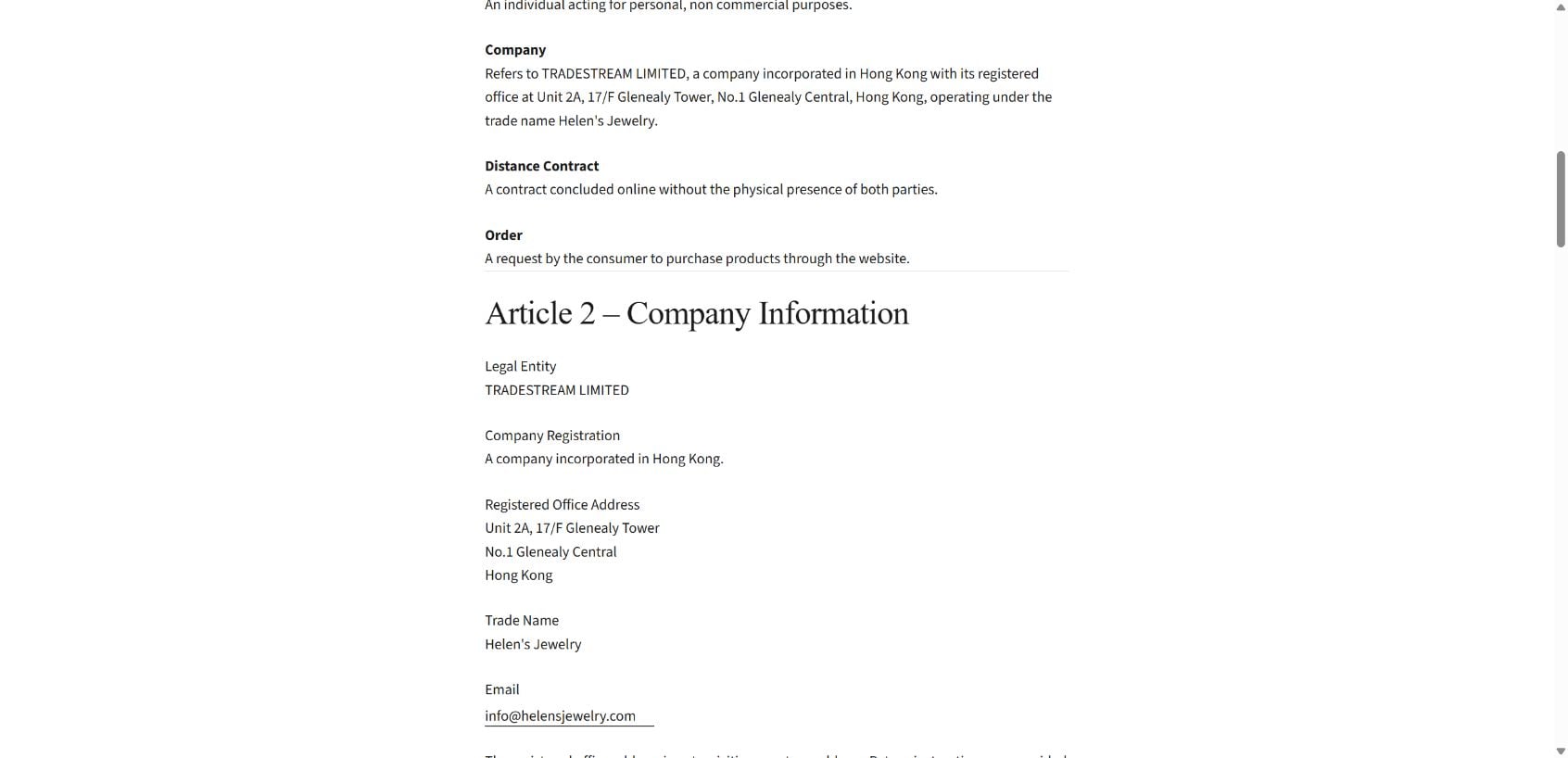
- The terms identify TRADESTREAM LIMITED in Hong Kong as the company operating the brand.
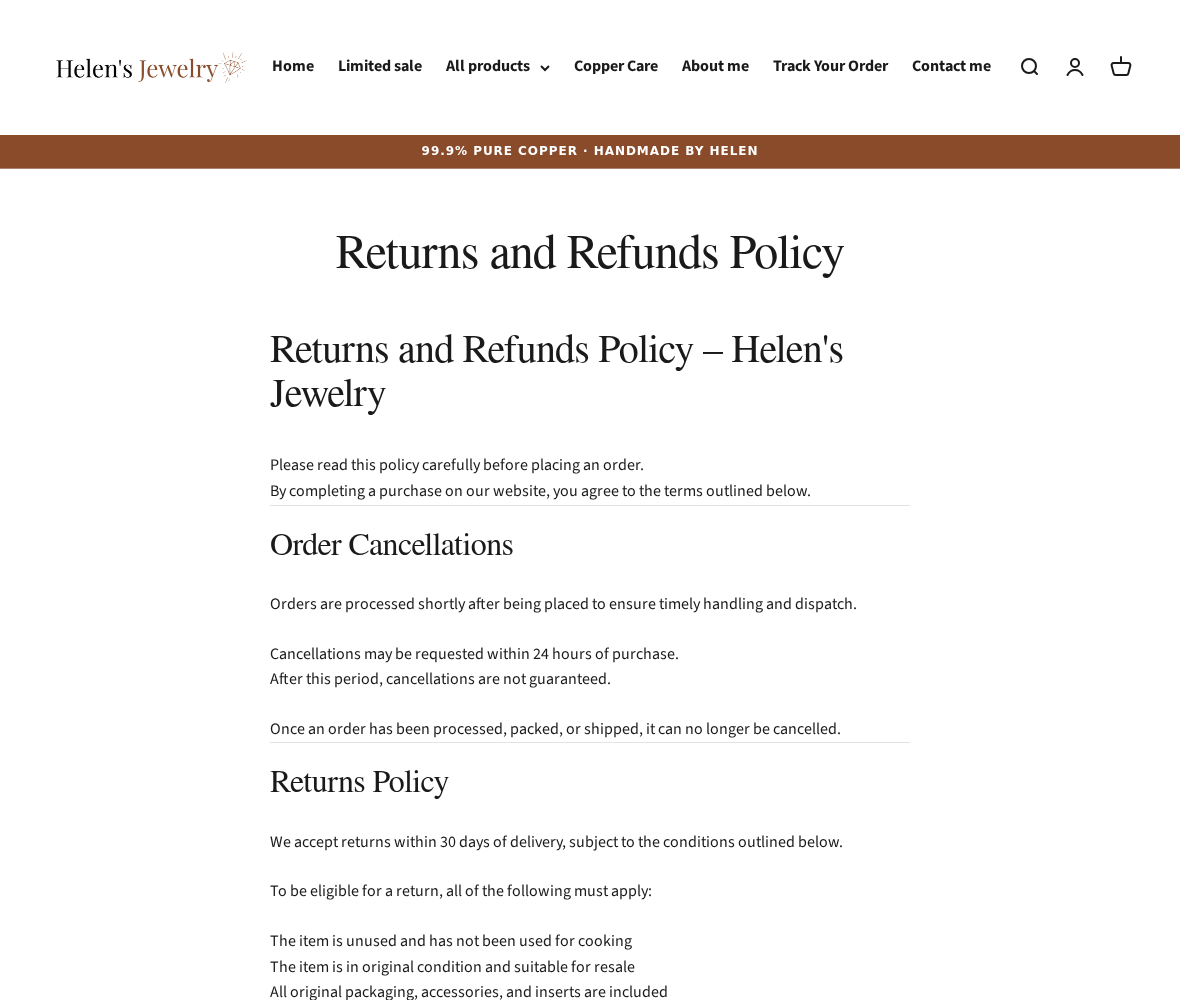
- Ordinary returns go to a facility outside America, with customer-paid postage estimated at $20–$40.
- The refund rules require unused jewelry and prior approval, despite the storefront’s reassuring return language.
- Copper jewelry testimonials are not clinical evidence that wearing a bracelet treats arthritis or improves circulation.
- The published company address is expressly not a place to visit or send returns.
The central issue is the gap between the purchasing experience suggested by the story and the obligations described in the policies.
Our assessment: do not buy on the story alone
We would not order for a medical benefit or assume returns will be cheap. Obtain the actual return destination and product provenance before paying.
If the merchant cannot explain those details clearly, skip the purchase. An emotional introduction cannot replace an accountable seller or a workable refund route.
We found commercial warning signs, not proof that the company never ships. Those are different conclusions, and buyers need the distinction.
Why the Helen Story Matters to the Purchase
A human story can quietly become a product guarantee
The homepage describes an Asheville workshop, decades of craftsmanship, health-related reasons to slow down, and a granddaughter named Claire encouraging online sales.
Those details invite the reader to imagine an individual making each piece, answering questions, and standing behind the work personally.
It is understandable to respond to that. Buying something meaningful from an experienced artisan feels different from ordering anonymous merchandise through an overseas storefront.
But storytelling is not documentation. A verified workshop location, manufacturing explanation, and named operator would help establish the connection the page invites shoppers to assume.
Our review did not establish those connections independently. We therefore cannot present the artisan narrative as a verified history.
Do not confuse an older promotion with today’s page
The current homepage discusses slowing down and taking the collection online. We did not verify an active closing-down announcement on that page.
This matters when researching Helen’s Jewelry reviews. Screenshots from another date can describe a promotion that has changed or a different storefront entirely.
Save the version you actually saw. If your advertisement promised a final workshop sale, keep that advertisement separately from the current product page.
Similarly named jewelry businesses should not be treated as the same seller. A complaint about another Helen-branded shop does not automatically concern this domain.
How the Helen’s Jewelry Sales Funnel Works
Step 1: The personal introduction establishes trust
The shop leads with an intimate craft story rather than its contracting company. This sets the emotional frame before buyers encounter the legal details.
A shopper may decide that the purchase supports a small American workshop. That expectation can influence willingness to accept a higher price or uncertain provenance.
Pause at this stage and separate three questions: Who tells the story? Who takes the payment? Who actually makes and dispatches the jewelry?
Those roles can belong to different parties. A legitimate international arrangement is possible, but it should be explained rather than left to the buyer’s imagination.
Step 2: Copper claims add a second reason to order
The storefront emphasizes copper purity and handmade production. Customer accounts also describe wellness benefits, including relief from stiffness or improved circulation.
That moves the sale beyond appearance. Someone buying a decorative ring can assess its style, while someone seeking pain relief is relying on a health claim.
Neither a purity slogan nor an enthusiastic testimonial establishes a treatment effect. Product composition and clinical performance require different kinds of evidence.
Before ordering, ask whether the merchant supplies a metal-composition report and product-specific evidence for any health benefit being used to persuade you.
Step 3: Discounts and easy-return language reduce hesitation
During our review, the Bind ring was displayed at $37.99 against $94.99. Another bracelet displayed $49.99 against $129.99.
These are storefront comparisons, not verified records of previous selling prices. The higher crossed-out figure does not independently establish the jewelry’s market value.
The reassuring return language encourages a familiar thought: if the piece disappoints, you can simply send it back.
That assumption needs checking before checkout. The practical value of a guarantee depends on the shipping destination, eligibility rules, and money left after returning it.
Step 4: Shipping reveals the less personal transaction
The shipping page separates processing from transit. A dispatch estimate is not a promise that the parcel will arrive within that same interval.
International carrier references do not prove where the jewelry was manufactured. They also do not verify dispatch from an Asheville workshop.
Keep the parcel label, tracking history, customs documentation, and packaging. Together, these can identify the actual fulfillment route more reliably than the sales story.
A tracking number alone is not delivery evidence. Check whether the carrier has accepted the package and whether the destination information matches your order.
Step 5: Returning the jewelry exposes the cost of changing your mind
The refund policy describes customer-paid international postage for ordinary returns. The item must meet the stated condition requirements and receive approval.
On a $37.99 purchase, hypothetical $20 postage leaves just $17.99 recovered, assuming a full item-price refund and no other deductions.
If postage reaches $40, the return costs more than that ring’s displayed price. The example illustrates return economics, not a charge imposed on every buyer.
Faulty or incorrect goods are treated separately in the policy. Do not allow an ordinary change-of-mind rule to be substituted automatically for a documented defect complaint.
Company, Address, Support, and Fulfillment Checks
The legal seller is not simply Helen at a workbench
The terms and conditions name TRADESTREAM LIMITED as the operator. That disclosure deserves at least as much attention as the artisan introduction.
A Hong Kong company can sell legitimate jewelry. The concern is whether shoppers understand who is responsible for their order and why that entity appears.
Compare the legal name with your receipt and payment descriptor. If another company appears, ask how it relates to the named operator.
We verified the website’s disclosure, not the company’s registry history. Do not interpret this article as independent confirmation of incorporation or ownership.
The registered office is not your return destination
The address provided is Unit 2A, 17/F Glenealy Tower, No. 1 Glenealy Central, Hong Kong.
The terms explicitly distinguish that registered office from a visiting or returns location. Mailing jewelry there without instructions could complicate recovery.
Request a complete authorized return address, including country and recipient, while you still have time to decide whether ordering makes sense.
If the destination is withheld until after payment, you cannot accurately price the risk of returning the item before buying it.
An email address is a contact route, not a service test
The site lists info@helensjewelry.com. We did not send a message or test how quickly the company processes cancellations and refunds.
Before purchasing, send focused questions about metal composition, dispatch country, and overseas returns. A response should answer them, not merely repeat the guarantee.
An unanswered pre-sale inquiry is a practical reason not to proceed. It is not proof that every existing customer’s request has been ignored.
Use written communication for return authorization. A verbal reassurance is harder to rely on when the policy and your expectations differ.
Copper purity and workshop origin remain separate checks
We did not verify that each piece contains 99.9% copper or is personally handmade by the individual described on the homepage.
Ask for information tied to the actual item, not a general certificate image that lacks a supplier, sample identification, or relevant test date.
Country of fulfillment does not determine craftsmanship or safety by itself. What matters is whether the seller can substantiate the claims used to justify the price.
Likewise, a lifetime craftsmanship promise should identify covered defects and the remedy. It does not automatically establish free international postage or unlimited refunds.
Can Copper Bracelets Really Relieve Arthritis?
Testimonials cannot isolate the bracelet’s effect
Someone may sincerely report feeling better after wearing copper jewelry. Pain can change over time, and other treatments or activities may change alongside it.
A controlled comparison helps determine whether the bracelet produces an effect beyond those influences. A seller’s selected customer stories cannot perform that comparison.
A randomized rheumatoid-arthritis trial found no meaningful therapeutic benefit beyond placebo from copper bracelets. The original paper is available in PLOS One.
That study did not test Helen’s products specifically or every claimed circulation benefit. It does challenge broad suggestions that copper bracelets are established arthritis treatments.
Buy a bracelet because you like wearing it, not because a shop’s testimonials have convinced you to replace treatment for persistent joint symptoms.
Decorative value should survive without the health pitch
Ask yourself whether you would still pay the same amount if every wellness statement disappeared. That separates personal taste from an unsupported medical expectation.
For a gift, consider the recipient’s size and skin sensitivities as well as appearance. A return policy limited to unused items can complicate suitability testing.
Any irritation, discomfort, or unexpected reaction should be taken seriously. Remove the jewelry and seek appropriate advice rather than accepting discomfort as evidence it is working.
No research in this investigation establishes that Helen’s Jewelry is contaminated. The issue is unsupported reassurance, not a laboratory finding we do not have.
What to Do If You Ordered From Helen’s Jewelry
- Save the exact promise that influenced your order.
Capture the advertisement, product description, craftsmanship statement, and guarantee. Include the page address and date so your evidence concerns your purchase, not a later revision.
Store the confirmation email and payment receipt beside those captures. A short timeline makes it easier to explain any mismatch.
- Request cancellation promptly if you have changed your mind.
Identify the order and state clearly that you want cancellation and repayment. The policy describes a short cancellation window and processing limits.
Ask whether an administrative deduction will apply before accepting one. Do not assume sending a request means the parcel has been stopped.
- Preserve the jewelry and packaging while deciding.
For a discretionary return, avoid wearing or modifying the piece. Photograph the item on arrival and retain labels, inserts, and packing materials.
If it is faulty or not what you ordered, describe the actual defect. Keep that complaint distinct from simply disliking its appearance.
- Get an approved return address and calculate the real cost.
Obtain authorization before mailing anything. Price tracked postage to the specified destination and ask which expenses will be reimbursed for an incorrect or faulty item.
Decide using the amount you can realistically recover. Expensive postage can turn a nominal full refund into a poor outcome.
- Escalate a documented unresolved problem through your payment provider.
Explain whether the issue is nondelivery, misdescription, a defect, or an unprocessed agreed refund. Provide the order, correspondence, and shipping evidence.
Ask about applicable dispute deadlines without waiting indefinitely for another reply. A bank dispute is reviewed on evidence, not guaranteed simply because you are disappointed.
- Keep medical decisions separate from the refund discussion.
If you bought the jewelry for pain or circulation concerns, speak with a qualified clinician about those symptoms. Do not discontinue prescribed care because of a testimonial.
Report material misrepresentations through the relevant consumer-protection channel in your location. Include specific claims rather than unsupported accusations about every product the merchant sells.
Frequently Asked Questions
Is Helen’s Jewelry a confirmed scam?
Our findings establish buyer risks and unverified marketing, not that every transaction is fraudulent. The Hong Kong operator and international-return costs warrant caution before ordering.
Does the website identify an American seller?
The artisan story mentions Asheville, but the legal terms identify TRADESTREAM LIMITED in Hong Kong. We did not independently confirm the claimed workshop arrangement.
Will Helen’s Jewelry pay my return postage?
The policy assigns ordinary return postage to the customer, with a faulty or incorrect-item exception. Obtain written instructions and reimbursement details for your circumstances.
Does a copper bracelet treat rheumatoid arthritis?
The cited controlled trial found no meaningful benefit beyond placebo. Seller testimonials should not be treated as proof that a bracelet replaces medical treatment.
Can I return jewelry to the Hong Kong company address?
The terms say that address is not a returns location. Wait for authorized instructions, and confirm the destination before purchasing if return costs matter to you.
Was the jewelry proven to be made in China?
No. Carrier references and a Hong Kong seller do not establish manufacturing origin. Product-specific provenance and composition remain unverified in this investigation.
The Bottom Line
Helen’s Jewelry offers an appealing craft story, but the documented transaction involves an overseas company and potentially costly returns. Those details should shape your decision.
Do not buy for promised health results. For a decorative purchase, insist on clear provenance, the actual return destination, and an affordable route to repayment.
If those answers are missing, leave the ring in the cart. The story is optional; accountability is not.








