

Novira FireNest is marketed as a compact emergency stove that can give you instant heat, cooking power, and peace of mind during blackouts, camping trips, and survival situations.
At first glance, it sounds useful.
But once you look closer, the product page raises several red flags: generic product positioning, urgency-based sales tactics, vague company details, inconsistent branding, refund restrictions, and a strong possibility that this is another dropshipping-style operation selling a low-cost camping stove at a markup.
The product may work as a basic alcohol stove. The problem is the way it is being positioned and sold.
Overview
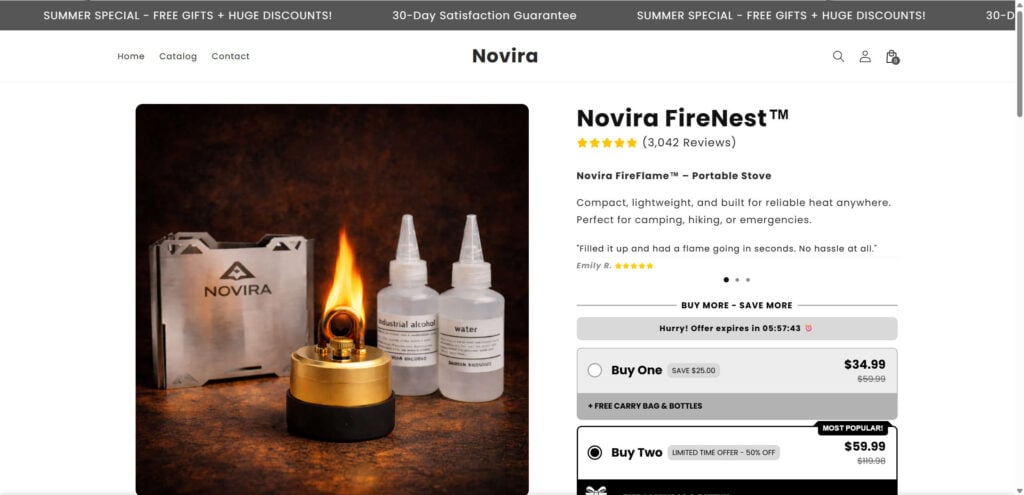
Novira sells the product as the Novira FireNest, but the page itself also calls it the Novira FireFlame – Portable Stove, which already creates brand confusion. The product is described as a compact emergency stove that runs on 95% alcohol and can provide heat and cooking power during outages, camping trips, and emergencies. The page also claims 3,042 reviews, “5000+ Happy Customers,” a 30-day satisfaction guarantee, and limited-time discounts with free gifts.
This looks less like a specialized survival brand and more like a high-conversion ecommerce page built around a generic portable stove.
What Novira wants buyers to believe
The page frames FireNest as:
- a reliable emergency cooking device
- a power-outage backup stove
- a portable camping and hiking tool
- a wind-resistant heat source
- a complete kit with free extras
- a limited-stock summer sale item
What it actually appears to be
Based on the product description, FireNest appears to be a small alcohol or solid-fuel camping stove. Similar foldable pocket stoves are widely available from other sellers, including generic products described as palm-size alcohol/solid-fuel stoves made from zinc-plated metal, with similar outdoor, hiking, and emergency-use positioning.
This does not mean the product is fake. It means the “premium emergency solution” angle may be stronger than the product itself.
Major Red Flags
1. The product appears generic, not innovative
The FireNest is promoted like a branded emergency tool, but the underlying concept is not new.
Small alcohol stoves and foldable fuel stoves have existed for years. Generic versions are sold widely as camping, backpacking, and emergency cooking accessories. Alibaba lists portable alcohol stoves in bulk, with prices ranging from low-cost models around a few dollars to more expensive titanium or specialty versions.
That matters because Novira sells FireNest at $39.99, marked down from $59.99. The product page creates the feeling of a special branded survival device, but the category itself is heavily commoditized.
2. The branding is inconsistent
The product title says Novira FireNest, while the description says Novira FireFlame – Portable Stove.
That kind of inconsistency is common in fast-built ecommerce stores where product names, templates, and ad angles are changed quickly.
A serious outdoor gear brand usually keeps naming consistent across:
- product title
- packaging
- manual
- product description
- checkout
- support documents
Here, the naming looks rushed.
3. The review and customer numbers are hard to verify
The product page shows 3,042 reviews, while another section says 5000+ Happy Customers.
That does not automatically prove the numbers are fake, but it is still a trust issue. The site does not provide independent review verification, third-party review links, or transparent review sourcing.
High review numbers are often used in dropshipping funnels to create quick trust. The buyer sees thousands of supposed customers and assumes the product is proven.
But site-controlled review numbers are not the same as independent proof.
4. The “limited stock” and discount language looks like pressure marketing
The page repeats banners like:
- “SUMMER SPECIAL”
- “FREE GIFTS”
- “HUGE DISCOUNTS”
- “Save up to 40% OFF”
- “Stock is limited”
- “Demand is extremely high”
These are classic urgency tactics. They are designed to make buyers act before comparing the product elsewhere. The page repeats the discount and guarantee messaging many times throughout the site header.
This does not prove the store is fraudulent. But it does show the page is built to close the sale quickly.
5. The product is sold as emergency-ready, but safety details are thin
The product is promoted for power outages and emergency cooking. It says the stove runs on 95% alcohol and gives users reliable heat when there is no electricity.
That is where caution is needed.
Fuel-burning stoves can create fire risk and carbon monoxide risk if used improperly or in poorly ventilated spaces. The CDC warns not to cook or burn anything on a stove or fireplace that is not vented.
The site’s marketing leans into indoor emergency scenarios, but the page does not provide enough visible safety guidance about:
- ventilation
- carbon monoxide risk
- fireproof surface use
- alcohol fuel handling
- burn risk
- refilling only after cooling
- keeping away from children
- never using while sleeping
- using a carbon monoxide alarm
For an open-flame emergency stove, this is important.
6. The refund policy may be more restrictive than the front-end guarantee suggests
The site repeatedly promotes a 30-day satisfaction guarantee. But the refund policy says returns must be requested within 30 days after receiving the item, the item must be unused, with tags, and in original packaging. It also says Novira does not accept returns for hazardous materials, flammable liquids, or gases, and unfortunately cannot accept returns on sale items.
That creates several concerns.
FireNest is promoted as a sale item. If “sale items” are not accepted, the guarantee may be less useful than buyers expect. Also, if a customer tries the stove, it may no longer qualify as unused. That matters because a buyer may only discover performance issues after using it.
7. Shipping claims are not perfectly consistent
The product page says orders are processed within 24–48 hours and standard delivery takes 4–7 business days.
The shipping policy says orders are processed within 1–3 business days and estimated delivery is 5–10 business days in the United States, 7–12 business days in Canada, and 7–15 business days internationally. It also says shipping times may vary due to high demand, customs delays, or carrier issues.
That is not the worst inconsistency, but it is still another sign that the front-end page may be more optimistic than the formal policy.
8. Company transparency is weak
The contact information page lists only:
- Trade name: Novira
- Email: support@getnovira.com
No company address. No legal entity. No phone number. No founder. No manufacturer. No product safety certification details.
For a small cosmetic item, thin company details are already a concern. For a product involving open flame and alcohol fuel, they matter even more.
9. The legal pages contain unfinished template language
The Terms of Service include obvious unfinished template placeholders, such as “Privacy Policy [LINK]” and Shopify template guidance text saying, “NOTE TO MERCHANT: This section accurately characterizes Shopify’s relationship with your store and should not be removed or modified.”
That is a major quality-control issue.
It suggests the store’s legal pages were not carefully finalized before launch. For a brand selling a fire-related emergency product, this is not reassuring.
10. The Terms heavily disclaim expectations and liability
Novira’s Terms say the company does not warrant that product appearance or quality will meet expectations or match what is depicted online. They also state that delivery times are estimates, not guaranteed, and that once products are transferred to the carrier, title and risk of loss pass to the buyer.
Again, this is standard legal language in many ecommerce policies. But it contrasts with the sales page’s strong “reliable emergency tool” tone.
What You Are Probably Buying
If the product arrives, you are most likely getting:
- a basic alcohol or solid-fuel stove
- a compact metal camping burner
- a small emergency cooking accessory
- possibly a fuel bottle and cloth as “free gifts”
- no fuel included unless clearly stated at checkout
You are probably not buying:
- a unique survival invention
- a premium engineered emergency stove
- a professional-grade cooking system
- a guaranteed indoor blackout cooking solution
- a risk-free product with effortless returns
This is the central issue. FireNest may function as a small stove, but it appears to be marketed with more polish and urgency than the underlying product justifies.
Why This Dropshipping Model Works
Products like this sell well because they target real fears.
The emotional hooks are strong
The sales page focuses on:
- blackouts
- no heat
- no way to cook
- emergency preparedness
- camping convenience
- peace of mind
That is effective because people want simple backup solutions.
The product looks useful
A small stove is easy to understand. It is not complicated. It feels practical.
That makes the buyer think:
- “I should have one just in case”
- “It is only $39.99”
- “The sale might end”
- “It could help in an emergency”
The problem
The buyer may not stop to check:
- whether the same product exists cheaper elsewhere
- whether the company is transparent
- whether the return policy actually protects them
- whether indoor use is safe
- whether the stove is certified or tested
- whether the reviews are independently verified
That is how simple products become high-margin dropshipping offers.
Is Novira FireNest a Scam?
Not necessarily a fake-product scam
The product likely exists. A buyer may receive a small alcohol stove.
But it is high-risk from a sales and trust standpoint
The concerns are:
- generic product category
- inconsistent product naming
- unverifiable review numbers
- urgency-heavy sales page
- thin company details
- template errors in legal pages
- restrictive refund language
- possible mismatch between “satisfaction guarantee” and actual eligibility
- limited visible safety guidance for an open-flame product
The most accurate classification is:
Novira FireNest appears to be a high-risk dropshipping-style emergency stove sold through aggressive marketing and weak brand transparency.
Should You Buy It?
For most buyers, caution is warranted.
Reasons to avoid it
- Similar camping stoves are widely available from established sellers
- The product does not appear unique
- Company details are minimal
- Return eligibility may be limited after use
- Sale-item returns may be excluded
- Safety documentation is not prominent
- The site contains unfinished legal template language
If you still want this type of product
A safer approach is to buy a portable stove from:
- a known outdoor brand
- a reputable retailer
- a seller with verified reviews
- a listing with clear safety instructions
- a product with clear return handling
- a product with proper fuel and use guidance
For emergency preparedness, reliability and safety matter more than flashy ads.
What To Do If You Already Ordered
1. Save the product page immediately
Take screenshots of:
- “30-Day Satisfaction Guarantee”
- “SUMMER SALE SPECIAL”
- review count
- “5000+ Happy Customers”
- “Reliable Flame”
- “wind-resistant”
- “Complete Kit Included”
- shipping promises
- refund policy
- checkout total
This helps if the product does not match the advertising.
2. Check your order confirmation
Confirm:
- how many units you bought
- whether any warranty add-on was included
- whether free gifts are listed
- whether shipping was charged
- total amount paid
The site’s catalog includes a separate “1 Year Warranty” item for $4.99, so check whether any add-on was included during checkout.
3. Inspect the product before use
When it arrives, check:
- metal quality
- stability
- sharp edges
- fuel bottle quality
- instructions
- safety warnings
- whether it matches the product photos
- whether any parts are missing
- whether the stove sits level under a pot
Do not use it if it feels unstable or poorly built.
4. Be careful with alcohol fuel
Use only the fuel type recommended by the instructions. Do not improvise with unknown flammable liquids.
Never refill while hot or burning. Never use near curtains, paper, bedding, carpet, or anything flammable.
5. Do not treat it as a casual indoor stove
If you use any fuel-burning device, ventilation and fire safety matter. CDC guidance warns not to burn anything on a stove or fireplace that is not vented.
At minimum, use extreme caution, keep a fire extinguisher nearby, and have working carbon monoxide alarms. CPSC recommends carbon monoxide alarms on every level of the home and outside sleeping areas.
6. Request a return early if dissatisfied
If the product looks cheap, incomplete, unsafe, or not as advertised, contact support immediately.
Use a clear message:
I am requesting a return for order #[number]. The product does not match the claims and presentation on the sales page. Please provide the return label, return address, and refund timeline in writing.
Do not send anything back without approval because the policy says unapproved returns will not be accepted.
7. Dispute the charge if necessary
If support refuses a reasonable return, delays until the return window closes, or the product is materially different from the listing, contact your bank or payment provider.
Use evidence showing:
- what was advertised
- what arrived
- the refund policy
- your support messages
- photos or videos of the product
The Bottom Line
Novira FireNest is not clearly a fake product. It may arrive and may work as a small alcohol stove.
But the operation raises multiple concerns:
- generic camping stove concept
- inconsistent product naming
- high-pressure sales language
- unverifiable review numbers
- minimal company transparency
- restrictive return terms
- unfinished legal template language
- weak safety visibility for an open-flame product
The safest conclusion is simple:
Novira FireNest looks like a basic portable alcohol stove sold through a dropshipping-style storefront with inflated emergency-prep marketing. It may be usable, but buyers should not treat it as a premium survival product or a risk-free purchase.

Join the discussion
4 commentsShare your experience or ask a question about this article.
Discussion
I bought one of these. Was charged $62.98 on my credit card, but never received the stove. This was back in April.
In reply to Richard
Hi Richard, I’m sorry this happened. If you paid and never received the stove, dispute the charge as item not received. Keep your receipt, order confirmation, and any messages from the seller.
In reply to Richard
Same thing happened to me and they just kept saying they were investigating and would let me know. I e-mailed them every month to ask what was going on and then they stopped replying to my e-mails.
Very Shady company, and no where on there page or advertisement did it say they were shipping from China!
I asked for them to re-ship or give me a refund and nothing, crickets. I reported them to the BBB after they stopped responding.
I Wouldn’t suggest anyone buy one from them. I have since ordered off Amazon and received almost the same products for less money and in three days time.
In reply to Dean
What you describe—months of “investigating” followed by silence—is not normal customer service. Save the order confirmation, tracking information, and every email, then contact your card issuer or payment provider and dispute the charge as goods not received or not as described. Do this promptly; a BBB complaint creates a record, but it does not recover the payment. Also be cautious of anyone who contacts you offering to recover the money for an upfront fee. Thank you for sharing the details—it may keep someone else from buying.