

Nucery is a jewelry brand that gets a lot of attention on TikTok and Instagram, especially through “brand ambassador” and “collaboration” offers. Some buyers report a smooth experience and attractive packaging, while others describe inflated shipping fees, low-cost items, and marketing that looks like a classic influencer trap.
So is Nucery a scam, or just a risky online store with aggressive promotion? The answer depends on how you encounter it.

What is Nucery Jewelry?
Nucery operates through the domains nucery.co and nucery.com (the .com product links commonly redirect to .co).
On its FAQ page, Nucery states:
- Design studio and head office are located in Hong Kong
- Processing time 2–5 days
- Delivery 7–21 business days
- Ships worldwide via “fulfillment warehouses located around the globe”
- Accepts major cards and PayPal
- Prices include UK VAT at 20%, with possible additional customs fees depending on country
That combination (Hong Kong + global fulfillment + long delivery windows) is common for brands that rely on third-party logistics and overseas sourcing.
Why people search “Nucery scam”
Most “Nucery scam” searches come from one of these situations:
1) You got a TikTok/Instagram “ambassador” message
This is the classic pitch: you are “selected,” you get free items, you just cover shipping, and you get a discount code for followers.
Consumer protection organizations have warned about this exact playbook. The BBB describes phony sponsorships where the target is asked to pay upfront (often for products or fees), and the promised commissions or exposure never materialize.
The FTC has also warned about bogus “brand ambassador manager” offers used to extract money or personal information.
On Reddit, multiple threads specifically mention Nucery in the context of “shipping-only” ambassador offers and claims that similar items appear on AliExpress, with shipping quoted at $30+ (or local equivalents).
2) The reviews look “too good to be true”
Nucery has a strong Trustpilot score and a large volume of reviews, which can reassure buyers. But it’s still smart to interpret review platforms correctly.
Trustpilot explicitly states it does not fact-check reviews, and it may label a review “Verified” only when it can confirm a business interaction occurred.
So the rating is a signal, not proof.
3) The site uses heavy “press” branding
Nucery has a “Press” page listing outlets like Vogue, Tatler, GQ, and Vanity Fair with month/year callouts.
That may be real, but unless the page provides independently verifiable citations (issue links, publisher pages, or direct references), treat it as marketing, not evidence.
What the evidence shows
1) Domain history
The nucery.co domain shows a creation date of 2023-01-21 in WHOIS records.
A domain age of a few years is not a guarantee of legitimacy, but it’s also not the “brand new domain from last week” pattern seen in many outright scam shops.
2) A company with the same name exists on Companies House
A UK-registered entity named NUCERY LTD (company number 15310762) appears on the UK government’s Companies House register, incorporated Nov 27, 2023, with business categories that include retail sale of watches/jewelry and internet retail.
Important: this does not automatically prove it’s the same operator as the website you’re viewing. It simply means a company with that name exists in the UK registry.
3) Shipping and sourcing signals
Nucery’s stated delivery window (7–21 business days) and “global fulfillment warehouses” language are consistent with overseas fulfillment.
That does not equal “scam,” but it does increase the odds of:
- Longer shipping times
- Harder returns (especially international)
- Variable product consistency
4) Warranty claims are inconsistent
Nucery’s “Our Mission” page says they offer a Lifetime Warranty.
But the FAQ describes a warranty of 12 months for manufacturing defects.
That mismatch is a credibility red flag. At minimum, it suggests policy pages are not tightly maintained. If you buy, screenshot the exact warranty language shown at checkout.
5) Trustpilot profile signals (good and bad)
On Trustpilot, Nucery shows:
- 4.7 rating with 1,004 reviews
- Rating distribution includes 81% 5-star and 9% 1-star
- “Claimed profile”
- “Hasn’t replied to negative reviews”
- Notes that the profile was merged with one or more other Trustpilot profiles (often due to identical domains, rebranding, or ownership changes)
Trustpilot also states it doesn’t fact-check reviews and relies on automated screening plus user flags.
Net: the volume of reviews suggests many real transactions, but the profile details do not eliminate the risks people report around influencer-style outreach.
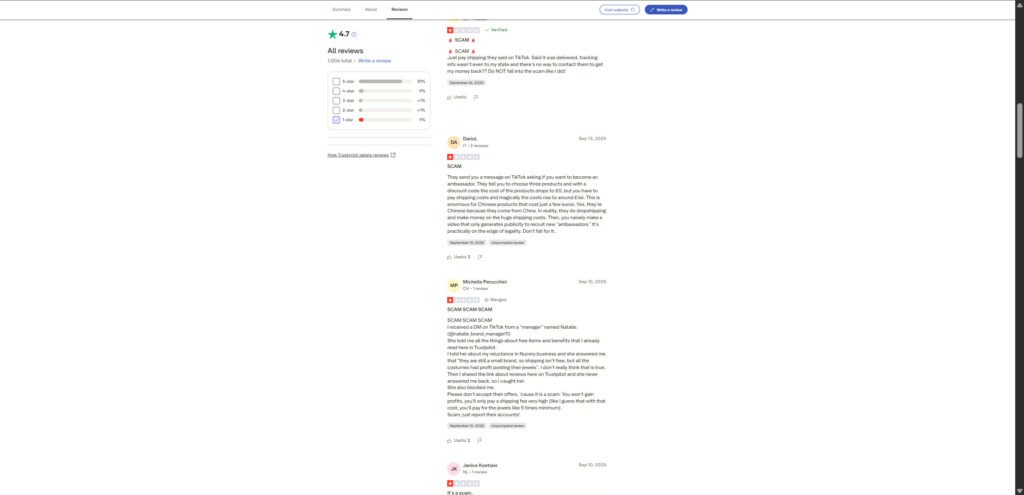
6) What complaints typically allege
The most consistent “scam” allegation is not always “they stole my card and vanished.” It’s usually:
- The jewelry is low-cost and widely available elsewhere
- The “ambassador” offer is basically a shipping-fee funnel
- Shipping is unusually expensive relative to item value
This aligns with BBB reporting on influencer scams that require upfront payment and deliver disappointing results.
The “brand ambassador” offer: how to evaluate it fast
If Nucery (or a “brand manager” account) contacts you, use this checklist:
High-risk warning signs
- You must pay shipping to receive “free” jewelry
- They push urgency (“spots are limited,” “today only”)
- They can’t provide a verifiable business email and contract
- The account messaging you is not clearly the official brand account
- They promise commissions/exposure but avoid specifics
BBB’s guidance is blunt: be cautious of any “job” or partnership that asks you to hand over money.
What a real partnership looks like
- A contract (deliverables, usage rights, payment terms)
- Payment to you, or at minimum product provided without you paying fees
- Outreach from a verifiable brand domain email
- Clear, consistent policies and a traceable business presence
If any part is missing, treat it as marketing, not a job.
If you want to buy from Nucery, reduce your risk
If you still want the jewelry, approach it like a higher-risk online purchase:
- Pay with a credit card or PayPal
Nucery says it accepts PayPal and major cards. Use those because they offer stronger dispute pathways than debit cards. - Screenshot everything before you pay
Product page, price, shipping fee, return window, warranty language, and the final checkout screen. - Start with a small order
Test product quality and delivery before spending heavily. - Reverse image search the product photos
If you find identical items on marketplace sites at a fraction of the price, you can make an informed call about value. - Treat press logos as unverified until proven
Nucery lists major outlets on its “Press” page, but you should look for independent confirmation (publisher pages, issue references). - Watch for subscription language at checkout
Some Shopify stores display recurring-purchase language in certain flows. If you see anything about “recurring” or “deferred purchase,” stop and confirm you are making a one-time purchase.
What to do if you already ordered (or paid shipping for an “ambassador” bundle)
- Collect evidence
Order confirmation, receipts, screenshots of the offer, DMs, and any tracking details. - Contact the company in writing
Use their official contact form/email route, keep it factual, ask for tracking or a refund timeline. - Set a short deadline
Example: “If I don’t receive tracking or a refund confirmation within 72 hours, I will dispute the charge.” - Dispute the transaction if needed
- Credit card: file a chargeback for non-delivery or misrepresentation
- PayPal: open a dispute under “Item not received” or “Significantly not as described”
- Report influencer-style scams
BBB and the FTC both collect reports and publish guidance for these schemes.
Bottom line
Nucery is not a clear-cut “fake website that never ships anything.” The public review footprint and the store’s own stated fulfillment process suggest many real deliveries happen. (Trustpilot)
However, the influencer “ambassador” pipeline is the main danger zone. Paying shipping to receive “free” items is a known scam pattern, and multiple users explicitly describe Nucery outreach in those terms.
If you buy, protect yourself with payment methods and documentation. If you’re being recruited, treat it as marketing unless independently verified.
FAQs
Is Nucery Jewelry dropshipping?
Nucery states it uses global fulfillment warehouses and gives a 7–21 business day delivery window, which is consistent with overseas sourcing and third-party logistics.
That does not prove dropshipping, but it does place Nucery in the same operational category as many brands that source from large manufacturers.
Are Nucery “brand ambassador” offers legit?
If the offer requires you to pay shipping or buy items upfront, it matches patterns the BBB and FTC warn about.
Assume it’s not a real paid partnership unless you can verify it independently.
Can I trust the Trustpilot rating?
Trustpilot shows a strong score and large review count for Nucery, but Trustpilot also states it doesn’t fact-check reviews and relies on screening plus flags.
Use it as one data point, not the only deciding factor.
Where does Nucery ship from?
Nucery says its head office is in Hong Kong and it ships via fulfillment warehouses “around the globe,” depending on what you order and where you live. (nucery)
Does Nucery have a lifetime warranty?
Nucery’s “Our Mission” page claims a Lifetime Warranty, but the FAQ describes a 12-month warranty for manufacturing defects.
If warranty matters to you, screenshot the policy shown at purchase and keep it with your receipt.
What’s the biggest red flag with Nucery?
The biggest red flag is the “pay shipping to get free jewelry” ambassador funnel, because it overlaps with widely documented influencer scam methods.

Join the discussion
0 commentsShare your experience or ask a question about this article.
Discussion
Start the conversation
Have a question or something useful to share? Add the first comment.