

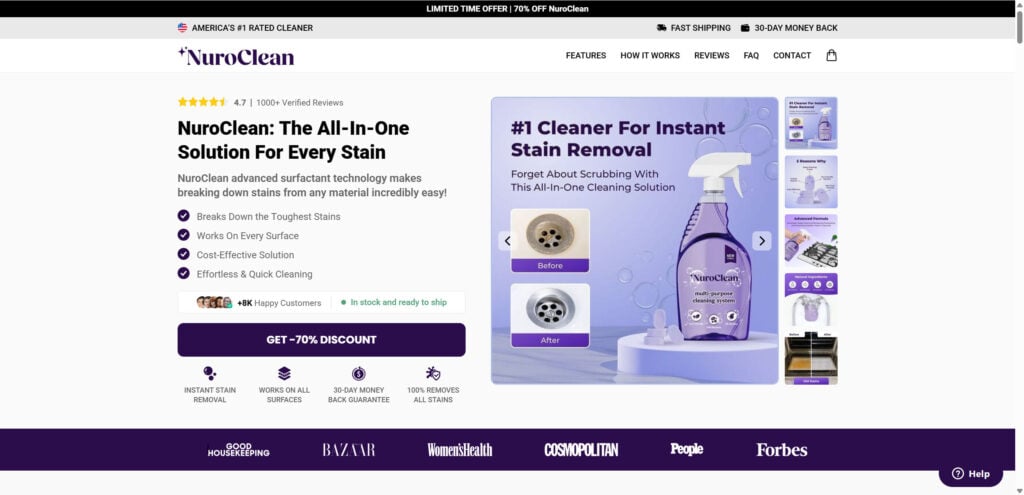
NuroClean is promoted as an all-purpose cleaning system designed to remove grease, stains, and everyday dirt using dissolvable tablets and a reusable spray bottle. Its marketing relies on polished demonstrations, strong performance claims, customer testimonials, and prominent trust symbols.
This review examines the product, the company behind it, its advertising methods, customer feedback, pricing, and return conditions to determine whether NuroClean delivers what its sales page promises.
What Is NuroClean?
NuroClean consists of a plastic spray bottle and concentrated cleaning tablets. Customers place a tablet in the bottle, add water, wait for it to dissolve, and then use the resulting mixture as a household cleaning spray.
There is nothing inherently fraudulent about concentrated cleaning tablets. Similar products are sold under numerous names on Amazon, Walmart, Alibaba, and other marketplaces.
The problem is how NuroClean is presented.
The company claims that the product:
- Instantly removes stains
- Works on every surface
- Removes 100% of all stains
- Eliminates grease, grime, mold, and mildew
- Requires little or no scrubbing
- Is non-toxic and safe around children and pets
- Is allergen-free
- Improves cleaning without irritating people with asthma
These are sweeping claims for a product whose complete ingredient list, testing reports, safety documentation, and independent performance data are not prominently provided on the sales page.
The Product Appears to Come From China
The strongest evidence does not come from critics. It comes directly from NuroClean’s own legal terms.
The company states that its products are manufactured in China and may be shipped from warehouses in China. The website is operated by UAB Rara Digital, a Lithuanian company, rather than by a well-known American cleaning-product manufacturer.
The wholesale screenshot shown above is particularly revealing. It displays an almost identical purple spray bottle, the same distinctive bottle shape, similarly colored tablets, and nearly identical “multi-purpose cleaning system” packaging.
Wholesale prices shown in the image range from approximately two to seven cents per unit, depending on the listing and order size. Alibaba also publicly lists generic cleaning tablets at approximately two to four cents each in bulk.
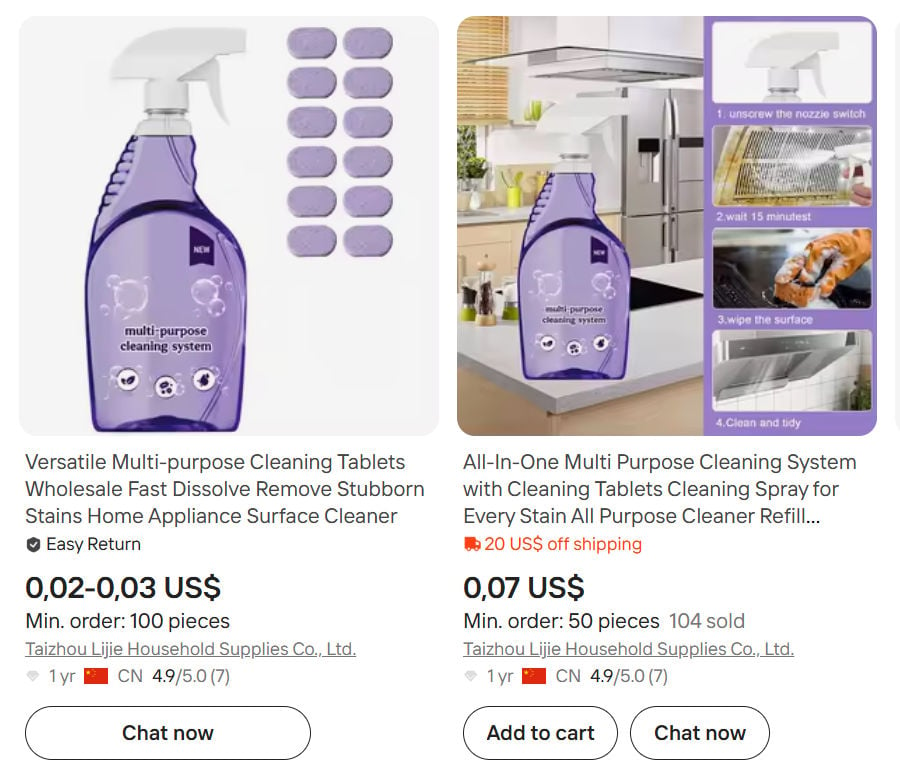
A matching appearance does not conclusively prove that every NuroClean unit comes from that exact supplier. However, it strongly suggests that this is not a unique cleaning invention developed through years of scientific research. It looks much more like an existing generic product that has been given new branding, a polished website, and an enormous advertising budget.
Part of an Affiliate Marketing Network
NuroClean does not hide the fact that it recruits affiliates.
Its affiliate page promises marketers “the highest payouts,” “top-converting funnels,” and a product lineup “built to sell.”
That language explains much of what consumers see online.
Affiliates earn commissions by driving customers to the checkout page. This encourages the creation of promotional articles, social media ads, supposed reviews, dramatic videos, and “limited-time” offers designed to generate immediate purchases.
The goal is not necessarily to provide balanced product information. The goal is conversion.
This type of network frequently uses several domains, landing pages, advertorials, and marketplace listings to make a basic product appear more popular and established than it really is. NuroClean appears through its main domain, separate promotional domains, retailer listings, and affiliate review pages using nearly identical language and imagery.
Are the NuroClean Testimonials Fake?
The sales page displays hundreds of overwhelmingly positive testimonials. Reviewers are labeled as “verified customers,” while the page claims a rating of 4.7 stars from nearly 2,000 reviews and says that 97% of customers would recommend the product.
There is no clear explanation of how these reviews were collected, how purchases were verified, or whether negative submissions are published.
In fact, the review form states that submitted reviews will appear only after approval. That means the seller controls which reviews become visible.
More importantly, NuroClean’s own terms state that testimonials may use fictional names and “associative pictures.” In other words, the face and name displayed beside a testimonial may not belong to the person who allegedly provided it.
That admission makes labels such as “verified customer” substantially less reassuring.
The Alleged Expert Is Another Red Flag
The website introduces “Jessica Reynolds” as a “Chemist & Cleaning Product Tester.” She supposedly recommends NuroClean as a safe, powerful, and environmentally responsible cleaning product.
However, the page provides no employer, professional biography, laboratory affiliation, academic background, certification, published research, or link to an independently verifiable profile. It simply displays a polished portrait and a promotional paragraph.
The portrait has the generic, hyper-polished appearance commonly associated with stock photography or AI-generated marketing images. That alone does not prove the person is AI-generated, but there is no reliable evidence on the page establishing that this individual is a real, qualified chemist who independently tested the product.
A genuine scientific endorsement normally includes credentials that can be checked. A first name, surname, smiling photograph, and sales copy are not enough.
AI-Generated Videos and Unrealistic Demonstrations
NuroClean advertisements reportedly use highly polished videos and images showing stains disappearing with minimal effort. Consumers should be skeptical of these demonstrations.
AI-generated video, edited footage, accelerated cleaning sequences, substituted products, lighting changes, and digitally enhanced before-and-after images can all make an ordinary cleaner appear extraordinary.
The website does not provide controlled tests, unedited demonstrations, laboratory reports, or side-by-side comparisons conducted by an identifiable independent organization.
It simply repeats phrases such as:
- “Instant stain removal”
- “Works on all surfaces”
- “100% removes all stains”
- “No other cleaning product compares”
- “America’s #1 Rated Cleaning Spray”
No credible nationwide ranking, published testing methodology, or recognized consumer organization is cited to substantiate these claims.
Be Skeptical of “As Seen On” Logos and Award Badges
Media logos and award-style graphics are frequently used by affiliate sellers to borrow credibility from recognizable publications.
A logo on a sales page does not prove that a publication independently reviewed, tested, or endorsed the product. Sometimes the company merely purchased an advertisement, distributed a sponsored press release, or placed its logo beside a media brand without providing a direct supporting article.
NuroClean displays an award-style claim stating that it was rated the “most effective Cleaning Spray of 2025,” yet the promotional page does not show a transparent testing process, competing products, test results, or meaningful methodology.
Unless an award or “as seen on” logo links to an independent article on the publication’s official website, it should be treated as marketing artwork—not proof of quality.
The “Risk-Free” Guarantee Is Not Really Risk-Free
NuroClean repeatedly advertises a 30-day, “no questions asked,” 100% risk-free money-back guarantee. The legal return conditions tell a very different story.
Customers must:
- Contact support before returning anything
- Provide photographs and explain why they want a refund
- Receive a specific return address
- Return the item within the deadline
- Keep the product in brand-new condition
- Use the original packaging
- Pay return shipping themselves
- Provide tracked-shipping documentation
The return policy also states that reduced-price products may not qualify for refunds. That is important because the sales page advertises NuroClean at up to 70% off.
The terms contain another major restriction: products may not be returned after the package has been opened. That makes it difficult to test the cleaner and still qualify for a refund if it fails to perform as advertised.
So while returns may not be literally impossible in every case, the guarantee is far more restrictive than the prominent “no questions asked” promise suggests.
Real Customer Reviews Tell a Different Story
The contrast between the company-controlled testimonials and independent customer feedback is substantial.
At the time checked, NuroClean’s Trustpilot profile had a score of approximately 2.6 out of 5, with 58% of reviewers giving the company one star. Trustpilot’s summary noted frequent complaints involving confusing checkout procedures, unexpected additional products, pricing problems, disappointing product performance, cancellation difficulties, and refund issues.
Individual reviewers reported orders becoming more expensive during checkout, excessive upselling, products failing to perform like the advertisements, slow deliveries, and difficulties stopping or correcting orders. NuroClean has disputed some of these allegations in its public responses, stating that products are not added without customer authorization.
Customer reviews are not laboratory evidence, and not every buyer had a negative experience. However, the overall feedback is very different from the nearly perfect picture presented on the official landing page.
Is NuroClean a Scam?
NuroClean appears to be a real product that customers may actually receive. For that reason, it is more accurate to describe it as an overpriced, aggressively marketed dropshipping-style product rather than a completely nonexistent-product scam.
The major concerns are:
- A generic China-manufactured product sold with premium branding
- Wholesale alternatives costing only cents
- Unsupported “#1 cleaner” and “100% stain removal” claims
- Possible AI-generated or heavily edited promotional material
- Testimonials using potentially fictional names and unrelated pictures
- An unverifiable expert endorsement
- Seller-controlled reviews
- A commission-based affiliate program
- Constant limited-time discounts and urgency
- Restrictive return conditions hidden behind a “risk-free” promise
Final Verdict
NuroClean is not the cleaning revolution its advertising makes it appear to be.
It is a simple bottle-and-tablet cleaning system similar to products already sold under numerous names across wholesale and retail marketplaces. The real product is ordinary. The extraordinary part is the marketing funnel built around it.
Do not assume that dramatic videos show typical results. Do not trust testimonials simply because they are labeled “verified.” Do not treat award badges or media logos as independent endorsements. Most importantly, read the complete return policy before opening the package.
Consumers can likely find comparable cleaning tablets for much less money from established retailers with clearer ingredients, easier returns, and genuine independent customer reviews.








