


Nutliva was an online store at nutliva.com that billed itself in 2025 as a Health Canada Registered Weight Loss and Wellness Store, with prices in CA$.
Its contact page named a UK company that has since been dissolved. Shopnovalift.com, which sells NovaLift eye patches, is a separate store with no link to Nutliva in the evidence.
Overview
A Canadian pitch with a UK company
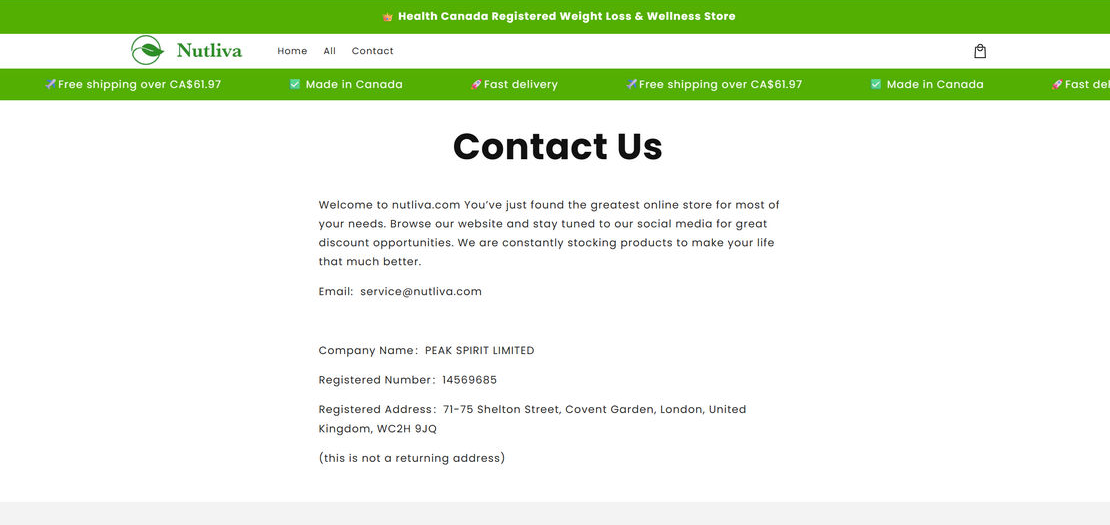
Nutliva’s banners promised free shipping over CA$61.97 and said its goods were Made in Canada. Its contact page listed Peak Spirit Limited at a London address.
What happened to Nutliva
Peak Spirit Limited was dissolved on September 16, 2025. The nutliva.com domain was registered again in June 2026 and now hosts an unrelated skincare shop in Pakistan.
Where Shopnovalift.com fits
Shopnovalift.com sells NovaLift microneedle eye patches with a Rewards Club membership. Its Trustpilot profile shows 134 reviews and a TrustScore of 1.2, many about recurring charges.
- Don’t rely on a store’s claim to be Health Canada registered. Check the product’s licence number instead.
- If you ordered from Nutliva in 2025, ask your card issuer whether a late dispute is possible, since the company behind it no longer exists.
- If you bought NovaLift patches, check your statements for monthly membership charges.
- Treat Nutliva and NovaLift as separate cases, since no shared owner, email or company appears in the evidence.
Is Nutliva Legit?
The 2025 Nutliva store gave Canadian buyers several reasons for doubt. Its main selling point, Health Canada registration, isn’t something an online store can hold.
Health Canada licenses individual natural health products, which carry an eight-digit product number on the label. It doesn’t register online shops as weight loss or wellness stores.
The Made in Canada strip didn’t match the company details either. The only business named on the contact page was a UK private company with a central London registered office.
The contact text was generic, describing nutliva.com as the greatest online store for most of your needs. The page added that the London address was not a returning address.
No customer reviews of the 2025 store remain on Trustpilot, which has no profile for nutliva.com.
Taken together, the old Nutliva store is one to avoid if it returns under a new name.
Nutliva Reviews and Complaints in Canada
The 2025 store left little public trace beyond its own pages, which are no longer online.
That makes the 2025 contact page above the main record. It shows the CA$ shipping threshold, the Made in Canada claim and the UK company details side by side.
Canadian buyers who paid Nutliva can still report it. The Canadian Anti-Fraud Centre collects reports about online shopping problems, and reports help track sellers that reuse the same approach.
If you paid in CA$ by card, your issuer can tell you the merchant name and country the charge came from.
A report doesn’t recover money by itself. Only your card issuer might still review a 2025 charge, using your order email and statement.
Who Was Behind Nutliva?
Peak Spirit Limited
Nutliva’s contact page named Peak Spirit Limited, company number 14569685. The UK Companies House register lists it as a private limited company incorporated on January 4, 2023.
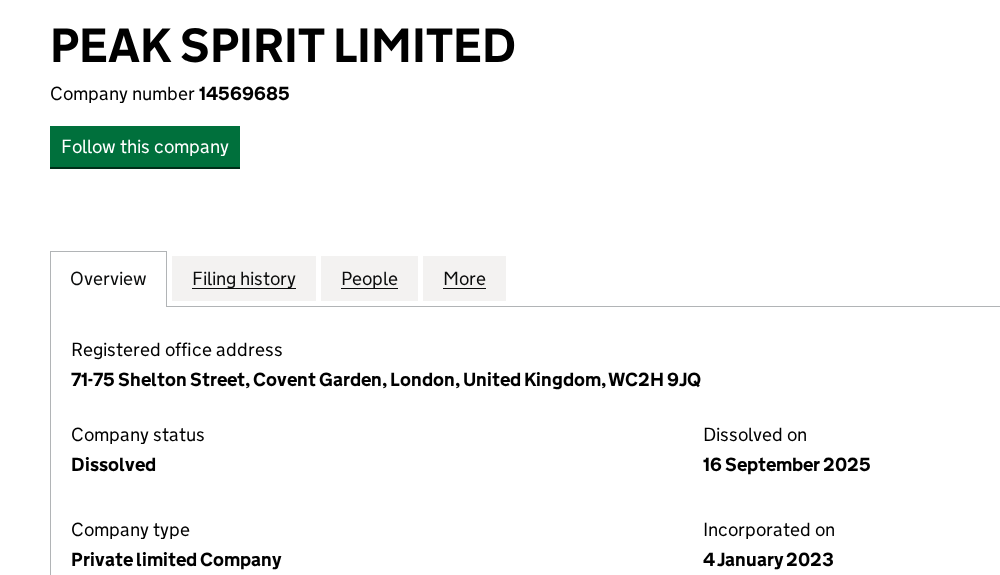
The register lists its business activities as retail sale of clothing and head office activities. Neither describes a Canadian weight loss or wellness business.
A dissolved company
Companies House shows Peak Spirit Limited as dissolved on September 16, 2025. Both sets of accounts it filed, to January 2024 and January 2025, were dormant company accounts.
That means it reported no significant trading up to January 2025. It applied to be struck off on June 18, 2025, yet Nutliva still named it in September.
A dissolved company no longer exists as a legal entity. Buyers can’t pursue it for a refund, which leaves the card issuer as the only possible route.
A shared London address
The registered office at 71-75 Shelton Street in Covent Garden is a mail and registered-office address used by many small companies. It doesn’t show where a business actually works.
A support email and nothing else
The contact page listed only service@nutliva.com. It gave no phone number, Canadian address or return address.
Who Uses Nutliva.com Now?
The nutliva.com domain was registered again on June 20, 2026, through Hostinger. It now shows Nutliva Skincare, a shop selling vitamin C and hair care products in Pakistani rupees.
That shop lists a Pakistani phone number and a mail@nutliva.com address, and promises delivery across Pakistan.
Nothing on it refers to Canada, Health Canada or Peak Spirit Limited.
Nothing in the evidence links the current shop to the 2025 store. A domain that lapses can be bought by anyone.
The new owner shouldn’t be judged by the old store’s record.
Is Shopnovalift.com Legitimate?
Shopnovalift.com sells NovaLift microneedle patches for the under-eye area. It runs on Shopify, and its domain was registered in April 2025.
The store does ship products, but its reviews describe a serious billing problem. Many buyers say they were enrolled in a monthly VIP membership they didn’t knowingly choose.
The homepage header advertises a Rewards Club with buttons to cancel a membership or view benefits. The support form lists Membership or Subscription as an inquiry type.
In late October 2026, the page ran a Black Friday Sale of up to 70% off with a countdown timer, a month before Black Friday.
Six packs, or 12 patches, cost $38.95 against a crossed-out $99.99. Sixteen packs, or 32 patches, cost $87.95 against $299.97. The page promised a 30-day money-back guarantee.
So the store isn’t fake, but the evidence shows a real risk of unexpected recurring charges. Anyone who orders should read every checkout screen and watch their statement.
What NovaLift’s Policies Say
NovaLift’s refund policy gives buyers 30 days after delivery to request a return. Items must be unused, in their original packaging and with proof of purchase.
The same policy says sale items can’t be returned. On the homepage, every patch pack is shown at a sale price below a crossed-out figure.
Accepted returns get a shipping label, and approved refunds go back to the original payment method within 10 business days, according to the policy.
The terms add a text-message marketing program with recurring messages, and send unresolved disputes to arbitration after a 30-day informal stage.
Support is listed as help@shopnovalift.com and a toll-free number staffed from 9am to 5pm Eastern time.
No company is named. The terms give a business address at 30 N Gould St in Sheridan, Wyoming, a registered-agent address shared by many small firms.
How the NovaLift Membership Charges Appear
Reviewers describe the membership as starting with the first order. Several say the checkout showed a series of final offers before payment.
One describes having to get through a run of don’t-leave-yet screens before checking out. Another calls the final offers page misleading.
The charges then arrive monthly. Reviewers quote $39.95, $39.99 and $49.99, and one says the statement line simply read Nova.
Because the line can be short or unfamiliar, some buyers only noticed after several months of charges.
Our reports on KylieBloom, Blidz and PackageApparelCo describe similar membership charges on other stores.
Shopnovalift Reviews
Trustpilot’s unclaimed profile for shopnovalift.com shows 134 reviews and a TrustScore of 1.2. The reviews come from the United States, Canada and Australia.
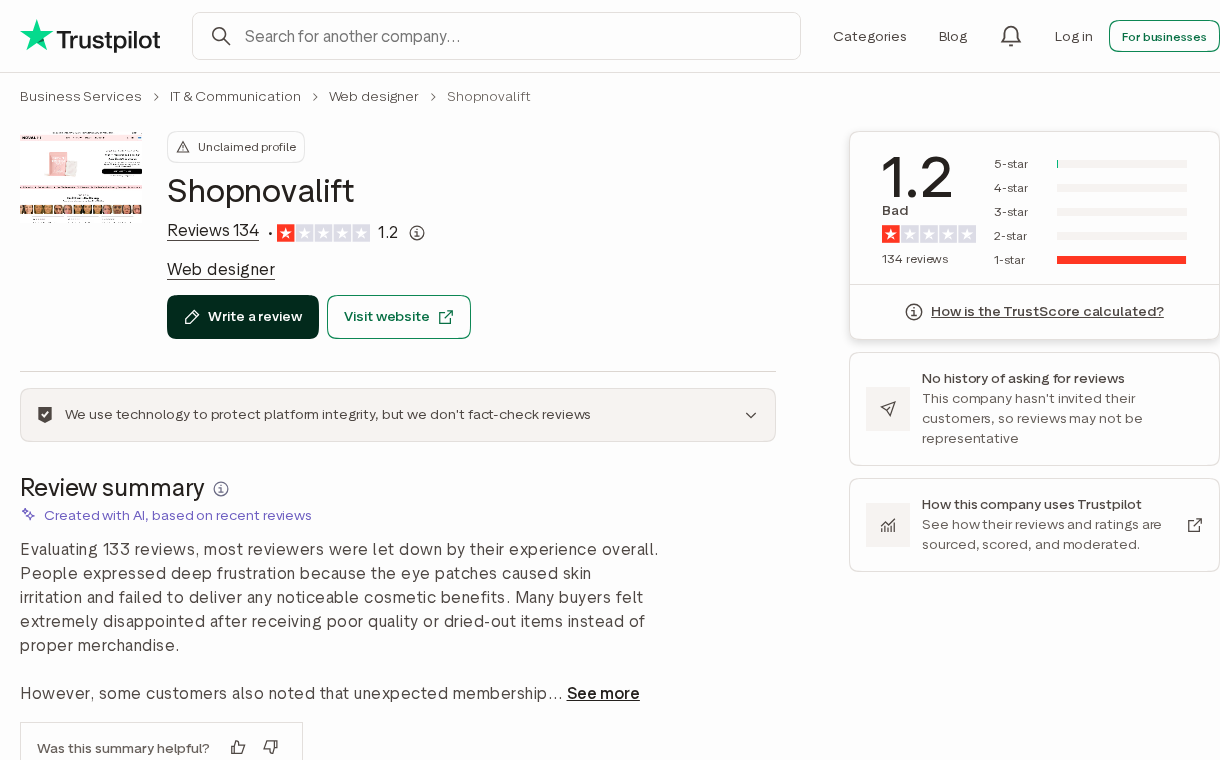
The most common complaint is a VIP membership charge. Reviewers report monthly fees of $39.99 or $49.99 that began after a single patch order.
Some say the charges ran for several months before they noticed. Others say the cancellation page wouldn’t load, or that the link only appeared on the desktop site.
Several reviewers describe burning, redness or swelling after using the patches, or patches that were dry or hard to remove. One says a parcel arrived labelled Nova Bliss.
A few buyers say support replied quickly by email. One says their card issuer would only dispute the most recent charges.
Are Nutliva and Shopnovalift Linked?
No link appears in the evidence. The two stores share no company name, address, email domain or product line.
Nutliva named Peak Spirit Limited, a UK company, and used a nutliva.com email. NovaLift names only its brand, a Wyoming registered-agent address and help@shopnovalift.com.
Nutliva sold itself as a weight loss and wellness store for Canada. NovaLift sells cosmetic eye patches to shoppers in several countries.
The two names turn up in the same searches, but that isn’t evidence of a shared owner.
What a Real Health Canada Licence Looks Like
In Canada, a licensed natural health product shows an eight-digit Natural Product Number, or NPN, on its label. Some homeopathic products use a DIN-HM number instead.
The licence belongs to a specific product, not to the shop selling it. A store can stock licensed products, but it can’t become Health Canada registered by saying so.
Health Canada’s online database lets anyone search by product name, company or number. If a product isn’t listed, treat any Health Canada claim about it as unproven.
Weight loss products deserve extra care. A licence covers the claims Health Canada has approved for that product, not every promise in an ad.
How a Store Like This Builds Trust
Step 1: An official-sounding badge
Nutliva’s top banner claimed Health Canada registration, borrowing the authority of a regulator that doesn’t certify stores.
A badge like this is easy to add and hard for a shopper to check in the moment.
Step 2: A local origin claim
Made in Canada and CA$ prices suggested a domestic seller, while the only company named was in the UK.
Step 3: A company name without a real address
The contact page listed a UK company and a shared registered-office address, then said the address wasn’t for returns.
Step 4: The company disappears
Peak Spirit Limited was dissolved in September 2025, and the domain later passed to a new owner.
How to Check a Health Store Before You Buy
- Search the product name or its eight-digit number in Health Canada’s licensed natural health products database.
- Look up any company named on the site in its national register, and check whether it’s still active.
- Read the checkout pages for memberships, clubs or subscriptions before you enter card details.
- Check reviews on Trustpilot for words such as membership, VIP or recurring charge.
- Pay by credit card so you can dispute charges you didn’t agree to.
How to Cancel an Unwanted Online Membership
- Find the exact merchant name and amount on your statement, then match it to your order email.
- Cancel through the store’s own membership page if it has one, and take a screenshot of the confirmation.
- Send a short email as well, quoting your order number, so there’s a dated record of your request.
- Ask your card issuer to block future charges from that merchant and to review earlier ones.
- Check the next statement to make sure the charges have actually stopped.
How to Spot Fake Wellness Stores
Fraudulent shopping websites often share common patterns that make them easier to detect once you know what to look for. Before entering personal information or making a payment, take a few minutes to check for these warning signs:
- Unrealistic prices and discounts
If a website offers products at prices far below trusted retailers, it’s often a red flag. Many of these sites advertise luxury or high-demand products at massive discounts to create a sense of urgency. A $300 product listed for $49.99 should immediately raise suspicion. - Recently registered or suspicious domain names
Many fraudulent websites operate on newly created domains that disappear after a few weeks. Look for signs like random characters in the URL, misspellings of well-known brands, or hyphenated domains.
You can check a site’s age with a WHOIS lookup, or run it through our free Scam URL Scanner. - Missing or vague company details
Legitimate businesses clearly display their company name, tax information, phone numbers, physical address, and return policies. Fraudulent sites often provide incomplete, fake, or no company details at all. A lack of verifiable contact information is a major warning sign. - No reliable customer service
Real businesses provide clear ways to contact support—email, phone, live chat, or physical return addresses. Fake stores often list nonfunctional contact forms, invalid phone numbers, or reply with generic automated messages. - Poor website quality and structure
Many fake stores are set up quickly with low-effort templates. Look for poor grammar, spelling errors, low-resolution product images, broken links, or missing legal pages (Terms of Service, Privacy Policy, Return Policy). A sloppy website often signals something isn’t right. - Copied product descriptions and images
Fraudulent sites often lift product listings directly from real retailers or marketplaces. If you reverse image search a product photo and find it on multiple unrelated websites, the listing is likely not original. - Lack of credible reviews or suspicious review patterns
A real store will usually have a mix of customer reviews across different platforms. Warning signs include no reviews at all, obviously fake five-star reviews, or multiple identical reviews posted on the same day. Searching “[website name] reviews” or “[website name] scam” on Google often reveals warnings from other consumers. - Unclear or unfair return and refund policies
Fake stores often use vague language around returns and refunds—or avoid the topic entirely. If you can’t easily find clear instructions for how to return an item or get a refund, proceed with caution. - Aggressive urgency and pressure tactics
Fraudulent websites commonly use fake scarcity (e.g., “Only 2 left in stock!”) or countdown timers (“Sale ends in 10 minutes!”) to push you to buy before you think it through. Legitimate stores don’t rely on fabricated urgency to make sales.
Quick Steps to Verify a Website’s Legitimacy
Before entering payment or personal details on a new shopping website, take a few simple precautions:
- Search for the store’s name along with words like “reviews” or “complaints” on Google and Trustpilot.
- Check the website’s domain registration using Whois.com.
- Use trusted tools to scan for malicious or fraudulent links:
- Malwarebytes ScamGuard – detect scams and unsafe links before they reach you on Android and iOS phone.
- Malwarebytes Browser Guard – block dangerous or fake websites on Windows and macOS browsers.
- Verify the business address on Google Maps to ensure it’s a legitimate location.
- Review the store’s accepted payment methods – credit cards and PayPal are traceable and safer than cryptocurrency or bank transfers.
- Trust your instincts; if something feels off, it’s better not to proceed.
How to Spot Similar Scams on Social Media
Many fraudulent shopping websites rely heavily on sponsored social media ads to draw in large numbers of potential buyers. These ads often promise extraordinary discounts—sometimes up to 90% off—and use emotionally charged language to push users into buying immediately.
They frequently appear on Facebook, Instagram, and TikTok, blending in with legitimate content. However, these ads follow predictable patterns that make them easier to identify once you know what to look for.
Spotting Fraudulent Facebook Ads
Facebook’s advertising platform is a favorite tool for fake online stores because of its massive reach. These ads often feature “unbelievable” offers designed to create urgency and bypass critical thinking. Warning signs include:
- Extreme, unrealistic discounts such as “90% OFF,” “Store Closing Sale,” or “Final Liquidation.” Real retailers rarely discount new products this aggressively.
- Poor grammar, awkward phrasing, or inconsistent language throughout the ad or website, indicating low-effort, mass-produced content.
- Generic stock photos or images with watermarks, suggesting the images were taken from legitimate brands or stolen from other sources.
- Recently created Facebook Pages, which is common for temporary fraudulent campaigns. Check the “Page Transparency” section to see when the page was created.
- Limited or no engagement from real customers. Authentic brands usually have reviews, comments, and visible user interaction.
If an ad raises doubts, search for reviews of the website or reverse image search the product photos to see if they’re copied from elsewhere. Never provide payment information until the site is verified.
Spotting Fraudulent Instagram Ads
Instagram is another major platform used to promote fake shopping sites through eye-catching visuals and short-lived “flash sale” captions. Warning signs to look for:
- New or disposable accounts with few posts and followers, often created just weeks or days before launching ads.
- Lack of tagged users in product posts. Legitimate stores often feature real customers, influencers, or product usage.
- Unsecured checkout pages. If the website linked in the bio does not use HTTPS, do not enter payment information.
- Fake or missing customer reviews. Fraudulent stores rarely have authentic purchase feedback.
- Unclear or restrictive return policies, often hidden or written vaguely to make refunds difficult.
When in doubt, search for independent reviews before buying, and only enter payment details on verified, secure websites.
Catching Fake TikTok Ads
TikTok is increasingly used to promote questionable shopping deals through short, persuasive videos. While many ads look polished, the same red flags apply:
- Links to unknown stores that don’t appear in search results or have no external reputation. Many of these sites are temporary and disappear after a short time.
- No verification badge on the TikTok account. While not every legitimate store is verified, the lack of a badge is one more indicator to check further.
- Aggressive countdown timers or “one-day only” promotions designed to rush decision-making.
- Lack of genuine customer reviews or real user content demonstrating the product in actual use.
- Comment sections filled with complaints or warnings from other users. This is often the first place victims speak up.
TikTok scams often rely on impulse buying. Take a moment to verify the website, read independent reviews, and use trusted browser protection before visiting external links.
What to Do If You Ordered From Nutliva or NovaLift
- Go through your card and PayPal statements, back to your first order, and list every charge linked to Nutliva, NovaLift or an unfamiliar membership.
- For a NovaLift membership, use the Cancel Membership option on the site or email help@shopnovalift.com, and save the cancellation confirmation.
- Ask your card issuer to stop future recurring charges from the merchant, and to review any charges you didn’t knowingly agree to.
- For a 2025 Nutliva order, PayPal’s 180-day claim limit has passed. Ask your card issuer anyway, though card dispute limits are often about 120 days.
- Stop using any patch or product that causes burning, redness or swelling, and speak to a pharmacist or doctor if the reaction doesn’t settle.
- Keep order emails, screenshots of the checkout and any replies from support as evidence.
- Canadian buyers can report the problem to the Canadian Anti-Fraud Centre, and US buyers to the FTC. Reports don’t guarantee a refund.
Frequently Asked Questions
Is Nutliva legit?
The 2025 Nutliva store claimed Health Canada registration it couldn’t hold and named a UK company that was dissolved in September 2025. Avoid it if it returns.
Was Nutliva really Health Canada registered?
No. Health Canada licenses individual natural health products, not online stores. A licensed product carries an eight-digit number you can check in its database.
Is shopnovalift.com legitimate?
It’s a real Shopify store selling NovaLift eye patches, but 134 Trustpilot reviews average 1.2, with many reporting monthly VIP membership charges they didn’t expect.
Is Shopnovalift connected to Nutliva?
No connection appears. The two stores use different company details, addresses, emails and products, and neither site mentions the other.
Who runs nutliva.com now?
Since June 2026, the domain has hosted a separate skincare shop in Pakistan. Nothing links it to the 2025 store.
How do I stop NovaLift membership charges?
Use the Cancel Membership option or email help@shopnovalift.com, keep the confirmation, and ask your card issuer to block further charges and review earlier ones.
The Bottom Line
Our verdict: avoid the 2025 Nutliva store or any copy of it. It claimed a Health Canada status that stores can’t have and named a now-dissolved UK company.
If you paid Nutliva, or found NovaLift membership charges on your statement, contact your card issuer now with your order emails and statement lines.
Shopnovalift.com is a separate business, but we don’t recommend ordering. Buyers report VIP charges they didn’t choose, and its refund policy excludes sale items, which is every pack.
This article is for informational purposes only and should not be relied upon for financial or business decisions. We identify potential scams using research, user experiences, and expert analysis. However, all claims should be independently verified. Mistakes may occur, and legitimate products could be flagged. We strive for accuracy but make no warranties regarding the completeness or reliability of the information.

If you are the owner of the website or product in question and wish to offer clarifications regarding your business or website, please reach out to us via our Contact form.

Reviews & discussion
0 commentsShare a firsthand experience, or ask a question.
Community reviews
shopnovalift.com
Moderated reader experiences, not an editorial verdict.
Start the conversation
Have a question or something useful to share? Add the first comment.