

PetGentle Dog Trainer is being promoted as a handheld ultrasonic device that can supposedly stop barking, leash pulling, jumping, chewing, biting, aggression, and other unwanted dog behaviors with one click.
But before ordering, buyers should look carefully at the claims, the checkout process, the multiple websites selling similar PetGentle-branded devices, the public complaints, and the return terms. This appears to follow a familiar dropshipping-style pet gadget pattern: exaggerated behavior claims, generic ultrasonic hardware, heavy discounts, multi-unit upsells, curated testimonials, and refunds that may be difficult in practice.
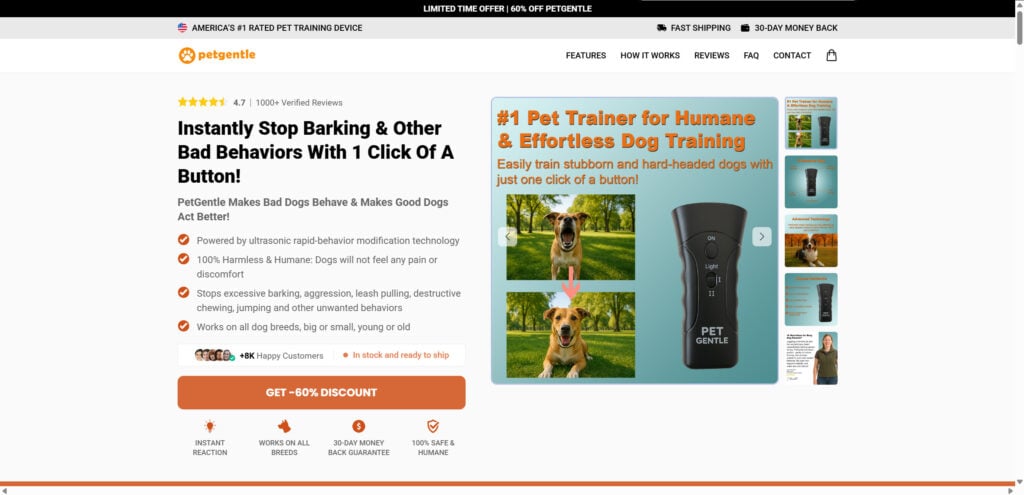
PetGentle Dog Trainer Overview
PetGentle Dog Trainer is marketed as an ultrasonic dog training device. The basic promise is simple: point the device at your dog, press a button, and the high-frequency sound interrupts unwanted behavior so you can redirect the dog.
The product is sold or promoted through several related or similar-looking sites, including PetGentle.com, BuyPetGentle.com, ThePetGentle.net, and other pages using the PetGentle name. Some pages describe it as “America’s #1 rated pet training device,” while others position it as an “official retailer” page.
The main advertised claims include:
- Stops excessive barking
- Helps with leash pulling
- Helps with jumping and biting
- Helps with chewing and digging
- Works on all breeds and sizes
- Produces instant reaction
- Uses ultrasonic sound only dogs can hear
- Causes no pain or discomfort
- Offers a humane alternative to shock collars
- Includes LED flashlight functionality
- Comes with a 30-day or 60-day guarantee, depending on the site
- Is available with large discounts such as 60% off
This pitch is attractive because many dog owners are frustrated. Barking, pulling, chewing, and reactivity can be stressful and embarrassing. A small device that claims to fix those problems without hiring a trainer sounds like an easy solution.
The problem is that dog behavior is not that simple.
A handheld ultrasonic device may interrupt some dogs temporarily. But it does not teach emotional regulation, address anxiety, build recall, fix leash skills, or solve aggression. It also may not work at all on some dogs, and for anxious or noise-sensitive dogs, it may create stress.
Why PetGentle Raises Red Flags
1. The claims are too broad
PetGentle is not just sold as a bark interrupter. Some pages claim it can help with barking, aggression, leash pulling, chewing, jumping, biting, and other behavior problems.
That is a major red flag.
Those behaviors do not all have the same cause. A dog may bark because of fear, boredom, territorial behavior, separation anxiety, excitement, pain, barrier frustration, noise sensitivity, or lack of exercise. A dog may pull on the leash because it has never been taught loose-leash walking. A dog may bite because it is afraid, overstimulated, guarding resources, playing too roughly, or reacting defensively.
One ultrasonic button cannot reliably solve all of that.
A device may interrupt the moment, but interruption is not the same as training. Training requires repetition, timing, reinforcement, management, and an understanding of why the behavior is happening.
2. “Works on all breeds” is unrealistic
The PetGentle sales pages claim the device works on dogs of all breeds, sizes, ages, and temperaments.
That is not realistic.
Dogs vary enormously. Some are sound-sensitive. Some are hard of hearing. Some are older. Some are fearful. Some are reactive. Some are highly food-motivated. Some are not bothered by ultrasonic sounds at all. Some may stop briefly, then return to the same behavior. Others may become more anxious.
No serious training tool should be advertised as universally effective for every dog.
3. “100% harmless and humane” should be treated carefully
PetGentle is marketed as humane because it does not use shock, prongs, or physical punishment. That sounds reassuring, but “no shock” does not automatically mean stress-free.
If the device works by producing a sound that stops a dog from barking or pulling, it is likely functioning as an aversive interrupter. In plain terms, the dog stops because the sound is unpleasant, startling, confusing, or disruptive enough to interrupt the behavior.
For some dogs, that may be mild. For others, especially anxious or noise-sensitive dogs, it may cause fear, avoidance, stress, or confusion.
This is why buyers should be careful with any product that claims to be completely harmless for every dog while also claiming to stop behavior instantly.
4. Multiple sites use similar claims but different guarantee language
PetGentle is promoted across multiple pages. PetGentle.com shows a 30-day money-back guarantee and links buyers to BuyPetGentle.com. ThePetGentle.net promotes a 60-day guarantee. Other related pages and review-style pages use similar product descriptions and claims.
That creates confusion.
A buyer may see one guarantee on one site, another guarantee on another site, and different return conditions in the actual policy. This is common in affiliate and dropshipping-style funnels, where several landing pages drive traffic to a checkout page.
When a product is sold through multiple domains with slightly different claims, shoppers should slow down and verify who is actually taking the payment, who handles returns, and which refund policy applies.
5. The checkout pushes multiple units
The BuyPetGentle checkout page promotes packages of 1, 2, 3, and 4 PetGentle trainers. The two-pack is labeled “Best Seller,” and the pricing makes larger bundles look like the better deal.
This is a common direct-response sales tactic. It increases the average order value by pushing customers to buy multiple devices before they have tested one.
The risk is that a buyer may intend to buy one unit but accidentally select a multi-pack or accept a checkout upsell. Public complaint summaries for PetGentle mention overbilling, duplicate charges, and refund requests, which makes this especially important.
Before paying, buyers should screenshot the cart and checkout page showing the exact quantity and final price.
6. The checkout includes extra add-ons
The BuyPetGentle checkout includes a shipping warranty option. Add-ons like this are common in dropshipping funnels. They may be presented as small extras, but they can increase the final cost and may not be refundable.
Buyers should carefully review every checkbox, warranty, VIP offer, shipping protection option, and post-purchase upsell before entering payment details.
7. The review claims are hard to verify
PetGentle pages use large social-proof claims: 1,000+ verified reviews, 8,000+ happy customers, 75,000+ happy customers, and thousands of five-star reviews depending on the page or checkout section.
That inconsistency is a trust issue.
If one page claims 1,000+ verified reviews and another claims 75,000+ happy customers, buyers should ask where those numbers come from and whether the reviews are independently verified.
On-page reviews are controlled by the seller. They may be selected, filtered, copied, edited, or displayed without meaningful verification.
8. The checkout page contains copy errors
The BuyPetGentle checkout includes refund/support copy that refers to a “cleaning spray” and says the company crafted a “formula” to remove stains.
That does not match an ultrasonic dog trainer.
This type of copy mismatch suggests a reused checkout template or sloppy funnel setup. It does not prove the product is fake, but it weakens trust. A serious brand should not have product-page copy for a cleaning spray inside a dog trainer checkout.
9. Public customer complaints are concerning
Independent review sites show many negative customer experiences around PetGentle.
Trustpilot reviews include complaints saying the device did nothing, was expensive rubbish, did not arrive, or led to refund frustration. PissedConsumer summarizes PetGentle complaints as mostly dissatisfied, with frequent issues involving non-delivery, overbilling, and product failure.
Those complaints do not prove every order will go badly. But they do show real consumer risk.
The pattern is familiar: a product looks promising in ads, the buyer orders quickly, the device either does not work as expected or the order has billing/shipping issues, and the refund process becomes difficult.
10. Similar devices are widely available from cheap suppliers
PetGentle-style ultrasonic anti-bark devices are widely sold on Amazon, Walmart, eBay, Alibaba, Made-in-China, and other marketplaces.
Many have the same general design:
- Handheld plastic body
- Ultrasonic speaker
- LED flashlight
- Button-based operation
- Dog bark deterrent claims
- Anti-biting or anti-jumping claims
- Battery-powered or rechargeable design
- “Safe and humane” marketing
Wholesale supplier listings show similar ultrasonic dog trainers for only a few dollars per unit.
That does not automatically mean every PetGentle device is fake. But it does suggest the product category is generic and easy to private-label. A seller can source a low-cost device, rename it, place it on a polished landing page, and sell it at a much higher price through social media ads.
How the PetGentle Sales Funnel Appears to Work
Step 1: The ad targets frustrated dog owners
The ads usually target people dealing with barking, pulling, jumping, chewing, or embarrassing behavior. This audience is emotionally motivated because the problem affects daily life, neighbors, walks, sleep, and stress levels.
The ad offers a fast solution: no trainer, no collar, no shock, no stress.
That is the hook.
Step 2: The product is framed as advanced behavior technology
The landing pages use phrases like “ultrasonic rapid-behavior modification technology,” “revolutionary ultrasonic pulse waves,” “real canine science,” and “instant results.”
This makes the product sound more sophisticated than a common ultrasonic sound emitter.
But technical-sounding language does not prove training effectiveness. A device can make a high-frequency noise and still fail to solve the underlying behavior problem.
Step 3: The page compares it to professional trainers
Some PetGentle pages suggest professional trainers are expensive or inconvenient, while PetGentle provides a cheaper at-home alternative.
This is misleading.
A professional trainer does more than interrupt barking. A good trainer identifies triggers, builds alternative behaviors, helps the owner manage the environment, creates a reward-based plan, and adjusts the approach to the individual dog.
PetGentle may be a tool, but it is not a replacement for real training.
Step 4: The site uses heavy social proof
The pages display star ratings, review counts, happy customer claims, and emotional testimonials. These are meant to build trust before the buyer checks independent reviews.
But the public review picture is much more mixed. Some buyers say it helped, while many others report that it did nothing, arrived faulty, created billing problems, or was not worth returning.
Step 5: The checkout pushes bundles
The checkout offers multiple packages and discounts. The larger the package, the lower the per-unit price appears.
This is how many dropshipping funnels increase revenue. Even if the customer intended to buy one unit, the checkout pushes the idea that two, three, or four units are a smarter deal.
Step 6: Returns become the buyer’s problem
If the product does not work, the buyer may discover that the guarantee is not as easy as the headline suggested.
Depending on the site, return terms may require:
- contacting support first
- receiving return instructions
- using the correct return address
- keeping original packaging
- paying return shipping
- losing shipping and handling costs
- meeting a short cancellation window
- proving a functional defect
That is why “money-back guarantee” should not be treated as proof that the purchase is risk-free.
Main Red Flags
- Sold through multiple websites with similar claims.
- Claims to stop barking and other bad behaviors instantly.
- Claims to work on all breeds, sizes, ages, and temperaments.
- Claims dogs feel no pain or discomfort.
- Uses broad behavior claims involving aggression, pulling, chewing, jumping, and biting.
- Heavy discount marketing such as 60% off.
- Checkout promotes 1, 2, 3, and 4-unit packages.
- Shipping warranty and other add-ons may increase the final cost.
- Review and customer-count claims vary across pages.
- Checkout copy contains mismatched “cleaning spray” and “formula” language.
- Similar ultrasonic dog trainers are available from marketplaces and Chinese suppliers at low wholesale prices.
- Public complaints mention non-delivery, overbilling, product failure, and refund difficulty.
- Return shipping may be the buyer’s responsibility.
- The device may be stressful or aversive for some dogs.
Is PetGentle a Scam?
PetGentle may ship a real ultrasonic dog trainer, so this may not be a simple “pay and receive nothing” scam in every case.
The bigger issue is whether the product is being oversold.
A fair conclusion is this: PetGentle Dog Trainer appears to be a high-risk dropshipping-style pet gadget because it combines exaggerated dog-behavior claims, generic product signals, multiple sales pages, heavy discounts, multi-unit upsells, mixed public reviews, and return terms that may make refunds difficult.
Some dogs may react to it. Some may ignore it. Some may become stressed. Buyers should not assume it is a guaranteed, humane, universal fix for barking, pulling, biting, aggression, or reactivity.
Why Ultrasonic Dog Trainers Should Be Used Carefully
A barking dog is communicating something. The bark may be annoying, but it usually has a cause.
Common causes include:
- fear
- boredom
- frustration
- alert barking
- separation anxiety
- territorial behavior
- lack of exercise
- excitement
- pain or discomfort
- poor socialization
- barrier frustration
- attention-seeking
If a device suppresses barking without addressing the cause, the problem may continue or come out in another way.
A fearful dog may stop barking but still feel afraid. A reactive dog may stop vocalizing but become tense. A noise-sensitive dog may hide or become more anxious. A frustrated dog may redirect into chewing, whining, pacing, lunging, or avoidance.
Reward-based training is usually safer and more effective for long-term behavior change. The goal should be to teach the dog what to do instead, not just interrupt the behavior.
What To Do Before Buying
1. Compare similar devices first
Search for:
- ultrasonic dog trainer
- anti bark handheld device
- PetGentle ultrasonic trainer
- dog bark deterrent with flashlight
- ultrasonic dog chaser
- rechargeable anti bark device
- generic PetGentle trainer
If similar-looking products are much cheaper elsewhere, that is a sign you may be looking at a marked-up generic item.
2. Avoid multi-unit packages
Do not buy two, three, or four devices before testing one. If the device does not work for your dog, a bundle only increases the loss.
3. Screenshot the checkout page
Before paying, save screenshots showing:
- selected quantity
- final price
- shipping fees
- handling fees
- shipping warranty
- checkout add-ons
- return terms
- guarantee wording
- merchant name
- whether any upsell was added
This helps if you need a chargeback.
4. Read the return policy carefully
Do not rely only on “30-day” or “60-day” guarantee language. Confirm:
- who pays return shipping
- whether shipping and handling are refunded
- whether original packaging is required
- whether only defective products qualify
- whether cancellation is time-limited
- where the return must be sent
5. Consider training help first
If your dog has aggression, separation anxiety, fear, reactivity, biting, or severe barking, do not rely on a gadget. Use a qualified reward-based trainer or veterinary behavior professional.
What To Do If You Already Ordered
1. Check your confirmation email
Confirm:
- how many devices were ordered
- total amount charged
- shipping and handling fees
- warranty or add-ons
- merchant name
- delivery estimate
- whether any subscription, direct debit, or recurring payment appears
2. Cancel quickly if needed
Some return terms make cancellation time-sensitive. If you ordered the wrong quantity or changed your mind, contact support immediately in writing.
3. Save all evidence
Save:
- ad screenshots
- product page screenshots
- checkout screenshots
- order confirmation
- return policy
- support emails
- tracking page
- payment statement
4. Test carefully and stop if your dog becomes distressed
If the device arrives, test it cautiously. Stop using it if your dog shows signs of stress, including:
- cowering
- shaking
- hiding
- avoiding you
- flattened ears
- tail tucked
- panting
- pacing
- whining
- increased barking
- sudden fear of walks or rooms where it was used
5. Keep the packaging
Return policies may require original packaging. Do not throw it away until you are sure you will keep the device.
6. Contact support in writing
If the product does not work, is defective, or you were charged incorrectly, ask for:
- refund instructions
- return address
- cancellation of any add-ons
- confirmation of refund eligibility
- confirmation that no future charges will occur
- prepaid return label if the order was wrong or defective
7. Dispute if necessary
Contact your bank, credit card issuer, or PayPal if:
- you were charged for more units than ordered
- you were charged duplicate amounts
- the product never arrives
- the device is defective
- the product does not match the advertised claims
- the seller refuses the advertised guarantee
- the return process is unreasonable
Use clear wording such as:
- “item not as described”
- “unauthorized quantity charged”
- “duplicate billing”
- “merchant refuses refund”
- “misleading advertising”
- “product failure”
FAQ
What is PetGentle Dog Trainer?
PetGentle Dog Trainer is a handheld ultrasonic device marketed to interrupt barking and other unwanted dog behaviors using a high-frequency sound.
Is PetGentle a scam?
PetGentle may ship a real device, but the offer has several red flags: exaggerated behavior claims, multiple sales pages, generic product signals, checkout bundle pressure, mixed public reviews, and difficult return risks.
Is PetGentle sold on multiple sites?
Yes. PetGentle-style offers appear on PetGentle.com, BuyPetGentle.com, ThePetGentle.net, and other pages using similar product claims and imagery.
Does PetGentle really stop barking?
Some dogs may react temporarily. Others may ignore it. Public reviews are mixed, and many complaints say the device did not work.
Is PetGentle safe for all dogs?
Do not assume that. Ultrasonic sounds may be stressful for some dogs, especially anxious, fearful, senior, reactive, or noise-sensitive dogs.
Is PetGentle made in China?
The exact sourcing may vary by seller, but similar PetGentle-style ultrasonic dog trainers are widely available from Chinese suppliers and marketplace sellers at low wholesale prices.
Why are there different guarantee periods?
Different PetGentle-related pages advertise different guarantee terms, such as 30 days or 60 days. Buyers should rely on the exact refund policy connected to the checkout page they use.
Can buyers receive multiple units by mistake?
That is a risk because the checkout promotes 1, 2, 3, and 4-device packages. Always check the final quantity and total before paying.
Are returns easy?
Not necessarily. Some return terms require the customer to pay return shipping, and shipping costs may be non-refundable. Certain pages also say refunds may require proof of a functional defect.
Should I buy PetGentle?
Be cautious. Compare similar devices first, avoid multi-pack offers, read the refund terms, and consider reward-based training instead of relying on an ultrasonic interrupter.
The Bottom Line
PetGentle Dog Trainer is marketed as a simple, humane way to stop barking and other unwanted dog behaviors with one button. The offer sounds convenient, but it carries several warning signs.
The biggest concerns are exaggerated “instant behavior correction” claims, “works on all breeds” language, multiple sales websites, generic ultrasonic device similarities, bundle checkout pressure, public complaints about product failure and billing, and return terms that may make refunds difficult.
PetGentle may work as a temporary interrupter for some dogs, but it is not a guaranteed training solution. If your dog’s barking or reactivity is caused by fear, anxiety, frustration, or aggression, a reward-based training plan is the safer and more reliable approach.








