

Purelia Complete Liver Support Drops are being promoted as a liquid supplement that claims to support liver enzymes, reduce bloating, improve energy, clear brain fog, support bile flow, and help the liver “repair” itself with ingredients like glutathione, NAC, milk thistle, dandelion, artichoke, beet root, and choline.
But before ordering, buyers should look closely at the health claims, the subscription setup, the refund wording, and the fact that similar liver support drops are widely available through generic supplement sellers and private-label suppliers. This appears to follow a familiar supplement funnel pattern: big liver-health promises, emotional testimonials, automatic refills, multi-bottle stocking pressure, and cancellation/refund terms that may be harder in practice than the sales page suggests.
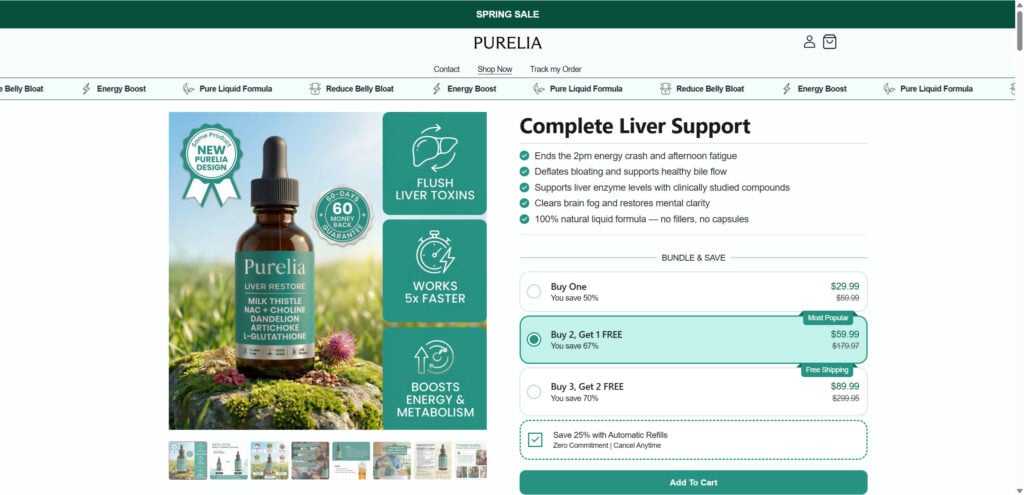
Purelia Liver Support Drops Overview
Purelia sells Complete Liver Support through OfficialPurelia.com as a liquid liver-support supplement. The product page claims it can help with the “2pm energy crash,” bloating, healthy bile flow, liver enzyme levels, brain fog, and mental clarity. It also describes the formula as a 100% natural liquid with no fillers or capsules.
The listed ingredients include glutathione, NAC, milk thistle extract, dandelion root extract, artichoke extract, beet root extract, choline citrate, and a proprietary blend containing chanca piedra, astragalus, ginger, burdock, turmeric, and schisandra.
The page is not marketed like a simple wellness supplement. It uses strong language around liver repair, toxin neutralization, healthy liver enzymes, liver fat accumulation, bile drainage, silent scarring, fatty liver, alcohol use, medication load, and follow-up blood work. It also displays customer-style stories claiming improved ALT/AST numbers, reduced liver fat, normal-range enzymes, reduced bloating, and better energy.
That is where buyers should slow down.
Liver health is a serious medical topic. Elevated liver enzymes, fatty liver disease, right-side abdominal discomfort, severe fatigue, and persistent bloating can have many causes. A supplement ad cannot diagnose these issues, and a liquid drop formula should not be treated as a replacement for medical care, bloodwork follow-up, or guidance from a healthcare professional.
Why Purelia Raises Red Flags
1. The health claims are unusually strong
Purelia’s page does not only say the product supports general wellness. It claims or implies benefits around:
- Liver enzyme levels
- Fatty liver support
- Bile flow
- Liver repair
- Liver detoxification
- Brain fog
- Energy crashes
- Post-meal bloating
- Medication-related liver stress
- Alcohol-related liver stress
- Fat accumulation in liver cells
- “Silent scarring”
- Liver function markers tracked by doctors
This is a broad and sensitive set of claims.
A liver supplement may contain familiar ingredients, but that does not mean it can reliably lower liver enzymes, reverse fatty liver, improve ultrasound findings, stop liver scarring, or fix chronic fatigue. Those are medical-adjacent claims that need strong evidence on the finished product, not just ingredient marketing.
2. Testimonials make medical-style claims
The product page includes customer-style stories that mention AST, ALT, elevated liver enzymes, fatty liver diagnosis, ultrasound changes, and doctors asking what changed.
These stories are persuasive because they feel personal and specific. But they also create a strong medical impression.
On-page testimonials are not independent clinical evidence. They can be selected, edited, unverifiable, or unrepresentative. Even if a testimonial is real, one person’s liver enzyme change does not prove the product caused it.
Liver enzymes can change for many reasons: weight loss, diet changes, alcohol reduction, medication changes, improved blood sugar, exercise, time, or changes in underlying disease activity.
3. The page pushes subscription refills
Purelia’s product page includes a low-stock warning that says subscribing protects against future stockouts and that subscriptions bill every 30 days. It also says “Cancel anytime.”
That is a major buyer risk.
Many people order supplements thinking they are buying one bottle, then later discover recurring charges or repeat shipments. Even if the subscription is disclosed, it may be easy to miss during a fast checkout flow.
Purelia’s terms say that by enrolling in a subscription, the customer authorizes recurring charges at the selected frequency, such as monthly or every 30 days, until canceled. The terms also state that cancellation applies to future shipments only.
That means if a renewal has already charged or is already being processed, canceling may not stop that shipment or automatically trigger a refund.
4. “Cancel anytime” does not mean “refund anytime”
This is one of the biggest problems with supplement subscriptions.
Purelia says customers may cancel before the next billing date. But the terms also state that cancellations apply to future shipments only and that subscription fees already charged for fulfilled or in-process shipments are subject to the refund policy.
In practice, this can create frustration. A customer may notice a charge, immediately request cancellation, and still be told the order is already in process.
That is why automatic refill supplements are risky. The cancellation window matters more than the phrase “cancel anytime.”
5. The refund messaging appears inconsistent
The product page says Purelia offers a 60-day money-back guarantee and claims buyers can get a full refund “even on empty pouches” if they do not see improvements.
But the refund policy says returns are accepted for items that remain sealed and unopened within 60 days. It also says Purelia will “work with you” to find a solution, which may include replacement, store credit, or refund.
That creates a mismatch.
The sales page sounds very broad and risk-free. The policy page sounds more conditional, especially for unopened items. Buyers should not assume the most generous wording will control the actual refund process.
6. Similar products are widely sold elsewhere
Purelia’s formula is not in a unique category. Similar liver support liquid drops are widely sold on Amazon and other marketplaces using ingredients such as milk thistle, dandelion, artichoke, NAC, glutathione, choline, beet root, ginger, turmeric, burdock, schisandra, and chanca piedra.
Some Amazon listings even use the Purelia name or very similar “liver restore drops” wording. Other brands sell similar liver cleanse/detox liquid supplements at lower prices.
That raises a generic/private-label risk. The product may not be a unique breakthrough formula. It may be part of a broader supplement category that can be sourced, branded, and marketed under many names.
7. Private-label liver drops are available from Chinese suppliers
Private-label liver support drops, milk thistle liquid drops, NAC/milk thistle blends, and liver detox supplements are available through Chinese supplier platforms.
That does not prove the exact Purelia bottle is manufactured in China. But it does show the product category is easy to source and relabel. Similar formulas can be bought wholesale and sold under new brands with aggressive health claims.
The concern is not that China-made products are automatically bad. The concern is when a generic supplement category is promoted as a premium, clinically meaningful liver repair solution without clear independent proof.
8. “Liquid absorption” claims are used to make it sound superior
Purelia says the liquid format bypasses the “processing burden” of capsules and delivers compounds directly into the bloodstream. It also compares its product to “knock-off” supplements and claims liquid absorption up to 98%.
That sounds technical, but buyers should be careful. “Liquid” does not automatically mean clinically superior. Absorption depends on the ingredient, dose, formulation, bioavailability, stability, and the individual user.
A liquid supplement can still be underdosed, unstable, poorly absorbed, or ineffective. The finished product needs evidence, not just liquid-format marketing.
9. The terms include a broad supplement disclaimer
Purelia’s terms state that the products are dietary supplements, are not intended to diagnose, treat, cure, or prevent disease, and that statements have not been evaluated by the FDA.
That disclaimer matters because the sales page uses strong language around liver enzymes, fatty liver, liver repair, scarring, detox, and doctor-tracked numbers.
Buyers should pay attention to that gap: the marketing may sound medical, but the legal disclaimer says the product is not a disease treatment.
10. Liver problems should not be self-treated through social media ads
If someone has elevated liver enzymes, fatty liver disease, abdominal pain, severe fatigue, jaundice, dark urine, pale stools, swelling, unexplained weight loss, or a history of heavy alcohol use, they should not rely on a supplement from an online ad.
Liver conditions can be serious. They require proper evaluation, blood tests, imaging, medication review, alcohol and diet assessment, and medical follow-up.
A supplement may be part of someone’s wellness routine, but it should not replace care.
How the Purelia Sales Funnel Appears to Work
Step 1: The page targets fear around liver health
The marketing focuses on common concerns: fatigue, brain fog, bloating, fatty liver, liver enzymes, alcohol use, and metabolic stress.
These topics are emotionally powerful. Many people are told by a doctor that their enzymes are “a little high” or that they should lose weight and come back later. That can make them vulnerable to products that promise a more active solution.
Step 2: The supplement is positioned as the missing repair formula
Purelia says other supplements fail because they do not combine glutathione, NAC, choline, milk thistle, dandelion, and other liver-support ingredients.
This creates the impression that Purelia is more complete than ordinary milk thistle capsules. It also makes the formula sound targeted and scientific.
But a more complex ingredient list does not automatically mean better outcomes.
Step 3: Medical-style stories build trust
The page uses testimonials about bloodwork, ultrasounds, doctors, liver enzyme numbers, and fatty liver diagnosis. These stories are designed to make the product feel proven.
But testimonials are not clinical trials. They do not show typical results, causation, safety, or long-term outcomes.
Step 4: The page encourages consistent use and stocking up
Purelia says liver repair takes time and that the best results come from sustained use. It also says customers should stock up and save.
This is a common supplement sales tactic. It encourages buyers to purchase more bottles or subscribe before knowing whether the product works for them.
Step 5: Subscription is framed as protection against stockouts
The page warns that the product sold out 12 times last year and says subscribing protects buyers from future stockouts.
That creates urgency. It also pushes customers toward automatic refills.
The risk is that those refills continue every 30 days unless canceled before the next billing date.
Step 6: Refunds may become a negotiation
The product page promises a full refund if the product does not work, even on empty pouches. But the refund policy says Purelia may offer a replacement, store credit, or refund and clearly states unopened items are eligible.
If a customer asks for money back after using the drops, they may not know which wording the company will apply. This is why screenshots matter.
Main Red Flags
- Strong liver enzyme, fatty liver, detox, repair, bile flow, and brain fog claims.
- Customer stories mention AST, ALT, ultrasounds, doctors, and normal liver numbers.
- Claims that liver enzyme improvements appear at 60–90 days.
- Subscription billing every 30 days is promoted on the product page.
- Terms authorize recurring charges until canceled.
- Cancellation applies only to future shipments.
- Product page promises refunds even on empty pouches.
- Refund policy highlights sealed, unopened items as eligible.
- Similar liver support drops are widely sold on Amazon and other marketplaces.
- Private-label liver drops are available from Chinese suppliers.
- “Liquid absorption” and “up to 98% absorption” claims may be overstated.
- The terms state the product is a dietary supplement and not intended to diagnose, treat, cure, or prevent disease.
- Buyers with liver enzyme issues or fatty liver should seek medical guidance, not rely on an ad funnel.
Is Purelia Liver Support Drops a Scam?
Purelia may ship a real liquid supplement. This may not be a simple “pay and receive nothing” scam.
The bigger issue is whether the product is being oversold and whether the refill model creates risk.
A fair conclusion is this: Purelia Liver Support Drops appear to be a high-risk supplement offer because of the strong liver-related claims, automatic refill subscription structure, generic/private-label product signals, and refund wording that may be less straightforward than the sales page suggests.
The product may contain real ingredients commonly used in liver supplements. But buyers should not assume it can lower liver enzymes, reverse fatty liver, repair liver damage, stop scarring, or replace medical care.
Safety Concerns Buyers Should Consider
Be careful with Purelia or any liver supplement if you:
- have diagnosed liver disease
- have elevated AST, ALT, GGT, bilirubin, or alkaline phosphatase
- have fatty liver disease
- drink alcohol regularly
- take prescription medication
- take metformin, statins, blood thinners, diabetes drugs, or blood pressure medication
- are pregnant or breastfeeding
- have gallbladder disease
- have kidney disease
- have autoimmune disease
- have abdominal pain or swelling
- have jaundice, dark urine, pale stool, nausea, or unexplained weight loss
Ingredients such as NAC, milk thistle, dandelion, turmeric, ginger, artichoke, and choline may be safe for many people, but they can still interact with medications or be inappropriate for certain conditions.
Ask a healthcare professional before using liver supplements, especially if you are already being monitored for liver enzymes or fatty liver.
What To Do Before Buying
1. Avoid automatic refills at first
Choose a one-time purchase if possible. Do not subscribe until you know the product is safe for you, you want repeat shipments, and you understand how to cancel.
2. Screenshot the checkout page
Before paying, save screenshots showing:
- one-time purchase or subscription
- quantity selected
- total price
- shipping cost
- billing frequency
- cancellation terms
- refund terms
- any upsells
- any “subscribe and save” box
This helps if you need to dispute a charge later.
3. Compare similar formulas
Search for:
- liver support drops NAC glutathione milk thistle
- milk thistle dandelion artichoke liver drops
- Purelia liver restore drops
- private label liver support drops
- liver detox liquid drops glutathione NAC
If similar products are much cheaper elsewhere, that is a sign to slow down.
4. Read the refund policy, not just the guarantee
Do not rely only on “60-day money-back guarantee” wording. Check whether opened bottles are eligible, whether shipping is refunded, whether return shipping is required, and whether subscription renewals are covered.
5. Do not use it instead of medical follow-up
If your doctor is monitoring your liver enzymes, do not replace follow-up bloodwork with a supplement. Ask your clinician before adding any product that claims to affect liver function.
What To Do If You Already Ordered
1. Check whether you are enrolled in a subscription
Look for words like:
- subscription
- recurring
- every 30 days
- monthly
- auto-refill
- subscribe and save
- next billing date
- reorder
- shipment reminder
Check both your order confirmation email and your customer account.
2. Cancel immediately if you do not want refills
Use the subscription link in the confirmation email and email support directly. Ask for written confirmation that the subscription is canceled and that no future charges will occur.
3. Save proof of cancellation
Take screenshots of the cancellation page and keep all emails. This matters if another charge appears.
4. Watch your payment method
Monitor your credit card, PayPal, Shop Pay, Apple Pay, or Google Pay account for repeat charges. If you see another charge after cancellation, dispute it quickly.
5. Save the product page and refund wording
Because the product page and refund policy may use different language, save screenshots of both. This can help if the seller refuses a refund after advertising one.
6. Do not open extra bottles
If you bought multiple bottles and may return them, keep unopened bottles sealed. The refund policy specifically says sealed and unopened items are eligible.
7. Dispute if necessary
Contact your bank, credit card issuer, or PayPal if:
- you were enrolled in refills without clear consent
- a refill charge appears after cancellation
- the product never arrives
- the seller refuses the advertised refund
- the refund policy contradicts the sales page
- you were charged for more bottles than ordered
- the product is not as advertised
Use clear wording such as:
- “unauthorized recurring charge”
- “subscription not clearly disclosed”
- “item not as described”
- “merchant refuses advertised refund”
- “misleading health claims”
- “unauthorized quantity charged”
FAQ
What are Purelia Liver Support Drops?
Purelia Complete Liver Support is a liquid dietary supplement marketed for liver support, bile flow, bloating, energy, brain fog, and liver enzyme support.
Is Purelia Liver Support a scam?
Purelia may ship a real supplement, but the offer has several red flags: strong liver-related claims, subscription refills every 30 days, generic product similarities, and refund wording that may be difficult to rely on.
Does Purelia have automatic refills?
Yes. The product page says subscriptions bill every 30 days, and the terms say customers who enroll authorize recurring charges until canceled.
Are Purelia refills hard to cancel?
The terms say customers can cancel before the next billing date, but cancellation applies to future shipments only. This means already charged or in-process shipments may not be automatically stopped.
Can Purelia lower liver enzymes?
Be cautious. The page claims liver enzyme improvements typically appear at 60–90 days, but buyers should not treat this as medical proof. Liver enzyme changes should be monitored by a healthcare professional.
Is Purelia FDA approved?
No dietary supplement should be assumed FDA-approved for safety and effectiveness before sale. Purelia’s terms say the product is a dietary supplement and is not intended to diagnose, treat, cure, or prevent disease.
Is Purelia a generic supplement from China?
The exact manufacturing origin of Purelia is not fully proven from the visible product page. However, similar liver support drops and private-label milk thistle/NAC/glutathione formulas are widely available from Chinese suppliers, which raises a generic sourcing risk.
Can I get a refund after using Purelia?
The product page says refunds are available even on empty pouches, but the refund policy says sealed and unopened items are eligible. That mismatch makes refund expectations uncertain.
Should I subscribe to Purelia?
Be careful. If you only want to test the product, avoid automatic refills. Choose a one-time purchase and monitor your payment method.
Should I take Purelia if I have fatty liver?
Speak with a healthcare professional first. Fatty liver and elevated liver enzymes require medical follow-up, not self-treatment through social media supplement ads.
The Bottom Line
Purelia Liver Support Drops are marketed as a powerful liquid formula for liver repair, detox, energy, bloating, brain fog, bile flow, and liver enzyme support. The product may contain real supplement ingredients, but the offer carries several warning signs.
The biggest concerns are the medical-style liver claims, emotional testimonials involving bloodwork and fatty liver, automatic 30-day refills, generic/private-label product signals, and refund wording that may be less simple than the sales page suggests.
Buyers should not treat Purelia as a proven treatment for liver disease, fatty liver, alcohol-related damage, elevated enzymes, or liver scarring. If you still want to try it, avoid subscriptions, screenshot the checkout, keep cancellation proof, and speak with a healthcare professional if you have any liver-related diagnosis or abnormal lab results.









The support staff are very helpful, except the story changes every day, I dont care about their shipping issues, delivery between 14 and 20 working days……how does that work, they earn so much by deceptive marking strategies that when the product does not arrive in that time frame, they blame the carrier. Fraudulent!
Changing explanations and an unusually long, shifting delivery window are not good customer service, James. Keep the promised delivery date and each later explanation in writing; if the order does not arrive within the agreed window, contact the payment provider rather than accepting an endless sequence of new estimates. Also avoid taking the drops until the ingredient label has been reviewed for your own health needs.
I purchased three bottles of purelia in early June using my Visa card , my bank shows purelia got paid June 15th. I still don’t have my order, I’ve tried calling them but can’t make contact I tried emailing them no response, I guess my 69.94 is gone.😡
Do not write off the $69.94 yet – the situation you describe is one of the easiest disputes to win. You have a card payment, a bank record showing it was taken, no goods delivered, and no response to calls or emails. Ring the number on the back of your Visa card, say you want to dispute the charge as “goods not received”, and give them the payment date. You normally have up to 120 days, and the merchant has to produce delivery evidence they will not have.
The silence is not bad luck, by the way – the phone number and support address on these sites are ornamental. Ask the bank to block the merchant and reissue your card number too, since these orders often carry a hidden monthly charge. And to be clear, MalwareTips is an independent review site rather than the seller, so we cannot ship or refund the order ourselves.