


A notice about your laboratory’s computer systems is easy to skim until you realize those systems may contain information about your own care.
For Quest Diagnostics patients, the Quanum incident raises two separate questions: what happened to the records, and which messages should you trust next?
Overview
The incident concerns Quanum Lab Services Manager
Quest Diagnostics disclosed unauthorized access involving Quanum Lab Services Manager, or LSM, a system used by certain healthcare clients for laboratory orders and results.
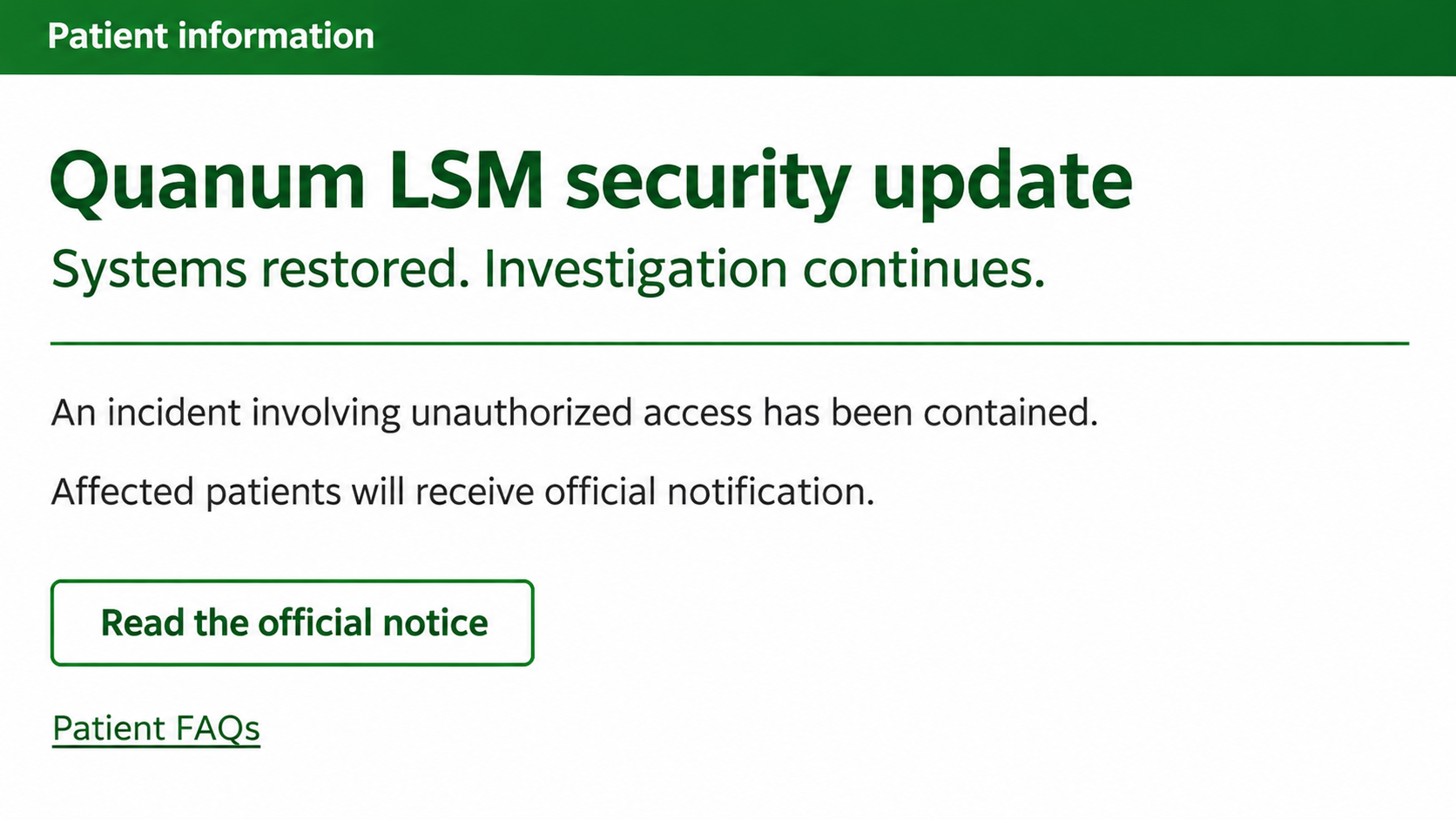
Its official notice, updated October 26, 2026, says the incident was contained and the system restored. The investigation into affected information continues.
This is a cybersecurity incident involving a legitimate laboratory company. It is not evidence that Quest itself operates a scam.
What patients should and should not assume
Quest says personal information and patient records were affected. The notice does not provide a complete field list or a final number of affected patients.
Do not assume that every Quest patient is affected, or that a particular Social Security number, payment card, or password was exposed.
The image above illustrates the update’s subject. It is not an authentic Quest screenshot, individual breach letter, or example of a scam message.
The immediate priorities
- Follow updates through Quest’s established website rather than an unexpected message link.
- Keep medical bills, insurance statements, and account records available for comparison.
- Question requests for payment, passwords, or verification codes supposedly needed to protect a laboratory account.
- Read an individual notification carefully if one arrives; its details matter more than speculation about the wider incident.
- Do not interrupt necessary care because an unsolicited caller claims your laboratory account is unsafe.
Restored Systems and Exposed Information Are Different Problems
A service returning does not undo unauthorized access
When a company restores a system, patients and clinicians can resume using the service. That is operational progress, but it does not answer every privacy question.
Information copied during an incident cannot necessarily be recalled when access is closed. Investigators still need to establish which records were involved.
Conversely, a temporary service interruption does not prove that every connected system lost data. Precautionary shutdowns and confirmed access should not be treated as identical events.
For patients, the sensible approach is to follow specific findings as they emerge, while taking proportionate steps that do not depend on a worst-case assumption.
Older headlines can describe an earlier stage
Early reporting may focus on paused access or disrupted provider tools. A later company update can change the service status without resolving the entire investigation.
Check when an update was issued and what it actually covers. Restored access, notification timing, and an affected-data assessment may follow separate timelines.
A headline saying a platform was paused should not persuade you that all testing remains unavailable. Confirm practical arrangements with your provider through established channels.
The same caution applies to messages claiming the investigation is complete. An individual caller cannot settle that question by sounding confident.
Why Medical Information Needs More Than a Credit Check
Identity misuse can appear in a bill or insurance statement
Medical identity theft involves someone using another person’s information to obtain care, prescriptions, equipment, or insurance payments. It is a possible downstream risk, not a confirmed outcome here.
The FTC’s medical identity theft guidance describes warning signs such as unfamiliar services, prescriptions, collection demands, and insurance benefit discrepancies.
A credit monitoring alert may therefore tell only part of the story. A claim submitted under a health insurance identity might first appear in an insurer’s records.
Keep checking ordinary communications from providers and insurers. The useful question is whether each service belongs to you, not whether every letter mentions the breach.
An explanation of benefits is a starting point, not a verdict
An explanation of benefits summarizes a claim processed by an insurer. It is not necessarily a bill, and an unfamiliar description does not automatically establish fraud.
A laboratory service may be listed under a business name you do not recognize. Start by matching the service date to an actual appointment or ordered test.
If it still makes no sense, contact the insurer and provider using known numbers. Ask them to explain the claim before making a payment.
Write down the representative’s name, reference number, and proposed next step. Those notes help when the same issue involves more than one organization.
Incorrect clinical information deserves prompt attention
Financial identity misuse and medical record errors can overlap, but they need different remedies. Reversing a bill does not necessarily correct information in a patient chart.
If a record includes a visit, prescription, allergy, or diagnosis that is not yours, bring the specific entry to the provider’s attention.
Do not edit your treatment based on that discrepancy yourself. Ask the clinical team to review the record and explain any effect on your care.
Keep copies of correction requests and responses. Share records through the provider’s established secure process rather than posting sensitive screenshots in a public discussion.
How Follow-Up Scams Can Exploit a Real Breach
A genuine incident can become a convincing opening line
Scammers do not need to have caused an incident to mention it. Public reporting gives them a recognizable subject for calls, texts, emails, and advertisements.
A message may offer account protection, claim compensation, or warn that test results are blocked. None of those claims becomes authentic merely because the breach is real.
Even accurate personal details should not replace verification. Information can come from previous incidents, public sources, or a conversation you had with someone else.
Verify the sender through a contact route you already trust. Do not let the message supply both the problem and the only supposedly safe solution.
Paying to protect a record is a different transaction
A demand for a card payment, cryptocurrency, gift card, or bank transfer deserves independent scrutiny. Do not confuse a new payment request with a normal laboratory bill.
If a caller says a charge is required to release a breach notice, end the call and check directly with the organization.
Credit monitoring invitations should also be verified before enrollment. Compare the provider, offer details, and enrollment instructions with an independently obtained official notification.
Do not submit a Social Security number to an unfamiliar page simply because its design resembles a health company or identity-protection service.
Urgency can push you past the ordinary checks
A message may claim that you have minutes to keep coverage, recover records, or preserve compensation. Take the time to confirm it anyway.
Caller ID, a familiar logo, and a professional signature can all be imitated. A lock icon only describes the connection, not the sender’s honesty.
Never read out an account login code to someone offering breach assistance. Read the code’s own message to understand which account or action it authorizes.
If a supposed helper requests remote access, stop. Protecting a medical record should not begin with an unexpected stranger controlling your computer.
What to Do If You Are a Quest Patient
- Bookmark the official incident notice.
Reach Quest through its established website and locate the Quanum update. Keep a copy of the information relevant to your situation.
A saved page helps you compare future messages without relying on a screenshot forwarded through a group chat.
- Look for an individual notification, but do not invent one.
Quest says it will notify patients determined to be affected and describe available resources. Read the specific notice if you receive it.
Its absence does not settle your status while an investigation remains ongoing. Equally, an alarming advertisement cannot establish that your record was affected.
- Confirm care arrangements with your own provider.
If you have an upcoming test or are waiting for results, ask the clinician or laboratory through a number you already use.
Do not cancel appointments or repeat tests because a caller claims the records disappeared. Let the treating team explain what is actually needed.
- Review bills and insurance activity for specific discrepancies.
Match service dates, provider names, prescriptions, and billed procedures with your own records. Keep a small list of entries you cannot explain.
Contact the relevant organization about those entries. Avoid treating every unfamiliar billing abbreviation as identity theft before it has been explained.
- Report incorrect medical information in writing.
Identify the exact record and explain why it is wrong. Ask the provider for its correction process and keep a copy of the request.
If the error could affect current treatment, tell the clinical team promptly. Billing support and clinical records staff may need to address different parts.
- Secure your patient and email accounts.
Use distinct passwords and available multifactor authentication. Check account contact details and recent activity if the service offers those views.
This is sound account hygiene, not a claim that patient passwords were exposed in this incident. A specific notice may provide more tailored instructions.
- Verify any monitoring offer before enrolling.
Use the offer described in a verified official notice, not a sponsored search result promising breach benefits. Confirm the enrollment provider through that independent route.
Understand what the service monitors and when any complimentary period ends. Monitoring alerts you to certain changes; it cannot prevent every form of misuse.
- Use identity-protection tools that match the exposure.
If an individual notice identifies sensitive financial identifiers, consider the relevant credit-report protections and follow the official guidance for that information.
A credit freeze addresses new-credit risk, not errors in a medical chart or all existing-account activity. Those problems still require their own follow-up.
- Act immediately if you responded to a suspicious message.
Contact your bank about exposed payment details. If you shared a password, secure the legitimate account directly and review active sessions.
If you shared health insurance information, notify the insurer. Explain the actual disclosure, rather than assuming that the company incident caused every later problem.
- Keep one organized evidence file.
Store notices, questionable messages, relevant bills, correspondence, and case numbers together. Include dates and brief notes explaining what each organization said.
Use IdentityTheft.gov if identity misuse occurs and you need a US recovery plan. Outside the US, use your established national reporting route.
Questions Worth Asking About an Individual Notice
Which information does the notice actually name?
Read the data categories carefully. A notice naming contact details is different from one naming insurance identifiers, medical information, or financial credentials.
Do not add categories from an older Quest incident or another company’s breach. That can lead to unnecessary alarm and the wrong protective action.
Which organization is providing the response?
A letter may name an outside service handling enrollment or assistance. Confirm that relationship independently before following its instructions or submitting sensitive information.
Keep the original letter rather than relying on an abbreviated social media summary. The details needed to verify an offer are often in the document.
What will you do if a problem appears?
Know whom to contact for an insurance claim error, an incorrect clinical record, an account login issue, and a suspicious payment.
Those are separate problems. Having the appropriate contacts ready makes it easier to respond calmly without trusting the first caller offering help.
If you help a parent or another family member, agree on a simple verification routine together. They can contact you before answering an unexpected laboratory-related request.
Do not ask them to forward complete medical records through an ordinary group chat. A description of the suspicious request is often enough initially.
Keep the provider’s established contact details somewhere accessible, especially if the patient does not normally use an online portal.
A calm second check can stop a rushed disclosure without requiring that person to understand every technical detail of the incident.
Frequently Asked Questions
Is Quest Diagnostics itself a scam?
No. This article concerns a disclosed security incident and the risk of unrelated impersonation attempts. A breach does not turn a legitimate healthcare provider into a scam.
Does the incident mean every Quest patient was affected?
The public notice does not establish that. Individual notifications and subsequent official findings are the appropriate basis for determining whether your information was involved.
Should I stop getting laboratory tests?
Do not interrupt needed care because of an unsolicited warning. Discuss practical arrangements and any concerns with your treating provider through established contact details.
Can a caller verify my breach status for a fee?
Do not pay an unexpected caller for that claim. End the interaction and confirm the situation directly with the organization through a known route.
Will credit monitoring catch medical identity theft?
It may flag some financial activity, but it does not replace checking insurance statements or addressing inaccurate medical records. Match the protection to the problem.
What if I already clicked a suspicious Quest-related link?
Act on what you disclosed or downloaded. A click alone differs from sharing a card, password, insurance number, or remote access.
Preserve the message and contact the relevant provider if sensitive information was submitted.
The Bottom Line
Follow Quest’s official updates, keep receiving necessary care, and watch for specific record or billing discrepancies. Do not treat speculative messages as a personal breach notification.
If someone uses this incident to request money or account access, stop and verify independently. If you already responded, protect the particular information you exposed.

Join the discussion
0 commentsShare your experience or ask a question about this article.
Discussion
Start the conversation
Have a question or something useful to share? Add the first comment.