

Social media has recently been taken over by short, cinematic clips of a mysterious figure known as MC Mateo, a supposed rapper who “turned his pain into art” by covering his neck with real golden scales. These videos, posted across TikTok, YouTube Shorts, and Instagram Reels, show a man with a metallic, reflective neck — sometimes animated, sometimes hyper-realistic — glimmering under studio lights as he performs or sits before a mirror.
The narrative is always the same: after a traumatic accident or emotional loss, MC Mateo underwent a secret surgery in Los Angeles, where doctors fused pure gold plates onto his skin. Fans call it a “golden rebirth.” Others say it’s impossible.
But here’s the truth: MC Mateo doesn’t exist.
His golden neck, his music, his story — all of it — are AI-generated fictions, crafted to harvest clicks, followers, and engagement. What we’re seeing is the perfect example of AI slop — a new form of viral disinformation that mixes digital art, AI storytelling, and emotional hooks to create believable but entirely fake online personas.
Let’s break down how this phenomenon started, how these videos are created, and why so many people are falling for MC Mateo’s golden illusion.
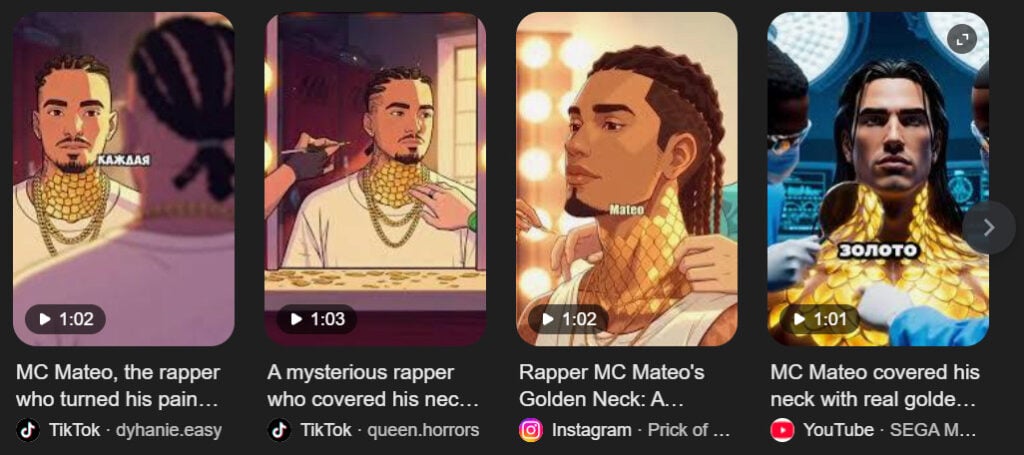
Overview: The Rise of the “Golden Neck” Myth
The videos featuring MC Mateo began circulating in late 2024 and quickly exploded in popularity by early 2025. TikTok accounts began posting clips under titles like:
- “MC Mateo, the rapper who turned his pain into gold.”
- “A mysterious rapper who covered his neck with real golden scales.”
- “Rapper MC Mateo’s Golden Neck: The man who rebuilt himself.”
Each video featured cinematic narration, dramatic music, and a consistent story arc — a tragic origin story followed by an unbelievable transformation.
The narrative goes something like this:
“After a brutal crash during the filming of a music video, MC Mateo decided to rebuild himself — not with scars, but with gold. At a secret Los Angeles clinic, doctors mixed mysterious metals and grafted golden scales onto his neck and shoulders. Under the light, he shimmered like molten sunlight.”
Each clip presents slightly different “facts”:
- Some say the operation was funded by record labels.
- Others mention a team of experimental doctors receiving “enormous secret payments.”
- A few claim the scales were alive, pulsing with blood.
This style of exaggerated storytelling is common in what’s now called AI slop content — short, sensationalized stories generated using artificial intelligence tools that can produce both visuals and narration.
The Ingredients of a Viral AI Hoax
Each “MC Mateo” video follows a recognizable formula designed for virality:
- Shock factor – The story opens with something outrageous: a rapper turning his skin into gold.
- Emotional depth – There’s a tragic or philosophical justification: “He wanted to turn pain into beauty.”
- Cinematic visuals – AI-generated video clips and stills with cinematic lighting, reflections, and motion blur to simulate realism.
- Engagement bait – Calls to comment (“Would you do this for fame?”), hashtags (#rappers, #aiart, #mysteryman), and vague captions like “Based on a true story.”
- Cross-platform reposting – Once a clip goes viral on TikTok, it gets re-uploaded to Instagram, YouTube Shorts, and Pinterest, each time slightly edited to bypass duplicate detection.
Why People Believed It
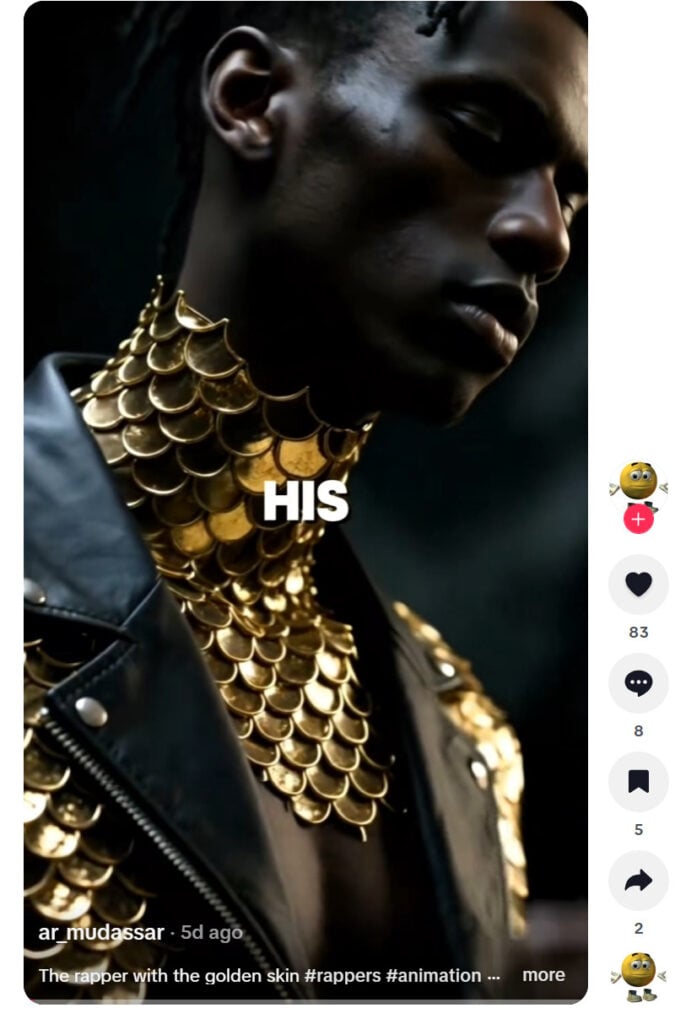
The reason many users believed MC Mateo was real lies in the quality of modern AI visuals. The golden scales look tactile, the lighting reflections seem physically accurate, and the voiceovers are narrated by AI voice models trained on real human accents. Combined, these elements mimic high-budget documentaries or music industry stories.
Moreover, TikTok’s fast-paced scrolling format encourages emotional reaction over critical thinking. When users see something intriguing — a rapper with golden skin — they’re more likely to share first and verify later.
Searches for “MC Mateo real name,” “MC Mateo surgery Los Angeles,” and “golden neck rapper real” spiked globally in April and May 2025.
The virality snowballed, feeding an endless cycle: viewers’ curiosity pushed engagement, which in turn motivated more creators to copy or remix the story — spawning dozens of “variants” like Golden Fingers, Golden Lips, and Golden Hair.
MC Mateo & AI Slop: The Anatomy of a Fabricated Legend
The story of MC Mateo didn’t start with a real person — it began as an AI experiment. The clip used AI-generated imagery, including hyper-realistic faces and lighting effects, combined with narration created using text-to-speech models like ElevenLabs or Speechify AI Voices.
Here’s how these viral videos are typically made — step by step.
Step 1: The Prompt
Creators start by crafting a text prompt in a generative AI tool like Midjourney, Runway Gen-2, or Kaiber AI. A sample prompt might read:
“A realistic cinematic portrait of a male rapper with gold scales fused to his neck, dramatic lighting, mirror reflection, emotional tone, hyperrealistic style.”
The AI then produces multiple still images, each unique but visually consistent with the golden motif.
Step 2: The Script
The text of the story — what we hear in the voiceover — is also AI-generated, often written in the same emotional, mysterious tone. Here’s a real excerpt found across multiple “MC Mateo” videos:
“Doctors mixed mysterious metals inside the gold and created golden scales that were fixed onto the rapper’s skin, making him look like a living golden reptile under the light. After a brutal crash, he decided to rebuild himself and glow beyond fame.”
This writing style is deliberately cinematic and vague, invoking curiosity without offering verifiable facts. There are no sources, no dates, and no real-world evidence — just a compelling narrative.
Step 3: The AI Voiceover
Next, creators feed the script into AI voice cloning or voiceover tools. These can produce realistic male or female voices with emotional inflection, pacing, and even background noise. The result sounds professional and believable — like a segment from a documentary or music biography.
Some voice samples even mimic the tone of popular YouTube narrators, giving the illusion of authenticity.
Step 4: The Video Composition
Once they have visuals and narration, they use AI video editors such as Runway Gen-2, Pika Labs, or Synthesia to animate the still images. The AI creates subtle head movements, breathing, lighting shifts, and reflections to make the static image look alive.
Creators overlay the voice, add cinematic music, fade-ins, and text overlays (“His Pain Became Gold,” “Real Surgery in Los Angeles,” “Doctors Warned Him”), and export the clip as a one-minute short video.
Step 5: Distribution and Engagement Farming
Finally, they upload the clip across multiple accounts — each pretending to be different sources.
Common patterns include:
- Fake watermarking
- Copying from one platform to another
- Comment bots repeating phrases like “I remember this news!” or “I saw this documentary!”
The purpose isn’t to promote a real artist — it’s to build viral traction and farm followers. Once an account reaches tens of thousands of followers, it can later be renamed or sold to promote other scams — including crypto schemes, fake investments, or counterfeit product stores.
This is why content like “MC Mateo” is called AI slop: it’s generated, emotionally charged, and ultimately meaningless. It’s designed to flood your feed, hijack attention, and make you interact with fabricated nonsense.
The Psychology Behind It
AI slop works because it triggers powerful psychological biases:
- Curiosity: People want to know if something this bizarre could be real.
- Emotion: The transformation story feels inspirational — pain to gold.
- Awe: The visuals are stunning, even if fake.
- Mystery: The lack of proof fuels speculation.
Creators rely on these reactions to keep audiences commenting and sharing. Every “Is this real?” comment boosts visibility.
How It Fits into the Larger AI Trend
The “MC Mateo” story is part of a much wider trend of AI-generated celebrity myths. Similar fictional figures have gone viral recently:
- A model who “aged backward” using nanotech injections.
- A boxer who “installed titanium ribs.”
- A singer who “merged DNA with coral.”
Each of these characters appears to exist, complete with backstories and footage, but none have any traceable identity or verified media presence outside AI platforms.
By combining generative AI imagery, deepfake-style storytelling, and social manipulation tactics, these creators fabricate convincing micro-legends — digital folklore for the social media age.
MC Mateo Many Variants – All Fake
Once the golden neck story gained traction, imitators began flooding the internet with “sequels” and alternate versions of MC Mateo’s transformation. All of them share the same structure, tone, and AI fingerprints.
Here are the most common variants — and how each one is fabricated.
1. MC Mateo’s Golden Fingers
Claim: A rapper from Miami implanted real gold nails into his fingers, each engraved with diamonds.
Reality: The same AI voice and structure were used from the neck video. The story claims a “7-hour operation in Los Angeles” and “doctors receiving enormous payments,” identical phrasing to the gold neck version.
The “hands glowing like the sun” effect is a simple AI-generated texture overlay, not real footage.
This “golden fingers” variation was uploaded to TikTok accounts recycling other AI horror and celebrity videos.
2. MC Mateo’s Golden Lips
Claim: Doctors injected liquid gold into his lips to fuse metal with skin, making his mouth shine under the spotlight.
Reality: No medical procedure can safely fuse gold with tissue in this way. Gold is non-reactive and cannot bond to living cells; it would either fall off or cause necrosis. The imagery in these videos shows impossible reflections and glow effects — signature traits of text-to-video AI tools.
Even the supposed “live stream reveal” is AI-generated, with synthetic reflections and distorted geometry visible when slowed down.
3. MC Mateo’s Golden Hair
Claim: A rapper from Mexico surgically implanted gold chains into his scalp, creating “golden dreadlocks.”
Reality: This concept appeared in several AI accounts under titles like “The Man with the Golden Head.” Every detail — titanium hooks, 24-karat chains, diamond tips — is a direct narrative copy of earlier AI hoaxes.
In reality, surgically implanting gold chains would be impossible without immediate rejection or infection. The visuals in these clips display perfect symmetry and texture consistency typical of AI art.
4. MC Mateo’s Golden Teeth and Fangs
Claim: He replaced his teeth with gold fangs that shimmered when he rapped, merging metal and bone.
Reality: Dental gold is common, but these videos show biologically impossible integrations — gold merging with gums and glowing from within. They use AI’s “specular highlights” artifact, where the light bounces unrealistically, giving the illusion of glowing tissue.
5. The “Golden Heart” and “Golden Blood” Myths
In late 2025, new versions began to appear — short animated videos claiming “MC Mateo’s gold entered his bloodstream,” or that “his heart pumps liquid gold.” These fantastical claims show the natural escalation of AI storytelling: once one story loses novelty, creators push the boundaries further into science fiction.
Each iteration recycles assets — the same face, lighting, and camera angles — because they’re generated from the same AI seed prompt.
Common Traits Across All Variants
- Identical voiceovers: Many use the same synthetic narrator, with only minor pitch or speed changes.
- No verifiable profiles: No real artist named “MC Mateo” exists on Spotify, Apple Music, Genius, or ASCAP.
- No independent coverage: No music magazine, entertainment outlet, or credible journalist has ever reported on him.
- Recycled tags: Every video uses the same hashtags — #rapper, #aiart, #mysteryman, #goldneck — suggesting coordinated reposting rather than organic fandom.
- Fake behind-the-scenes images: Supposed “surgery photos” show obvious AI distortions like melted gloves, misaligned fingers, or warped instruments.
The Business Behind the Hoax
Once a “golden neck” or similar story goes viral, the uploader gains tens of thousands of followers. At that point, they can:
- Sell the account to scammers for promotion of fake investment apps, crypto coins, or “AI story” eBooks.
- Rename it into a “mystery facts” or “viral science” channel.
- Monetize through affiliate links or TikTok Creator Fund payouts.
This is why AI slop like MC Mateo keeps multiplying: it’s profitable.
One viral video can generate tens of millions of views — and when the audience moves on, another variant appears.
The Evolution of the Hoax
Initially, MC Mateo was presented as a “mysterious rapper.” Now, he’s part of a larger AI mythos that includes fake doctors, fake operations, and even “hidden footage.” Some creators now claim to have “exclusive interviews” or “behind-the-scenes clips” of the procedure — all AI-generated.
The purpose isn’t to fool people forever; it’s to capture attention long enough to convert engagement into followers.
And as long as platforms reward engagement, these AI characters will continue to rise and fall in cycles.
Why It Matters: The Broader Implications of AI Slop
The MC Mateo hoax isn’t just a harmless story — it represents a growing trust crisis in the digital age. Every year, AI-generated content becomes harder to distinguish from reality. When fake stories like this go viral, they desensitize audiences and blur the line between fact and fiction.
This has three main consequences:
- Erosion of media literacy: People stop verifying information and start accepting whatever looks believable.
- Exploitation of virality: Malicious actors use viral AI stories to build audiences for scams, impersonation, or disinformation.
- Algorithmic pollution: Genuine creators and educators are drowned out by AI-generated nonsense designed only for clicks.
The “MC Mateo” phenomenon may seem minor, but it highlights how AI-generated folklore can spread faster than truth — and how creators can manipulate algorithms to make fake stories trend like real news.
The Bottom Line
MC Mateo — the rapper with the golden neck — does not exist.
There was no surgery in Los Angeles, no doctors mixing metals, and no human covered in living gold scales.
The entire concept is a work of AI fiction, created using text-to-image and text-to-video tools, narrated by AI voices, and distributed by engagement farming accounts seeking followers and monetization.
Every variant — golden neck, golden fingers, golden lips, golden hair — follows the same blueprint: an emotionally charged story with impossible science, cinematic AI visuals, and a clickbait moral.
What we are witnessing isn’t a music legend; it’s AI slop storytelling — algorithmic myth-making that preys on human curiosity and platform incentives.
If you encounter similar stories online — whether about golden skin, diamond eyes, or titanium hearts — remember that the more unbelievable a claim sounds, the more likely it was designed by an algorithm, not an artist.
In the end, MC Mateo’s gold neck was never meant to shine — only to make you watch.
Frequently Asked Questions (FAQ)
Who is MC Mateo?
MC Mateo is a fictional rapper popularized through viral short videos that depict him with a golden, metallic neck. These videos claim he underwent a secret medical operation to fuse real gold scales onto his skin after a life-changing accident. In reality, there is no record of any rapper named MC Mateo, no music released under that name, and no evidence of such a procedure ever taking place.
Is the “gold neck” real
No. The so-called “golden neck” is entirely AI-generated visual fiction. The images and videos were created with modern generative tools that simulate photorealistic lighting and texture. What appears to be gold fused with skin is simply a digital illusion, produced for shock value and online virality rather than any genuine transformation.
Was there really a surgery in Los Angeles?
The “Los Angeles surgery” storyline is fabricated. None of the claims about doctors mixing metals, secret clinics, or experimental implants have any factual basis. These are recurring elements of AI-generated narratives intended to sound cinematic and mysterious. There is no hospital, medical team, or verifiable documentation supporting these events.
Why do so many people believe the videos are real?
The combination of hyper-realistic AI imagery, professional-sounding voiceovers, and emotional storytelling makes these clips appear authentic at first glance. On fast-scrolling platforms, viewers rarely pause to verify information, so the illusion spreads quickly. The human brain also tends to accept visually convincing scenes as real, especially when paired with a compelling personal story.
What tools are used to create videos like this?
Creators of these viral shorts typically use a mix of text-to-image generators (such as Midjourney or Leonardo AI), AI video platforms (like Runway Gen-2 or Pika Labs), and AI voice narrators trained to sound human. They combine these assets in video editors, add dramatic music, and publish them as if they were real news or documentaries.
Are there other versions of MC Mateo’s story?
Yes. After the first “golden neck” video went viral, many imitators released alternate versions claiming MC Mateo had golden fingers, golden lips, golden hair, or golden teeth. Each one follows the same formula: emotional narration, impossible medical details, and flashy AI visuals. None of these variants are authentic; all reuse AI content and recycled scripts.
Is this part of a larger online trend?
Absolutely. MC Mateo is one example of a broader wave of AI-slop content—automatically generated stories and images designed to go viral without offering any truth or artistic merit. Similar fabrications include tales of people implanting diamonds, merging DNA with machines, or transforming their bodies with futuristic materials. They exploit curiosity and confusion to drive clicks and followers.
Could anyone actually cover their neck with real gold?
No legitimate medical procedure could achieve what these videos show. Gold cannot safely fuse with living tissue. Even if attached superficially, it would restrict movement, damage skin, and cause infection. Medical science offers cosmetic gold treatments (such as fine-dust facials), but nothing resembling the permanent metallic scales seen in the videos.

Join the discussion
0 commentsShare your experience or ask a question about this article.
Community experiences
Did this happen to you?
Your experience could help someone recognize the same scam. Submit a private report for our team to review.
I experienced this tooReports are reviewed before publication. Sharing publicly is always your choice.
Discussion
Start the conversation
Have a question or something useful to share? Add the first comment.