

Every few months, a new “miracle” weight loss product floods the internet — a product that supposedly melts fat effortlessly, no diets or exercise required. The latest name to make the rounds is RejuvaCare OzemPatch, a so-called “transdermal fat-burning patch” marketed as a revolutionary alternative to Ozempic.
The product’s advertisements show stunning before-and-after photos, glowing testimonials, and slick promotional videos that claim clinical proof of effectiveness. But a closer look reveals a much darker truth: RejuvaCare OzemPatch is at the center of a coordinated online scam network, one that uses fake ads, fabricated results, and misleading marketing to sell false hope.
This detailed investigation exposes how the RejuvaCare OzemPatch scam works, why so many people are falling for it, and what you can do to protect yourself.
Overview
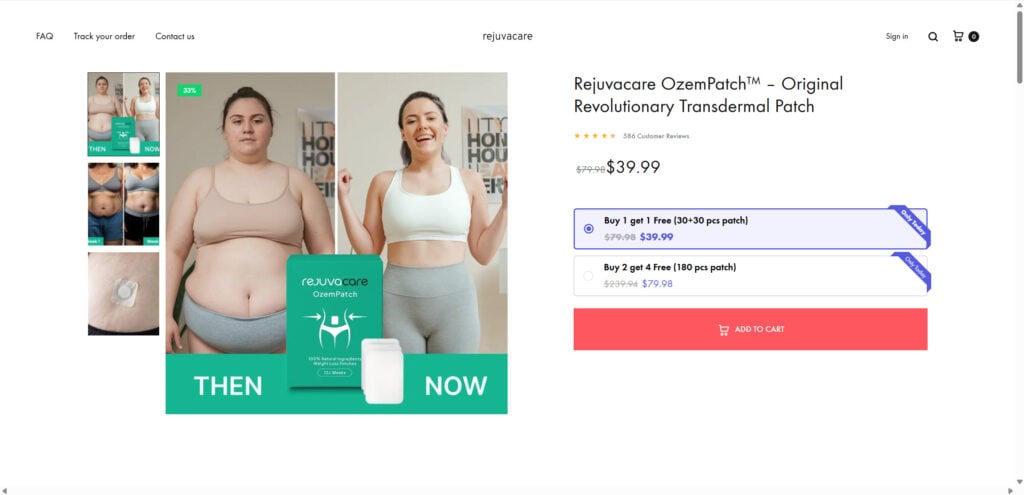
At first glance, the RejuvaCare OzemPatch looks legitimate. The product’s website — usually hosted under rejuvacare.com, ozempatch.shop, or similar lookalike domains — presents itself as a clean, modern e-commerce site selling a “revolutionary weight loss patch.” It even includes before-and-after photos, ingredient lists, usage guides, and a handful of fabricated customer reviews that seem convincing.
But the more you look, the more the inconsistencies start to show.
The Promise: “Lose Weight Effortlessly Without Diet or Exercise”
The site claims that OzemPatch uses “transdermal delivery technology” to absorb fat-burning ingredients directly through the skin. According to the product page, users just have to stick the patch on their abdomen or upper arm and let it “target stubborn fat.”
The page further claims that the patch:
- Boosts metabolism
- Reduces appetite
- Blocks fat accumulation
- Provides “clinically proven” results
The language mirrors real pharmaceutical marketing — phrases like “clinically tested,” “backed by science,” and “doctor recommended” are liberally sprinkled across the page. But there’s one glaring problem: none of these claims have any scientific backing whatsoever.
There are no citations, no studies, and no real doctors associated with the brand.
Fake Before-and-After Photos and Testimonials
The site heavily relies on before-and-after transformation photos — all of which are stolen stock images or AI-generated fakes. Reverse image searches show that these photos have been used across multiple unrelated products, from diet pills to fitness teas.
Some “customer reviews” even reuse names and identical wording seen on other known scam sites. Comments like “I lost 25 pounds in just 3 weeks!” or “I finally feel confident again!” are common — but they’re generic, unverifiable, and often paired with AI-generated profile pictures.
Dubious Ingredient Claims
RejuvaCare claims that OzemPatch contains ingredients like:
- Green Tea Extract
- Garcinia Cambogia
- Yerba Mate
- Guarana
- Acai Berry
- Seaweed Extract
While these are common in over-the-counter supplements, none of them are proven to cause significant fat loss, especially through skin absorption. Medical experts confirm that the skin acts as a natural barrier — meaning these compounds can’t simply “melt fat” when applied topically.
In short, the product’s scientific claims are physiologically impossible.
The Website Design: Clean, But Misleading
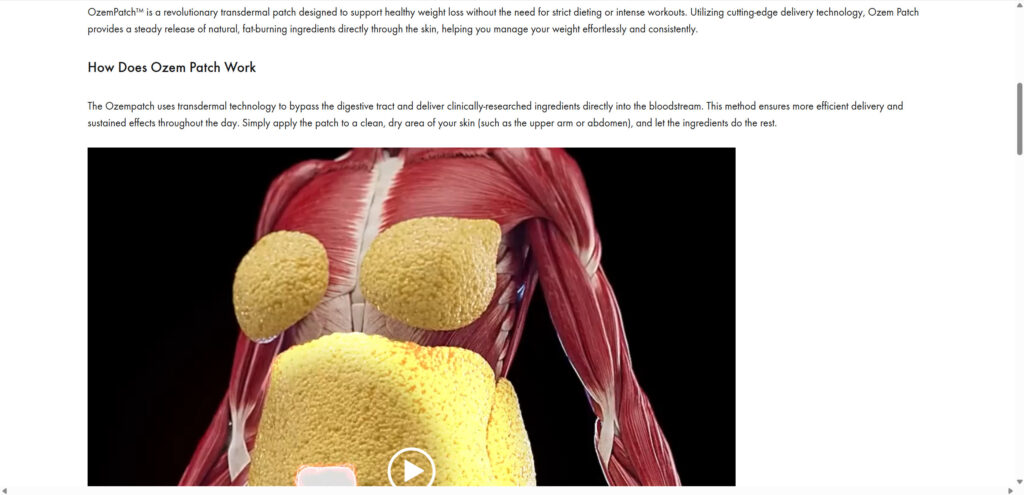
The official site tries to appear professional and trustworthy, with neat formatting, medical illustrations, and graphics suggesting the patch “targets fat layers under the skin.”
However, all these visuals are computer-generated renderings, not medical diagrams. Even the “anatomy” video showing yellow fat cells dissolving is a stock animation found on video template libraries.
Beneath the polished design lies the same pattern seen in dozens of health product scams — emotional marketing, vague promises, and a total lack of verifiable science.
Fake Discounts and “Only Today” Pressure Tactics
RejuvaCare OzemPatch’s pricing structure is another major red flag. It uses deceptive urgency tactics such as:
- “Buy 1 Get 1 Free — Only Today!”
- “Limited Stock Left!”
- “Offer Expires in 00:00” (with a fake countdown timer)
These are psychological pressure tools designed to rush buyers into acting without thinking. Even after the timer “expires,” refreshing the page restarts it — proving the urgency is fake.
No Real Business Transparency
Most scam sites at least attempt to provide a company name or address. RejuvaCare OzemPatch provides none. The “Contact Us” section usually lists a generic email address, with no phone number or physical business location.
Some versions of the site include a vague line such as “©2025 Rejuvacare. All rights reserved.” — but searches for “RejuvaCare company registration” return zero results in any official business database.
The website’s domain registration is private, concealing the owner’s identity, which is a common tactic used to avoid accountability.
Suspicious Review Patterns
Another giveaway is the review manipulation. The site shows hundreds of 5-star reviews, but none of them can be verified externally. Platforms like Trustpilot, Reddit, and consumer protection boards list numerous complaints about unauthorized charges, undelivered products, and ignored refund requests.
This pattern is consistent with large-scale dropshipping scams, where the website disappears within months — only to reappear under a new name.
How the RejuvaCare OzemPatch Operation Works
The RejuvaCare OzemPatch scam follows a familiar but highly effective structure used across the internet by health supplement scammers. It’s a carefully engineered funnel designed to attract, manipulate, and convert victims into paying customers before they realize what’s happening.
Here’s how it typically unfolds.
Step 1: The Deceptive Ads
The scam begins with misleading social media ads. These usually appear on platforms like Facebook, Instagram, or TikTok, showing “real people” losing incredible amounts of weight using the patch.
The ads feature side-by-side “before and after” photos, dramatic text overlays such as “Lose 30 Pounds Without Exercise!” or “Doctors Shocked By This New Discovery,” and often fake video testimonials.
In reality, these videos use AI-generated actors or stock clips repurposed from unrelated content. The voiceovers sound robotic, and the names used are fictional.
Step 2: The Clickbait Landing Page
Once a user clicks the ad, they’re redirected to a fake health website that mimics legitimate news outlets. The headline often reads:
“Harvard Scientists Discover Revolutionary Fat-Burning Patch That Works Better Than Ozempic.”
These sites are registered under random domains like healthtodaynews.co or wellnessdailyshop.net, but their design mimics popular outlets like CNN, Forbes, or Women’s Health.
The articles claim that “top doctors” recommend the OzemPatch and include fake interviews or quotes supposedly from medical experts. None of this content is authentic.
Step 3: Emotional Manipulation
The content plays on readers’ insecurities and desires. It often tells emotional stories of women or men who “finally found confidence again” or “lost weight effortlessly after years of trying.”
By blending these testimonials with pseudo-scientific explanations, scammers build trust and lower skepticism.
The copy is filled with lines like:
- “Doctors don’t want you to know this!”
- “Pharmaceutical companies are trying to ban this breakthrough!”
- “This secret patch is changing lives!”
These are deliberate psychological tactics designed to trigger curiosity, outrage, and urgency.
Step 4: Fake Authority and Medical Endorsements
The next part of the funnel adds fake credibility indicators — stock photos of doctors, fake “FDA Approved” badges, and “clinically tested” icons.
None of these claims are legitimate.
The FDA does not approve dietary patches in this way, and no scientific database lists any studies or patents related to RejuvaCare OzemPatch.
These authority symbols exist purely to deceive.
Step 5: The Sales Page and Checkout Pressure
After the user scrolls down the fake article, they’re prompted to “claim their limited-time offer.” This button redirects them to the RejuvaCare OzemPatch sales page — a typical Shopify-like storefront.
Here, the buyer is confronted with pricing packages such as:
- 1 pack for $39.99
- 2 packs for $79.98 (Buy 2 Get 4 Free)
The site uses urgency triggers like countdown timers, fake “in-cart” popups showing other buyers, and flashing “low stock” warnings.
During checkout, the form asks for full personal information — name, email, phone number, and address — followed by credit card details.
Once the payment is submitted, buyers may or may not receive a product. If they do, it’s usually a cheap adhesive patch with no active ingredients or benefits.
Step 6: Post-Purchase Problems
Victims report several post-purchase issues, including:
- Unauthorized charges for recurring subscriptions.
- No response to refund requests.
- Invalid tracking numbers or non-existent shipments.
- Emails bouncing back or customer support disappearing.
By the time a buyer realizes they’ve been scammed, the website is often taken down or replaced with a clone under a new name.
Step 7: Rebranding and Repeat
The final phase involves rebranding the scam. Once too many complaints accumulate, the domain is abandoned. The same scammers then relaunch under a new name — sometimes changing only the logo or packaging.
This allows them to evade detection and continue preying on new victims using the same marketing formula.
What to Do If You Have Bought This
If you believe you’ve fallen victim to this scam, take immediate action to minimize financial and data-related damage.
- Contact Your Bank or Credit Card Provider
Report the transaction as fraudulent and request a chargeback. Financial institutions can often reverse unauthorized payments if reported quickly. - Cancel Any Recurring Charges
Some scammers enroll victims in automatic monthly subscriptions. Ask your bank to block recurring charges from the same merchant. - Change Your Passwords
If you used the same email and password combination elsewhere, change them immediately. Scammers may sell your information to data brokers. - Monitor Your Accounts Closely
Keep a close eye on your credit card and bank statements for suspicious activity. Report unauthorized transactions right away. - Report the Scam to Authorities
File a complaint with:- FTC (Federal Trade Commission): reportfraud.ftc.gov
- Internet Crime Complaint Center (IC3): ic3.gov
- Better Business Bureau (BBB): bbb.org/scamtracker
- Warn Others
Share your experience on social media or consumer forums to help prevent others from falling for the same trap. - Use a Reputable Identity Monitoring Service
If you provided personal information, consider using an identity protection service to monitor for potential misuse.
The Bottom Line
The RejuvaCare OzemPatch scam is yet another example of how sophisticated online marketers exploit people’s health concerns and desperation for quick results. Behind the glossy design, fake testimonials, and pseudo-scientific claims lies a network of deceptive sellers whose goal is to extract money — not deliver real results.
There is no scientific proof that transdermal patches like OzemPatch can burn fat, boost metabolism, or mimic Ozempic. Real weight loss requires sustainable lifestyle changes, not miracle products.
Consumers should remain skeptical of any health product that promises dramatic results without effort, especially when it relies on fake endorsements, countdown timers, and emotional manipulation.
If it sounds too good to be true — it probably is.
FAQ: RejuvaCare OzemPatch Scam
1. Is RejuvaCare OzemPatch a legitimate weight loss product?
No. There is no scientific or clinical evidence proving that OzemPatch helps with fat burning or weight loss. The product’s claims are unsupported and marketed using deceptive advertising.
2. Is RejuvaCare affiliated with Ozempic or any medical institution?
No. Despite the similar name, RejuvaCare OzemPatch has no affiliation with Novo Nordisk (the manufacturer of Ozempic) or any licensed medical organization.
3. How does the RejuvaCare OzemPatch scam operate?
The scam relies on fake ads, AI-generated testimonials, and cloned health websites that imitate trusted news outlets. Victims are funneled through emotional marketing and pressured into buying via countdowns and fake discounts.
4. What happens after you purchase the OzemPatch?
Victims often face unauthorized charges, undelivered products, or recurring subscriptions. Customer support is usually nonexistent, and refund requests go unanswered.
5. How can you report the RejuvaCare OzemPatch scam?
Report the website and related ads to the FTC, IC3, and BBB Scam Tracker. Also, notify your bank immediately to dispute the transaction.
6. Are there other names or versions of this product?
Currently, the scam appears under RejuvaCare OzemPatch, but scammers may reuse the same design under new brand names in the future.
7. Are any weight loss patches scientifically proven?
No reputable scientific study has proven that transdermal patches can cause significant fat loss. Most “fat-burning patches” on the market are unregulated and ineffective.
8. What should I do if I shared my personal details with them?
Change your passwords, monitor your accounts, and consider enrolling in an identity protection service to detect suspicious activity.
9. Why are these scams so effective?
They exploit emotional pain points — such as body image, aging, and failed diets — and combine them with fake science, urgency, and social proof to lower skepticism.
10. What’s the safest way to lose weight?
Consult a licensed healthcare provider or dietitian. Safe, effective weight loss comes from balanced nutrition, regular exercise, and long-term lifestyle habits — not miracle patches or “quick fixes.”

Join the discussion
2 commentsShare your experience or ask a question about this article.
Discussion
Thank you for posting this information. Although I have not been turned on by this product, I have been gullible enough to purchase other products. I finally learned my lesson and now check out each and every product before buying them. Please continue your research on these products and sharing your comments!
In reply to S M Tiffee
That habit of checking every product before buying is worth more than any single article we could write, so thank you for saying so – and please retire the word “gullible”. Being persuaded by professionally tested advertising is not a character defect; the material is refined against thousands of people until it works, and the current generation uses cloned voices and fabricated video that did not exist a couple of years ago.
If it is useful, the short checklist that catches most of them: look up the domain’s registration date on a free WHOIS lookup, since a site a few weeks old selling a breakthrough is the single strongest signal; search the product name with “complaints” rather than “reviews”, because review results are dominated by affiliate pages earning commission on each sale; read the small print under the buy button for a recurring charge; and pay by credit card, never by transfer, gift card or crypto. If your bank offers virtual card numbers with a spending limit, using one for anything found through an advert means a hidden subscription simply fails.
One last thing worth knowing: having bought from one of these sellers puts you on a list that gets traded, so expect approaches from people offering to recover money or cancel subscriptions for you. Those are scams without exception.