

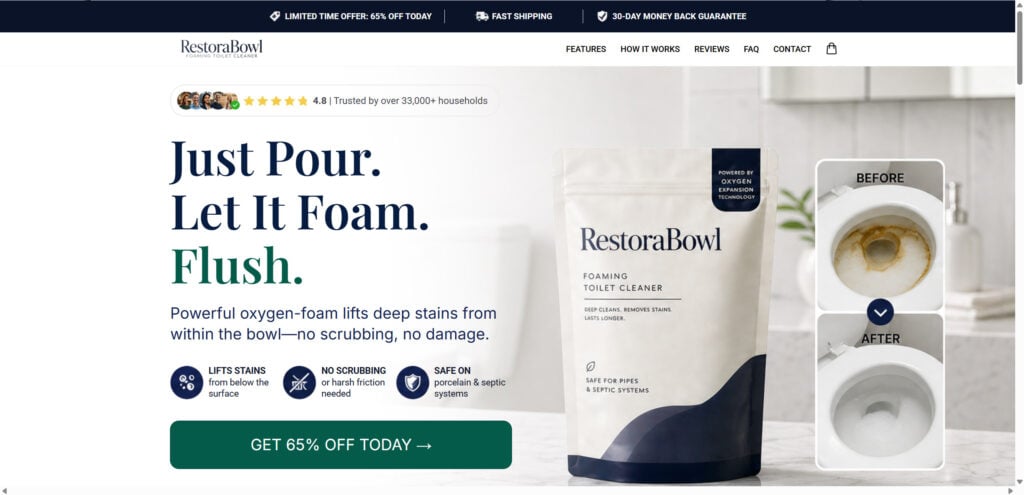
RestoraBowl is advertised as a no-scrub toilet bowl cleaner that claims to remove hard water rings, rust, grime, mold stains, and pink buildup using an “oxygen foam” formula.
The offer looks simple: pour it in, let it foam, flush, and supposedly enjoy a cleaner bowl without scrubbing.
But the sales page raises several red flags, including exaggerated cleaning claims, vague ingredient details, large review numbers, generic product positioning, pressure-based discounts, and refund terms that are not as simple as the “30-day guarantee” makes them sound.
Overview
RestoraBowl is sold through restorabowl.com as a foaming toilet cleaner. The page claims it uses powerful oxygen foam to lift deep stains “from within the bowl,” remove buildup without scrubbing, and work in 3–5 minutes. The site also claims the product is safe on porcelain and septic systems, trusted by over 33,000 households, and backed by a 30-day money-back guarantee.
The core pitch is built around convenience:
- No scrubbing
- No harsh friction
- Works in minutes
- Removes rust, hard water rings, black mold growth, pink bacteria, and hidden grime
- Safe for plumbing and septic systems
- Keeps bowls cleaner longer
That sounds appealing, especially for people dealing with old toilet stains. But when a product claims to remove years of buildup in minutes with no scrubbing, buyers should slow down and look closer.
What RestoraBowl Claims
The website claims RestoraBowl can:
- Lift stains from below the surface
- Remove hard water rings
- Remove rust buildup
- Remove black mold growth
- Remove pink bacteria and slime
- Clean without scrubbing
- Work in 3–5 minutes
- Clean microscopic grooves inside the bowl
- Be safe for porcelain and septic systems
- Keep toilet bowls cleaner for longer
The page explains the mechanism as “oxygen expansion,” saying millions of micro-bubbles penetrate into microscopic grooves and lift stains away so they rinse clean when flushed.
That explanation sounds scientific, but the page does not show a full ingredient list, safety data sheet, independent lab testing, or side-by-side testing against established toilet cleaners.
That is the first major problem.
Major Red Flags
1. The cleaning claims are very broad
RestoraBowl does not simply claim to freshen a toilet bowl. It claims to work on:
- Hard water rings
- Rust buildup
- Black mold growth
- Pink bacteria and slime
- Hidden grime
- Long-term stains
These are different cleaning problems. Rust, limescale, mineral rings, biofilm, and mold-like staining may require different active ingredients or cleaning methods.
A serious cleaning product should clearly explain what is inside it and which stains it is designed to handle. RestoraBowl’s page focuses heavily on “oxygen foam” but does not clearly disclose the chemical composition on the main sales page.
2. “No scrubbing” is probably exaggerated
The site repeatedly says RestoraBowl works without scrubbing. It claims users simply pour, wait, and flush.
That may work for light staining or fresh buildup. But old toilet rings, heavy rust, mineral scale, and under-rim buildup often require contact time, acidic cleaners, brushing, or repeated treatment.
A foam cleaner can help loosen residue. But the claim that deep stains disappear with no scrubbing should be treated as marketing unless supported by controlled testing.
3. The product category is not unique
Foaming toilet cleaners, oxygen-based cleaning powders, toilet tablets, and bowl-cleaning gels are widely available from generic suppliers. Alibaba listings include products described as “Oxygen Particles Magic Foam Cleaner,” “Magic Bubble Powder Toilet Cleaner,” and foaming toilet cleaner chemicals from Chinese suppliers.
Other wholesale listings show foaming toilet tablets and toilet bowl cleaner tablets sold in bulk, with some listings showing prices around $0.52–$0.80 per pack for toilet bowl cleaner tablets
That does not prove RestoraBowl uses a specific supplier. But it does show this product category is common and easy to rebrand.
The likely concern is that buyers may be paying a premium price for a generic foaming toilet cleaner sold with more dramatic marketing.
4. The review numbers are inconsistent
RestoraBowl claims it is “trusted by over 33,000+ households.” The same page also shows “4.8/5 from 1,00+ Verified Reviews,” which appears to contain a formatting or typo issue.
That kind of inconsistency matters.
If a product is truly backed by thousands of verified customers, the site should provide a transparent review system, independent review platform, clear dates, and verifiable purchase records.
Instead, the reviews appear to be controlled by the seller’s own page.
5. The “founder story” is vague
The site includes a founder story saying the creator was tired of scrubbing toilets that never stayed clean and therefore created RestoraBowl. However, the visible page does not clearly identify the founder by full name, provide a company background, or show manufacturing details.
That is a weak trust signal.
A real household cleaning brand should be transparent about:
- Who makes the product
- Where it is manufactured
- What ingredients are used
- Safety warnings
- Certifications
- How it was tested
- Whether it is safe for septic systems and plumbing
RestoraBowl does not provide enough of that on the main page.
6. The return policy is not as frictionless as the sales pitch suggests
The website repeatedly promotes a 30-day money-back guarantee and says dissatisfied customers can get a full refund, “no questions asked.”
But the contact page says customers must email support for return instructions, are responsible for paying their own return shipping costs, and shipping costs are non-refundable. It also says the refund is issued only after the return is received, less shipping and handling.
That is not the same as a truly risk-free purchase.
If the product is inexpensive but return shipping is costly, many customers may simply give up.
7. The company information is confusing
The contact page lists corporate offices in Canada, the United Kingdom, and Australia, while the Terms and Conditions refer to “RestoraBowl Inc.” and say the governing law is California.
That is not automatically proof of a scam, but it creates questions.
Where is the actual company registered? Where are orders fulfilled from? Where do returns go? Who manufactures the cleaner? Which office is responsible for customer complaints?
The page does not make that clear.
8. The site uses classic urgency tactics
RestoraBowl’s page displays “Limited Time Offer: 65% Off Today” and repeated calls to get the discount immediately.
These discount banners are common in direct-response ecommerce funnels. They are designed to push visitors to buy quickly before comparing prices, checking ingredients, or researching alternatives.
A limited-time discount does not prove fraud. But combined with vague ingredients, broad claims, and controlled reviews, it is a warning sign.
9. Ingredient and safety transparency appear weak
For a toilet cleaner, ingredient disclosure matters.
Cleaning products can contain acids, oxidizers, surfactants, fragrances, bleach-like ingredients, or other chemicals that may irritate skin, eyes, or lungs if misused. The CDC warns people never to mix bleach with ammonia or any other cleaner and recommends using ventilation and protective gear when cleaning with stronger products.
RestoraBowl’s main page claims the formula is safe, but it does not clearly show a full ingredient list or safety data sheet on the visible product page.
That is a problem because customers need to know what they are putting into their toilet, especially if they have septic systems, pets, children, respiratory sensitivities, or existing cleaning chemicals in the bowl.
What RestoraBowl May Actually Be
RestoraBowl may simply be an oxygen-based foaming toilet cleaner, tablet, or powder.
If it arrives and contains a legitimate cleaning formula, it may help with:
- light toilet stains
- mild hard water buildup
- odor
- surface grime
- fresh rings
- maintenance cleaning
But buyers should not assume it can reliably remove:
- years of rust
- heavy limescale
- deep mineral deposits
- black mold staining
- severe under-rim buildup
- old scratched-in stains
The product may work as a basic cleaner. That is very different from being a miracle no-scrub toilet restoration product.
Why This Looks Like a Dropshipping-Style Funnel
RestoraBowl has several characteristics often seen in dropshipping or direct-response product funnels:
- Big discount banner
- Simple “miracle” problem-solution pitch
- No-scrub cleaning promise
- Large household/review claims
- Generic product category
- Limited visible ingredient transparency
- Broad “safe for septic” claim
- Customer-paid return shipping
- Vague company structure
- Repeated calls to buy now
The product may ship. But the marketing appears designed to make an ordinary cleaner feel like a breakthrough.
Is RestoraBowl a Scam?
Not necessarily a fake-product scam
RestoraBowl may ship a real cleaning product.
Customers may receive a powder, foam, tablet, or liquid that produces bubbles and cleans some stains.
But it is high-risk
The concerns are:
- Exaggerated no-scrub claims
- Vague ingredient transparency
- Generic product category
- Seller-controlled reviews
- Confusing company details
- Customer-paid return shipping
- Broad safety claims without visible testing proof
- Pressure-based discount marketing
The most accurate verdict is:
RestoraBowl appears to be a high-risk foaming toilet cleaner sold through exaggerated marketing and weak transparency. It may work as a basic cleaner, but buyers should not assume it can restore badly stained toilets with no scrubbing.
Should You Buy RestoraBowl?
For most buyers, caution is warranted.
Reasons to be careful:
- Similar foaming toilet cleaners are widely available.
- The product does not appear unique.
- The site does not clearly disclose full ingredients.
- The review numbers are not independently verified.
- Returns require customer-paid shipping.
- The “no scrubbing” claims may be unrealistic for old stains.
- Safety and septic claims are not backed by visible third-party proof.
Better alternatives:
Before buying a viral toilet cleaner, consider established products from reputable retailers with:
- Clear ingredient labels
- Safety warnings
- Verified reviews
- Transparent manufacturer details
- Known return policies
- EPA Safer Choice listings where relevant
The EPA’s Safer Choice program helps consumers identify products that perform and contain ingredients that are safer for human health and the environment.
What To Do If You Already Ordered RestoraBowl
1. Save the product page
Take screenshots of:
- “65% off today”
- “no scrubbing”
- “works in 3–5 minutes”
- “safe for septic systems”
- “30-day money-back guarantee”
- review claims
- checkout total
- shipping promises
- return policy
These screenshots can help if the product does not match the advertising.
2. Check the merchant name
Look at your bank or card statement.
Check whether the charge appears as:
- RestoraBowl
- MyRestoraBowl
- another merchant name
- a third-party processor
- an unfamiliar company
If the merchant name does not match the website, document it.
3. Do not mix it with other cleaners
This is important.
Do not use RestoraBowl in a toilet that already contains bleach, ammonia, drain cleaner, acid cleaner, or another toilet product unless the label clearly says it is safe. The CDC specifically warns never to mix bleach with ammonia or any other cleaner.
Flush thoroughly and ventilate the bathroom before using any new cleaning product.
4. Inspect the packaging
When it arrives, check for:
- full ingredient list
- safety warnings
- manufacturer name
- country of origin
- batch or lot number
- directions
- poison-control information
- child-safety warnings
- septic-safe instructions
If the packaging lacks basic safety information, do not use it.
5. Test carefully
Use it first on one toilet and follow the directions exactly.
Do not leave it longer than instructed unless the label says it is safe. Do not combine it with brushing chemicals, bleach tablets, or tank additives.
6. Request a refund quickly if dissatisfied
The contact page says customers must email support for return instructions and pay return shipping.
Use a clear message:
I am requesting a refund for order #[number]. The product does not match the claims advertised on the sales page. Please provide the return address, return instructions, and refund timeline in writing.
Keep all replies.
7. Dispute the charge if necessary
If the product never arrives, arrives without proper labeling, does not match the advertising, or support refuses to honor the stated guarantee, contact your bank or payment provider.
Use evidence showing:
- what was promised
- what arrived
- the guarantee
- the return terms
- your support emails
- photos of the product
The Bottom Line
RestoraBowl is marketed as a powerful no-scrub toilet cleaner that can remove deep stains, rust, grime, mold growth, and hard water rings in minutes.
The product may exist, and it may clean some toilet stains.
But the marketing raises serious concerns.
RestoraBowl appears to be part of a common viral-cleaner pattern: a generic foaming product category wrapped in strong claims, large review numbers, urgency discounts, and a “money-back guarantee” that still requires customer-paid returns.
The safest conclusion is simple:
RestoraBowl looks like a high-risk foaming toilet cleaner promoted with exaggerated no-scrub claims and limited transparency. Buyers should treat it as a basic cleaning product, not a miracle toilet restoration solution.









Yes, I tested the product. It does not foam up to the rim as the video on their website suggests, but only reaches slightly above the water line; therefore, it doesn’t even reach the actual hard-water stains I’m trying to remove around the sides of the bowl. I called customer service to complain, and the lady told me that my toilet must not be dirty enough and that’s why it wasn’t foaming up like the video showed. Complete nonsense. She offered to give me a 60% refund and let me keep the product, or I could mail the product back for a 100% refund (minus shipping). I settled for the 60% refund, but am never making this mistake again!
If you accept the 60% refund, it will probably not be 60% of what you paid for it. Of course they know you won’t return it because it would cost you too much. No matter what, you will Not get back what you paid for it. My guess would be that even if you return the product, you will not get a full refund and you’ll be out shipping costs. Good luck. Take it from someone who made the same mistake.
Thank you for testing it and describing the result so precisely, Rachel. The fact that the foam only rises slightly above the water line directly contradicts the visual promise shown in the advertisement and explains why it cannot reach the stains being demonstrated. That first-hand detail is extremely useful for readers.
I hear a lot of could be and may be here did anyone actually test the product???
I tried it. It doesn’t work. Lots of warnings on the box. And their return policy is BS. Although they supply a product, their claims about it are less than honest
That is a fair challenge, Dale. A reader named Rachel has now reported testing it and found that the foam rose only slightly above the water line, not to the rim as shown in the promotional video, so it did not reach the hard-water stains being advertised. That user result supports the concerns about the demonstration while remaining separate from a controlled laboratory test.