

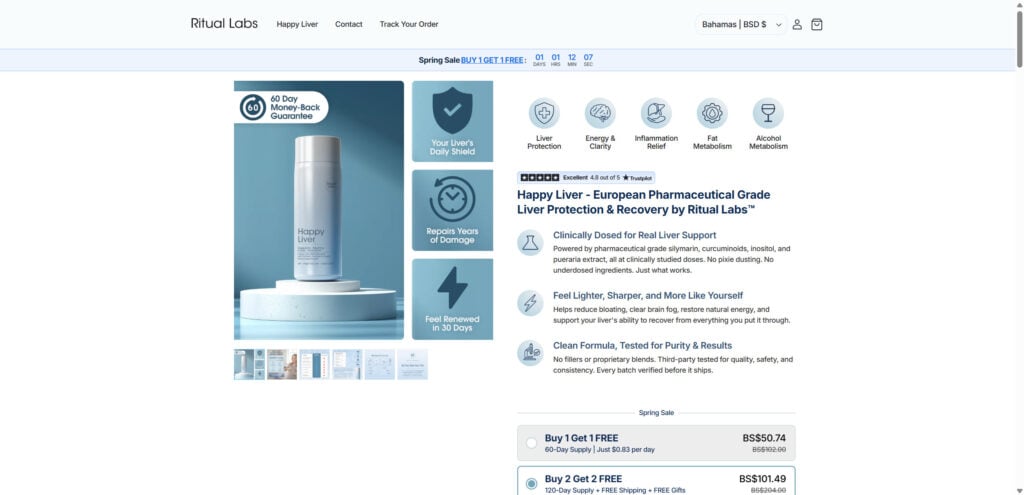
Ritual Labs Happy Liver is marketed as a “European pharmaceutical grade” liver support supplement that claims to help with liver protection, bloating, brain fog, inflammation, fat metabolism, alcohol recovery, energy, clarity, and even liver enzyme markers.
The sales page is polished. The claims sound scientific. The testimonials are written to feel personal and convincing.
But once you look closely, Happy Liver shows the same pattern seen in many aggressive supplement funnels: broad health claims, detox-style language, huge review numbers, subscription infrastructure, urgency tactics, and a guarantee that may not be as simple as the sales pitch makes it sound.
The product may exist. The issue is whether the marketing is trustworthy.
Overview
Ritual Labs sells Happy Liver as a daily capsule formula containing milk thistle/silymarin, curcuminoids, inositol, and pueraria extract. The product page claims these ingredients support liver protection, energy, clarity, inflammation relief, fat metabolism, and alcohol metabolism. It also says the formula is third-party tested and “backed by 32+ peer-reviewed studies,” while claiming large customer numbers such as “75,500+ people,” “22K+ five star reviews,” and “34,423+ reviews.”
That combination deserves scrutiny.
A liver supplement can contain real ingredients and still be marketed in an exaggerated way. The main concern here is not whether milk thistle or turmeric exist. They do. The concern is that the page frames a supplement as if it can “protect, repair, flush fat, and support recovery all at once,” while also tying it to bloating, brain fog, fatigue, alcohol recovery, and liver markers.
What Ritual Labs Claims
The site says Happy Liver can help with:
- Liver protection and recovery
- Energy and mental clarity
- Inflammation relief
- Fat metabolism
- Alcohol metabolism support
- Reduced bloating
- Improved digestion
- Morning grogginess
- Brain fog
- Liver enzyme markers such as ALT and AST
The product page also claims users may notice reduced bloating and improved digestion in days 1–7, better energy and clarity in days 7–14, and deeper benefits by days 14–30. It further claims that liver marker changes may begin within 30–90 days if tracked with a doctor.
What it actually appears to be
Happy Liver appears to be a standard liver-support supplement built around familiar ingredients:
- Milk thistle / silymarin
- Curcuminoids
- Inositol
- Pueraria extract
These are common supplement ingredients. The issue is not that the ingredients are fake. The issue is that the marketing gives them a broad, almost all-in-one health role: detox, liver protection, fat metabolism, alcohol recovery, brain fog improvement, energy restoration, and inflammation support.
That is a very wide promise for a supplement.
Major Red Flags
1. The liver claims are extremely broad
The sales page says Happy Liver targets several liver “pathways” at once and claims the formula helps protect liver cells, calm inflammation, flush trapped fat, and support alcohol detox. It also says customers may feel “like a completely different person” after the product builds up over time.
That is strong language.
A supplement may support normal liver function. But when a product starts implying liver repair, fat flushing, alcohol recovery, improved liver markers, reduced inflammation, and dramatic energy changes, buyers should demand serious product-specific evidence.
General studies on individual ingredients are not the same as proof that this exact product delivers those advertised results.
2. “Detox” and liver-recovery language can mislead buyers
The page repeatedly connects the product to detoxification, alcohol metabolism, toxins, and liver recovery. That language is persuasive because many people worry about alcohol, processed food, fatigue, bloating, and “overloaded liver” symptoms.
But detox marketing is often overstated. The NCCIH notes that detoxes and cleanses are promoted for removing toxins and improving health, but the human research is limited and often low quality.
That matters because the liver already performs detoxification as part of normal physiology. A supplement should not be presented as a shortcut that “cleans,” “flushes,” or “repairs” the liver without strong evidence.
3. The site uses medical-style outcomes while relying on supplement disclaimers
Ritual Labs’ terms say product statements have not been evaluated by the FDA and that products are not intended to diagnose, treat, cure, or prevent disease.
That disclaimer is important because the sales page still talks about liver enzyme markers, liver fat buildup, alcohol-related damage, inflammation, and NAFLD-related ingredient research.
The FDA explains that dietary supplement claims must include a disclaimer when they describe effects on the body, and that supplements cannot legally claim to diagnose, treat, cure, or prevent disease.
So the concern is simple: the front-end page creates a strong health-improvement impression, while the legal language steps back from medical responsibility.
4. The review and customer numbers are hard to reconcile
The page uses several large trust signals:
- “Excellent 4.8 out of 5”
- “Trusted by thousands”
- “75,500+ people”
- “22K+ five star reviews”
- “34,423+ reviews”
Those numbers may be intended as social proof, but they are difficult to independently verify from the page alone. The site also repeats some testimonial blocks, including the same named reviews appearing more than once in the page content.
Large review counts are common in supplement funnels because they reduce buyer hesitation. But site-controlled reviews are not the same as independent proof.
5. Testimonials imply dramatic results
The page includes testimonials claiming reduced bloating within 5–6 days, improved energy, better doctor-noticed numbers, brain fog changes by day 6 or 7, and bloating being “actually gone.”
These stories are powerful because they make the product feel proven.
But testimonials are still advertising. The FTC says health-related product claims must be truthful, not misleading, and supported by science.
If testimonials imply typical results, the seller should have reliable evidence showing buyers can generally expect those results.
6. “Backed by studies” does not prove this product works
Ritual Labs says Happy Liver is backed by “32+ peer-reviewed studies,” then discusses research around silymarin, curcumin, inositol, and pueraria. (Ritual Labs US)
This is a common supplement marketing tactic.
There is a major difference between:
- studies on individual ingredients
- studies using different doses or formulations
- studies in people with diagnosed conditions
- product-specific testing on Happy Liver itself
- proof that normal customers will experience the advertised results
Unless the company provides product-specific clinical evidence, the “backed by studies” claim should be treated cautiously.
7. Subscription risk is built into the website
This is one of the biggest practical concerns.
The contact page includes a “Manage Subscription” portal and even has a support topic titled “I didn’t know this was a subscription.” It tells customers they can cancel from the portal and email support if they were charged unexpectedly.
The terms also state that subscription products renew automatically according to the interval selected at checkout unless the customer updates or cancels before the next billing date.
That does not prove every buyer is enrolled without consent. But it does show subscription billing is part of the store’s infrastructure.
For supplement funnels, this is a major risk area because customers may:
- think they placed a one-time order
- miss subscription wording at checkout
- receive recurring charges
- struggle to cancel before the next billing date
- need to use a portal or support email to stop billing
8. The guarantee sounds simple, but the policy gives the seller discretion
The sales page says Happy Liver has a 60-day money-back guarantee with “no hoops, no hassle,” and another section says buyers can return it even if the bottles are empty.
The formal refund policy is more flexible but less absolute. It says the company offers a 60-day return window from delivery, asks for an order number and explanation, says products should be in original, lightly used, or reviewable condition “depending on the case,” and states customers may be responsible for return shipping for discretionary returns.
That creates a gap between the sales pitch and the policy.
The sales page says “no questions asked.” The policy says requests are reviewed and eligibility depends on the case.
9. Urgency and bundle pressure are used to push quick purchases
The page displays a “Spring Sale BUY 1 GET 1 FREE” countdown timer.
Countdown timers and bundle deals are common in high-conversion supplement funnels. They are designed to increase urgency and push buyers to order before doing deeper research.
That does not automatically make the product fake. But it does show the page is built to convert quickly.
10. The product leans into alcohol-recovery claims
The product page says many customers take Happy Liver because they want liver support while still enjoying wine or drinks on the weekend. It claims pueraria supports alcohol metabolism and helps the liver handle what users “put it through.”
This is a sensitive area.
No supplement should be interpreted as protection against heavy drinking or alcohol-related liver damage. Anyone with abnormal liver enzymes, fatty liver, alcohol-related liver concerns, or symptoms should speak with a medical professional rather than relying on a supplement funnel.
How This Operation Appears to Work
Step 1: Use a common health anxiety
The product targets concerns many people recognize:
- bloating
- fatigue
- brain fog
- alcohol use
- processed food
- poor digestion
- liver numbers
- inflammation
These concerns are broad, emotional, and easy to market around.
Step 2: Present the liver as “overloaded”
The page frames symptoms like low energy, brain fog, bloating, and grogginess as signs that the liver needs support.
That creates a simple problem-solution story.
Step 3: Use scientific-sounding mechanisms
The page discusses glutathione, oxidative damage, inflammation, acetaldehyde, liver fat buildup, NAFLD, ALT, AST, and insulin resistance.
That makes the product sound more clinical than a normal supplement.
Step 4: Add testimonials and large review numbers
The page uses review counts, “verified buyer” language, and dramatic customer stories to build confidence.
Step 5: Add urgency and a guarantee
The buyer sees:
- countdown timers
- Buy 1 Get 1 Free
- 60-day guarantee
- “no hoops” language
This reduces hesitation.
Step 6: Subscription infrastructure supports repeat billing
The site includes a subscription management portal and terms for automatic renewal.
That means buyers should check the checkout page very carefully.
Is Ritual Labs Happy Liver a Scam?
Not necessarily a fake-product scam
Happy Liver appears to be a real supplement. A customer may receive capsules containing common liver-support ingredients.
But it is high-risk from a marketing standpoint
The operation raises concerns because of:
- broad liver and detox-style claims
- alcohol recovery framing
- testimonials implying fast and dramatic benefits
- large review numbers that are difficult to verify
- subscription infrastructure
- aggressive urgency and bundle tactics
- guarantee language that sounds broader than the formal policy
- lack of visible product-specific clinical proof on the sales page
The most accurate verdict is:
Ritual Labs Happy Liver appears to be a high-risk liver supplement funnel marketed with broad health claims and subscription-based sales mechanics.
Should You Buy It?
For most buyers, caution is warranted.
Reasons to avoid it
- The claims are stronger than the proof shown on the page
- Liver health is a medical topic, not just a wellness trend
- “Detox” and “flush fat” language can be misleading
- The page links the product to alcohol recovery and liver markers
- Subscription billing appears to be part of the store model
- The guarantee may still require review and possible return shipping
If you still consider buying it
Do not buy it as a treatment for:
- fatty liver disease
- abnormal ALT or AST
- hepatitis
- cirrhosis
- alcohol-related liver damage
- chronic fatigue
- unexplained bloating
- digestive disease
- inflammation-related conditions
Use it only as a supplement, not as medical care.
What To Do If You Already Ordered
1. Check whether you were enrolled in a subscription
This is the first thing to verify.
Look for:
- “subscription”
- “auto-renew”
- “recurring”
- “next billing date”
- “manage subscription”
- “skip, pause, cancel”
- “charged unexpectedly”
The site itself has a subscription portal and a support topic for customers who say they did not know it was a subscription. (Ritual Labs US)
2. Cancel immediately if you did not intend recurring billing
Use the subscription portal and take screenshots of:
- cancellation confirmation
- subscription status
- next billing date removed
- emails from support
If the portal does not work, email support and contact your payment provider.
3. Save all product claims
Take screenshots of:
- liver protection and recovery claims
- alcohol metabolism claims
- fat metabolism claims
- brain fog and energy claims
- liver enzyme marker claims
- testimonial claims
- “60-day money-back guarantee”
- “even if bottles are empty”
- subscription language
- checkout totals
This matters if you need to dispute the charge.
4. Do not rely on it for liver problems
Do not use Happy Liver as a substitute for medical evaluation.
Speak with a doctor if you have:
- abnormal liver enzymes
- yellowing skin or eyes
- dark urine
- persistent abdominal pain
- swelling
- unexplained fatigue
- heavy alcohol use
- known fatty liver disease
- hepatitis or cirrhosis
- medication-related liver concerns
5. Watch for side effects and interactions
Ingredients like milk thistle, turmeric/curcumin, and other botanicals may interact with medications or affect sensitive users.
Be careful if you take:
- blood thinners
- diabetes medication
- immunosuppressants
- liver-metabolized medication
- anti-inflammatory medication
- supplements with similar ingredients
The site itself notes that silymarin may interact with some medications, including warfarin, diabetes medications, and immunosuppressants.
6. Request a refund early
Do not wait until the 60-day window is almost over.
Send a clear message:
I am requesting a refund for order #[number]. The product does not match the results and claims advertised. Please confirm the refund process and any return instructions in writing.
Keep all responses.
7. Dispute charges if needed
If you are charged again, cannot cancel the subscription, receive more bottles than expected, or the refund process becomes unreasonable, contact your bank or payment provider.
Use documentation showing:
- what you intended to buy
- what you were charged
- whether subscription terms were unclear
- what the product page promised
- how support responded
The Bottom Line
Ritual Labs Happy Liver is not a proven liver repair breakthrough.
It appears to be a liver-support supplement sold through a polished, high-conversion funnel using broad health claims, detox-style language, alcohol recovery messaging, large review numbers, subscription infrastructure, and a “risk-free” guarantee that may still involve review and return conditions.
The product may arrive.
That does not mean the marketing is reliable.
The safest conclusion is simple:
Ritual Labs Happy Liver looks like a high-risk supplement operation built around exaggerated liver-support claims and recurring-purchase mechanics. Buyers should be especially careful about subscriptions, refund terms, and any suggestion that this product can replace real medical evaluation for liver problems.

Join the discussion
4 commentsShare your experience or ask a question about this article.
Discussion
You’ve listed all the reasons not to buy this product, and I assume you’ve done your research. So what is a better product? Someone that has listened/read all of this wants a solution. Do you have any suggestions? Or are you just debunking this product? I am looking for a solution to all the ailments listed here, if this won’t fix it what will?
In reply to Rebecca
That is a fair question, Rebecca. We are debunking the unsupported product claims rather than recommending another supplement as a cure-all, because the symptoms listed in these ads can have very different causes and no single product safely addresses all of them. The useful next step is to discuss the specific symptoms and any medications or supplements you take with a doctor or pharmacist, who can check for an underlying cause and recommend an evidence-based option.
You’ve included many great reasons to avoid doing business with this company. But there’s one more: they fail to provide any product after being paid. Pretty simple reason to regard this as a scam. I’d be surprised to learn that any product actually exists.
In reply to Jackie Marshall
Fair point, and it’s the simplest test of all: a company that takes payment and ships nothing has failed the only obligation that matters, regardless of what the product claims. Non-delivery is also the easiest chargeback to win, so anyone in that position should go to their card issuer rather than waiting for a reply. Your suspicion that no product exists is well founded for many of these brands – the operation is a checkout page and an ad budget, with fulfilment as an afterthought.