

A $2,000 couch marked down to about $295 can stop you mid-scroll. It feels like you just caught a rare liquidation deal at the perfect moment.
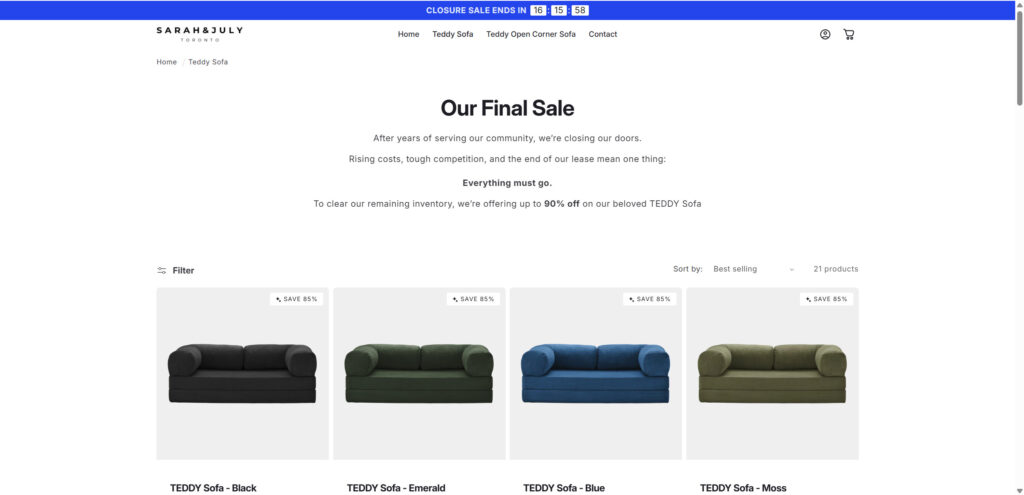
Then you notice the countdown timer at the top of the page. “Closure sale ends in…” with minutes ticking away.
That is usually the point where smart shoppers rush, not because they want to, but because the website is designed to make waiting feel unsafe.
If you are looking at the Sarah & July Toronto “Teddy Sofa” closing sale page, this article is here to slow that moment down. You will learn the specific red flags to look for, how these “final sale” furniture sites typically operate, what you can verify before you buy, and what to do immediately if you already paid.
Scam Overview
The Sarah & July Toronto “Teddy Sofa” site uses a familiar formula that shows up again and again in online furniture scams: a clean storefront, a believable brand name, and an extreme discount anchored to a dramatic story.
On the page, the core narrative is simple. The store claims it is shutting down, cites rising costs and competition, and frames the sale as the last chance to buy. Everything “must go,” with discounts advertised up to 90% off.
That story matters because it acts as a credibility shortcut.
When people hear “closing sale,” they subconsciously fill in the missing details: a lease ending, a local store clearing inventory, a real business that just could not survive.
But a story is not verification.
When you step back and look at the mechanics, the page is also packed with conversion pressure and trust badges. The combination is important, because it is exactly how these sites get otherwise cautious people to buy a high-ticket item from a brand they have never heard of.
The biggest hook: unrealistic price anchoring
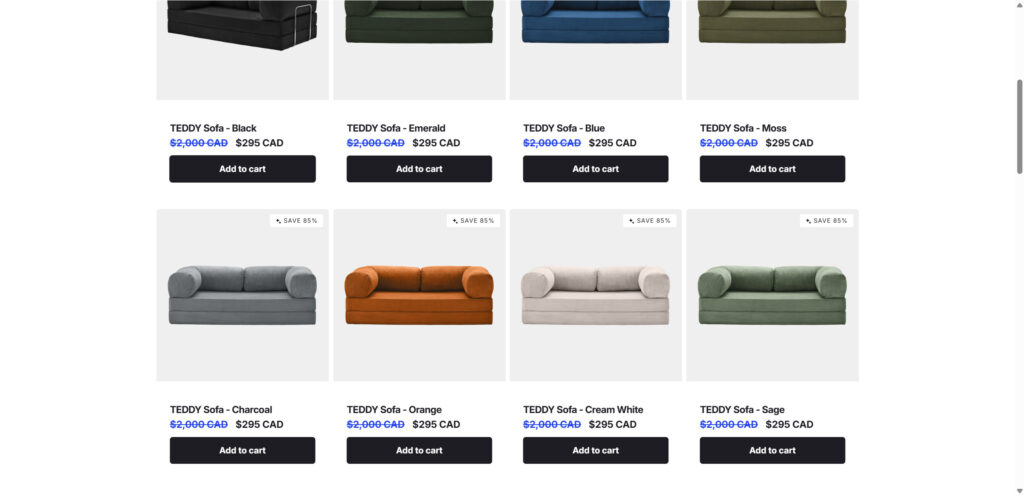
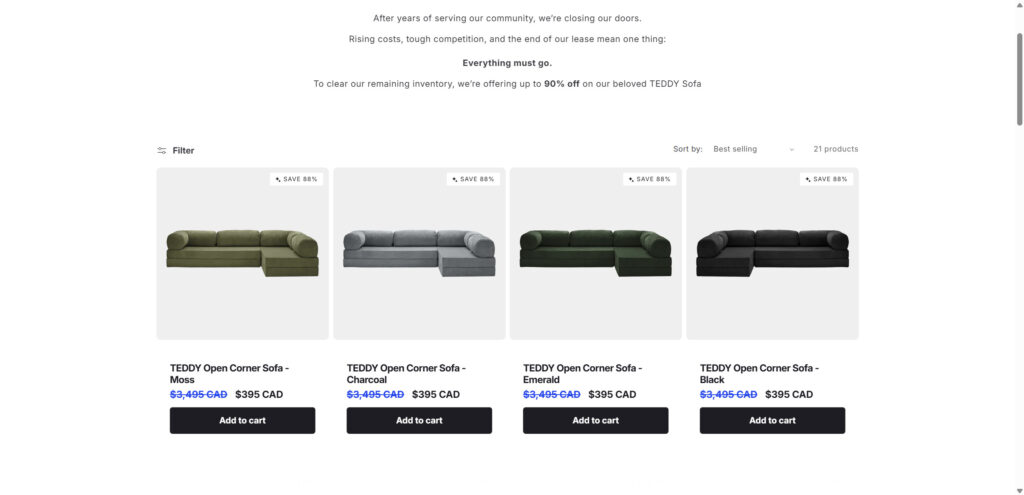
In your screenshots, the site shows large, furniture-store-style “regular” prices crossed out and replaced with low sale prices in CAD.
Examples shown include pricing like:
- A TEDDY sofa listed around $2,000 CAD reduced to roughly $295 CAD.
- An open corner sofa listed around $3,495 CAD reduced to roughly $395 CAD.
Those are not ordinary discounts. They are “I should buy two” discounts.
That is the point.
Furniture pricing is flexible in the real world, but it still has constraints: materials, shipping weight, warehousing, last-mile delivery, returns, damage rates, and service costs. When a site promises a massive sofa for a few hundred dollars delivered, it forces an obvious question:
How does that business survive even one week of orders at that price?
Scam sites avoid answering that question by keeping everything vague.
The countdown timer is a classic pressure trigger
The “closing sale ends in…” countdown at the top of the page is not just decoration.
It is a high-pressure conversion tool, and it is common in fraudulent storefronts because it creates a fear of missing out that overrides verification behavior.
Instead of checking the company’s address, reviews, and return policy details, people focus on beating the clock.
A legitimate business can run a limited promotion without a constantly ticking timer on every page, especially for big-ticket furniture that customers normally research for days.
Trust symbols without substance
The site also shows reassurance cues that look comforting at a glance, such as:
- “Fast shipping”
- “30 day free returns” (often phrased as “no questions asked”)
- “24/7 customer support”
- Claims that sound local, such as delivery across Canada
Again, these elements are not proof. They are design patterns.
The key is whether these promises are supported by operational details:
- Who is the carrier for delivery?
- Is white-glove delivery included or is it curbside?
- What is the return address and who pays return freight?
- What is the exact refund timeline and what fees apply?
- Is there a phone number and a real support team, or only a web form?
In your screenshot, the contact area appears to be a basic form asking for name, email, phone number, and a comment.
A form is not the same as a real support system.
For furniture purchases, you want to see an address, a phone number, support hours, and a policy page that reads like it was written for real disputes, not marketing.
Why this pattern is so effective
Furniture scams succeed because they exploit three things at once:
- High intent
People shopping for a couch are already ready to buy. They are not browsing casually. - High price sensitivity
Sofas are expensive. A “final sale” discount feels like a once-in-a-decade chance. - High delivery complexity
Furniture delivery is slow and complicated even for legitimate retailers. Scammers hide behind “shipping delays” and “carrier issues” because those excuses sound plausible.
When you combine a believable story, an incredible price, and a countdown timer, many buyers skip the steps that would normally protect them.
Common outcomes reported with “closing sale” furniture sites
Not every fraudulent storefront plays out identically, but the same clusters of complaints show up repeatedly across this category:
- No delivery at all
You receive an order confirmation, then weeks of silence or vague replies. - Fake or meaningless tracking
The site provides a tracking number that updates slowly, shows odd locations, or never reaches “delivered.” - A cheaper substitute item
Instead of a sofa, a small package arrives, sometimes a low-cost item that creates confusion and reduces chargeback success if the buyer stops acting quickly. - Returns that are technically offered but practically impossible
The policy may require the buyer to pay return shipping, ship to an overseas address, or meet strict deadlines that do not match real freight timelines. - Support that exists only to stall
Replies, if any, repeat the same lines: “processing,” “in transit,” “warehouse delay,” “rest assured.”
These outcomes are why the verification phase matters more than the discount.
If a site is legitimate, it can withstand basic scrutiny. If it is not, the cracks show quickly.
How The Scam Works
This is the typical step-by-step funnel used by “closing sale” sofa scams, mapped to what your screenshots show.
Step 1: Create a brand that sounds local and safe
“Sarah & July Toronto” sounds like a small, friendly brand.
Adding a city name, especially “Toronto,” increases trust. It implies a real business presence without proving one.
Scam storefronts often choose brand names that:
- sound like a boutique
- have a personal, human feel
- are easy to put on a logo
- do not trigger immediate suspicion in ads
They do not need brand history. They need a name that feels like it has history.
Step 2: Pick a trendy product people actively search for
“Teddy sofa” is a keyword-driven product category.
It is the kind of item people see on social media, save for later, and search for by name.
That matters because scams do best when they can:
- run ads to a popular trend
- rank for long-tail searches like “teddy sofa sale” or “teddy sofa Toronto”
- convert impulse shoppers with a dramatic discount
Furniture trends change, but the strategy stays the same.
Step 3: Build a clean storefront that looks like a real shop
The layout in your screenshots is minimal, modern, and familiar.
That is intentional.
Most scam storefronts today use polished templates that mimic real ecommerce brands. They include:
- product grids with crossed-out prices
- “save” percentages like “save 85%” or “save 88%”
- cart and account icons
- a simple menu with product categories and contact
To many buyers, the site “looks legit” because it looks like hundreds of legitimate sites.
But design is not identity.
Step 4: Add urgency triggers that punish hesitation
This is where the countdown bar matters.
A real liquidation sale can be time-limited, but the hallmark of scam urgency is that it is always on, always visible, and always telling you the deal ends soon.
The goal is to compress decision time from days to minutes.
They want you to buy before you:
- search for independent reviews
- check the company’s address
- compare photos to other listings
- read the return policy carefully
- question how freight delivery works at that price
Step 5: Add trust badges to reduce fear at checkout
The icons and short claims do a lot of psychological work:
- “Fast shipping”
- “30 day free returns”
- “24/7 customer support”
These statements are designed to remove the two biggest objections:
- “What if it never arrives?”
- “What if it looks bad and I cannot return it?”
The trick is that many scam sites use broad, friendly phrasing while hiding strict or unrealistic terms in policy pages, or offering no meaningful details at all.
With furniture, returns are expensive. If a site promises “no questions asked” returns for huge items but does not explain return freight, that is a red flag.
Step 6: Collect payment and lock you into delay
Once you pay, the playbook usually shifts from persuasion to stalling.
You may see:
- an instant confirmation email
- an order number
- sometimes a “processing” status that lasts far too long
If tracking is provided, it may be:
- delayed
- inconsistent
- unrelated to your package
- routed through odd locations
Delays work in the seller’s favor because payment dispute windows are not infinite.
Many consumers lose chargeback protection simply by waiting too long, especially if the seller keeps promising “just a bit more time.”
Step 7: Make refunds difficult, slow, or conditional
If the buyer complains, the site may respond with tactics like:
- offering a small partial refund to keep the buyer from disputing the full amount
- asking the buyer to wait for delivery before refunding
- insisting the buyer must return the item, even if it never arrived
- requiring the buyer to pay return shipping, sometimes to an address that makes freight returns unrealistic
This phase is about one thing: running out the clock.
What To Check Before You Buy
If you are still considering buying, use this checklist. These are the verification steps scammers struggle to fake.
1) Confirm the business identity, not the branding
Look for:
- a full company name (legal entity)
- a physical address that can be mapped
- a phone number that answers
- a support email tied to the domain
A simple web form is not enough for a furniture retailer.
2) Read the return policy like you expect a dispute
For sofas, you need clear answers to:
- Who pays return freight?
- Where do returns go?
- Are there restocking fees?
- What counts as “unused” for a sofa?
- How long do refunds take after return delivery?
If the policy is vague, overly short, or reads like generic template text, treat it as a risk signal.
3) Scrutinize delivery claims
“Fast shipping” on a sofa is meaningless without details.
Legitimate furniture delivery usually specifies:
- curbside vs room-of-choice
- appointment scheduling
- carrier type
- timeline ranges that reflect freight reality
If the site promises broad delivery without specifics, that is a concern.
4) Reverse image search the product photos
This step often reveals the truth fast.
If the same teddy sofa photos appear on:
- marketplaces
- other unrelated stores
- manufacturer catalogs
- overseas listings
Then the site may not be a real brand at all.
5) Be skeptical of extreme markdowns that do not match logistics
A sofa sold for $295 with delivery included should trigger a sanity check.
Even if the product were cheaply made, the shipping and handling costs alone can be significant.
When the numbers do not make sense, assume you are the product, not the sofa.
What To Do If You Have Fallen Victim to This Scam
If you already ordered from the Sarah & July Toronto Teddy Sofa site and you suspect a scam, treat this like a time-sensitive payment dispute.
1) Take screenshots of everything
Capture:
- the product page
- the price and discount
- the checkout page
- the order confirmation
- any shipping or tracking page
- the return policy and terms pages
- your bank or card transaction details
Save the screenshots in a folder. Email them to yourself so you have a backup.
2) Contact your bank or card issuer immediately
Ask for the dispute process and start it.
Use clear language:
- “I believe this merchant is fraudulent.”
- “The merchant is not delivering the item as advertised.”
- “I am requesting a chargeback.”
If you paid by credit card, you usually have stronger protection than with debit.
3) If you paid via PayPal, open a dispute inside PayPal
Do not rely on emailing the merchant.
Open the dispute, upload your evidence, and follow PayPal’s deadlines closely. Escalate to a claim if required.
4) Cancel the card if you entered it on a suspicious site
If the site looks fraudulent, assume your card details may be at risk.
Ask your bank about:
- card replacement
- blocking the merchant
- monitoring for recurring charges
5) Do not accept a small “partial refund” if you want the full amount back
This is a common tactic.
A partial refund can be used to:
- reduce the dispute amount
- convince you to close the case
- delay you until dispute deadlines pass
Only accept a partial refund if you are comfortable walking away from the rest.
6) Report the site to the right places
If you are in Canada, consider:
- Canadian Anti-Fraud Centre
- your provincial consumer protection office
If you are in the US, consider:
- FTC fraud reporting
- IC3 (if there is clear online fraud behavior)
If you are in the UK, consider:
- Action Fraud
Also report the ad platform where you found it (Facebook, Instagram, TikTok). Include screenshots.
7) Watch your inbox for follow-up scams
After a purchase, victims often get targeted again with:
- fake “support” emails
- “refund processing” links
- phishing attempts pretending to be the bank or shipper
Do not click links. Go directly to official sites.
The Bottom Line
A legitimate furniture sale can be a great deal.
A “closing sale” site that pairs extreme sofa discounts with a constant countdown timer and vague trust claims is a different situation.
The Sarah & July Toronto Teddy Sofa storefront, as shown in your screenshots, fits the high-pressure template used by many scam ecommerce operations: big markdowns, urgency, minimal support verification, and policies that look comforting but lack operational detail.
If you have not bought yet, pause and verify the business identity, delivery reality, and return logistics before you risk hundreds of dollars.
If you already paid, move fast, document everything, and prioritize a formal payment dispute over long email threads with the seller.
FAQ
Is Sarah & July Toronto a real furniture store?
A brand name and a polished storefront do not prove a real store exists. Verification depends on clear business identity, a physical address, working phone support, and independent reputation signals that are not controlled by the seller.
Why is the Teddy Sofa price so low?
These sites use extreme markdowns to trigger impulse purchases. A large sofa discounted from about $2,000 CAD to roughly $295 CAD is not automatically impossible, but it is a strong anomaly that deserves strict verification of fulfillment and returns.
What does the “closing sale” countdown mean?
In many scam storefronts, countdown timers are pressure tools, not real deadlines. They are designed to reduce research time and push you into checkout.
The site says “30 day free returns.” Does that protect me?
Not necessarily. Furniture returns require logistics. If the policy does not clearly explain return freight, return addresses, fees, and timelines, “free returns” may be marketing language rather than a workable promise.
What if I already placed an order and received a tracking number?
Tracking numbers can be misleading. What matters is whether the carrier and route make sense for freight delivery, whether updates look normal, and whether the package is actually moving toward you. If weeks pass with no progress, start a dispute.
How long should I wait before filing a chargeback?
Do not wait for long “processing” periods if you suspect fraud. Disputes are time-sensitive. If the seller is stalling, that is often the point.
Can scammers ship a small item to create “proof of delivery”?
Yes, it happens. Some operations ship a low-cost package so the tracking shows “delivered,” which complicates disputes. That is why documenting what you received (or did not receive) is important.
What payment method is safest for big online purchases like sofas?
Credit cards typically offer stronger dispute rights than debit cards. Payment processors with buyer protection can help, but you must follow their deadlines and escalation steps.
What should I tell my bank when I dispute the charge?
Be direct: you believe the merchant is fraudulent or the goods were not delivered as advertised. Provide screenshots of the listing, policies, and order confirmations.
Should I keep emailing the seller first?
You can send one message to create a paper trail, but do not rely on email as your main solution. Start the formal dispute process while you still can.
Can I report the site even if I am not sure it is a scam?
Yes. You can report suspicious ecommerce behavior to ad platforms and fraud reporting agencies. Your report may help other buyers avoid the same trap.
How can I avoid these “closing sale” scams in the future?
Slow down and verify:
- real business identity and address
- realistic delivery terms for freight
- returns that make logistical sense
- independent reviews outside the seller’s website
- product photos that are not reused everywhere








