


A $500 7-Eleven gift card would cover plenty of everyday purchases. Savzio.com puts that possibility beside four short steps and a brightly colored claim button.
The page also shows people supposedly claiming cards while a countdown runs. Before giving it your email, look at where those reassuring details actually come from.
Overview
The offer uses a familiar retailer to sell a quick result
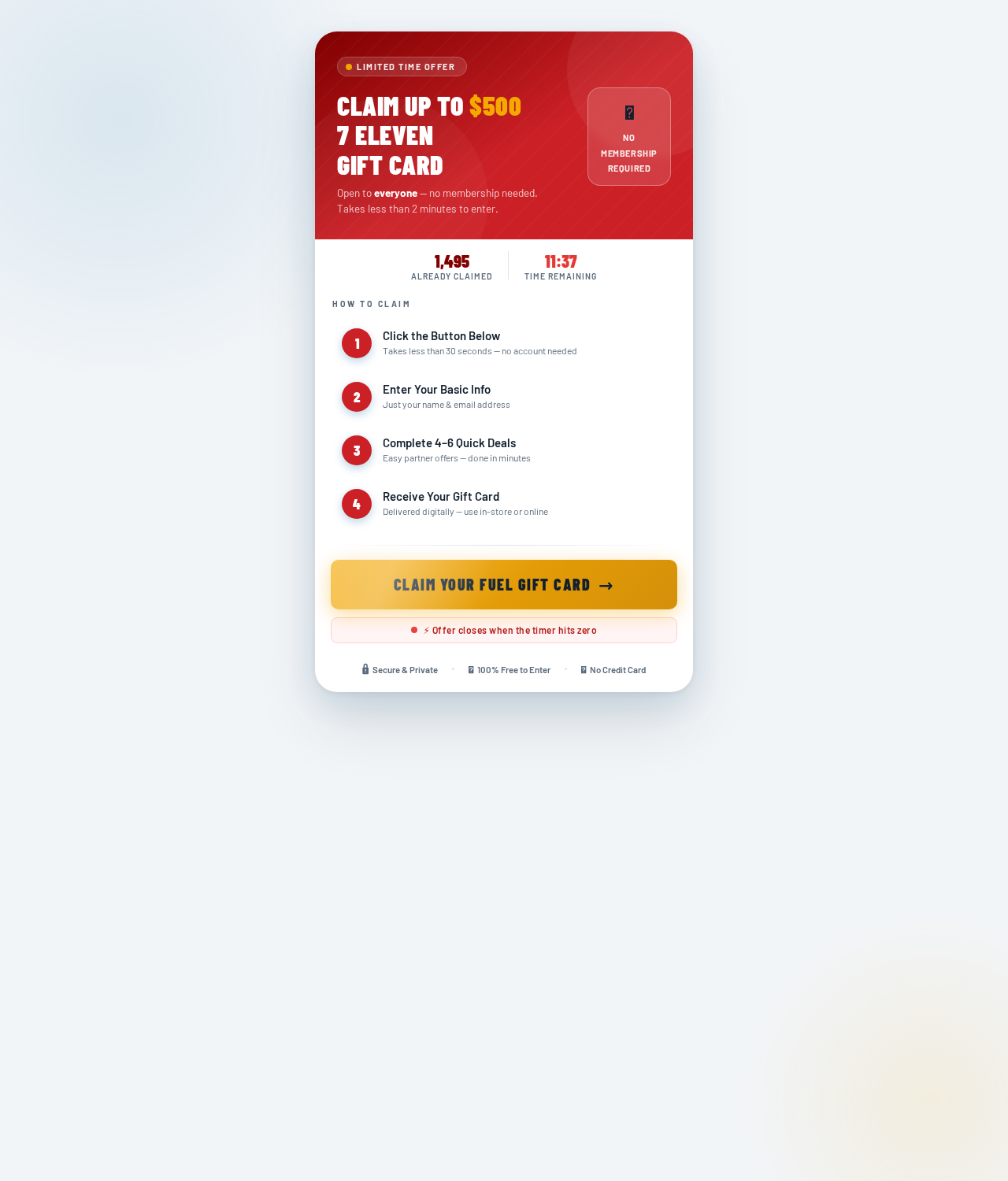
Savzio.com promotes a 7-Eleven gift card, asks for basic information, and tells visitors to complete partner deals. The headline makes the reward feel close.
Nothing on that landing page establishes a reward already belonging to you. A displayed amount is an advertising promise, not an issued card or account credit.
The confidence-building numbers are manufactured
The page’s own JavaScript generates its claimed-card total and countdown. These are not independent records of customers receiving rewards or a verified promotion deadline.
That is the concrete deception here. The page presents invented activity and artificial urgency to make an unverified reward offer look popular and time-sensitive.
The claim button hands you to a separate advertising route
The button uses an affiliate-tracking address. In a Romania-based check, the route opened an offers list instead of a page fulfilling the advertised gift card.
- The retailer name on the first page does not identify the company responsible for a reward.
- Scripted counters cannot establish that anybody received the advertised card.
- A new destination can have different requirements, privacy terms, or payment conditions.
- There is no reason to buy anything or submit financial details to investigate this offer.
How the Savzio.com Gift Card Scam Works
Step 1: A large reward is reduced to a short checklist
The headline advertises up to $500. Beneath it, a four-part checklist moves from clicking to basic information, partner deals, and receiving a digital card.
That arrangement leaves the hardest questions unanswered. Which deals count? Who checks completion? Who owes the card? What happens if an offer fails to register?
A short checklist is not a substitute for those rules. Without them, you cannot price the commitment or know what would satisfy the supposed reward conditions.
The button calls it a fuel gift card, without identifying the issuer or explaining that particular redemption arrangement.
Step 2: A random number becomes an apparent crowd
The claimed-card counter begins with a randomly selected number between 1,200 and 1,499. Another routine can increase it every three seconds.
The code does not obtain those numbers from a reward-delivery record. It generates them locally, giving the visitor a fabricated impression of other people succeeding.
Even the comments describe starting at a believable number. The count is persuasive decoration, not evidence that a stock of cards exists.
Step 3: A fresh timer creates pressure to hurry
A separate routine chooses a starting time between eight minutes and just under eighteen minutes. The visible page says the offer closes when the timer reaches zero.
The routine counts down to zero, but does not disable the claim link or validate a shared closing deadline. Its starting point comes from randomness.
That makes the urgency misleading. You should not rush an information or purchase decision because a page invented a personal clock for your visit.
Step 4: The retailer promise becomes an affiliate handoff
The claim link points to giftclick.org, with offer and affiliate identifiers. Those fields associate a visit with an advertising route, not a 7-Eleven rewards account.
An affiliate link alone is not fraud. Here, the problem is the combination: fabricated reassurance on the landing page and no clear responsibility for its advertised reward.
Once the destination changes, stop treating the original headline as the terms of whatever appears next. A second business cannot be evaluated from the first page’s button.
What the Current Redirect Actually Shows
The Romania-based route reached an EdgeOffers page titled Opportunity Search. It listed Surveoo surveys and separate PIKE and MegaPari casino promotions.
That is not a digital 7-Eleven gift card or a completed reward claim. It is a different selection of advertising opportunities.
The destination also describes itself as advertising and separates responsibility for third-party rewards from the promotion. That disclaimer does not repair the original page’s fabricated counters.
Routes can depend on location, availability, and campaign settings. This observation describes that particular visit, not every destination a US visitor might receive.
The listed brands should not inherit Savzio’s deception merely because an advertising page displayed them. Each offer has its own operator and conditions.
Do not start gambling, surveys, or a paid trial to see whether the gift card eventually appears. That would add commitments without resolving the original promise.
There was no account registration, deal completion, payment, or reward redemption in this check. It cannot establish that every downstream program refuses all qualifying claims.
What it does establish is enough to reject this promotion: its reassurance is manufactured, and its button does not keep the visitor inside a clearly explained retailer offer.
Why Sam’s Club Appears in the Code
The JavaScript file still carries a Sam’s Club gift-card heading, even though the visible page advertises 7-Eleven. That is a concrete sign of reused promotional material.
The leftover heading sits in a source-code comment, not the visible offer. It describes an earlier branding choice without supplying any authorization from either retailer.
Another page can reuse these components while changing its reward amount, colors, and store name. That makes the fabricated reassurance more important than the branding.
A matching affiliate identifier would connect advertising traffic, but would not identify every publisher, merchant, processor, or beneficiary. Shared code is not a complete ownership record.
A reward page deserves less trust when its visible success stories are generated by code. You do not need a complete ownership map to stop responding.
Who Is Responsible for the Savzio Offer?
The advertised retailer is not the identified promoter
Savzio.com is a different domain from 7-Eleven’s official site. Naming a retailer in a headline does not establish authorization, sponsorship, or responsibility for an outside promotion.
The landing page does not identify a legal entity that promises to fulfill the reward. A recognizable store name cannot fill that gap.
The page gives no usable reward-claim procedure
The visible checklist does not provide detailed qualification terms, a claim reference, or a dispute process. Those omissions matter before you devote time or disclose information.
A useful reward agreement would explain eligible participants, qualifying actions, deadlines, verification, and who handles failures. An upbeat instruction to complete deals does not answer those questions.
The next page introduces separate responsibilities
A downstream advertiser can be responsible for a survey or subscription without owing Savzio’s advertised card. Do not assume one support team can cancel everything.
If you enrolled anywhere, the confirmation email and receipt matter more than the first page’s design. Identify the actual company that accepted your registration or payment.
A useful complaint identifies the actual transaction
If a downstream business charged you, distinguish that transaction from the landing page’s advertised card. Save the charge description and the exact offer you accepted.
Ask the business named on the receipt to explain its own enrollment and cancellation terms. Give your payment provider those records, rather than an unsupported ownership assumption.
Keep Retailer Rewards Separate From Outside Offers
7-Eleven’s official 7REWARDS page describes an app-based loyalty program with points and member benefits. That is an independently accessible reference for the retailer’s own program.
It is not proof that Savzio’s separate promotion is approved. Nor should a question about Savzio persuade you to disclose an existing retailer password elsewhere.
Open the retailer’s website or app independently. If a message claims a reward already exists in your account, check there without following its embedded link.
A prize and a conditional incentive are different offers. A genuine incentive program can require documented actions, but it should explain those conditions before you commit.
However, qualifying conditions do not justify invented customer activity. A business should describe its offer honestly before asking someone to enter a separate commercial arrangement.
What to Do If You Responded to Savzio.com
Choose the actions that match what you actually did. Viewing a reward page, giving an email address, starting a subscription, and exposing credentials are different situations.
- If you only viewed the page, close it. You do not need to complete the checklist, pay a fee, or run a scan simply because the offer appeared.
- Save the relevant evidence before blocking it. Keep the original message, page address, advertised amount, destination address, and a screenshot showing the promise.
- If you gave contact details, expect possible marketing. Screen unexpected messages and avoid follow-up links claiming a reward is waiting or needs another verification step.
- Identify each actual registration separately. Search your inbox for confirmations and receipts. Record the business name, enrollment date, price, trial length, and cancellation route.
- Cancel unwanted renewals with the relevant merchant. Ask for written confirmation and keep it. Closing Savzio’s browser tab does not cancel a subscription started elsewhere.
- Discuss suspect charges with your payment provider promptly. Describe whether the payment was unauthorized, misrepresented, or an unwanted renewal. Ask about the correct dispute process and deadline.
- Protect passwords only where exposure warrants it. If you entered a reused password on an untrusted page, change it on affected accounts and enable multifactor authentication.
- Remove permissions you actually granted. Revoke unwanted browser notifications. If you installed unfamiliar software, remove it and investigate that separate exposure.
- Report the promotion accurately. Flag the originating ad or message and include the misleading counter, timer, and redirect. US readers can use ReportFraud.ftc.gov.
A card replacement is not automatically necessary after an ordinary payment to a known merchant. Ask your issuer what protection fits the actual transaction and exposure.
For payment or account compromise, the FTC’s recovery guidance separates actions by what happened. Reporting promptly does not guarantee reimbursement.
Keep the distinction clear when contacting a bank. Explain what you authorized and what you dispute; do not describe a regretted purchase as an unauthorized transaction.
If a merchant says cancellation was too late, retain the terms and timestamps. Ask which renewal the cancellation stops and whether any refund is available.
Not every confirmation is a bill. Separate a mailing-list registration from a completed order, and check for an actual trial or purchase before alleging an unwanted charge.
Keep a simple record for each merchant: what you joined, when you canceled, and the reference supplied. One confirmation does not necessarily cover other enrollments.
If a payment is still pending, ask your issuer what can be done now and what must wait. Do not rely on the reward page for banking instructions.
Do not post full card details, identity documents, or private account information in public warnings. Share redacted evidence that helps others recognize the same approach.
Someone offering a guaranteed refund for an upfront payment is not a shortcut. Do not give a stranger remote access or another payment to recover a supposed reward.
If the Page Led You to Apps or Persistent Ads
Device cleanup belongs to an actual installation or browser problem, not the gift-card claim itself. Do not confuse financial cancellation with removing unwanted software.
If an unfamiliar app or extension was installed, inspect its permissions and remove it. A Malwarebytes Free scan can help investigate suspected malware.
A scan cannot cancel a trial, reverse a payment, or confirm that a reward will arrive. Those problems need the relevant merchant, account provider, or payment issuer.
For recurring advertising exposure, AdGuard can help filter unwanted ads. It is optional protection, not a fee required to leave Savzio.
If nothing was installed and no permission was granted, do not follow an unsolicited support message into a repair session. Close the offer and address any information disclosure.
Frequently Asked Questions
Is Savzio.com a genuine 7-Eleven reward page?
It is a separate promotional domain, not the retailer’s official rewards page. Its fabricated activity counter and randomized deadline make the promotion untrustworthy.
Are the people claiming cards on Savzio real?
The displayed claimed-card total is generated and increased by JavaScript. It cannot serve as a verified count of people receiving cards.
Does the countdown show a genuine closing deadline?
No. Its starting time is randomized, and the countdown routine does not disable the claim link at zero. Do not make decisions around that clock.
Will completing the deals definitely produce a gift card?
Do not treat it as guaranteed. No redemption was tested, and the accessible landing page does not establish a reliable agreement governing the advertised reward.
Where does the claim button go?
It uses giftclick.org affiliate tracking. A Romania-based visit reached an EdgeOffers advertising list; other locations or times may receive different destinations.
What if I already paid for an offer after clicking?
Find the actual merchant and cancel any unwanted renewal there. Keep receipts and cancellation records, then ask your payment provider about any disputed charge.
The Bottom Line
Do not pursue Savzio.com’s gift-card promotion. Its claimed-card activity and deadline are manufactured, while the advertising handoff leaves the promised reward without clear accountability.
If you already responded, deal with the exposure you actually created: protect disclosed credentials, cancel unwanted merchant enrollments, and document disputed payments. Do not complete more deals chasing the headline.

Reviews & discussion
0 commentsShare a firsthand experience, or ask a question.
Community reviews
savzio.com
Moderated reader experiences, not an editorial verdict.
Start the conversation
Have a question or something useful to share? Add the first comment.