


TrueVision glasses arrive with a story designed to make replacing your prescription sound overdue. Mark Cuban, Shark Tank, and automatic focusing supposedly explain the breakthrough.
Before trusting that story with your eyesight or card details, follow it past the television pictures. The product description, checkout, and membership paperwork tell different stories.
Overview
The offer is TrueVision glasses from America Gadgets
This investigation concerns the rimless glasses promoted at americagadgets.com, including its TrueVision advertorial, separate product page, and linked secureorder checkout.
The pictures show rectangular lenses, a gold-colored bridge, and blue temples. That appearance identifies the pictured offer, not the optical power of a delivered pair.
These pages should explain one straightforward purchase. Instead, they disagree about how the glasses focus, what delivery costs, and how long the guarantee lasts.
The television story falls apart before the order
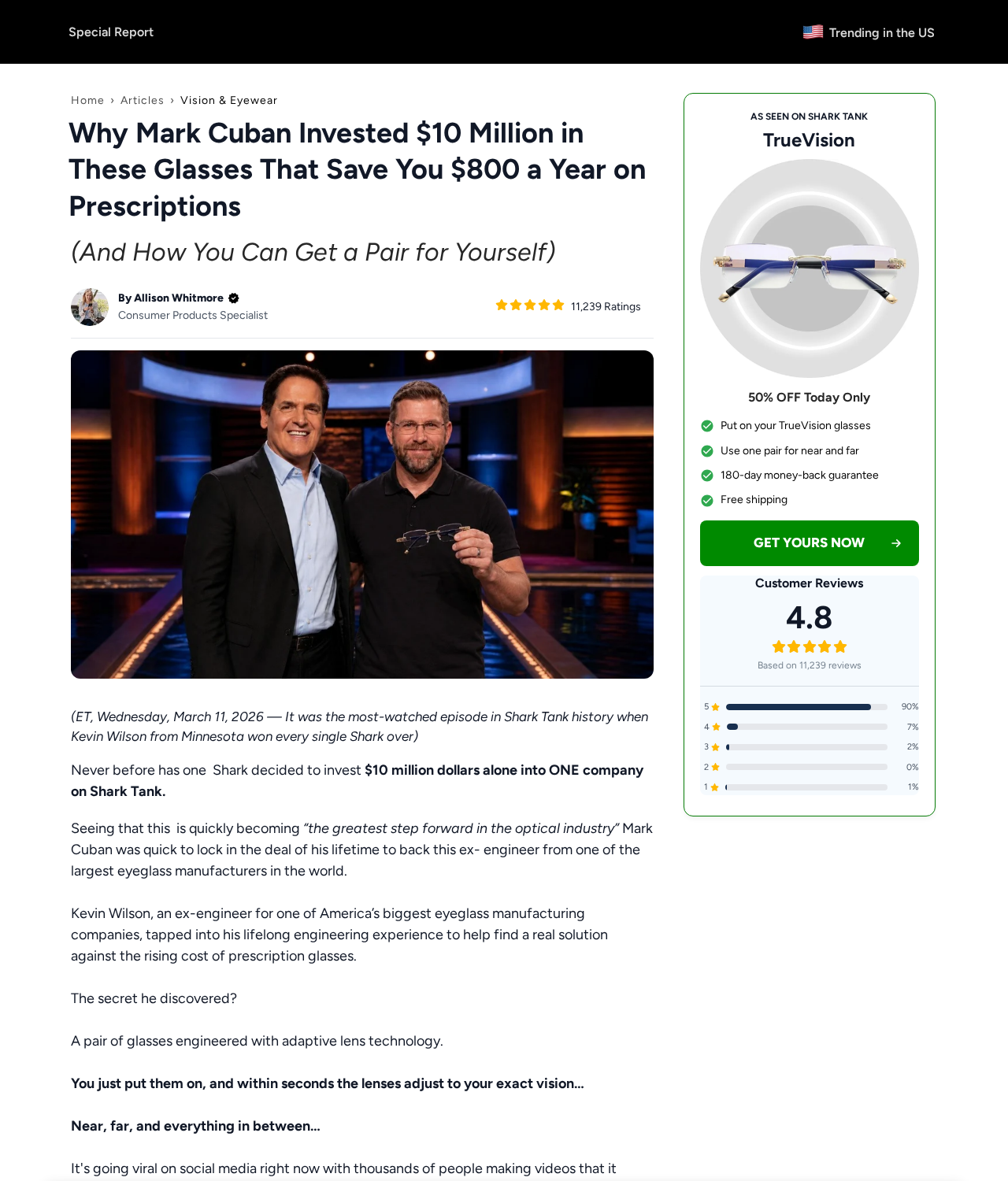
The advertorial places a $10 million Cuban investment on a March 2026 Shark Tank episode. Cuban’s own biography places his final appearance in May 2025.
Elsewhere, identical customer stories acquire different names. These are concrete problems with the sales pitch, not simply a shortage of independent reviews.
The main buying risks are separate
- The claimed television endorsement is fabricated around a show timeline that does not fit.
- The same merchant describes automatic focusing on one page and manual adjustment on another.
- The direct checkout starts with three pairs and paid shipping, not one pair with free delivery.
- A separate product route displays recurring-membership consent. Its billing interval conflicts with the terms.
- Return promises vary between 30 and 180 days, so keep the exact promise attached to your order.
The deceptive promotion warrants a clear warning. It does not establish that every buyer accepted a subscription or received the same lens specification.
How the TrueVision Glasses Scam Works
Step 1: A sales page dresses up as a television breakthrough
The page resembles a consumer report rather than a simple shop listing. A specialist byline and photographs make the purchasing recommendation look independently researched.
Its central story features a Minnesota entrepreneur, a televised demonstration, and Cuban’s supposed investment. It also invokes his pharmaceutical business to borrow a familiar consumer-friendly reputation.
The event is dated March 11, 2026. That date matters because Cuban’s official biography identifies May 2025 as his final Shark Tank appearance.
The claim is about a televised deal, not an ordinary private investment. That is why the show’s timeline is decisive.
The broader TrueVision promotion also has changing versions. One video-documented pitch described a rejected $30 million offer, rather than the current page’s accepted $10 million investment.
Do not combine those stories into one deal. A changing television legend does not become authentic because the product name remains familiar.
The merchant’s artwork adds another problem. Some image filenames explicitly reference Gemini or ChatGPT image-editing tools, including promotional benefit graphics.
Those filenames indicate an AI-assisted production trail. They cannot authenticate a television appearance, and they do not prove that every pixel in every photograph was generated.
A photograph containing a celebrity is not an endorsement record. The relevant question is whether the claimed event happened, not whether the collage looks convincing.
The FTC has warned about doctored Shark Tank endorsements. That general warning explains the technique; it is not an enforcement finding against this particular merchant.
Step 2: The glasses become a supposed escape from prescriptions
The advertorial describes lenses that automatically handle near and far vision. It goes further by suggesting the product can stop eyesight decline and eliminate continuing prescription needs.
That is a much bigger promise than helping someone read a menu. It encourages readers to treat an inexpensive online purchase as an alternative to individualized care.
Then the merchant’s ordinary TrueVision product page changes the explanation. It describes manual side dials rather than automatic adaptation.
It also says the glasses do not replace an eye examination or prescribed lenses when needed. That qualification directly undercuts the advertorial’s escape-from-prescriptions message.
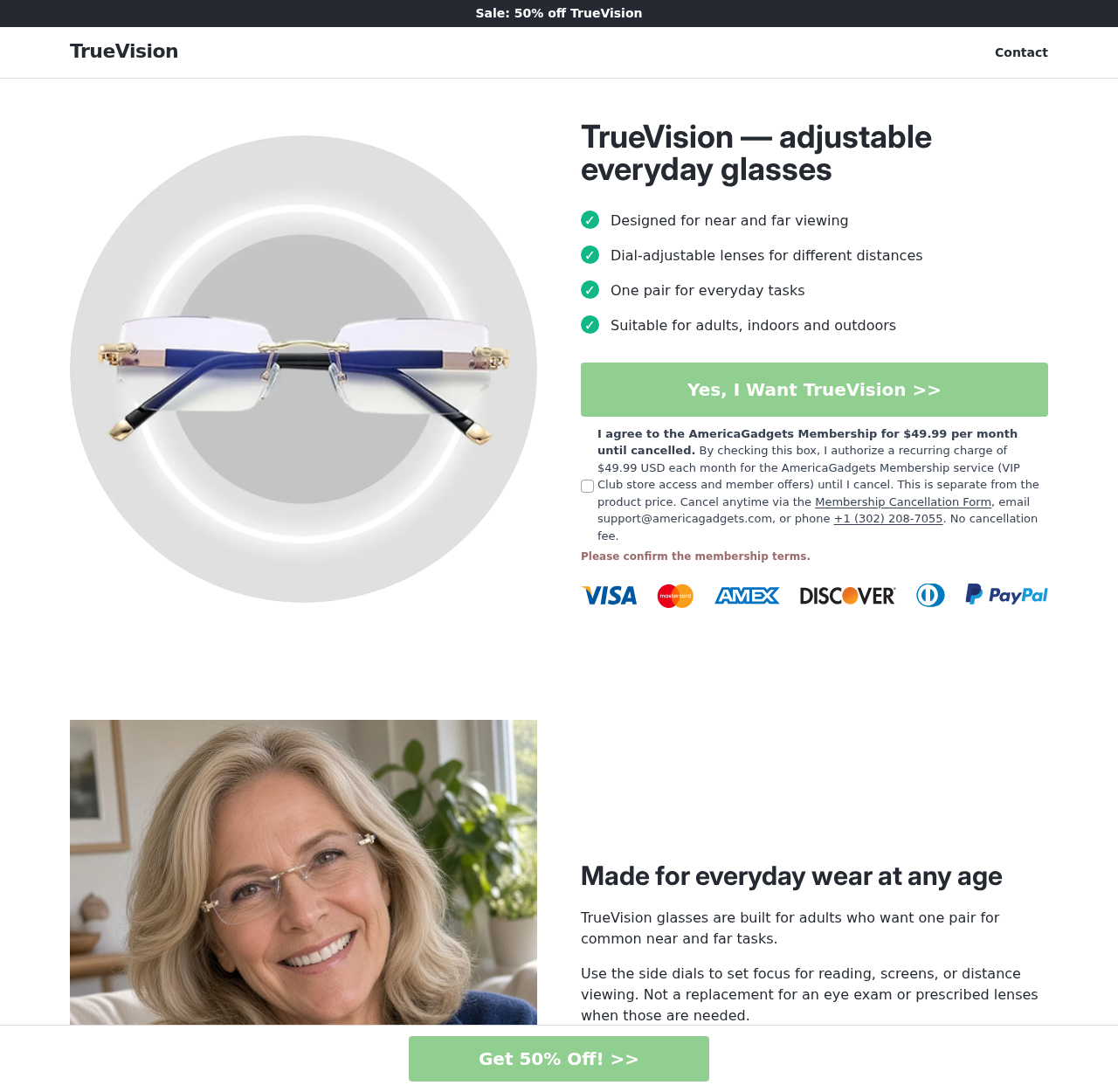
Manual adjustment and automatic sensing are different mechanisms. Before paying, a buyer needs a consistent explanation of what physically changes inside the lens.
The displayed frame alone does not demonstrate that mechanism. Neither a rendering nor an instruction written on a webpage measures the lenses shipped to you.
The delivered lenses have not been independently measured here. What is already clear is that the seller cannot keep its own explanation consistent.
According to the National Eye Institute, presbyopia develops as the eye’s lens becomes harder and less flexible with age.
That is different from the sales narrative that ordinary prescription lenses are the hidden cause of worsening near vision.
The institute also explains that refractive errors have different causes and correction needs. Nearsightedness, astigmatism, and age-related reading difficulty are not interchangeable diagnoses.
Even if generic glasses make some print clearer, that does not establish clear distance vision, appropriate correction in both eyes, or treatment of an underlying condition.
Do not use a sales-page promise to replace prescribed correction for driving. If the pair blurs your vision or causes discomfort, stop using it.
Step 3: Customer stories change identities
The advertorial and checkout reuse the same testimonial wording but assign it to different people. That is more revealing than a high star rating.
One story about 12 years wearing progressives belongs to Margaret Sullivan on the advertorial. At checkout, the same account is presented under Susan M.
Another story moves from Robert Delgado to Terry Y. A 67-year-old customer’s account moves from Linda Kowalski to Nathan G., with a different photograph.
These changes break the connection between a testimonial and its supposed speaker. The account cannot verify that either pictured person used the product.
The problem is the testimonial evidence this funnel supplies. Reassigning a personal experience is not a harmless change to a button or page layout.
Save both versions if a testimonial influenced your purchase. A screenshot of the rating alone misses the more important attribution problem.
Step 4: One advertised pair becomes a selected bundle
The advertorial links to secureorder.americagadgets.com. Once loaded, that checkout starts with three pairs selected and a displayed price of $29.33 each.
A one-pair option is also displayed at $29.99. The important point is the quantity already selected when the reader arrives.
Expedited processing and shipping at $9.99 is selected too. Regular processing and shipping is listed at $4.99, rather than free.
The page displays a $97.98 total before a private address is entered. Read that total, not just the smaller per-pair number.
The checkout page also offers an extended warranty for $9.99. Review optional extras before entering payment details.
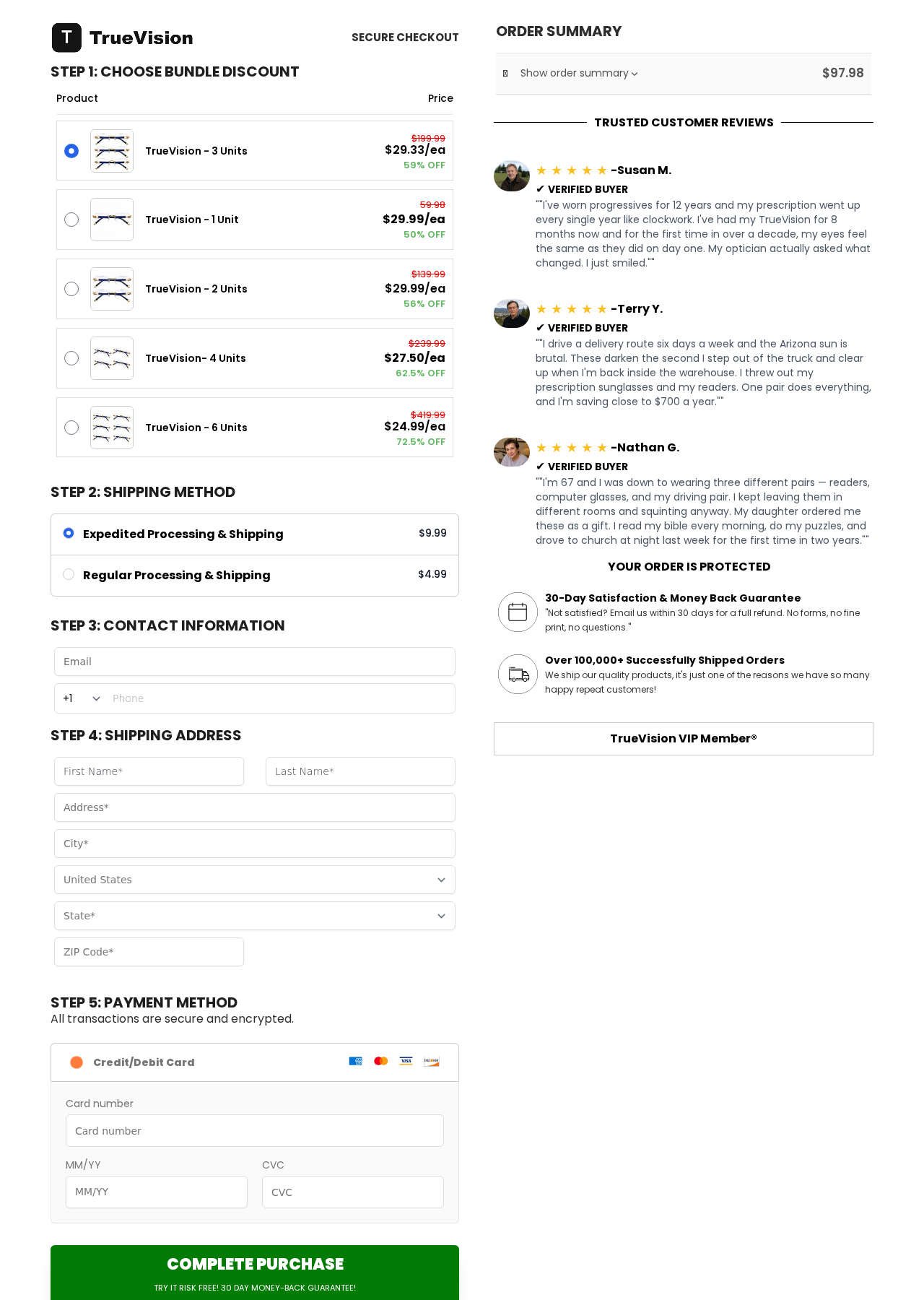
The checkout has another mismatch: its browser title says FuelSaver, and footer policies lead to getfuelsaver.com while the visible product is TrueVision.
That is a concrete sign of reused sales infrastructure. It also leaves buyers asking which product’s paperwork actually governs the transaction.
Keep the checkout address and its footer with your receipt. They may become important when support points to a different policy.
No purchase was completed for this investigation. The default selections show the page’s starting position, not a verified post-payment charge.
Step 5: Membership creates a separate billing decision
The ordinary product page displays a membership authorization for $49.99 per month. Its visible consent boxes are initially unchecked.
America Gadgets’ VIP page also describes a recurring paid club. However, its terms specify $49.99 every 28 days, not once per calendar month.
Those intervals are not equivalent. Over a year, a 28-day cycle can produce more billing dates than a monthly subscription.
The product-page route and advertorial checkout are not identical. A visible unchecked box on one page cannot prove consent on another.
The direct checkout includes a TrueVision VIP information control, but the observed state does not visibly explain a recurring fee beside it.
Do not assume that every glasses order subscribes. Equally, do not assume that paying for a physical item rules out an additional membership agreement.
Your receipt, accepted terms, and actual statement entries determine what you need to dispute or cancel. Ask for the enrollment record if a renewal appears unexpectedly.
Step 6: The guarantee changes before a return begins
The advertorial promotes 180 days, while the direct checkout displays a 30-day guarantee. The product page contains another 30-day comparison alongside its longer promise.
The merchant’s refund policy allows requests within 180 days after delivery and permits reasonable trial use. The product page separately suggests waiting 21 days before returning.
A buyer should not have to reconcile that paperwork after the deadline has passed. Request written instructions promptly and keep the original advertised guarantee.
This is not a documented no-returns policy. Satisfaction returns normally leave postage with the buyer; confirmed defective, damaged, or incorrect items have different stated treatment.
The current shipping policy supplies a Delaware return address. Obtain instructions before sending the glasses back, and keep the policy that accompanied your order.
America Gadgets, Support, and the Reused Glasses Pitch
The storefront name does not resolve every identity question
The policies identify America Gadgets, but they do not provide a verified manufacturer or establish who produced the lenses.
Shopify supplies the storefront platform. Its presence is not an endorsement of the glasses, their medical claims, or a television investment.
Compare the merchant named on your receipt with the card descriptor. If they differ, retain both rather than guessing which company a charge belongs to.
The published return destination is in Delaware
The listed destination is America Gadgets, 1130 Ogletown Road, Suite 2, Dept. RA1, Newark, DE 19711, USA.
The terms separately give a Sheridan, Wyoming contact address. Use the authorized return destination, not whichever address happens to appear first in the paperwork.
Get authorization and the applicable return address in writing before mailing anything. A tracking receipt is useful only if the parcel reaches the authorized destination.
Contact information is not a tested refund outcome
The published support email is support@americagadgets.com. The contact page also lists +1 (302) 208-7055.
The VIP cancellation route is cancel.americagadgets.com/login. Use it only for a membership you actually hold, and retain confirmation separately from any glasses return.
Published contact details do not establish how a particular complaint will be handled. There is no completed support or refund test behind this article.
The pictured design has appeared under another sales story
MalwareTips previously covered auto-adjusting Vision Pro glasses and a recurring membership offer involving Aviroo.
Its captured promotion uses the same posed gold-and-blue rimless frame, the same 11,239-review count, and similar automatic-vision and 180-day messaging.
That helps explain why another name can feel familiar. Reused product imagery and sales ingredients are visible; shared ownership and identical billing rules are not established.
Do not transfer Aviroo’s cancellation deadlines to America Gadgets. Follow the terms actually attached to your purchase, while challenging contradictions in the offer you saw.
What to Do If You Ordered TrueVision Glasses
-
Preserve the offer before it changes.
Save the advertisement, product page, selected quantity, order summary, guarantee, receipt, and confirmation emails. Include the page address and date in your private records.
Keep the television story if it influenced your decision. It connects your complaint to the misleading claim, rather than a general dislike of the product.
-
Check what was actually ordered.
Compare pairs, shipping, warranty, and total against your confirmation. If the order is still processing, request cancellation immediately rather than waiting for delivery.
Ask support to identify any optional service and show when it was accepted. Request an itemized explanation if the receipt does not reconcile.
-
Deal with recurring billing separately.
Look for VIP enrollment or recurring charges in the receipt and statement. If unwanted, send a written cancellation and use the published cancellation route.
Ask for the cancellation’s effective date, the next scheduled charge, and written confirmation. Returning glasses does not necessarily cancel a separate service.
If the business claims consent, request the exact terms and acceptance record. An initially unchecked box in a screenshot does not settle your individual enrollment.
-
Request a return with the correct reason.
Explain whether the complaint concerns misleading claims, an unsuitable item, damage, or a wrong product. Attach photographs of the actual pair and packaging when relevant.
Ask which guarantee applies and who pays postage. Keep any 180-day promise rather than accepting that a conflicting checkout label automatically erases it.
Obtain instructions before shipping, use tracking, and keep proof of delivery. Include all supplied parts and accessories required by the return instructions.
-
Escalate an unresolved payment problem promptly.
Contact your card issuer or payment provider with the receipt, screenshots, cancellation attempts, and merchant response. Explain the specific disputed charge accurately.
Ask about applicable dispute deadlines. Do not keep waiting for repeated merchant promises until your payment provider’s time limit expires.
A dispute is not a guaranteed refund. Your documentation helps the provider assess misleading representation, an unfulfilled return, or an unauthorized renewal.
-
Protect your vision, not the sales story.
Keep using prescribed correction as directed. Take the pair and its advertised claims to an eye-care professional if you need help assessing suitability.
Do not postpone an examination because a webpage promises to stop deterioration. Do not drive in glasses that blur the road or distort your vision.
Frequently Asked Questions
Did Mark Cuban invest in TrueVision glasses on Shark Tank?
The current advertorial’s March 2026 television story conflicts with Cuban’s official final-appearance timeline. It should not be treated as an authentic Shark Tank endorsement.
The promotion needs a genuine episode and deal, not a familiar celebrity photograph. Do not rely on its television story when deciding to order.
Do TrueVision glasses automatically replace prescription lenses?
The seller’s descriptions do not agree: the advertorial says automatic focusing, while its product page describes manual dials and retains prescription and eye-examination limits.
No measured lens specification establishes a universal replacement. Do not abandon prescribed correction because of this sales pitch.
Is a $49.99 membership included with every order?
That has not been established. The ordinary product page displays initially unchecked membership consent, while the direct advertorial checkout is a separate route.
Review your accepted terms and receipt. The merchant also needs to explain why monthly wording differs from the terms’ 28-day cycle.
Why did the checkout select three pairs and paid shipping?
Those were the loaded defaults, despite the advertorial’s free-shipping message. A bundle price per pair is not the complete amount payable.
Check quantity, delivery, warranty, and final total before payment. If already ordered, compare the receipt with what you intended to buy.
Can TrueVision glasses be returned?
The merchant publishes a 180-day refund policy and a Delaware return destination, but the checkout displays 30 days. Contact support promptly and preserve the longer promise.
Get return authorization, postage responsibility, and the applicable deadline in writing. A published policy is not proof that every request succeeds.
Are TrueVision and Aviroo the same company?
Their promotions share distinctive pictured glasses and sales elements. That is a documented pattern, not proof of the same legal operator.
Keep the merchants and their billing terms separate. A different name does not make the familiar automatic-vision pitch medically credible.
The Bottom Line
Do not buy TrueVision glasses through this fabricated Shark Tank pitch. The false television story, conflicting lens descriptions, and reassigned testimonials undermine the recommendation before payment.
If you already ordered, preserve the offer, check the full charge and any actual membership, and request written cancellation or return instructions. Keep prescribed eye care separate.

Join the discussion
0 commentsShare your experience or ask a question about this article.
Discussion
Start the conversation
Have a question or something useful to share? Add the first comment.