

Blurry print and uncomfortable night driving can make an eye-health advertisement feel unusually relevant. SharpVision presents a bottle that seems to speak to both concerns.
Several pages claim to explain the supplement, with confident badges and different packages. Following those details matters more than choosing the biggest advertised discount.
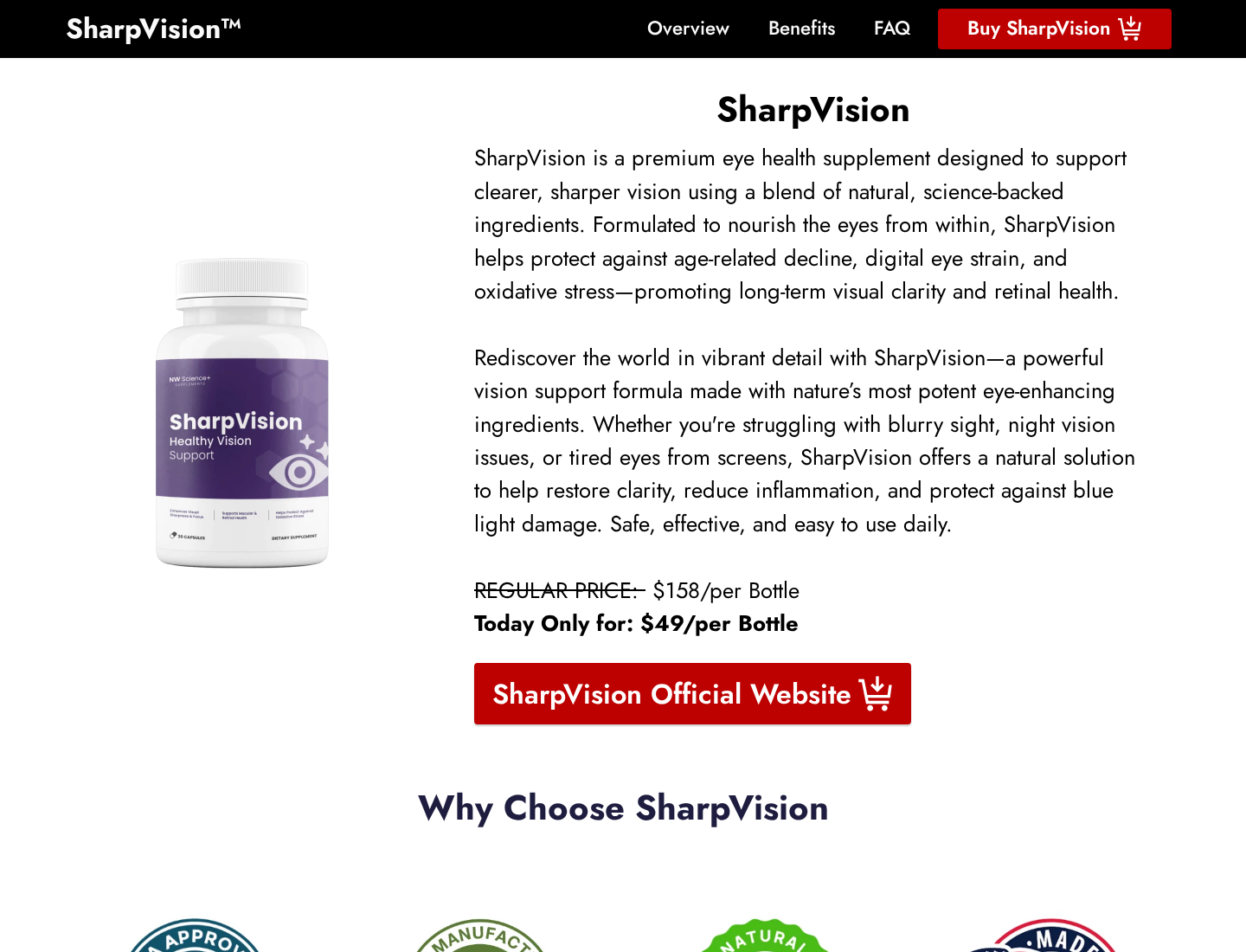
Overview
A supplement promoted beyond ordinary nutritional support
SharpVision is sold as a vision-support capsule. Promotional pages connect it with clearer sight, night driving, age-related eye problems, and reduced dependence on corrective lenses.
Those outcomes are not interchangeable. Tired eyes after screen use, a new prescription, and retinal disease need different assessment and treatment.
The pages combine familiar nutrients with promises about repairing or protecting vision. The ingredient names alone cannot establish that the finished product produces those results.
The approval badge and package details raise specific concerns
A page at sharpvision-usa.com explicitly describes SharpVision as FDA approved. Dietary supplements do not receive FDA premarket approval for safety and effectiveness.
That page’s package summary also differs from the trysharpvision.com offer reached through its buying link. This affects both the starting quantity and the amount payable.
- The promotion describes a single bottle at $79 plus $19.99 shipping.
- The linked basic package instead shows two bottles for $158 plus $19.99 shipping.
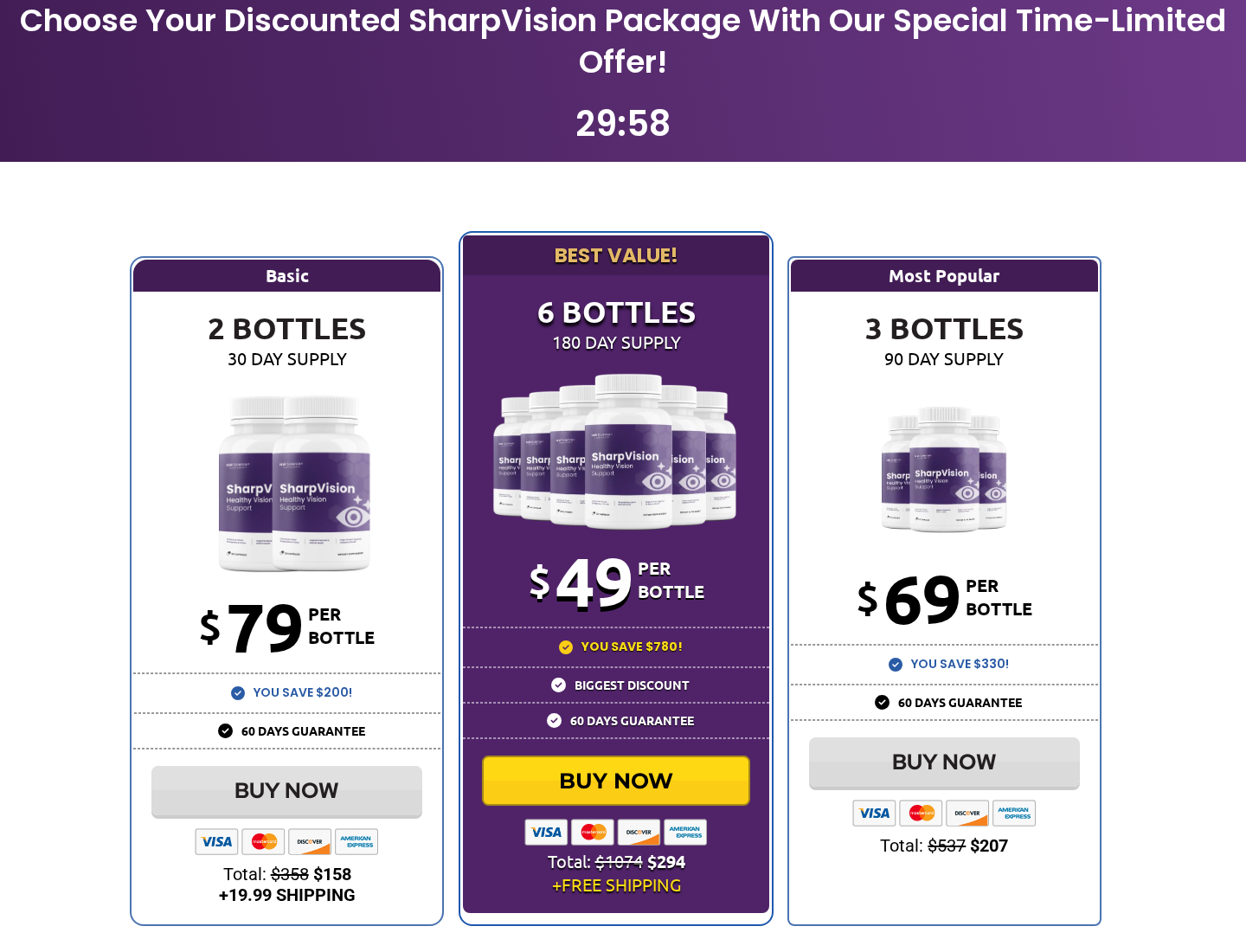
- Three bottles change from $177 in the promotion to $207 on the package page.
- The six-bottle package shows $294, not a $49 total order.
A firm warning about these offers, not every similarly named product
Do not buy through promotions using the misleading approval claim and conflicting package information. Neither a badge nor a countdown should direct your eye care.
The evidence concerns these specific SharpVision promotional routes. It does not establish common ownership of every website using a similar vision-supplement name.
The FDA Approval Claim Is Not a Harmless Badge
The approval wording appears beside a promise that the supplement meets safety, efficacy, and quality standards. A reader could reasonably interpret that as government verification.
The FDA explains that it does not approve dietary supplements for safety and effectiveness before sale.
A manufacturing facility’s registration is a different administrative matter. It does not turn a supplement into an approved treatment or prove that its advertised results occur.
The promotional pages blur those ideas, referring variously to approval, certification, registration, and manufacturing standards. Those terms should not be treated as interchangeable reassurance.
Nor does a footer stating that claims were not evaluated undo a prominent approval message higher on the same page.
A certification claim should name its issuer and scope. A facility claim should identify the facility. A treatment claim needs evidence for the specific product.
Buying because a label appears official is especially risky when the product concerns eyesight. An incorrect reassurance can cost more than the purchase price if care is delayed.
Why Eye-Supplement Research Does Not Validate Every Bottle
There is legitimate research involving nutritional supplements and certain eye conditions. That makes an accurate comparison more important, not less.
The National Eye Institute’s AREDS guidance concerns particular formulas and people with particular stages of age-related macular degeneration.
It does not show that an arbitrary eye-support blend restores everyone’s sight, replaces glasses, or prevents all age-related visual problems.
Matching the word lutein is not enough. Amounts, accompanying ingredients, the person’s diagnosis, and the studied outcome determine whether a comparison is meaningful.
SharpVision’s inspected promotional ingredient lists describe nutrients and botanicals without a complete, consistently quantified formula that can be matched to those trial conditions.
One page includes eyebright and vitamin A as beta-carotene. Another discusses selenium and ginkgo in its explanation. Buyers need the actual bottle’s label, not a composite.
Do not assemble a supposed formula by combining ingredients from multiple pages. Differences may reflect inaccurate promotion, different versions, or another unresolved source of confusion.
Bring the complete Supplement Facts panel to an eye-care professional if you are considering supplementation. A product’s name is not a substitute for a diagnosis.
How the SharpVision Promotional Sales Route Works
Step 1: Address several types of vision worry at once
The advertising moves between blurry vision, night glare, eye strain, and age-related decline. That gives many readers a reason to identify with the pitch.
But a supplement cannot be judged against a vague idea of better vision. Ask what outcome is promised and whether evidence addresses that outcome in comparable people.
A testimonial about reading comfortably cannot establish treatment for macular degeneration. Likewise, an ingredient study does not verify a driver’s ability to see safely at night.
Step 2: Make familiar ingredients sound like a complete repair plan
The pages explain antioxidants, circulation, and nourishment, then connect those ideas with restoring clarity and protecting delicate eye structures.
Nutrients can have biological roles without every supplemental dose improving an already adequate intake. A plausible explanation is not a measurement of the advertised benefit.
The missing bridge is a suitable trial of the actual finished formula, with relevant participants and a meaningful comparison.
Step 3: Add official-looking assurance
The approval and manufacturing badges make the sales explanation feel checked. They can also discourage a reader from looking for the specific evidence underneath.
Here, the direct FDA approval claim is misleading. Registration or a manufacturing standard cannot supply the government efficacy assessment the presentation implies.
Keep attention on the exact words used. A statement about a factory is not proof that the agency tested the capsules or verified a vision-restoration promise.
Step 4: Lead with a low unit price, then display larger packages
A headline advertises $49 per bottle. That figure belongs to the six-bottle offer, whose merchandise total is $294.
The linked basic offer begins at two bottles, $158 before its $19.99 shipping charge. That is $177.99 before any further applicable adjustment.
Meanwhile, the three-bottle route displays $69 each and $207 total, rather than the promotion’s $59 each and $177 total.
A changed price or package needs clear explanation before payment. It is not evidence that an order was secretly altered afterward, because no order was placed.
Step 5: Encourage a longer supply than the refund period
A promotional FAQ recommends three to six months of use. The stated guarantee lasts 60 days, and one page counts that from the original purchase.
Someone waiting until a six-month supply is finished could be far outside that window. Starting the clock at purchase also includes time spent waiting for delivery.
Ask for the actual guarantee covering the transaction, including the deadline and whether empty bottles are required. Do not infer coverage from the size of the bundle.
Read the Package Page, Not Just the Advertised Price
The linked page presents a countdown and three package cards. It is a sales selection page, not a completed payment confirmation.
Its basic card describes two bottles as a 30-day supply, while the larger packages describe three bottles as 90 days and six as 180 days.
That difference needs an explanation of capsule count and daily serving. A bottle image cannot resolve conflicting supply descriptions.
The crossed-out comparison amounts deserve the same attention. The six-bottle card starts from $1,074, while another part of the promotion names $158 as the regular bottle price.
Six times $158 is $948, not $1,074. The pages do not explain why their comparison baseline changes.
That inconsistency does not establish what anyone previously paid. It does make the headline saving an unreliable way to judge value.
Set aside the crossed-out amount and compare only the exact quantity, actual total, and credible evidence for the result you want. A larger claimed saving cannot repair missing evidence.
The page also carries marketing and advertising disclosures. It describes a financial connection to the offer and explains that portrayed people can be models.
Those disclosures matter when comparing the page with the impression of independent advice. A paid promotional route is not an outside clinical assessment.
They do not independently prove that every testimonial is fabricated. They do mean the presentation should not be treated as neutral evidence of typical results.
Seller Accountability, Support, and Product Traceability
An affiliate page is not automatically the manufacturer
The sharpvision-usa.com footer describes commissions from merchant links. The linked package page also discloses a financial connection to referred sales.
That distinguishes promotion from manufacturing. The entity collecting the payment, the business publishing the advertisement, and the company making the capsules may have different roles.
The inspected promotion does not establish a factory address
Made-in-USA wording is presented, but the inspected material does not independently establish the named manufacturing site or a matching return depot.
Do not borrow an address from a similarly named website. Use the merchant identity and authorized return instructions attached to the actual order.
Keep payment support separate from promotional contacts
One promotional terms page lists adds.djar@gmail.com for concerns about the site. That address is not automatically the fulfillment merchant’s refund department.
A reference to BuyGoods in promotional copy likewise does not establish the payment arrangement for every route. Your receipt should identify who handled your transaction.
The delivered bottle must identify its own formula
A front-label picture and a list of beneficial nutrients are not enough to establish serving amounts, lot traceability, or independent testing.
Retain the full label, manufacturer or distributor details, lot, expiration date, and packaging. Resolve discrepancies before taking a product with an unclear identity.
What Has Not Been Established About Refills
One promotional FAQ says the purchase is a one-time payment without autoship. The inspected package page did not establish recurring billing terms.
That is not a completed checkout test. It would be equally wrong to promise that every route is subscription-free or claim that every buyer faces hidden refills.
Read the final summary for renewal price, interval, and consent. If any recurring term appears, stop and compare it with the one-time-payment promise.
A six-bottle purchase is a large upfront bundle, not inherently a subscription. Future charges require their own evidence.
What to Do If You Ordered SharpVision
-
Reconcile the price and quantity now. Compare the advertisement, package selected, payment total, and confirmation. Note any difference between one bottle and a two-bottle starting offer.
Include shipping when calculating the disputed amount. A unit price and a full order total are different figures, even when both appear beside a buy button.
-
Identify the merchant from the receipt. Use the support route supplied by the business that accepted payment, not a random promotional page or search advertisement.
Ask for cancellation before shipment if you no longer want the order. Keep the request separate from any question about future recurring payments.
-
Save the approval claim and conflicting offer. Preserve the page asserting FDA approval, the package amounts, the guarantee, and the resulting receipt.
Explain precisely which representation influenced the purchase. This gives the seller or payment provider a concrete issue to address.
-
Check the guarantee deadline immediately. If the applicable wording counts 60 days from purchase, do not wait for a three- or six-month course to end.
Request the authorized destination and bottle-return requirements in writing. Keep empty containers if instructions require them, but do not continue taking capsules merely to qualify.
-
Have your eye concern assessed properly. Bring the actual label to your optometrist, ophthalmologist, or pharmacist. Continue prescribed lenses and treatment unless your clinician changes them.
New or suddenly worsening vision should not be left to a supplement trial. Seek prompt professional assessment rather than waiting for an advertised improvement timeline.
-
Challenge unresolved billing or merchandise problems accurately. Give your payment provider the offer, confirmation, cancellation record, and merchant replies, then ask about the relevant dispute deadline.
Do not describe a disclosed bundle as stolen money without evidence. Focus on an actual pricing mismatch, misleading representation, unauthorized renewal, or failure to supply.
Frequently Asked Questions
Is SharpVision FDA approved?
The promotional claim is misleading. FDA does not approve dietary supplements for safety and effectiveness before sale, and a facility registration does not change that.
Does the $49 price buy one bottle on its own?
In the inspected package route, $49 is the unit price for six bottles totaling $294. The basic offer shows two bottles for $158 plus shipping.
Why does the three-bottle price differ between pages?
The promotion states $177, while its linked offer displays $207. The reason is unexplained. Rely on neither without reconciling the final summary before payment.
Is SharpVision equivalent to an AREDS2 formula?
That has not been demonstrated. Sharing nutrient names does not establish the tested doses, complete formula, or appropriateness for a particular stage of eye disease.
Will the order automatically refill?
The available material does not establish that. A promotional one-time-payment claim should be checked against the actual receipt and any final recurring-payment disclosures.
Should I buy six months and wait to see?
No. A longer recommended course does not extend a 60-day guarantee. Do not postpone eye care or overlook the offer’s misleading approval and package inconsistencies.
The Bottom Line
Do not buy SharpVision through these promotions. The FDA approval claim is misleading, the linked packages differ, and the presentation does not establish the promised vision improvements.
If you paid, verify the merchant, quantity, renewal status, and refund deadline today. Take concerns about your sight to an eye-care professional, not a countdown-driven supplement offer.

Join the discussion
0 commentsShare your experience or ask a question about this article.
Discussion
Start the conversation
Have a question or something useful to share? Add the first comment.