

Skulta Deep Peptide Collagen Eye Mask is being promoted as a Korean-inspired full eye contour treatment that claims to smooth fine lines, reduce puffiness, soften crow’s feet, hydrate the eye area, and help lift the look of tired or drooping eyelids.
But before ordering, buyers should look closely at the claims, the refund policy, the generic product category, and the difference between temporary hydration effects and real anti-aging results. This appears to follow a familiar beauty-product funnel pattern: dramatic wrinkle and lifting claims, “Korean technology” positioning, large social-proof claims, urgent stock messaging, and return terms that may not be as generous as the product page suggests.
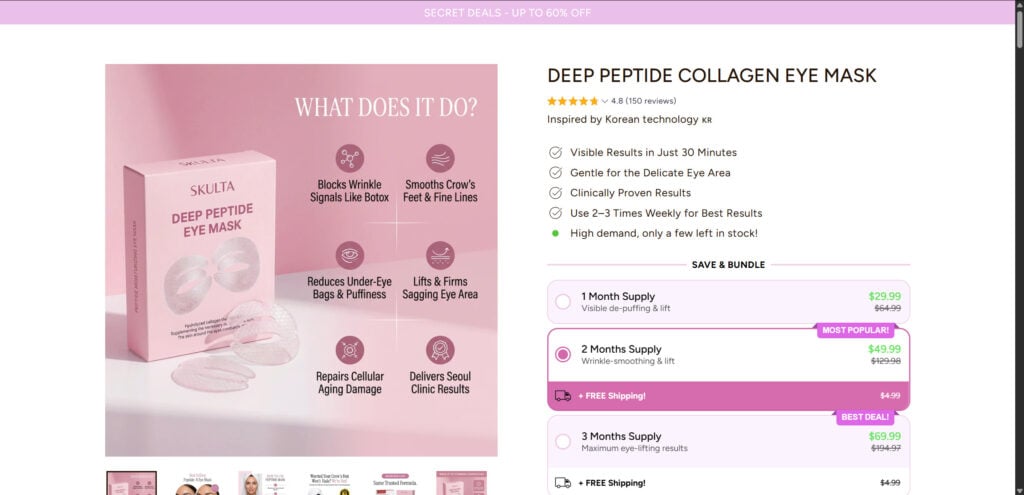
Skulta Eye Mask Overview
Skulta sells the product as the “Deep Peptide Collagen Eye Mask.” The product page lists it at $64.99 and says it is “inspired by Korean technology.”
The advertised claims include:
- Visible results in just 30 minutes
- Gentle for the delicate eye area
- Clinically proven results
- Use 2–3 times weekly
- Helps smooth fine lines
- Helps soften crow’s feet
- Helps reduce puffiness
- Helps lift the look of tired or drooping eyelids
- Full 3-piece eye contour coverage
- Dermatologically tested
- Hypoallergenic
- Suitable for all skin types
- 30-day money-back guarantee
The product is designed as a 3-piece mask system for the under-eye, eyelid, and brow area. That makes it more visually interesting than standard under-eye patches, which usually cover only the lower eye area.
However, the key concern is the marketing. Skulta is not simply advertised as a hydrating eye patch. It is positioned as a complete anti-aging eye contour treatment that can visibly smooth, firm, lift, and refresh the eye area. Those are strong beauty claims, especially for a disposable mask.
Why Skulta Raises Red Flags
1. “Visible results in 30 minutes” can be misleading
Skulta highlights visible results in just 30 minutes. That sounds impressive, but buyers should understand what that usually means in skincare.
Eye masks can temporarily hydrate the skin. Hydrated skin can look smoother, plumper, and fresher for a short period. Puffiness can also look reduced if the patch is cooling.
But this is not the same as reversing wrinkles, rebuilding collagen, tightening loose eyelid skin, or creating a lasting lifting effect.
A 30-minute cosmetic improvement is usually temporary. It may help before an event or makeup application, but buyers should not expect procedure-like results.
2. The lifting and drooping-eyelid claims should be treated cautiously
The page says the mask targets drooping lids and provides a more complete lifting effect across the eye contour.
That is a major claim.
Drooping eyelids can be caused by skin laxity, genetics, aging, fat pad changes, muscle weakness, fluid retention, allergies, or medical issues. A topical mask may hydrate or temporarily tighten the surface appearance, but it cannot physically reposition eyelid tissue like surgery, lasers, radiofrequency, or other professional treatments.
Buyers should treat “lifting” language as cosmetic marketing unless the company provides strong clinical evidence on the exact finished product.
3. “Clinically proven” is not clearly explained
The product page says the mask has clinically proven results and mentions an independent study with 527 users after 30 days.
That sounds reassuring, but the visible product page does not clearly show:
- who conducted the study
- where it was published
- whether it was placebo-controlled
- whether it was blinded
- what exact outcome measures were used
- whether the study tested this exact Skulta product
- whether results were self-reported or measured by instruments
- whether participants were compensated
- whether the data was independently audited
Without those details, “clinically proven” should be treated as a marketing claim, not conclusive proof.
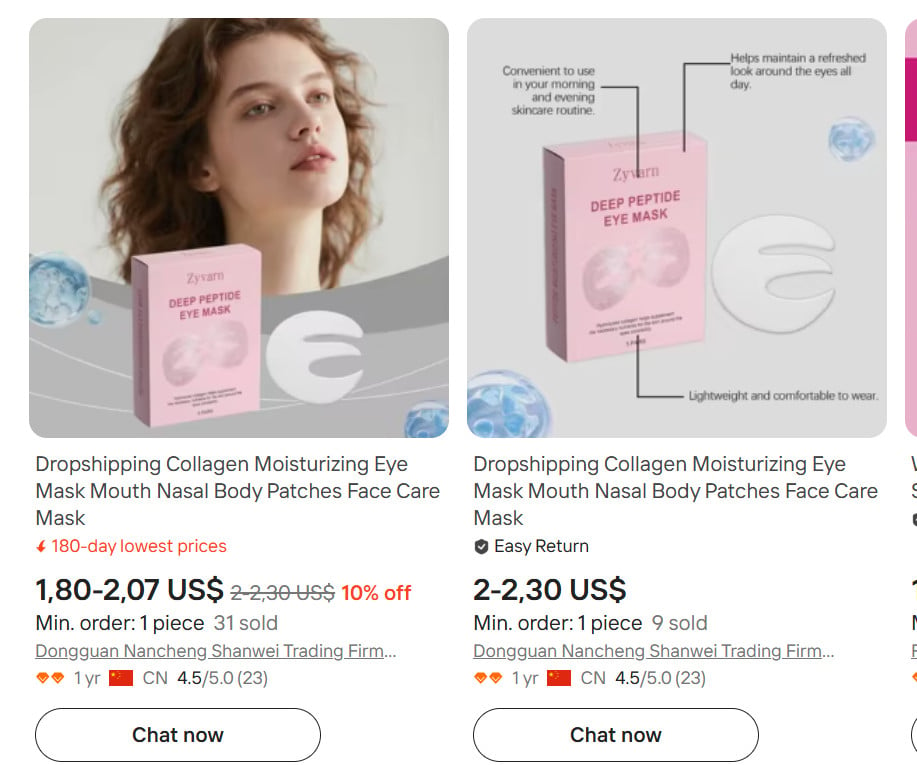
4. The product appears to sit in a generic beauty category
Collagen eye masks, peptide under-eye patches, caviar eye patches, hydrogel masks, and Korean-style eye patches are widely sold across Amazon, Alibaba, Temu, Ubuy, and other marketplaces.
Many of these products use similar claims:
- collagen
- peptides
- hydration
- puffiness reduction
- firming
- anti-aging
- crow’s feet
- dark circles
- Korean skincare
- hydrogel delivery
- sensitive skin
This does not prove Skulta is fake. But it does suggest the product category is generic and easy to private label.
The risk is that buyers may be paying a premium price for a product type that is widely available under many names.
5. “Collagen” in topical masks is often about hydration, not rebuilding skin
Collagen is a popular skincare ingredient, but topical collagen does not automatically rebuild the collagen structure inside the skin.
Most collagen masks work mainly by hydrating and plumping the skin’s surface. That can temporarily soften the look of fine lines, but it is not the same as stimulating deep collagen regeneration.
Peptides may be useful in skincare, but their results usually require consistent use over time and depend heavily on formula quality, concentration, delivery, and supporting ingredients.
6. The refund wording is inconsistent
The product page says Skulta will refund the purchase in full with “no questions asked” if the buyer is not satisfied.
But the refund policy is more restrictive. It says returns are accepted for unused items in original packaging within 30 days. It also says that, for hygiene reasons, Skulta offers store credit instead of a cash refund for returns.
The contact page adds more confusion by saying returns are accepted only for damaged or defective products and not for change of mind.
That is a major red flag.
A buyer may see the product page and believe they can try the mask risk-free. But the policy pages suggest that used products may not qualify for a cash refund, and change-of-mind returns may not be accepted.
7. Sale orders may be harder to cancel
The refund policy says full-price orders can be canceled within 30 minutes for a full refund, but sale or promotional orders can only be canceled for store credit, even inside the 30-minute window.
That matters because the site promotes “secret deals” and discounts up to 60% off. If buyers purchase during a sale, cancellation may not be straightforward.
8. The product is applied very close to the eye
Any product used around the eyelid, under-eye, or brow area should be treated carefully.
Skulta markets the mask as gentle and suitable for all skin types, but “hypoallergenic” does not mean impossible to react to. The eye area is thin and sensitive, and some people may experience irritation, redness, burning, itching, swelling, or contact dermatitis from skincare products.
Buyers with sensitive skin, eczema, rosacea, allergies, active irritation, or recent cosmetic procedures should be cautious.
9. The site uses strong social proof
The page says “20,000+ happy customers” and displays several enthusiastic testimonials. It also includes claims about visible results after repeated use.
Seller-controlled testimonials can be useful, but they are not the same as independent verified reviews. They can be selected, edited, filtered, or difficult to verify.
When a product relies heavily on testimonials, buyers should look for independent reviews, real customer photos, return experiences, and complaints outside the brand’s own website.
10. Shipping and lost-package responsibility may fall on the buyer
Skulta’s shipping policy says delivery may take several business days, may be extended by logistics issues, and that customs duties or local fees may be the customer’s responsibility.
The refund policy also says Skulta is not responsible for packages that are lost, stolen, or delayed.
That makes it important to track the order carefully and document any shipping issue quickly.
How the Skulta Sales Funnel Appears to Work
Step 1: The page targets eye-area insecurities
The product targets common concerns:
- crow’s feet
- fine lines
- puffiness
- tired eyes
- crepey texture
- drooping lids
- under-eye dehydration
- aging around the eye contour
These are emotional beauty concerns because the eye area strongly affects how rested or youthful someone looks.
Step 2: The product is framed as more advanced than normal eye patches
Skulta’s 3-piece design is the main differentiator. Instead of only covering the under-eye area, it covers the under-eye, eyelid, and brow area.
This makes the product feel more premium and complete.
Step 3: Korean skincare language adds credibility
The page says the product is inspired by Korean technology and uses phrases like “Korean dermatologist certified.”
Korean skincare has a strong reputation, so this positioning helps build trust. But buyers should still ask for exact manufacturer details, testing documents, and certification evidence.
Step 4: Ingredients are used to support the anti-aging story
Skulta highlights ingredients such as Acetyl Octapeptide-8, Centella Asiatica, Sturgeon Caviar Extract, and a “Honeycomb Technology” delivery system.
These names make the product sound scientific and premium. But ingredient names alone do not prove dramatic results.
Step 5: Urgency pushes buyers to order
The product page uses “high demand,” “only a few left in stock,” and “backordered, shipping soon” language.
This creates pressure. Buyers may order quickly instead of comparing similar eye masks or reading the refund policy.
Step 6: Refund friction appears after purchase
If a buyer opens the product and dislikes it, the refund may not be as simple as expected. The product page suggests a full no-questions refund, but the policy pages mention unused items, original packaging, store credit, and damaged/defective-only returns.
This mismatch can create frustration.
Main Red Flags
- Claims visible results in just 30 minutes.
- Claims to help lift drooping eyelids.
- Claims clinically proven results without clearly showing study details on the product page.
- Uses “Korean technology” and “Korean dermatologist certified” positioning.
- Heavy reliance on seller-controlled testimonials.
- “20,000+ happy customers” claim is difficult to independently verify.
- Similar peptide/collagen eye masks are widely available on marketplaces and wholesale supplier platforms.
- Product page suggests a full no-questions refund.
- Refund policy says unused items in original packaging and store credit for hygiene reasons.
- Contact page says returns are only accepted for damaged or defective products, not change of mind.
- Sale/promotional cancellations may only receive store credit.
- Used skincare products near the eye may not be easily returnable.
- Eye-area products can cause irritation in sensitive users.
Is Skulta Eye Mask a Scam?
Skulta may ship a real eye mask product, so this may not be a simple “pay and receive nothing” scam.
The bigger issue is whether the product is being oversold and whether the refund guarantee is as strong as the sales page suggests.
A fair conclusion is this: Skulta Deep Peptide Collagen Eye Mask appears to be a high-risk beauty offer because it combines strong anti-aging and lifting claims, generic product-category signals, urgency marketing, heavy social proof, and refund-policy wording that may limit cash refunds after the product is opened or used.
The mask may hydrate and temporarily smooth the eye area. Some buyers may like it. But buyers should not expect it to permanently erase crow’s feet, lift drooping eyelids, or replace professional anti-aging treatments.
What To Know About Collagen Eye Masks
Collagen eye masks can be useful for short-term hydration. They can make the under-eye area look fresher, smoother, and slightly plumper.
But buyers should separate temporary cosmetic effects from structural anti-aging claims.
A mask may help with:
- temporary hydration
- surface smoothness
- cooling sensation
- temporary puffiness reduction
- makeup prep
- short-term plumping
A mask is unlikely to:
- permanently lift eyelids
- erase deep wrinkles
- rebuild lost collagen dramatically
- remove crow’s feet permanently
- reverse aging around the eyes
- replace retinoids, procedures, or professional treatments
For real long-term improvement, consistent skincare, sun protection, retinoids or retinals where tolerated, peptides, moisturizers, and professional guidance usually matter more than one mask.
Safety Concerns Buyers Should Consider
Because Skulta is used around the eyes, be careful if you have:
- sensitive skin
- eczema
- rosacea
- allergies
- recent laser treatment
- recent chemical peel
- active irritation
- broken skin
- eye infection
- eyelid inflammation
- contact lens sensitivity
- history of reactions to eye creams or adhesives
Stop using the product if you experience burning, itching, redness, swelling, rash, watery eyes, pain, or irritation.
Do not place the mask on broken, sunburned, or inflamed skin. Avoid getting essence into the eye.
What To Do Before Buying
1. Compare similar products first
Search for:
- peptide collagen eye mask
- 3-piece eye contour mask
- Korean collagen eye patch
- caviar peptide eye patches
- hydrogel collagen eye mask
- private label collagen eye mask
If similar products are much cheaper elsewhere, slow down.
2. Read the refund policy before ordering
Do not rely only on the product-page guarantee. Check the actual policy for:
- cash refund or store credit
- unused condition requirement
- original packaging requirement
- change-of-mind exclusions
- damaged/defective-only wording
- sale order cancellation rules
- refund processing time
3. Screenshot the guarantee
Save screenshots of:
- product claims
- price
- stock warnings
- guarantee wording
- refund policy
- contact page return wording
- checkout page
- final total
This helps if the refund process becomes disputed.
4. Patch test first
Before using the mask around both eyes, test a small amount of the essence on a less sensitive area. Wait to see if redness or irritation appears.
5. Do not buy multiple boxes first
Test one box before buying bundles or repeat orders. If the product irritates your skin or does not perform as expected, a larger order increases the loss.
What To Do If You Already Ordered
1. Check your order confirmation
Confirm:
- quantity ordered
- total amount charged
- shipping cost
- merchant name
- discount applied
- delivery estimate
- return window
2. Save all evidence
Save:
- product page screenshots
- guarantee language
- refund policy
- contact page return terms
- order confirmation
- tracking details
- support emails
- product photos
3. Inspect before using
Check whether the package is sealed, labeled, undamaged, and matches the advertised product.
Do not use it if the packaging is open, leaking, damaged, or missing key labeling.
4. Stop using it if irritation occurs
If the eye area becomes red, swollen, itchy, painful, or irritated, stop using the product immediately.
If symptoms persist, contact a healthcare professional.
5. Contact support quickly
If the product is damaged, defective, or not as advertised, contact contact@skulta.co within the stated timeframes. Include photos or videos.
6. Request a cash refund clearly
Because the policy mentions store credit, be specific if you want your payment refunded rather than store credit.
Use wording such as:
“I am requesting a refund to my original payment method under the guarantee shown on the product page. I do not accept store credit as resolution.”
7. Dispute if necessary
Contact your bank, credit card issuer, or PayPal if:
- the product never arrives
- the seller refuses the advertised guarantee
- the refund policy contradicts the product page
- the product is damaged or defective
- you receive store credit instead of the advertised refund
- support does not respond
- the item is not as advertised
Use clear wording such as:
- “item not as described”
- “merchant refuses advertised refund”
- “return policy contradicts sales page”
- “defective cosmetic product”
- “misleading beauty claims”
FAQ
What is Skulta Eye Mask?
Skulta Deep Peptide Collagen Eye Mask is a 3-piece eye contour mask marketed for fine lines, crow’s feet, puffiness, eyelid area, brow area, and tired-looking eyes.
Is Skulta Eye Mask a scam?
Skulta may ship a real product, but the offer has red flags: strong anti-aging claims, generic product-category similarities, urgency language, heavy social proof, and inconsistent refund wording.
Does Skulta really work in 30 minutes?
It may temporarily hydrate or smooth the eye area, but 30-minute results are likely cosmetic and short-term. Buyers should not expect permanent wrinkle or lifting results.
Can Skulta lift drooping eyelids?
Be cautious. A topical mask may temporarily tighten or hydrate the skin’s appearance, but it cannot physically lift eyelids like a medical or cosmetic procedure.
Is Skulta really clinically proven?
The page claims clinically proven results and references a study with 527 users, but the visible page does not provide enough study details to evaluate the claim fully.
Is Skulta a Korean product?
The page says it is inspired by Korean technology and uses Korean skincare positioning. Buyers should verify manufacturing details and certifications before relying on that claim.
Are similar eye masks sold elsewhere?
Yes. Similar collagen, peptide, hydrogel, caviar, and Korean-style eye patches are widely sold on marketplaces and supplier platforms.
Can I return Skulta after using it?
That is unclear and risky. The product page suggests a broad guarantee, but the refund policy says returns are for unused items in original packaging and may result in store credit for hygiene reasons.
Is Skulta safe for sensitive skin?
The product is marketed as gentle and hypoallergenic, but eye-area products can still irritate some people. Patch testing is recommended.
Should I buy Skulta Eye Mask?
Be cautious. Compare alternatives, read the refund policy carefully, buy only one box first, and do not expect permanent anti-aging or eyelid-lifting results.
The Bottom Line
Skulta Deep Peptide Collagen Eye Mask is marketed as a premium Korean-inspired eye contour treatment that can visibly smooth, firm, hydrate, de-puff, and lift the look of the eye area.
The product may provide temporary hydration and a smoother appearance for some users. But the offer carries warning signs: bold 30-minute results, lifting claims, unclear clinical-study details, generic product similarities, urgency messaging, and refund-policy wording that may not match the “no questions asked” impression on the product page.
Buyers should treat Skulta as a cosmetic eye mask, not a proven anti-aging treatment. Compare similar products, read the refund terms, patch test before use, and keep screenshots if you order.
10 SEO Titles
- Skulta Eye Mask Review: Scam or Legit?
- Skulta Deep Peptide Collagen Eye Mask Scam? Buyer Warning
- Is Skulta Eye Mask Legit or a Dropshipping Beauty Product?
- Skulta Eye Mask Review: Claims, Refunds, and Red Flags
- Skulta Deep Peptide Eye Mask Exposed: Real Results or Hype?
- Skulta Eye Mask Refund Policy: What Buyers Should Know
- Skulta Collagen Eye Mask Review: 30-Minute Claims Explained
- Skulta Eye Mask Warning: Lifting Claims and Return Issues
- Skulta.co Review: Read Before Buying the Eye Mask
- Skulta Eye Mask: Generic Collagen Patch or Premium Treatment?








