


When an investment site stops answering, a service that promises to trace your crypto can sound like the first useful lead you’ve had.
SkyHawk Assets asks for your case details before explaining who would take responsibility for recovering anything. Its own pages provide a place to start checking.

Overview
The homepage makes a bigger promise than the form can deliver
SkyHawk Assets uses the phrase “Absolute Recovery.” It advertises wallet tracing, international court orders and asset freezes, then invites you to send your transaction history through its website.
A transaction trace can tell you where cryptocurrency moved. It does not put somebody in control of the funds or establish a legal right to take them.
The name and address do not establish who you would hire
SkyHawk Assets appears in the page titles. The footer instead names Aegis Forensic Recovery. It does not explain whether one name is a registered business or trading name.
That footer gives the same Denver suite shown by Asset Recovery, Inc. The latter describes a real-estate-related unclaimed funds service. Its published description is not a SkyHawk credential.
There is a better place for your records
The SkyHawk form asks for contact details, transaction hashes, wallet addresses and a timeline. Those records are useful to a genuine investigator and valuable to someone targeting you again.
Give the relevant records to the exchange, bank or reporting authority through a channel you open independently. Don’t hand them over simply because a page calls its form secure.
- Keep the original wallet and payment evidence, but don’t upload it to SkyHawk.
- Do not pay a fee to unlock, release or receive a promised return.
- Separate a transaction hash from a wallet recovery phrase. Never disclose the phrase.
- If you already paid, report the original loss and the recovery payment separately.
What SkyHawk Assets Offers After a Crypto Loss
Step 1: The claim starts with a promise of reach
The homepage claims more than 100 jurisdictions and an average trace time of 48 hours. It also displays a figure of 2.3 billion in capital traced.
The measurements sound related, but neither tracing time nor capital traced tells you how much was actually returned. The page does not identify a currency next to that figure.
It also calls its approach unrestricted. A cross-border case may require records from an exchange, cooperation from several parties and a decision by an authority with the right jurisdiction.
You need evidence of the firm’s role in a real proceeding, not a large number on a site. The pages we reviewed show no case citation validating the figures.
Step 2: The form makes you identify yourself and the loss
The form requests a full name, email, phone number and claim details. It specifically prompts for transaction hashes, wallet addresses and a timeline.
A public blockchain address may not show your email or phone number. The intake form brings all of that together and tells the recipient that you are seeking help.
The page promises an initial review within 24 hours and says submissions are stored on Swiss servers. That is a statement on the page, not a verified storage arrangement.
The advertised 24-hour review and 48-hour trace are different claims. Neither says which exchange would cooperate or when an individual could expect to receive anything.
Step 3: The published process jumps from tracing to legal action
SkyHawk lists intake, tracing, legal action and asset reclamation. The site says it seeks court orders across borders, without identifying a lawyer assigned to the reader’s case.
Anyone can say a trace has located a wallet. Before accepting a claim that money is frozen, you would need to know who controls it and who ordered the freeze.
Do not treat a promise of recovery as evidence somebody has your specific funds. Ask the exchange or authorities what they can verify from the original transfer instead.
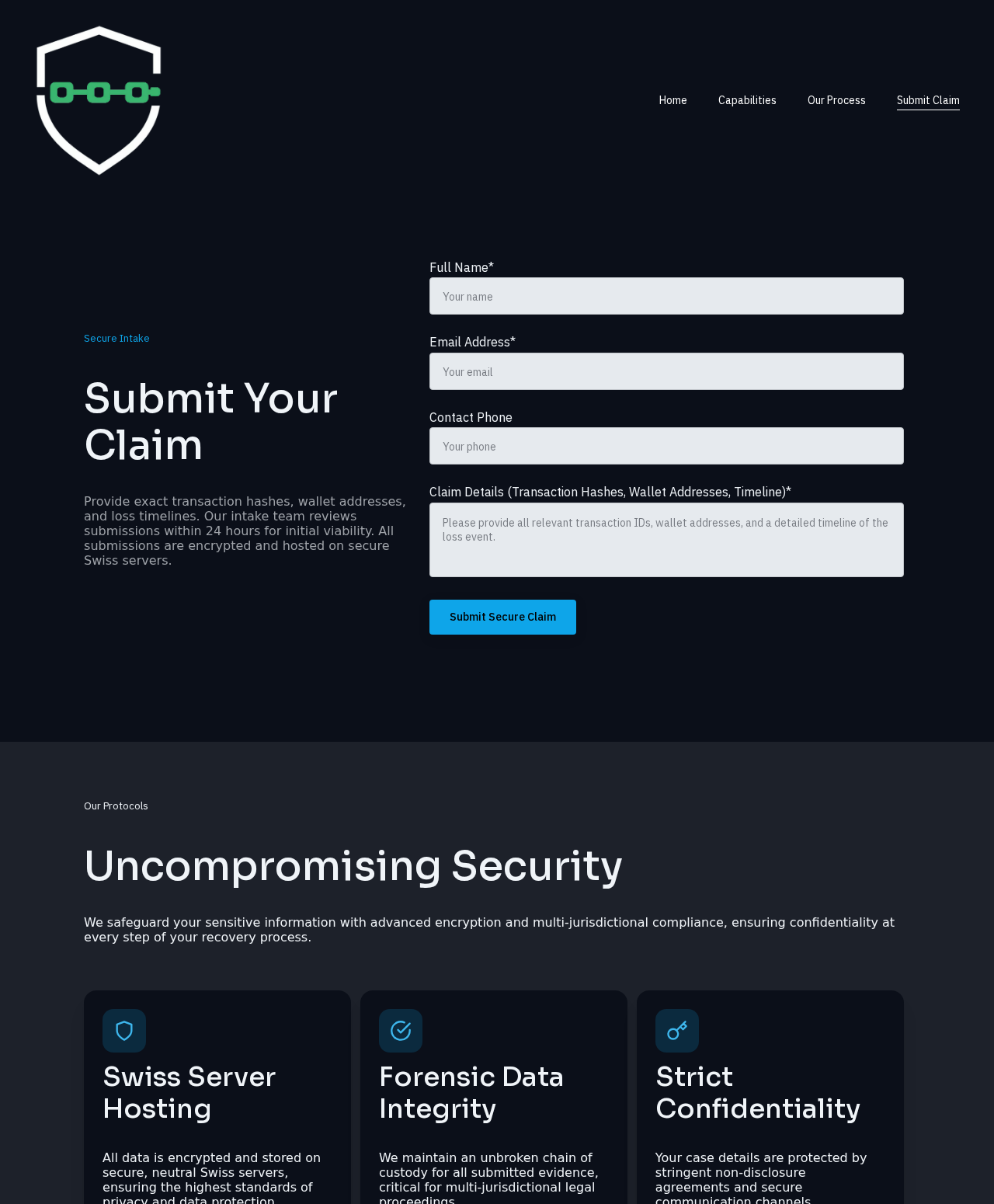
The Denver Address and the Two Names
SkyHawk on the intake page, Aegis at the bottom
The claim page’s title names SkyHawk Assets. The footer credits Aegis Forensic Recovery, including on the same page where you are asked to enter details of your loss.
Describing the inconsistency does not require guessing why it happened. The reader’s question is which legal entity would receive the data and take on the case.
A service asking for this much information should be able to identify the business responsible for it and explain its terms before you share any information.
The listed suite is already published by another service
The Colorado address is 910 16th St Mall, suite 624, Denver. Asset Recovery, Inc.’s own website lists the same location.
The other company describes help claiming unclaimed funds related to real property and similar assets. It does not present itself as the SkyHawk service or verify its crypto claims.
A matching suite is not proof of who designed the SkyHawk site. It makes the address useless as independent confirmation of SkyHawk’s identity without a separate documented connection.
The listed support channel is not a professional credential
SkyHawk lists a contact email and a WhatsApp number. A way to reach someone is not the same as a verifiable law practice, exchange fraud team or regulator.
On the public pages examined, neither the name of a lawyer who would handle your specific case nor the basis for their relevant authority was provided.
Don’t use a number from the offer to confirm the offer. If someone claims to be a licensed lawyer, use the relevant bar or regulator to find them.
There is no shown fee schedule or case-specific agreement
The form starts with your information. It does not tell you what a specific review, report or legal engagement will cost before you share that information.
That does not prove everyone gets charged, or establish how much. It means there is no basis to send money on the assumption that a later payment guarantees recovery.
What Tracing Can and Cannot Do
Transaction records can show whether funds left your wallet and where the next visible transfer went. They cannot normally tell you who controls a wallet just from its address.
A wallet address may be shared by a service or reflect an intermediate payment step. You cannot assume the person who contacted you owns whichever destination appears first.
If funds land at a cooperative exchange, the exchange may be able to review them using facts from your report. It decides what it can disclose or freeze.
The FBI’s recovery-service alert warns that private companies can’t issue seizure orders. It describes cases in which recovery operators collect advance fees and then ask for more.
That is the broader fraud pattern to watch for. The SkyHawk website does not document a particular victim’s payment or a tested withdrawal or recovery outcome.
Don’t confuse the risk of submitting an intake form with the risk of signing a wallet transaction. If you signed something or exposed a recovery phrase, act on that separately.
Compare a real freeze with the language of a sales page
A genuine freeze restricts where assets can go. When an exchange restricts an account or receives an order, that does not automatically make the crypto payable to you.
If someone sends a document that looks like a court order, don’t forward them a passport to see the rest. Check the court, jurisdiction and case reference independently.
An authority may not be able to share details of an investigation. A lack of public information does not turn a screenshot from the recovery contact into confirmation.
Likewise, a transaction dated after your loss may be a real transfer that has nothing to do with you. Compare the network, asset and original transfer before drawing conclusions.
Separate the authority to help from a claim about results
If you want legal advice, select a lawyer through an independent route. Ask what services they can provide in the relevant jurisdiction before sharing your case file.
Read how fees are calculated, which work the engagement covers and how you can end it. Do not accept assurances about someone else’s money as a guarantee about yours.
The FBI warns that some recovery operators claim affiliation with authorities to establish trust. A badge or a document that uses the agency’s name doesn’t prove that relationship.
Someone who genuinely represents your bank or an agency can be reached through a verified route. A recovery contact demanding secrecy or a fee to speak to them changes nothing.
What to Do If You Already Contacted SkyHawk
- Stop sending information. Keep your copy of the website, profile or message that first led you there.
- Save original transaction hashes, networks, dates and totals. Keep the initial investment transfer separate from any later payment for recovery.
- Contact the bank or exchange you used, directly from its app or verified website. Ask for the fraud team and record its case number.
- If a wallet interaction was involved, tell the wallet provider precisely whether you connected, approved, signed or shared a secret. Don’t sign a cleanup request from a stranger.
- Report the case through your country’s fraud-reporting channel. In the United States, the FBI takes online reports at IC3.
- Don’t post attachments containing your ID, balance or contact details. Provide evidence through a verified private reporting channel, not a comment thread.
If you only submitted the form
Record exactly what you entered. A name, email and public address don’t give somebody your private keys, but they can make a later message sound uncannily well informed.
If a caller quotes the correct amount lost or knows the exchange you used, treat that as knowledge of your case, not evidence they recovered anything.
Expect attempts to move you into a new conversation under another name. You do not need to correct the person’s story, argue about the case or respond.
If you paid for recovery
Tell the payment provider as soon as possible. A card payment, bank transfer and cryptocurrency transfer have different procedures; do not assume any can be reversed.
Make a timeline with both payment routes. Paying the investment platform and paying a company claiming to recover your money may involve entirely different accounts.
Be careful with offers to refund the recovery fee in crypto. A link that asks you to connect or sign something is not a normal reason to keep engaging.
In that timeline, label what a website displayed separately from funds that actually moved. Include only a settled payment in the sum you report as paid.
Save messages about taxes, stamps, clearance or refundable deposits even if you didn’t pay them. A demand can help explain why you stopped and what the sender wanted next.
If you paid from an exchange and know the destination, tell support which blockchain you used. An address without its network can be ambiguous in a support request.
If you can no longer access the original account, preserve the transfer confirmations you already have. Do not pay somebody to log you back in or recreate the records.
One more person asking about your case is not one more independent lead. Keep the evidence with the same verified case contact rather than starting over with every new offer.
If you exposed access to an account or wallet
If you shared an exchange password, open the exchange yourself and work through its account security checks. Never use a password-reset link supplied by the recovery contact.
If you shared a wallet recovery phrase, assume someone else may be able to use it. Follow the wallet maker’s security guidance from a trusted device.
Do not give anyone your authentication codes to “verify” ownership. Genuine help should be able to tell you which facts are needed without taking control of the account.
Frequently Asked Questions
Should I use SkyHawk Assets to get my money back?
No. Its public claims don’t provide a verifiable legal team or establish recovery. The form asks for valuable information without clearly identifying who is responsible for it.
Is SkyHawk Assets the same as Asset Recovery, Inc.?
The pages list the same Denver suite, but that is not evidence the services are connected. Asset Recovery, Inc. describes a different business.
Can SkyHawk get cryptocurrency back in 48 hours?
Its page describes an average trace time, not a refund deadline. Tracing and returning money are different actions and require different evidence.
Is a transaction hash the same as a private key?
No. The hash identifies a transaction. A private key or recovery phrase can grant control over funds and should never be disclosed to a recovery service.
What if a caller says my money is frozen?
Verify any claim involving the exchange or an authority through its own public channel. Do not pay a release charge or sign a wallet request to test the story.
Can I still report the first loss after paying a recovery service?
Yes. Keep the two events distinct in your report and include records for both. Ask your bank or exchange what it can still do on each payment.
The Bottom Line
Don’t send SkyHawk Assets your case file or your money. A recovery slogan, a mismatched footer and an address used by another business don’t establish authority over your funds.
If you already shared details, stop the conversation. Take your original transfer records and any recovery payment to your bank, exchange and the appropriate fraud-reporting authority.

Join the discussion
0 commentsShare your experience or ask a question about this article.
Community experiences
Did this happen to you?
Your experience could help someone recognize the same scam. Submit a private report for our team to review.
I experienced this tooReports are reviewed before publication. Sharing publicly is always your choice.
Discussion
Start the conversation
Have a question or something useful to share? Add the first comment.