

Sonus Zen is being promoted as a natural hearing-support supplement that claims to help with tinnitus, ringing ears, auditory clarity, stress, inflammation, and mental focus. Depending on the sales page or checkout used, buyers may also be pushed toward multi-bottle packages, automatic refills, or recurring billing.
But before ordering, buyers should look closely at the claims, the multiple sales pages, the refund process, the recurring-charge risk, and the fact that similar tinnitus supplements are sold under many names. This appears to follow a familiar supplement funnel pattern: exaggerated hearing claims, fake or AI-style ad content, urgent health messaging, high-priced bottle bundles, difficult cancellations, and refund friction after the order is placed.
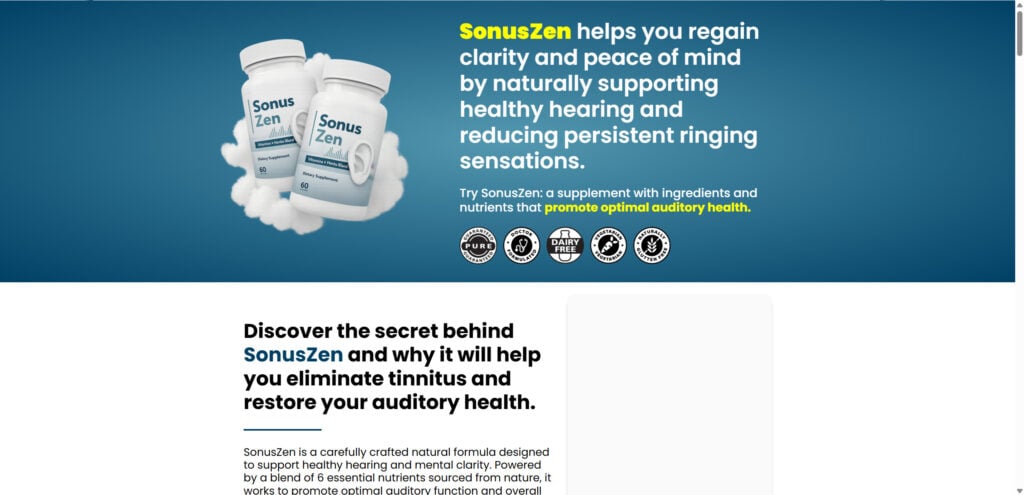
Sonus Zen Overview
Sonus Zen is marketed as a dietary supplement for tinnitus and hearing support. The product is promoted to people dealing with ringing, buzzing, hissing, ear noise, poor focus, poor sleep, and stress related to tinnitus.
The sales pages and promotional listings commonly describe Sonus Zen as a natural formula that may include ingredients such as ginkgo biloba, garlic, rhodiola, vitamin C, vitamin B6, hawthorn berry, or similar auditory-health ingredients. Some listings promote it as a capsule supplement, while other ad funnels in the same niche may use drops, sprays, or “natural ear support” language.
The advertised claims often include:
- Reducing ringing in the ears
- Supporting hearing clarity
- Improving auditory balance
- Supporting blood flow to the inner ear
- Reducing inflammation or stress triggers
- Helping with focus and mental clarity
- Supporting calmer moments
- Helping sleep by reducing ringing discomfort
- Providing natural tinnitus support
- Working within weeks with consistent use
That pitch is attractive because tinnitus can be exhausting. Many people with tinnitus are desperate for relief and may be willing to try anything that promises silence, calm, or better sleep.
The problem is that tinnitus is a complex medical symptom, not a simple supplement deficiency. A capsule sold through social media ads should not be treated as a cure for tinnitus or hearing damage.
Why Sonus Zen Raises Red Flags
1. Tinnitus “relief” claims are a sensitive health claim
Tinnitus is not just a minor annoyance. It can be linked to hearing loss, noise exposure, earwax, middle-ear problems, jaw disorders, medication side effects, age-related changes, auditory nerve issues, and other causes.
A supplement ad cannot diagnose the cause of someone’s tinnitus. It also cannot prove that one formula will work for everyone.
Any product claiming to reduce ringing, restore auditory balance, or calm tinnitus should be supported by serious clinical evidence on the finished product, not just ingredient descriptions and customer stories.
2. Supplements are not approved tinnitus treatments
Sonus Zen is marketed as a dietary supplement, not a prescription treatment. That distinction matters.
Dietary supplements are not FDA-approved for safety and effectiveness before sale, and supplement companies are responsible for making sure their products are properly labeled and not misleading.
The American Tinnitus Association warns that dietary supplements are not effective for reducing the perception of tinnitus and points to clinical guidance saying clinicians should not recommend ginkgo biloba, melatonin, zinc, or other dietary supplements for persistent bothersome tinnitus.
That does not mean every user will report no benefit. But it does mean buyers should be very cautious of any supplement promoted as a tinnitus solution.
3. Multiple sites and listings create confusion
Sonus Zen appears under several names and listings, including SonusZen, Sonus Zen, “official” Sonus Zen pages, Amazon listings, and promotional advertorial pages.
This is a red flag because buyers may not know who is actually selling the product, which refund policy applies, which checkout is legitimate, or whether the order is one-time or recurring.
A trustworthy supplement brand should have a clear official website, clear company identity, consistent pricing, consistent refund terms, and transparent customer support.
When the same product name appears across many pages and sellers, the buyer should slow down.
4. Similar products are sold under many tinnitus-support names
Sonus Zen is part of a larger category of tinnitus and hearing-support supplements. Many of these products use similar claims, ingredients, funnels, and sales structures.
They often promise natural relief for ringing ears, improved hearing clarity, reduced inflammation, better circulation, nerve support, and improved focus.
The product names change, but the formula story is often similar.
This suggests Sonus Zen may not be a unique breakthrough. It may be another supplement in a crowded private-label or affiliate-driven tinnitus niche.
5. Fake or exaggerated ad claims may be used
Tinnitus supplement ads frequently use fake doctor stories, fake news-style pages, AI-generated videos, celebrity-style endorsements, and dramatic “they don’t want you to know” messaging.
The user specifically warned that depending on the site, Sonus Zen may be sold with refills or multiple bottles. That matches the broader pattern seen in tinnitus supplement funnels: emotional ads, exaggerated claims, and checkout designs that push larger purchases or recurring charges.
Buyers should be especially cautious if an ad uses:
- fake doctor interviews
- AI-generated celebrity videos
- news-style landing pages
- “one simple trick” language
- “hidden cause of tinnitus” claims
- “big pharma doesn’t want you to know”
- fake Facebook comments
- fake social proof
- countdown timers
- huge bottle discounts
These are marketing tactics, not proof.
6. Multi-bottle packages pressure buyers to spend more
Sonus Zen offers often push larger packages. A single bottle may be priced high, while three- or six-bottle packages are made to look like the best value.
This is common in supplement funnels because the seller wants a higher average order value. The page may say the product takes 60 or 90 days to work, which encourages customers to buy several bottles before they know whether the supplement helps.
That creates risk. If the product does not work, the buyer may be stuck trying to return multiple opened or partially used bottles.
7. Automatic refills may be hidden or easy to miss
The user warned that depending on the site, multiple bottles or refills may be sent. That is a major concern.
Some checkout pages may include:
- Subscribe and Save
- auto-refill
- recurring billing
- monthly shipment
- VIP membership
- continuity program
- priority shipping club
- “free gift” tied to membership
- post-purchase one-click upsells
- preselected multi-bottle packages
A buyer may believe they placed a one-time order, only to later see another charge or receive another shipment.
This is one of the most common problems with supplement funnels: the first purchase is easy, but canceling refills becomes difficult.
8. Refund promises may not be simple in practice
Sonus Zen pages may advertise a 60-day money-back guarantee or claim buyers can return bottles, even empty ones, for a full refund.
That sounds reassuring. But buyers should not rely only on the headline guarantee. They need to check:
- whether return shipping is required
- whether shipping and handling are refundable
- whether empty bottles qualify
- whether all bottles must be returned
- whether subscriptions are excluded
- whether renewals are refundable
- whether a return authorization is required
- whether support responds before the deadline
In many supplement funnels, the refund process is where buyers become frustrated. They may be offered partial refunds, told to keep the product, asked to return bottles at their own cost, or told a renewal has already processed.
9. Payment processors and checkout platforms can complicate disputes
Some supplement funnels use third-party checkout platforms. Charges may appear on statements under a processor name rather than the product name.
This can confuse customers who later see a charge they do not recognize. It can also make it harder to know whether to contact the product seller, the checkout platform, or the payment processor.
If you order Sonus Zen, save the exact merchant name from the receipt and your bank statement.
10. Online tinnitus sufferers are a vulnerable audience
People with tinnitus often feel desperate because the sound is constant and hard to ignore. That makes them vulnerable to ads promising quick relief, restored silence, or a hidden natural cure.
This is why tinnitus supplement marketing is especially concerning. It targets people who may be stressed, sleep-deprived, anxious, and searching for hope.
A product may ship real capsules, but that does not make the claims reliable.
How the Sonus Zen Sales Funnel Appears to Work
Step 1: The ad targets tinnitus distress
The funnel usually begins with a video, social media ad, search ad, or advertorial page about ear ringing.
The message may focus on fear: tinnitus getting worse, losing hearing, being unable to sleep, feeling distant from loved ones, or struggling to focus.
That emotional pressure pushes the viewer to keep watching or click through.
Step 2: The ad presents a hidden cause
Many tinnitus supplement funnels claim tinnitus is caused by toxins, inflammation, nerve irritation, poor circulation, or a missing nutrient.
This creates a simple story: the ringing is not random, and a natural formula can target the root cause.
The problem is that tinnitus can have many causes. A marketing video cannot determine which cause applies to a specific person.
Step 3: The product is made to sound natural and risk-free
Sonus Zen is presented as a natural supplement, often with herbs, vitamins, antioxidants, and circulation-support ingredients.
“Natural” makes the product feel safer. But natural ingredients can still cause side effects, interact with medications, or be inappropriate for certain medical conditions.
Step 4: Fake authority may be used
Tinnitus supplement ads often use doctor-style figures, fake media pages, or AI-generated celebrity-style videos to create credibility.
If an ad suggests a famous doctor, podcast host, news outlet, or medical authority endorsed Sonus Zen, verify it independently. Do not trust the ad itself.
Step 5: The buyer reaches a pricing page
The pricing page usually shows bottle bundles. The larger package is framed as the best value, while the single-bottle option looks expensive.
This makes buying multiple bottles feel logical.
Step 6: The checkout may include refills or add-ons
Depending on the site, the checkout may include auto-refill terms, subscription language, shipping upgrades, VIP memberships, or post-purchase upsells.
This is where buyers need to be most careful. A small checkbox can create recurring charges.
Step 7: Refunds become harder than expected
If the buyer is disappointed, the refund process may involve support delays, return instructions, bottles needing to be mailed back, shipping costs, and renewal charges that are not refunded.
This is why buyers should document everything from the start.
Main Red Flags
- Claims to support or reduce tinnitus, ringing, buzzing, or hearing discomfort.
- Tinnitus is a medical symptom with many possible causes.
- Supplements are not FDA-approved tinnitus treatments.
- The American Tinnitus Association warns that dietary supplements are ineffective for reducing tinnitus perception.
- Multiple Sonus Zen and SonusZen pages/listings create confusion.
- Similar tinnitus supplements are sold under many names.
- Ads may use fake doctors, AI-style videos, fake news pages, or exaggerated testimonials.
- Multi-bottle packages pressure buyers to spend more.
- Some sites may include automatic refills or recurring billing.
- Refund guarantees may require returning bottles and paying shipping.
- Subscription renewals may be hard to cancel once processed.
- Charges may appear under a checkout platform or merchant name buyers do not recognize.
- Buyers may receive more bottles than expected if they select a bundle or upsell.
Is Sonus Zen a Scam?
Sonus Zen may ship a real supplement, so this may not be a simple “pay and receive nothing” scam in every case.
The bigger issue is whether the product is being oversold and whether the checkout/refill structure creates buyer risk.
A fair conclusion is this: Sonus Zen appears to be a high-risk tinnitus supplement offer because it combines broad hearing-related claims, multiple sales pages, generic supplement-category signals, bundle pricing, possible automatic refills, and refund friction.
Buyers should not treat Sonus Zen as a proven tinnitus cure, hearing-restoration product, or substitute for medical evaluation.
Why Tinnitus Supplement Claims Should Be Treated Carefully
Tinnitus can be caused or worsened by many factors, including:
- hearing loss
- loud noise exposure
- earwax buildup
- ear infection
- medication side effects
- TMJ problems
- Ménière’s disease
- stress
- sleep problems
- blood pressure issues
- jaw or neck tension
- auditory nerve problems
Because the causes vary, treatment also varies.
Some people benefit from hearing aids, sound therapy, tinnitus retraining therapy, cognitive behavioral therapy, treating earwax or infection, medication review, stress management, or specialist care.
A supplement advertised online cannot replace that process.
What To Do Before Buying
1. Check for subscription language
Before paying, look for:
- Subscribe and Save
- auto-refill
- recurring billing
- monthly shipment
- VIP membership
- continuity program
- next shipment
- rebill
- cancel anytime
- recurring or deferred purchase
- “future bottles”
If any of these appear and you do not want refills, do not continue until you fully understand the terms.
2. Avoid multi-bottle bundles
Do not buy three or six bottles before testing one. If the product does not help, returning multiple bottles may be difficult.
3. Screenshot the checkout page
Save screenshots showing:
- selected package
- number of bottles
- final price
- shipping cost
- subscription status
- refund wording
- guarantee terms
- merchant name
- any upsells or add-ons
4. Verify endorsements independently
If an ad claims a doctor, celebrity, podcast host, or news outlet supports Sonus Zen, search that person’s official channels. Do not trust the ad.
5. Talk to a hearing professional
If you have persistent tinnitus, sudden hearing loss, one-sided tinnitus, dizziness, ear pain, pulsatile tinnitus, or tinnitus after medication changes, speak with a healthcare professional.
What To Do If You Already Ordered
1. Check the confirmation email
Look for:
- number of bottles ordered
- total amount charged
- shipping fees
- subscription/refill terms
- next billing date
- merchant name
- refund instructions
- support email
2. Check your bank statement
Note the exact charge descriptor. It may not say “Sonus Zen.” Save a screenshot.
3. Cancel refills immediately
If you see any recurring billing or refill language, email support immediately and request cancellation. Use clear wording:
“I am canceling all subscriptions, refills, memberships, and recurring billing connected to this order. Do not charge my payment method again.”
Ask for written confirmation.
4. Save proof
Save:
- product page screenshots
- ad screenshots
- checkout screenshots
- receipt
- refund policy
- cancellation request
- support replies
- bank charge descriptor
- tracking information
5. Do not open every bottle
If you bought multiple bottles and may request a refund, keep unused bottles sealed unless the guarantee clearly allows empty bottles.
6. Request a refund in writing
Use direct wording:
“I am requesting a full refund under the advertised money-back guarantee. Please provide return instructions and confirm that no future refills or charges remain active.”
7. Do not accept unwanted partial refunds too quickly
Some supplement sellers offer partial refunds to avoid full returns. If you were misled or enrolled in refills without clear consent, a chargeback may be more appropriate.
8. Dispute if necessary
Contact your bank, credit card issuer, or PayPal if:
- you were charged for more bottles than ordered
- a refill or subscription was created without clear consent
- you were charged again after canceling
- the product never arrives
- the seller refuses the advertised guarantee
- refund instructions are unclear or unreasonable
- the product is not as advertised
Use clear wording such as:
- “unauthorized recurring charge”
- “subscription not clearly disclosed”
- “item not as described”
- “misleading health claims”
- “merchant refuses advertised refund”
- “unauthorized quantity charged”
FAQ
What is Sonus Zen?
Sonus Zen is a dietary supplement marketed for tinnitus, ringing ears, hearing support, auditory balance, and mental clarity.
Is Sonus Zen a scam?
Sonus Zen may ship a real supplement, but the offer has several red flags: tinnitus-related claims, multiple sales pages, multi-bottle packages, possible automatic refills, and refund friction.
Does Sonus Zen cure tinnitus?
There is no reliable evidence that Sonus Zen cures tinnitus. Tinnitus has many causes, and dietary supplements are not FDA-approved tinnitus treatments.
Is Sonus Zen FDA approved?
No dietary supplement should be assumed FDA-approved for safety and effectiveness before sale. Supplements are regulated differently from drugs.
Can Sonus Zen reduce ringing in the ears?
The product is marketed that way, but buyers should be skeptical. The American Tinnitus Association states that dietary supplements are ineffective for reducing the perception of tinnitus.
Can buyers receive multiple bottles?
Yes, that is a risk because many Sonus Zen offers push multi-bottle packages or checkout upsells. Always check the final quantity before paying.
Is there an automatic refill risk?
Yes. Depending on the site or checkout used, buyers may encounter refill or recurring billing terms. Always inspect the checkout for subscription language.
Are refunds easy?
Not necessarily. Even when a page advertises a money-back guarantee, buyers may need to return bottles, pay shipping, meet deadlines, and deal with support delays.
Should I buy Sonus Zen?
Be cautious. Do not treat it as a tinnitus cure. Speak with a hearing professional and avoid multi-bottle or recurring offers if you still decide to try it.
What should I do if I was charged again?
Contact the seller in writing, cancel all refills, save proof, and dispute the charge with your bank or PayPal if the charge was not clearly authorized.
The Bottom Line
Sonus Zen is marketed as a natural tinnitus and hearing-support supplement, but the offer carries several warning signs. The claims target a serious and frustrating health problem, while the sales model may include multi-bottle packages, recurring refills, and refund steps that are harder than the headline guarantee suggests.
Sonus Zen may ship real capsules, but buyers should not treat it as a proven tinnitus cure or a reliable way to restore hearing. Tinnitus deserves proper evaluation, especially when symptoms are persistent, one-sided, sudden, or worsening.
If you already ordered, check for subscriptions immediately, save screenshots, cancel refills in writing, and monitor your payment method for repeat charges








