

The Sorose Beauty 5 in 1 MultiStyler Pro is marketed as the ultimate all-in-one hair tool. Ads claim it can dry, curl, smooth, and style hair with salon-quality results—without causing heat damage. At first glance, it looks like a promising Dyson Airwrap alternative for a fraction of the cost.
But before you rush to hit “buy now,” it’s important to ask: Is Sorose Beauty legit, or is the 5 in 1 MultiStyler Pro just another dropshipping scam disguised with flashy marketing?
In this deep dive, we’ll break down how this operation works, what real buyers are saying, and what you should do if you’ve already purchased one.
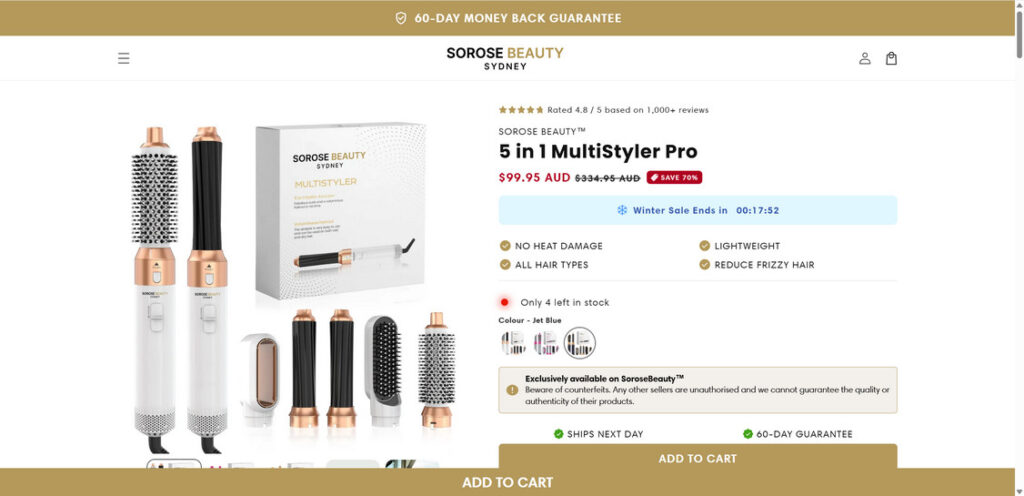
Overview of Sorose Beauty 5 in 1 MultiStyler Pro
On the official website, Sorose Beauty promises a professional-grade hair styling tool that is:
- Suitable for all hair types
- Capable of drying, curling, smoothing, and volumizing
- Lightweight and easy to use
- Designed to reduce frizz and heat damage
- Backed by a 60-day money-back guarantee
It’s presented as a premium product, priced at $99.95 AUD, supposedly discounted from $334.95. That 70% off deal, paired with countdown timers and “only 4 left in stock” banners, creates a sense of urgency to buy fast.
Why It Looks Appealing
The marketing highlights features that many people want in a hair styler:
- Multi-functionality: Instead of buying separate tools, you get one device with multiple attachments.
- Dyson Dupe Appeal: Ads often position it as a cheaper alternative to the Dyson Airwrap, which costs over $800.
- Professional Results at Home: Promises of salon-quality outcomes without needing professional tools.
- Hair Health Claims: The “no heat damage” claim is especially appealing to people with fragile or color-treated hair.
Red Flags in the Claims
However, closer inspection reveals red flags:
- Price Inflation: The “original price” of $334.95 appears inflated. Similar multi-stylers on AliExpress sell for $35–$45 USD.
- Fake Exclusivity: The site claims the product is “exclusively available on Sorose Beauty,” yet identical products are listed under different brand names across multiple websites.
- Rebranding History: Customers have linked Sorose Beauty to other sites such as Bondi Curls, which used the same product images but changed branding after negative reviews.
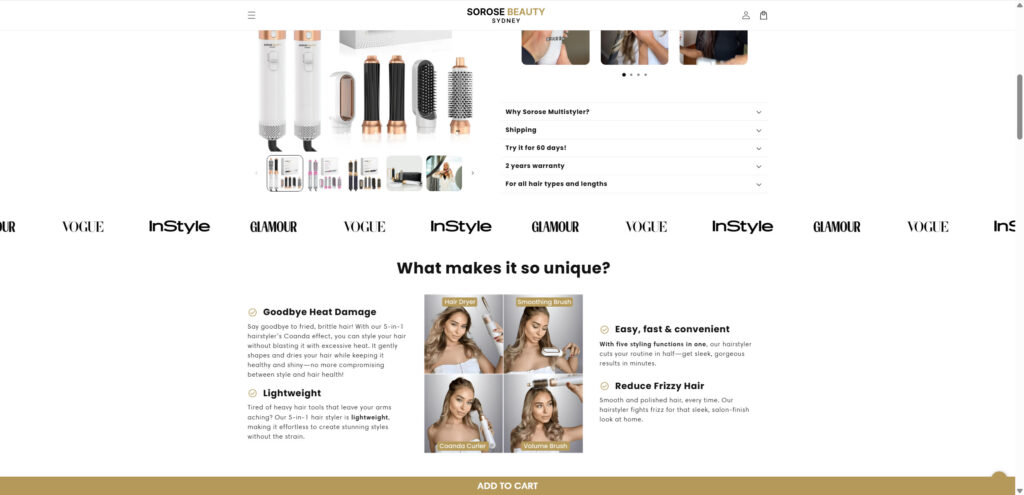
- Trust Signals Misuse: Logos of Vogue, InStyle, and Glamour appear on the site, but there’s no real evidence these outlets have reviewed or endorsed the product.
Customer Reviews
On independent platforms like Facebook groups and Reddit, reviews are far less flattering than those on the official site:
- Many customers report the product feels cheap and flimsy, not premium.
- The attachments don’t rotate properly or fit securely.
- Weak airflow makes drying and styling slow.
- Promised refund policies are difficult to claim.
While some users did receive their products and managed to style their hair, the majority describe it as an overhyped version of a budget styling tool.
How The Operation Works
The Sorose Beauty MultiStyler Pro is part of a dropshipping business model. Here’s a breakdown of how the operation works:
Step 1: Source from Cheap Suppliers
Factories in China produce generic 5-in-1 hot air stylers for around $30–$45 USD. These are listed on wholesale platforms like Alibaba and AliExpress.
Step 2: Rebrand and Mark Up
Sellers create a branded storefront (Sorose Beauty in this case) and market the product as premium. The price is marked up 3x–5x—from $40 wholesale to $100–$150 retail.
To boost perceived value, they often inflate the “original price” to make the discount look massive (e.g., “$334.95 → $99.95”).
Step 3: Aggressive Marketing
The operation relies heavily on paid ads across Facebook, Instagram, and TikTok. These ads:
- Compare the product to high-end tools like Dyson.
- Use before-and-after photos to exaggerate results.
- Feature fake urgency tactics like “Only 4 left in stock” or “Sale ends in 10 minutes.”
- Claim celebrity magazine endorsements without proof.
Step 4: Fake Trust and Reviews
Websites include:
- Trustpilot badges (often misleading or cherry-picked).
- Doctored reviews—some may be AI-generated or copied from other platforms.
- Social proof manipulation, like inflated customer counts (“68,000+ women tested”).
Step 5: Complicated Refund Policies
The website promises a 60-day money-back guarantee, but when customers request refunds:
- They’re told refunds only apply if the item is faulty.
- Even then, they must ship the product back to China at their own expense.
- Parcels often get rejected at customs, making refunds nearly impossible.
Step 6: Rebranding After Complaints
Once negative reviews build up, the store simply shuts down or rebrands under a new name. This cycle allows the sellers to continue selling the same product while avoiding accountability.
What To Do If You Have Fallen Victim
If you bought from Sorose Beauty and feel misled, here are steps you can take:
1. Contact the Seller
- Email Sorose Beauty directly and request a refund.
- Keep all receipts, email confirmations, and screenshots.
2. File a Chargeback
- If you paid by credit card or PayPal, open a dispute.
- Provide proof of misleading advertising and screenshots showing identical products on AliExpress at much lower prices.
3. Report the Business
- Australia: Report to the Australian Competition and Consumer Commission (ACCC).
- US buyers: File with the Federal Trade Commission (FTC).
- UK buyers: Report to Action Fraud.
4. Leave Public Reviews
Warn others by posting your experience on:
- Trustpilot
- Reddit (scams and beauty product threads)
- Facebook groups
5. Watch Out for Rebrands
If Sorose Beauty shuts down, it may reappear under a new name. Look out for:
- Similar product photos.
- Same sales tactics (fake discounts, urgency timers).
- “Australian” branding without real business registration.
6. Choose Safer Alternatives
Instead of risking your money, buy from trusted beauty brands that offer warranties and customer service:
- Dyson Airwrap (high-end but proven quality).
- Revlon One-Step Volumizer (budget-friendly and reliable).
- Hot Tools Professional Stylers (salon-grade at fair prices).
The Bottom Line
The Sorose Beauty 5 in 1 MultiStyler Pro is not the premium hair tool it claims to be. Instead, it’s part of a dropshipping operation that uses fake urgency, inflated pricing, and misleading branding to sell a generic product at a huge markup.
While some customers may receive a working product, many report poor quality, refund issues, and misleading marketing. The risks outweigh the benefits.
Verdict: Should you buy it? No. Stick to reputable brands that deliver consistent quality and real customer support.








