

Strtvoid’s Halloween banner is hard to miss. Below it, the shop jumps from ornaments to car gadgets, beauty tools, and surprisingly powerful machines.
That mix can make a bargain hunt entertaining. It also makes the fine print and product claims more important than the seasonal artwork.

Overview
A general store wearing a seasonal costume
Strtvoid is an online general-merchandise shop. Its current homepage leads with a Halloween sale, then displays a broad set of unrelated products.
Among the listings we reviewed were a handheld vacuum, car display, ear-cleaning device, novelty ornaments, and a claimed laser welding tool.
The site presents steep markdowns and attention-grabbing product names. That style is not proof of fraud, but it increases the need for item-level verification.
The easy-return banner conflicts with the details
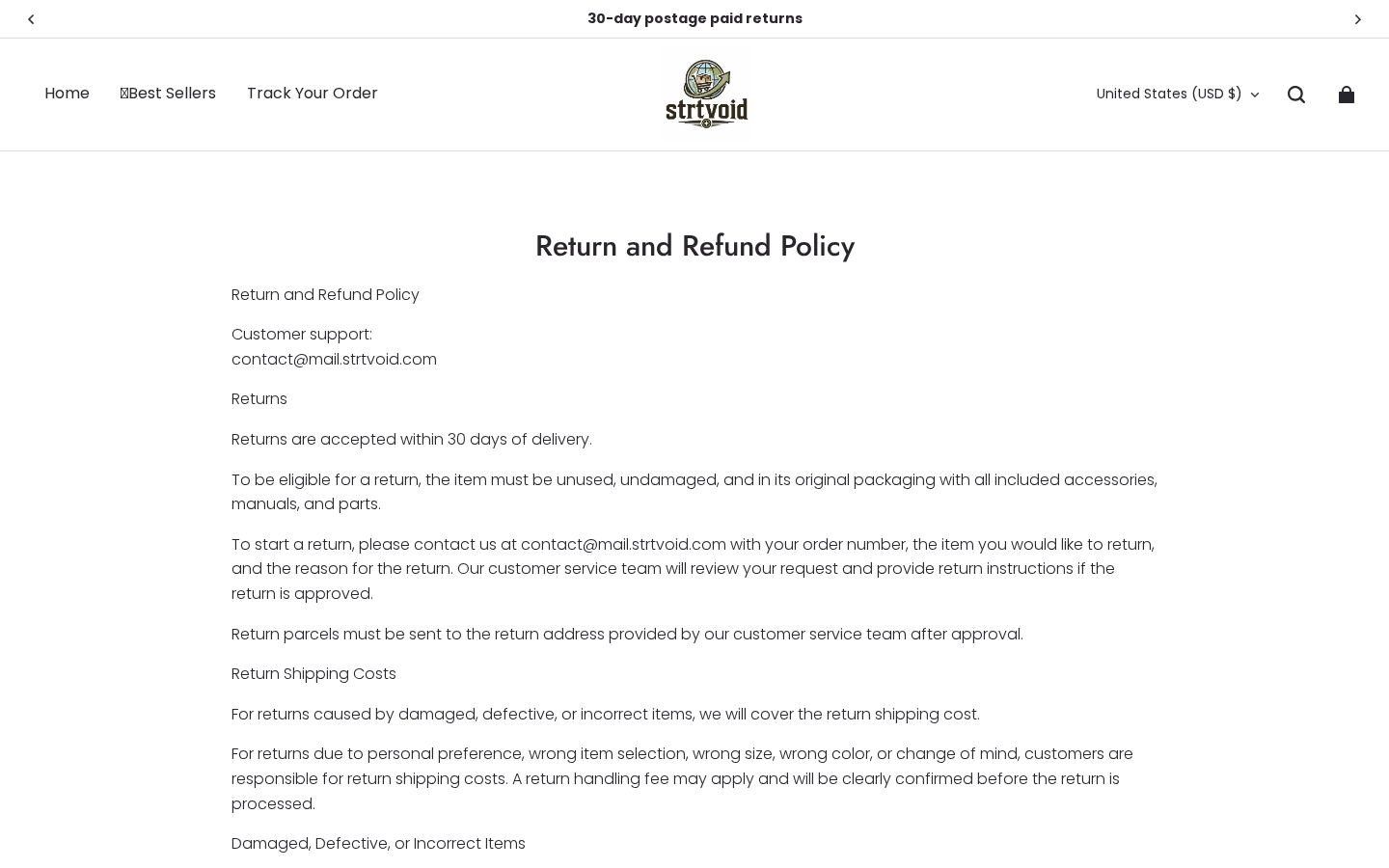
The top banner says “30-day postage paid returns.” A return-policy view we captured required customers to pay shipping for preference returns.
It also required an unused, complete item and an approved request before the return destination would be supplied.
Another current crawl of that policy URL displayed older, inconsistent wording, including a 7–14-day general return period. The page merits rechecking before purchase.
We cannot infer from inconsistent wording that every return will fail. We can say buyers lack a single, clear promise on the pages reviewed.
Overseas fulfillment changes the practical timeline
The shipping policy says parcels may leave overseas partners or warehouses and allows two to five business days for processing.
It gives the United States a 7–15 business-day delivery estimate. Tracking can take additional time to update.
The policy also asks customers to contact the store if an order has not arrived within 60 days, rather than promising an automatic refund.
Before buying, separate the store’s promises into four questions:
- What exact model or specification is being sold?
- Where will the item ship from, and when?
- What is the complete price after shipping and possible import charges?
- Who pays to send it back if it is disappointing?
- Which written return window actually applies?
- Is the support route good enough for a time-sensitive defect report?
Why the Product Claims Need Their Own Investigation
A store can sell many categories without doing anything wrong. The challenge is that each category demands different proof.
A kitchen ornament needs accurate dimensions and materials. A powered tool needs credible electrical specifications, safety instructions, and repair support.
Strtvoid’s catalog compresses those differences into similarly styled discount cards. That can make a technical claim look as casual as a gift listing.
One page described an ear-irrigation kit with professional-sounding approval and guideline language. The listing itself does not verify an individual clinician’s endorsement.
Another offered a “German Technology” multifunction laser welding gun at $49.90, with exceptionally broad safety and capability promises in the title.
We did not purchase the tool, identify its manufacturer, or verify a German patent. The page’s claim should not be repeated as an established product fact.
Laser welding, cutting, and rust removal involve substantial power and safety issues. A headline saying a device is burn-proof deserves a specific independent test.
The same caution applies to an ear device. People with pain, drainage, a known perforation, or prior ear surgery should seek professional guidance.
The point is not that every item is harmful. It is that a dramatic product title cannot substitute for a manual, traceable manufacturer, and credible testing.
Start with the item you want, then look for an exact model outside Strtvoid. A generic photograph can appear under many unrelated labels.
If you cannot identify the device, you also cannot easily check replacement parts, recalls, compatibility, or real owner experiences.
For a novelty purchase, you may accept that uncertainty. For a safety-relevant product, it is a reason to pause.
How the Strtvoid Shopping Journey Works
Step 1: A wide sale creates a sense of discovery
The visitor lands on a festive banner and a sequence of products that seem to solve unrelated problems with unusually simple gadgets.
A broad “up to 50% off” message makes the page feel like an opportunity rather than a collection requiring careful product-by-product scrutiny.
That is a familiar online-retail technique. What matters is whether each listing supports its strongest measurable claim.
Take an item out of the sale carousel mentally. Would its specifications still justify the price without the countdown or crossed-out amount?
Step 2: Long titles do the persuading before evidence appears
Some listings contain performance numbers, professional-sounding terms, and national-origin language directly in the title.
That presentation can make a shopper feel the facts are already settled before opening the product page.
For a vacuum, ask how suction was measured and at what battery level. For a car display, verify compatibility and installation requirements.
For a medical or electrical device, demand the manufacturer, model, manual, and authentic certification information.
We found no basis to treat every listing as false. We found ample reason to demand more than the headline.
Step 3: Checkout begins an overseas delivery path
According to the shipping policy, orders can be fulfilled from overseas warehouses. Payment may be followed by several processing days before shipment.
The U.S. estimate of 7–15 business days is not a promise that every parcel reaches its buyer in one week.
The store also warns that tracking may take time to update after handoff to a carrier or arrival in the destination country.
A buyer should record the order date, processing estimate, dispatch message, and carrier scans rather than relying on a vague “fast delivery” badge.
International duties and customs charges may fall to the customer, depending on destination and checkout terms.
Step 4: The written return route appears after support approves it
A customer wanting to return an item must contact support first and wait for instructions. The destination is not posted as a universal address.
That can be reasonable for a warehouse operation, but it prevents a shopper from estimating return postage before paying.
The captured policy made preference-return shipping the buyer’s expense, despite a banner promising postage-paid returns.
Get the seller to explain that difference in writing. Ask whether “postage paid” applies only to damaged goods, certain regions, or every eligible return.
Also ask whether any handling fee applies. Different versions of the policy page we observed were not perfectly consistent.
Step 5: A delayed or disputed parcel needs documentation
The shipping policy says an order missing after 60 days should be reported for investigation. A replacement or refund is described as possible, not automatic.
Sixty days is a long time to wait for a low-cost impulse purchase, and payment-provider dispute deadlines may not match that timeline.
If tracking stalls, contact the seller earlier. Keep the record active while checking your card issuer’s time limits.
For a defective item, photograph the problem promptly. Do not modify a technical device in ways that obscure its original condition.
The more precise your evidence, the less the dispute depends on broad slogans like “lifetime support.”
The Return Wording Is a Real Buyer-Risk Signal
There is a meaningful difference between a 30-day refund guarantee, a 30-day return window, and prepaid return shipping.
Strtvoid uses language that evokes all three, yet the detailed policy view we captured places preference postage on the customer.
The older text returned by another current crawl described a 7–14-day general return period and a separate 30-day damaged-product guarantee.
This may reflect cached versions or recent policy edits. We cannot establish which version would control a specific order without the seller’s written confirmation.
The safest approach is to save the page you saw at checkout and ask support to identify the applicable terms.
Get the start date of the clock: order, shipment, or delivery. Those dates can differ by weeks when a parcel comes from overseas.
Ask whether an item may be opened or tested. A policy requiring unused goods may be difficult to apply to a device bought for its advertised function.
Finally, request the country and estimated cost of the return route. “Easy” means little if the postage consumes the refund.
Company, Address, and Fulfillment Checks
The store name does not identify an accountable company
The reviewed About page talks about the Strtvoid brand and its broad interests, but it does not prominently identify a registered legal entity.
It also contains the stray phrase “slimveron intense selection process,” which appears unrelated to the Strtvoid name.
That looks like a copy-editing or template problem, not proof that the businesses are connected or that orders are fraudulent.
Ask for the company name on the receipt and compare it with the card statement and support reply.
The return warehouse is withheld until approval
The published policy says support will provide the return address after a request is approved. It does not name one universal destination upfront.
We cannot verify whether that address is a warehouse, mailbox, or third-party logistics facility before an order-specific authorization exists.
The shipping policy’s reference to overseas partners makes the location financially important. International return postage could be material.
Do not mail an item to an address from a package label without checking the seller’s instructions. Fulfillment and returns may use different facilities.
Support is reachable by an email address, not a verified response history
The site publishes contact@mail.strtvoid.com and a web form. It says customer service typically responds within 24 to 48 hours.
We did not place a test order or send a support request. We therefore cannot say whether that promise is consistently honored.
For a product with unusually strong claims, ask a specific technical question before buying. A substantive answer is more informative than a badge.
Keep replies in the same email thread so any changing policy explanation remains traceable.
Origin and safety need product-specific proof
The site acknowledges overseas fulfillment but does not establish where each product was manufactured or what testing applies to it.
Do not assume all Strtvoid goods share one factory or country. That would be an inference, not an observation.
For powered tools, ask for electrical ratings, safety instructions, manufacturer and warranty. For body-contact items, check material and risk warnings.
Calling an item “German-engineered” or “ENT-approved” is not equivalent to providing a verifiable certificate or named approving organization.
Practical Checks Before Buying a Specific Strtvoid Item
The right question depends on the item. A seasonal decoration and a laser tool should not pass through the same quick trust checklist.
For any listing, compare the exact product image and model number across multiple stores. A generic item may be widely available at different prices.
Look for actual dimensions, weight, included parts, operating voltage, and a user manual. Shortcomings in those details matter after delivery.
For a claimed medical or protective product, do not rely on the store title as a professional recommendation.
For electronics, verify the power source and regional plug compatibility. A low price does not compensate for an unusable or unsafe unit.
Before paying, calculate the total with shipping, import fees if applicable, and the cost of a possible return.
Keep a screenshot of the precise claim that persuaded you. If the product differs, that sentence becomes more useful than a generic complaint.
If essential answers remain unavailable, choosing a seller with clear specifications and a local return route can be worth the extra cost.
What to Do If You Ordered from Strtvoid
- Save the listing and current policies. Store screenshots of the product description, price, postage-paid banner, return text, shipping terms, and order confirmation.
- Check the merchant identity and total. Compare your receipt and card statement. Ask about any unexplained descriptor or added product, without sending your full card number.
- Track processing and transit separately. The policy allows two to five business days before shipping and longer U.S. delivery. Record each update with its date.
- Document a problem immediately. Photograph a damaged, incorrect, or nonworking item, including packaging and model label. Report it before a short policy window passes.
- Resolve the return conflict before mailing. Ask whether the postage-paid banner covers your reason, who pays shipping, what window applies, and where the authorized parcel goes.
- Keep payment deadlines in view. If a package remains missing or support stalls, contact your payment provider early rather than waiting until a stated 60-day investigation point.
- Choose the appropriate escalation. For a documented misdescription, missing delivery, or unauthorized charge, provide the seller’s pages and your messages to the card issuer.
If the product is electrical or used on the body, stop using it when its identity, instructions, or condition are unclear. Seek qualified advice when needed.
Frequently Asked Questions
Is Strtvoid a proven scam store?
No. We found significant claim and policy concerns, but not independent proof that the store systematically fails to deliver orders.
Are all returns postage paid?
The banner suggests that, while the detailed policy view placed preference return postage on customers. Get a written answer for your order.
Where do Strtvoid orders ship from?
The shipping policy says overseas fulfillment partners or warehouses may handle orders. It does not identify the origin of every item.
How long might a U.S. order take?
The policy allows two to five business days for processing and gives a 7–15 business-day U.S. delivery estimate.
Does “German-engineered” prove a product was made in Germany?
No. The phrase in a listing title does not establish manufacturing origin, patent ownership, or independent safety testing.
Why does the About page mention another name?
It includes an unrelated “slimveron” phrase. That signals weak editing or templating, but it does not establish shared ownership or fraud.
The Bottom Line
Strtvoid’s wide catalog combines aggressive product promises with an overseas shipping route and return wording that needs clarification.
The strongest documented concern is simple: a postage-paid banner does not match the buyer-paid preference-return language we captured.
Buy only after the exact product claim, delivery estimate, company identity, and return cost make sense in writing.








