


Sugar Defender’s offer makes a bigger order feel reassuring: lower bottle prices, free shipping on selected packages, and a prominent money-back promise.
That promise matters when you’re buying something you haven’t tried. The less obvious question is what happens when you actually ask for your money back.
Overview
The Facebook link reaches a Sugar Defender sales page
The Sugar Defender Blood Sugar Control Facebook page directs visitors through besthealthtopic.com to sugardefender24.com. The destination sells a liquid blood-sugar supplement.
Its pitch combines plant ingredients, customer stories, package savings, and a 60-day guarantee. The three-bottle and six-bottle offers also include digital bonuses.
This article examines that purchase route and its linked policies. Other websites using the Sugar Defender name can present different claims or conditions.
The discount and refund wording don’t fit together comfortably
The offer presents its packages as discounted purchases. The linked returns page says sale items cannot be refunded, while reserving refunds for regularly priced items.
That creates an important question about the exact deal being promoted. A buyer shouldn’t need to discover after payment whether the guarantee covers it.
- The advertised guarantee lasts 60 days from the original purchase.
- Return authorization is required under the returns policy.
- The shipping policy requires returned bottles to arrive within that same 60-day period.
- Return postage is paid by the customer.
A refund risk is different from a proven refill trap
The offer’s FAQ explicitly describes a single payment, with no future payments needed. No recurring enrollment was demonstrated through the inspected material.
The documented concerns are the guarantee conflict, purchase-based deadlines, and health claims that go beyond what an ingredient list can establish.
Those concerns support a firm buying warning without claiming that every customer receives unauthorized charges or is refused a refund.
The $49 Bottle Is a $294 Product Purchase
Read the package total before the savings figure
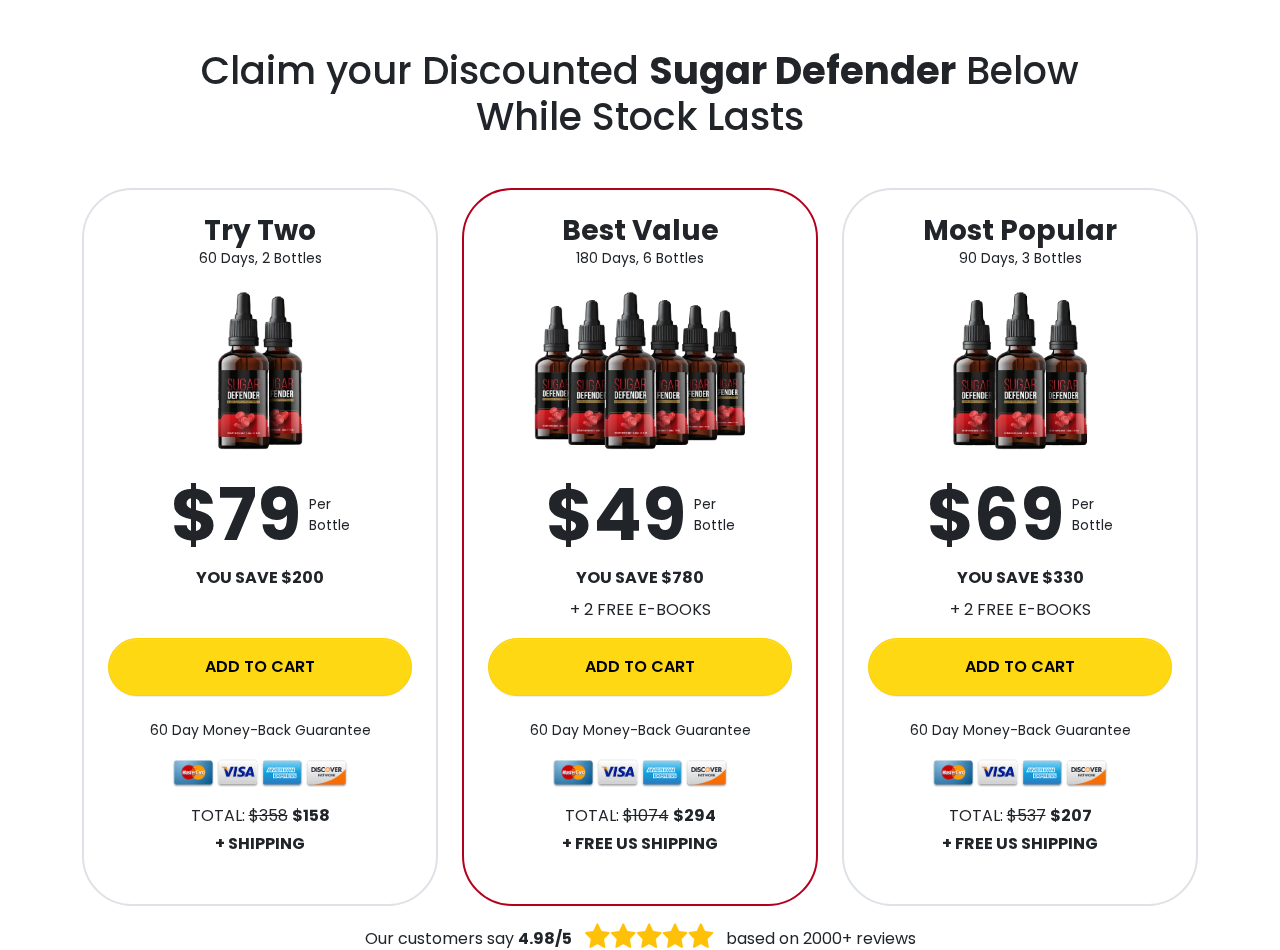
The smallest package contains two bottles at $79 each, totaling $158 before shipping. There isn’t a one-bottle purchase among these three displayed options.
The middle package costs $207 for three bottles. The six-bottle package totals $294, with $49 emphasized as its unit price.
Free U.S. shipping on the larger packages can make them feel easier to justify. It doesn’t reduce the quantity of an untried supplement you’re committing to.
These are package prices, not a payment plan. Nothing in the displayed $49 figure means the $294 product total will be divided into monthly installments.
Customer counters don’t answer whether the product suits you
The page displays a high rating, a large review count, and a claim that most customers choose six bottles.
Those figures belong to the seller’s presentation. The page doesn’t supply the underlying order dataset that would let a reader independently check that purchasing claim.
More importantly, somebody else’s package size says nothing about your medication, nutritional needs, or willingness to spend $294 before trying the product.
How This Sugar Defender Offer Moves Toward Payment
Step 1: The Facebook page supplies a familiar starting point
That page describes blood-sugar and metabolic support, then provides an ordering link labeled as an official website.
That wording is a promotional claim. It isn’t independent confirmation of who manufactures the drops or who must handle a return.
Follow the names through the sale: the social page, destination, retailer, receipt, and package should tell a consistent story.
Step 2: A dedicated order page makes the bundles the first decision
The link opens a page headed with discounted Sugar Defender packages. Price cards appear before the longer explanations further down.
This order matters. It’s easy to begin choosing between two and six bottles before deciding whether the product deserves a purchase at all.
Pause at this point and read the complete price, ingredient information, warnings, and return conditions. The cheapest unit isn’t necessarily the best decision.
Step 3: The health pitch encourages a longer supply
The FAQ recommends consistent use for three months or longer and points shoppers toward the three-bottle or six-bottle discount.
But the money-back period is 60 days from purchase. Someone waiting three months to judge the advertised result would be outside that stated window.
A longer suggested routine doesn’t extend a shorter refund deadline. Buyers need to decide whether they’re comfortable with that difference before ordering.
Step 4: The chosen package is handed to BuyGoods
Each package button links to BuyGoods with a product code for the selected quantity. BuyGoods identifies itself as the retailer.
Before authorizing payment, confirm the final product name, shipping country, total charge, and quantity. Keep a copy of the offer connected to that receipt.
Don’t confuse a checkout’s encryption statement with proof of medical effectiveness. Protecting a card transaction and substantiating a health claim are separate matters.
Step 5: The customer must navigate several return conditions
The returns page requires approval for an RMA, meaning a return authorization number. It asks for that request within 60 days of purchase.
It then gives 14 days after receiving the authorization to send the product back. The shipping page separately requires arrival within the original 60 days.
Those instructions can lead to different expectations, particularly when authorization is issued near the end of the period.
The discounted-item exclusion adds another unresolved condition. Ask for an answer tied to the exact advertised package, not a general reassurance about customer satisfaction.
What the Ingredient Claims Can and Cannot Tell You
The page names eight ingredients, not a proven treatment
The sales page highlights eleuthero, coleus, maca, African mango, guarana, gymnema, ginseng, and chromium. It associates them with energy, metabolism, and glucose support.
Knowing those names is a starting point. A useful product assessment also needs amounts, extract specifications, serving instructions, and the full current label.
The page’s scientific references include research on particular ingredients and health topics. They aren’t automatically trials of the bottled formula being sold.
A study using one preparation cannot establish what happens when a buyer takes a different blend, at undisclosed individual doses, alongside prescribed medicine.
Blood-sugar claims deserve more care than beauty advertising
Someone worried about a glucose reading may be particularly receptive to a convenient natural alternative. That makes an exaggerated expectation more consequential.
NCCIH’s diabetes guidance says most supplements lack evidence of benefit for diabetes or its complications and should not replace established care.
If you have diabetes, take the actual label to your healthcare team. Don’t reduce medication because a testimonial describes a favorable reading.
A seller’s customer story doesn’t show what else changed, whether the diagnosis was confirmed, or whether the same result is likely for you.
Facility registration isn’t product approval
The offer refers to an FDA-registered manufacturing facility and GMP standards. Those statements concern claimed manufacturing arrangements, not approval of Sugar Defender as a diabetes treatment.
A finished-product testing report would identify the sample, methods, laboratory, and measured results. A general quality badge doesn’t provide those details.
No independent product test was carried out here. The findings concern the sales page, its ingredient claims, and the return conditions attached to the advertised packages.
Who Handles the Sale, Shipping, and Refund?
The retailer and product brand have different roles
The order page names BuyGoods as retailer while using Sugar Defender branding throughout the pitch. Its disclaimer says the retail role doesn’t endorse promotional claims.
Keep that distinction when seeking help. The retailer can identify the transaction, while product questions may require the seller’s own label and manufacturing information.
A receipt should make it possible to connect those roles without sending financial information to an unrelated social-media account.
The return destination is in Aurora, Colorado
The policy lists 19655 E 35th Dr #100, Aurora, CO 80011, as the return address. It tells customers not to return purchases to the manufacturer.
That makes the address a stated return destination, not proof that the drops are manufactured in Colorado or that the brand’s headquarters are there.
Obtain current authorization before mailing anything. An address copied from a webpage may not be sufficient to connect your package with an approved refund.
Support details should be matched to the order
The contact page publishes +1-866-994-8188 for product and order support. No call or message test was performed for this article.
Ask for a written answer about sale-item eligibility, RMA timing, and the required arrival date. A phone reassurance is harder to document later.
If you speak with support, record the date, reference number, and promised next step in your own notes. Don’t publish sensitive order details.
Delivery time uses part of the refund window
The shipping policy describes processing before transit, excludes certain nonworking days, and warns that international delivery can take substantially longer.
Because the return deadline begins at purchase, a delayed delivery can leave less time to assess the product and arrange a tracked return.
The policy also requires every bottle, including bonus or free bottles, for the stated full-refund process. Keep the packaging rather than throwing it away.
Don’t Let a Delivery Delay Decide the Refund for You
The purchase-based deadline creates a practical problem for anyone whose parcel arrives late. Time spent waiting is also time disappearing from the return window.
Keep the order date, dispatch date, tracking history, and delivery date in one place. Those records distinguish a late shipment from an extended personal trial.
If the package hasn’t arrived, contact the retailer before the refund period runs down. Ask what remedy applies while the goods remain undelivered.
A request to keep waiting shouldn’t leave the deadline unexplained. Obtain written confirmation of any extension rather than assuming delivery trouble automatically pauses the clock.
If support offers a replacement, clarify whether accepting it changes the refund timetable. The important point is preserving a usable remedy, not starting another uncertain wait.
These are questions for the exact order. They don’t establish that every late parcel is lost or that a merchant’s policy overrides applicable consumer protections.
What to Do If You Purchased Sugar Defender
-
Gather the complete order record. Save the receipt, item count, original offer, product photographs, and payment entry.
Keep the purchase date visible. The posted refund clock starts there, even if the package arrived later.
-
Cancel promptly if the order was unintended. The shipping policy describes a narrow cancellation opportunity, with processing or dispatch potentially preventing a stop.
Request cancellation immediately and ask whether fulfillment has begun. Keep the response rather than assuming a submitted message canceled the shipment.
-
Ask whether your discounted package qualifies for the guarantee. Attach the saved offer and quote the conflicting policy only as needed.
Request the applicable refund amount and any deductions. A specific written answer is more useful than a link back to the same inconsistent pages.
-
Request an RMA before the deadline. Ask whether the return must arrive within 60 days or whether the stated authorization-based shipping period applies.
Plan around the earlier date until support confirms otherwise. Retain proof showing when you first requested help.
-
Return the required contents with tracking. Preserve all bottles and obtain the complete authorized address and packing instructions.
Photograph the contents before sealing the parcel. Keep the postage receipt and delivery record until the refund has actually posted.
-
Follow up through the retailer when needed. Use the order lookup associated with your BuyGoods confirmation to identify the purchase.
Explain the disputed condition and attach the timeline. Don’t send full card details by email or through Facebook messages.
-
Check later debits without assuming their cause. The inspected offer describes one-time payment, so preserve that representation.
For an unexpected charge, request its authorization and ask your payment provider about available controls or dispute deadlines.
-
Keep medical decisions outside the sales conversation. Share the actual product label with your clinician or pharmacist before use.
If symptoms or glucose readings concern you, seek appropriate care rather than waiting for the advertised three-month routine to finish.
Frequently Asked Questions
Does Sugar Defender’s $49 offer buy one bottle?
Not on this page. The $49 unit price belongs to a six-bottle package costing $294 for the products. The smallest displayed package contains two bottles.
Are discounted orders definitely excluded from refunds?
The returns page excludes sale items, while the offer advertises discounted packages with a guarantee. That conflict needs clarification; it doesn’t prove every refund is refused.
Can I try it for three months and still use the guarantee?
The advertised guarantee lasts 60 days from purchase. A three-month recommendation doesn’t automatically extend that deadline, and return transit may need to fit inside it.
Does this offer include automatic monthly billing?
The inspected FAQ says payment is one-time. No monthly refill agreement was established. Keep your own accepted terms and investigate any later charge individually.
Who pays to send the bottles back?
The posted policies put return postage on the buyer and require the specified bottles and documentation. Confirm the exact instructions before mailing the parcel.
Can these drops replace diabetes medication?
Don’t replace prescribed treatment with this supplement. Discuss its label and any intended use with a qualified professional familiar with your condition.
The Bottom Line
Do not buy Sugar Defender through this offer. Its discounted packages and sale-item exclusion leave the advertised guarantee unclear, while purchase-based deadlines shorten the practical trial.
Already ordered? Preserve the offer, request cancellation or an RMA promptly, and get written confirmation of refund eligibility before the earliest stated deadline passes.

Join the discussion
0 commentsShare your experience or ask a question about this article.
Discussion
Start the conversation
Have a question or something useful to share? Add the first comment.