

Forget a name at dinner, and suddenly every memory supplement ad feels personal. MemoBlast leans into that familiar worry with a polished page and a confident promise.
Before choosing a bottle or a larger package, it is worth looking at the details a hurried buyer could miss.
Overview
What MemoBlast promises
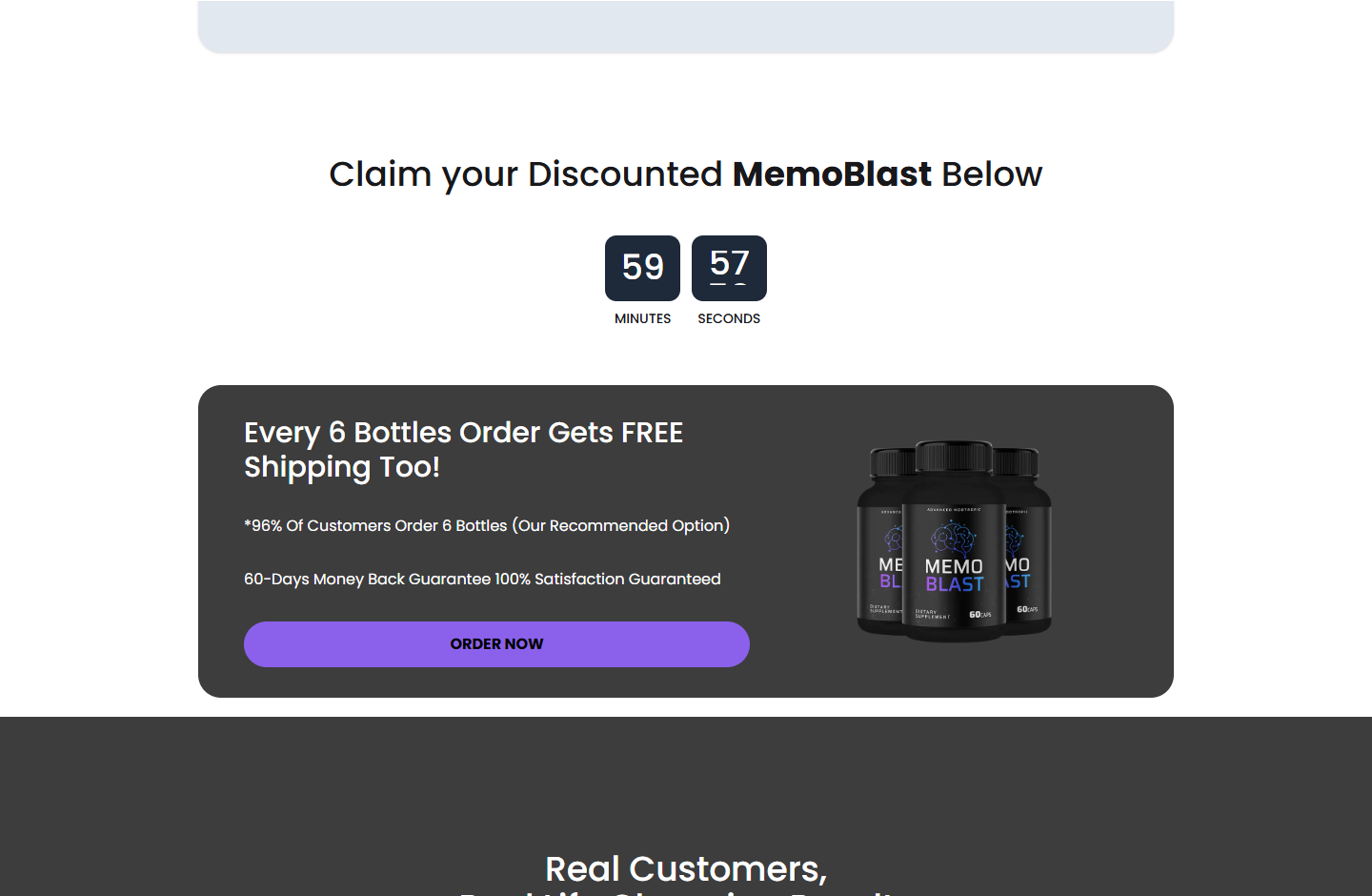
MemoBlast is marketed as a dietary supplement for memory, focus, and mental clarity. The sales page uses a discounted-package pitch, a countdown, testimonials, and repeated references to a 60-day guarantee.
That presentation invites a simple reading: try the capsules, judge how you feel, and ask for your money back if they disappoint.
The written return policy tells a more complicated story.
The page we examined pushes a six-bottle selection and says 96% of customers choose it. That figure is the seller’s claim, not a statistic we independently verified.
- One, three, and six-bottle offers can produce very different total charges.
- The guarantee is presented prominently near the order buttons.
- The return policy applies conditions that could materially reduce a refund.
- Claims about memory improvement are marketing claims, not proof that the product treats disease.
The guarantee deserves a closer reading
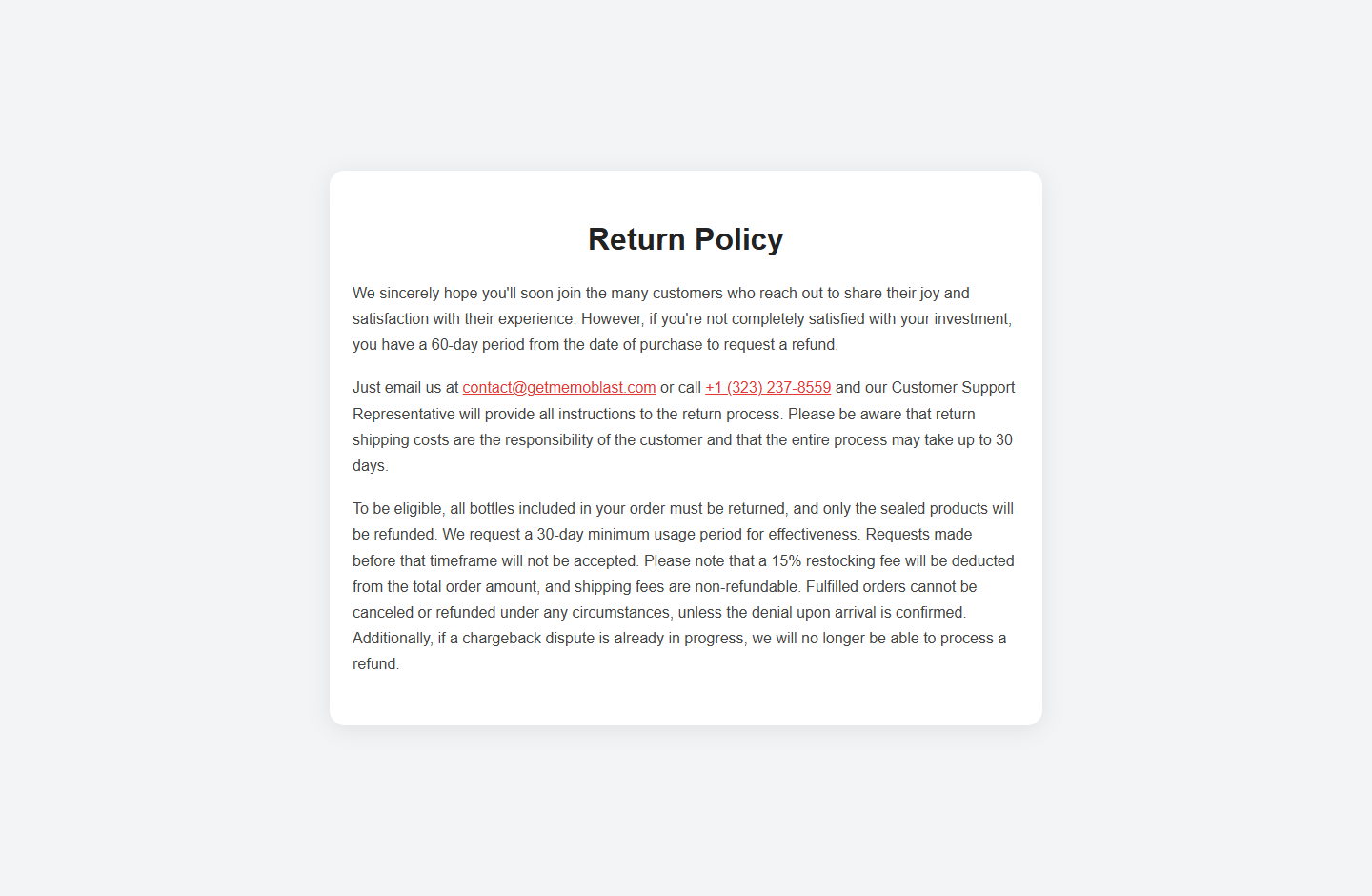
The published return policy gives buyers 60 days from purchase to request a refund. It also says requests made before 30 days of use will not be accepted.
The same policy requires every bottle in an order to be returned, yet says only sealed products will be refunded.
A buyer who actually tests one bottle may therefore face a deduction.
Return postage falls on the customer, and the policy says a 15% restocking fee will be deducted. Original shipping is nonrefundable, and the process may take up to 30 days.
Most strikingly, the policy says fulfilled orders cannot be canceled or refunded, except where delivery is refused and confirmed. That sentence appears difficult to reconcile with the wider 60-day promise.
What this investigation does, and does not, establish
The page is a real sales destination, and the restrictive policy is visible on that destination. Those observations support a clear warning about costs and refund expectations.
They do not establish that every customer is billed again, that every bottle is ineffective, or that a particular customer was denied a refund.
We did not find an automatic-refill term on this page.
Different websites use the MemoBlast name. A similarly named site may have different checkout terms or a different operator.
Check the exact address in your browser and receipt before comparing policies.
Why a Memory Supplement Pitch Can Feel Convincing
Memory slips are unsettling because their meaning is often unclear. Poor sleep, stress, medication, mood, and normal aging can all affect concentration.
A sales page can turn that uncertainty into urgency.
MemoBlast’s page frames the product as an easy daily answer. The risk is not just spending money on capsules.
It is assuming a supplement can explain or resolve a symptom that deserves medical attention.
The page’s medical disclaimer says the product is not intended to diagnose, treat, cure, or prevent disease. That disclaimer matters even when more prominent copy sounds considerably more ambitious.
If you have new, worsening, or disruptive memory problems, discuss them with a qualified clinician. A supplement advertisement cannot tell you whether the cause is harmless or urgent.
How the MemoBlast Sales Funnel Works
Step 1: The ad meets a genuine anxiety
The first message usually concerns forgetfulness, mental sharpness, or the fear of losing independence. That is powerful because the shopper may already be looking for reassurance.
An ad or search result can lead to a sales page that seems to offer a direct answer.
The original traffic source can vary, so do not assume every visitor saw the same claim.
Read the exact promise that brought you there. Was it about everyday focus, or did it imply a serious medical condition could be reversed? The distinction matters.
Step 2: The landing page builds urgency
On the sales page we reviewed, a countdown sits above the bottle offers. Timers encourage a quick decision even though the essential question is whether the product suits you.
The design repeats guarantee language near the packages. Repetition can make the guarantee feel straightforward, while the actual eligibility rules sit on a separate policy page.
Testimonials supply reassurance, but they cannot establish what an average buyer should expect. Personal accounts may be genuine, selected, edited, or simply unrepresentative.
Step 3: A per-bottle price changes the calculation
Multi-bottle offers can make the unit price look attractive. The card charge, however, is the package total, not the amount printed beside one bottle.
Check each package’s full total, delivery charge, taxes, and currency before pressing the payment button. A six-bottle order also creates a larger potential return problem.
If you ordered more than intended, save the checkout confirmation immediately. The seller’s policy treats cancellation after fulfillment differently from an ordinary change-of-mind request.
Step 4: The guarantee turns into conditions
A buyer who reads “60-day guarantee” may imagine using the product for several weeks and then returning it. The written rules say only sealed bottles qualify for a refund.
The 30-day minimum-use request makes that especially awkward. A buyer has to use the product to evaluate it, but the opened bottle is apparently outside the sealed-bottle refund condition.
The 15% restocking deduction, nonrefundable shipping, and customer-paid return postage further narrow the value of a successful claim. Ask support for a written calculation before mailing anything.
Step 5: Contact becomes part of the evidence
The contact page lists an email address. The return policy also lists a phone number, but a listed number is not proof that a dispute will be resolved.
Use written communication where possible. State your order number, what you ordered, what you received, and the remedy you seek. Keep screenshots of the promise and the policy.
If support replies with different rules, ask for the policy version and clause they are applying. A dated record helps if a card issuer later reviews the transaction.
The Refund Terms in Plain English
There are several clocks in this policy. The 60-day request window runs from purchase, not delivery. Shipping delays therefore reduce the time available to evaluate the product.
The page simultaneously asks customers to wait 30 days before requesting a refund. That leaves a narrower practical window than the headline alone suggests.
Returning all bottles is another trap for the unwary. Throwing away empty packaging or gifting unopened bottles could make a claim harder even if the purchased product disappoints.
A 15% fee on a large bundle can be meaningful. Add return shipping and nonrefundable original shipping, and “money back” may be far from a full reversal.
We cannot decide whether every clause would be enforceable in every jurisdiction. Consumer rights can differ by location and by what was represented at checkout.
The practical takeaway is simpler: keep a copy of the exact offer, ask for written clarification, and do not assume a headline guarantee overrides the detailed terms.
Company, Address, and Fulfillment Checks
Find the seller behind the bottle
The name on a supplement label may not be the legal entity charging your card. Compare the order confirmation, terms, return page, package, and card statement.
If those names differ, ask support which entity sold the product and which entity receives returns. Do not automatically treat a processor’s name as the manufacturer.
A return address is not headquarters
The policy directs customers to obtain return instructions from support. It does not provide a public return address on the page reviewed.
Wait for written authorization before mailing bottles. A warehouse can receive parcels without being the brand’s office or the place where capsules were made.
Test support before the deadline
A phone number and email appear in the site’s materials. Contacting both early is sensible because the policy’s 60-day window continues while a buyer waits.
Ask whether opened bottles count, how the 15% deduction is calculated, and whether the order has already been fulfilled. Preserve each answer.
Trace ingredients and manufacturing claims
A polished bottle image does not identify the actual factory or confirm independent testing. Look for a complete Supplement Facts panel, lot number, maker, and importer.
Do not infer that this product is made in China or is contaminated. The concern is the information a buyer can verify, especially if other medications are involved.
Questions to Ask Before Buying
Ask the seller whether checkout is a one-time purchase. We found no automatic-refill term on the reviewed sales page, so a subscription accusation would go beyond this evidence.
Check whether the package selected by default matches what you intended. The page’s six-bottle recommendation is not the same as an obligation to buy six.
Request the exact return address and fee calculation in writing. If the answer is vague, think carefully before placing a multi-bottle order.
Ask for ingredient amounts rather than relying on a branded formula name. A health professional can help assess potential interactions, but needs an accurate label.
Search independently for the merchant named on your statement. Reviews may surface problems, though a single complaint cannot establish the experience of all customers.
What a Six-Bottle Return Could Cost
The offer we reviewed showed a six-bottle total of $294. That amount can be easy to miss when the adjacent marketing emphasizes the lower price per bottle.
A 15% restocking deduction on $294 is $44.10. That calculation assumes the seller applies its stated fee to the full order, as the policy describes.
If one bottle was opened for the suggested 30-day test, the policy’s sealed-bottle condition could reduce the refund further. The page does not supply a worked example.
Return postage is another variable. A tracked parcel with several bottles may cost more than returning a single item, especially across a long distance.
Original shipping is nonrefundable under the written terms. Ask whether any free-shipping promotion changes that result or merely means no shipping amount was charged initially.
The policy also says the process may take up to 30 days. That can overlap with a payment-card dispute window, so note both dates immediately.
Suppose you expected a complete $294 reversal. After the restocking fee alone, the maximum would be $249.90, before any opened-bottle or postage effects.
This is an illustration of the policy, not a verified refund from a real order. The seller should provide the actual calculation for your purchase in writing.
That calculation matters even if you are comfortable trying the product. A guarantee only protects you to the extent that its practical conditions let you use it.
For a first purchase, a smaller order may reduce the amount at risk. Still, compare the one-bottle total and shipping with other options before deciding.
Do not buy a larger package solely because a timer or “most popular” label appears. Those design cues cannot tell you whether six bottles are appropriate for you.
What to Do if You Have a Problem With MemoBlast
- Keep the order records. Save the offer page, package total, receipt, tracking, policy, and photographs of every bottle. Note when the purchase occurred and when delivery arrived.
- Ask for written cancellation or return instructions. Contact the address in the seller’s policy promptly. State whether the order is unfulfilled, delivered, damaged, or different from what you selected.
- Request a precise refund calculation. Ask which bottles qualify, whether the 15% fee applies, and who pays postage. Do not ship to an address found in an unrelated forum post.
- Contact your card issuer if the charge is wrong. Explain the amount you authorized and provide the checkout evidence. Ask about dispute deadlines and how to block any truly unauthorized later charge.
- Get medical advice for symptoms. If memory problems persist or worsen, consult a clinician. Report side effects and bring the actual ingredient label, not just the advertisement.
- Check your device only if the ad led somewhere suspicious. Malwarebytes can scan for unwanted software. AdGuard can help block malicious ads and known scam destinations, but neither reverses a card charge.
- Report deceptive advertising. Send the ad and policy screenshots to the relevant consumer regulator or advertising platform. Be wary of anyone offering guaranteed recovery for an upfront fee.
Frequently Asked Questions
Is MemoBlast definitely a scam?
The reviewed page sells a supplement, but its guarantee language and restrictive return policy deserve scrutiny. The available evidence does not prove every transaction is fraudulent.
Does MemoBlast automatically enroll buyers in refills?
We did not verify an automatic-refill term on this particular sales page. Check your exact checkout, confirmation email, and card activity because another seller may use different terms.
Can I get a full refund after trying one bottle?
The policy says only sealed products are refunded and adds a 15% restocking fee. Ask support to confirm the calculation before assuming an opened bottle qualifies.
When does the 60-day period begin?
The published policy says it begins on the purchase date. Keep the order timestamp and do not wait until the last day to ask for instructions.
Should I stop medical treatment to try MemoBlast?
No. A supplement advertisement is not medical advice. Speak to your clinician before changing prescribed treatment, particularly when memory symptoms are new or progressing.
What if I bought from a different MemoBlast website?
Use the domain on your receipt to identify the relevant seller and policy. Similar brand names do not prove the sites share an owner or identical refund rules.
The Bottom Line
MemoBlast’s pitch makes a memory supplement and a generous guarantee look easy to try. The actual return terms introduce a short practical window, sealed-bottle limits, fees, and cancellation restrictions.
Those documented details warrant caution. If you already ordered, save the pages you saw and contact the seller promptly.
Use your card issuer’s dispute process when the charge or delivery is wrong.

Join the discussion
0 commentsShare your experience or ask a question about this article.
Discussion
Start the conversation
Have a question or something useful to share? Add the first comment.