

T.J. Maxx is one of the most popular discount retail chains in the United States, offering brand name apparel, accessories, home goods, and more at up to 60% off department store prices. However, phony T.J. Maxx clearance sale websites promoted heavily on social media are tricking customers and stealing their money.
Overview of the Scam
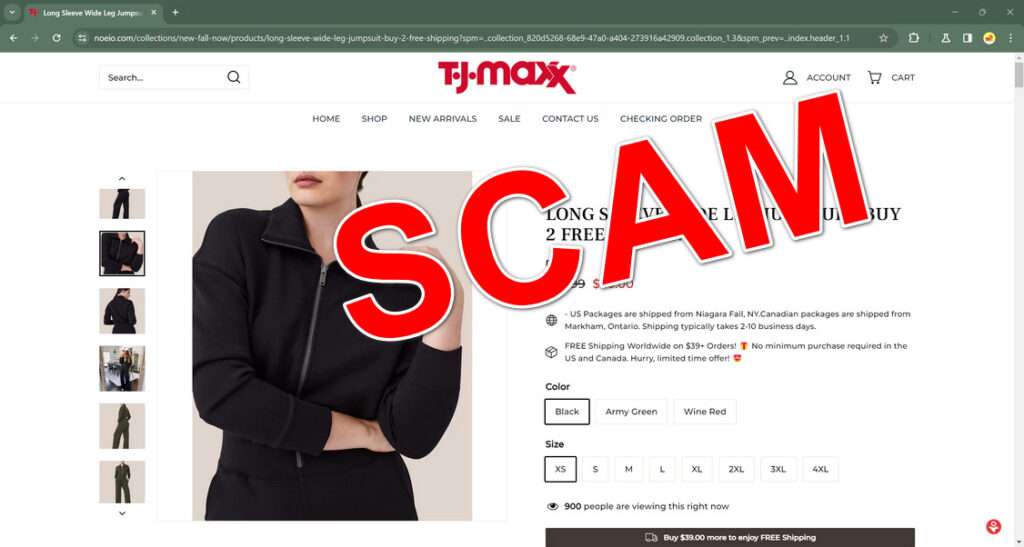
The T.J. Maxx clearance sale scam involves a network of fake websites that pretend to offer limited-time deep discounts on T.J. Maxx merchandise. They bait customers with deals like “Up to 90% off” and “Going out of business sale” along with the real T.J. Maxx logo and stock photos.
However, these websites have no association with the real T.J. Maxx company. They are fraudulently using the brand name to deceive people into thinking they are legitimate. The fake sites seem convincing at first glance, but a closer look reveals many red flags:
- Recently registered domain names
- No contact details aside from an email
- No physical address listed
- Plagiarized policies and web copy
- No customer reviews
- Too-good-to-be-true pricing
These scam websites are solely designed to collect payment and personal information from victims without ever shipping out any actual products. Customers end up receiving nothing at all, cheap knockoffs, used or broken items, and sometimes completely wrong products.
Research indicates this T.J. Maxx scam comes from an interconnected network of fake shopping websites run out of China. The group specializes in cloning the sites of major Western retailers to defraud customers globally. They promote the scam sites heavily using social media ads and fake celebrity endorsements.
This article will provide an in-depth examination of how the T.J. Maxx clearance sale scam works, how to identify these fraudulent websites, and what you can do if you have fallen victim to protect yourself.
How the T.J. Maxx Clearance Sale Scam Works
The operators of these sites have a well-oiled scam process designed to rip off consumers under the guise of an official T.J. Maxx blowout sale. Here are the steps victims typically experience:
Bait: Phony Social Media Ads
The first point of contact is usually a Facebook, Instagram, or TikTok ad promoting a T.J. Maxx clearance event with crazy low prices. The ads feature images of people happily shopping with slogans like “Our biggest sale ever!” and “70% off clearance.”
To add legitimacy, the ads may use the T.J. Maxx logo and brand fonts. Some even employ fake celebrity endorsements from personalities like Ellen DeGeneres, Oprah Winfrey, and Kelly Ripa. The scam ads link directly to the fraudulent websites.
Hook: Convincing But Fake Website
Once on the site, victims find a professional-looking webpage laid out like a real T.J. Maxx or e-commerce store. The sites often clone legitimate discount retailers down to the images, web copy, policies and branding.
The landing page displays tantalizing sale banners and reminders of limited-time offers. Shoppers are drawn in by up to 90% off deals on brand name products displayed with convincing graphics and descriptions.
However, a close inspection reveals no real contact details, physical addresses or indications of who owns the sites. They are essentially anonymous storefronts designed only to collect money, not ship products.
Reel-In: Checking Out with Personal and Payment Details
Duped by the flashy website, jaw-dropping prices and urgency of the fake sales, customers add items to their cart and proceed to checkout.
At checkout, victims are prompted to enter a trove of personal and financial information including:
- Full name
- Home address
- Email address
- Phone number
- Credit/debit card number
- Card expiration date
- Card security code
This data allows scammers to steal identities and commit payment fraud. They may sell the stolen details or use them to make unauthorized purchases and drain bank accounts.
The Sting: No Products Shipped Out
After submitting payment and personal information, the only follow-up victims receive is an order confirmation email packed with more lies. But no products ever ship out.
Any inquiries sent to the site’s dubious contact email address go unanswered. The fake T.J. Maxx sites eventually vanish altogether or reappear under new scam domain names.
Victims are left confused, empty-handed and at risk of fraud. Research indicates most people receive absolutely nothing from these scam websites. However, some end up with:
- Cheap knockoffs: Flimsy, poor-quality items very different from the real products advertised.
- Used, damaged or tampered goods: Items that are clearly not new-with-tags as described. They appear worn, broken or repackaged.
- Completely wrong products: Products that are entirely different from the customer’s order to the point of being random. Further proof no proper order processing occurs.
The only upside for consumers is that credit card charges from these scam sites can usually be disputed as fraudulent and reversed. However, victims still lose time and suffer abuse of their personal data which can enable additional forms of fraud.
8 Warning Signs of a Fake T.J. Maxx Website
While the T.J. Maxx clearance scam websites put in effort to look authentic, they do overlook key details that expose their fraudulent nature. Here are the top red flags to watch for:
1. Suspicious Domain Name
Scam sites tend to use domain names very close to the real company’s or containing odd strings. Example: tj-maxxonline75.store or tjmaxstyle.fashion. Real companies own their official domain names like tjmaxx.com.
2. Hyperbolic Language and Prices
If an unknown website claims to offer legitimate $200 T.J. Maxx comforters for $17, it’s likely too good to be true. No real merchant could sustain 90%+ discounts. These unrealistic deals are a core tactic scammers use to manufacture urgency and bait victims.
3. No Contact Details
There will be no phone number, physical address, email, or other legitimate contact methods on a fake site. At most, an untraceable email address is given, but inquiries won’t be answered. This lack of transparency is a huge red flag.
4. No Real Company Information
Scam websites do not provide legitimate information in their “About Us” pages and legal policies. This includes who owns the business, how long they have operated, where they are located, etc. Opaque businesses should never be trusted.
5. Plagiarized Content
Fake T.J. Maxx sites copy content like privacy policies word-for-word from other existing websites.You can check this by copying unique passages into Google. Results should reveal if text is stolen.
6. No Customer Reviews
Authentic online stores display reviews from past customers. Scam sites have zero reviews because they’ve never actually sold anything to anyone.
7. Spelling/Grammar Errors
Sloppy spelling mistakes and sentence structure reveal these sites are hastily assembled foreign scams. A real American company would present polished copy.
8. Newly Registered Domain
Using tools like Whois.net, you can check when a domain name was registered. Recently created domains signal fake operations put up quickly to scam people. Beware any site created in the past 1-2 years.
How to Identify This Scam on Facebook
The scam ads promoting fake T.J. Maxx clearance sales frequently get distributed on Facebook to reach a large audience. Here are some tips to analyze Facebook ads and avoid falling for this scam:
- Scrutinize the URL – Hover over the ad’s headline or image to preview the landing page URL. Fake sites have odd strings of numbers/letters not affiliated with TJMaxx.
- Research new Pages – Check how long the Page running the ad has been on Facebook. Scam pages were often just created this month versus years for legitimate brands.
- Look for disclaimers – Authentic brands include “not affiliated with X company” disclaimers in ads. Scams pretend to be real brands.
- Assess engagement – Real brand ads see high engagement like shares and comments. Scams have near zero engagement from followers.
- Analyze page content – Scammer Pages only share ads, no additional brand content. Real brand Pages have a mix of diverse posts.
- Check for verification badge – Facebook verifies legitimate brand Pages with a blue badge icon. Scams won’t have one.
- Search for user warnings – Look at other user Comments on the Ad or Page for reports of fraud.
With critical thinking, you can spot the signs of a scammy Facebook advertiser versus real brand. Report any shady Pages or ads to Facebook right away to get them removed.
What to Do If You’re a Victim of the T.J. Maxx Clearance Sale Scam
If you suspect you’ve been defrauded by a fake T.J. Maxx website, take the following steps right away to report the issue and protect your information:
Step 1: Call Your Bank Immediately
If you paid by debit or credit card, call the bank ASAP and explain you believe it was an unauthorized fraudulent charge. Ask them to reverse the payment and issue you a new card number. This will prevent scammers from making additional charges.
Step 2: Report Fraud to Authorities
Contact agencies like the Federal Trade Commission, FBI Internet Crime Complaint Center, and your local police department to report being scammed. Provide domain names, website screenshots, order details and any other evidence. Authorities may be able to pursue legal action if enough victims speak up.
Step 3: Secure Your Accounts
Change passwords on all your online accounts, especially financial and email, to lock out scammers. Monitor closely for any suspicious activity and be on high alert for identity theft. Sign up for credit monitoring which alerts you when accounts are opened in your name.
Step 4: Post Reviews to Warn Others
Leave comments sharing your experience on scam warning sites like Ripoff Report and the Better Business Bureau to help protect other shoppers searching for information. Also report the scam ads to social media platforms like Facebook. Prevent them from promoting dangerous websites.
Step 5: Discretion Moving Forward
Be much more cautious when shopping online after being scammed. Only order from secure sites you can thoroughly verify and trust. Use credit rather than debit cards for better protection. And never enter payment or personal details into an untrusted website.
Frequently Asked Questions
What is the T.J. Maxx clearance sale scam?
This scam involves fake websites that pretend to offer huge discounts on T.J. Maxx products like “90% off everything.” They trick people into thinking it’s an authorized TJ Maxx blowout sale. But it’s really just a ploy to steal money and personal information.
How do they advertise the fake sales?
Scammers run ads on Facebook, Instagram, TikTok and other platforms promoting the clearance sales. The ads contain photos of the T.J. Maxx brand and too-good-to-be-true prices. Links bring victims to convincing copycat websites.
What happens when you order from the fake sites?
In most cases, absolutely nothing is shipped out and the “order” just disappears. Some unlucky victims receive cheap knockoffs, used items, completely wrong products, or purchases are stolen through fraud.
How can you identify the scam sites?
Red flags include unrealistic discounts like 90% off, no contact information, recently registered domains, plagiarized policies, no customer reviews, and bad grammar/spelling.
What should you do if you placed an order?
Immediately call your bank to report fraudulent charges and cancel your card. File complaints with agencies like the FTC and BBB to alert authorities. Monitor your accounts closely for suspicious activity.
Can you get your money back if you are scammed?
If you paid by credit card, you can likely dispute the charges as fraudulent and receive reimbursement. Debit card cases may be harder to recoup losses. Act quickly to improve results.
How can you avoid these scams in the future?
Only shop on the real TJMaxx.com website. Research unfamiliar sites before purchasing. Beware unbelievable deals. Use credit cards for better protection. And don’t enter info on sketchy sites.
Are the scam websites legal?
No, these sites violate trademarks by unlawfully using the TJ Maxx name and logo. They also defraud customers, which is illegal. However, most operate abroad in China beyond reach of US law.
What should you do if you see one of the scam ads?
Report the ads immediately to the social media platform as a scam, trademark violation or fraud. Also leave comments to warn others anywhere you see promotions for the fake sites.
How can I spot similar online shopping scams?
Be cautious of unbelievable discounts from unknown sites. Look for missing contact info, recent domains, and zero online presence. Only shop trusted sites like Amazon, Walmart and directly from brand sites.
Conclusion
The T.J. Maxx clearance sale scam is causing real harm to unsuspecting shoppers through deceptive websites promoted on social media. But some simple precautions can help you avoid this fraud:
- Beware unbelievable deals and high-pressure sales tactics.
- Research unfamiliar sites and inspect for red flags.
- Only shop on the real TJMaxx.com site or verified retailer domains.
- Pay safely with credit cards and closely monitor statements.
- Never enter personal or payment data on opaque sites.
- Report any suspected scam activities to proper authorities.
Avoiding these fake discount shopping websites and reporting them whenever possible helps curb their illegal operations. Being an informed and vigilant consumer is the best way to protect yourself and your hard-earned money from opportunistic retail scammers.








