


The exit company says your timeshare is taken care of, but the resort just sent another bill. The paperwork you paid for may not answer the question that matters.
Before sending another fee or stopping your payments, find out what the resort actually recorded. The money you paid for assistance and the original contract are separate issues.
Overview
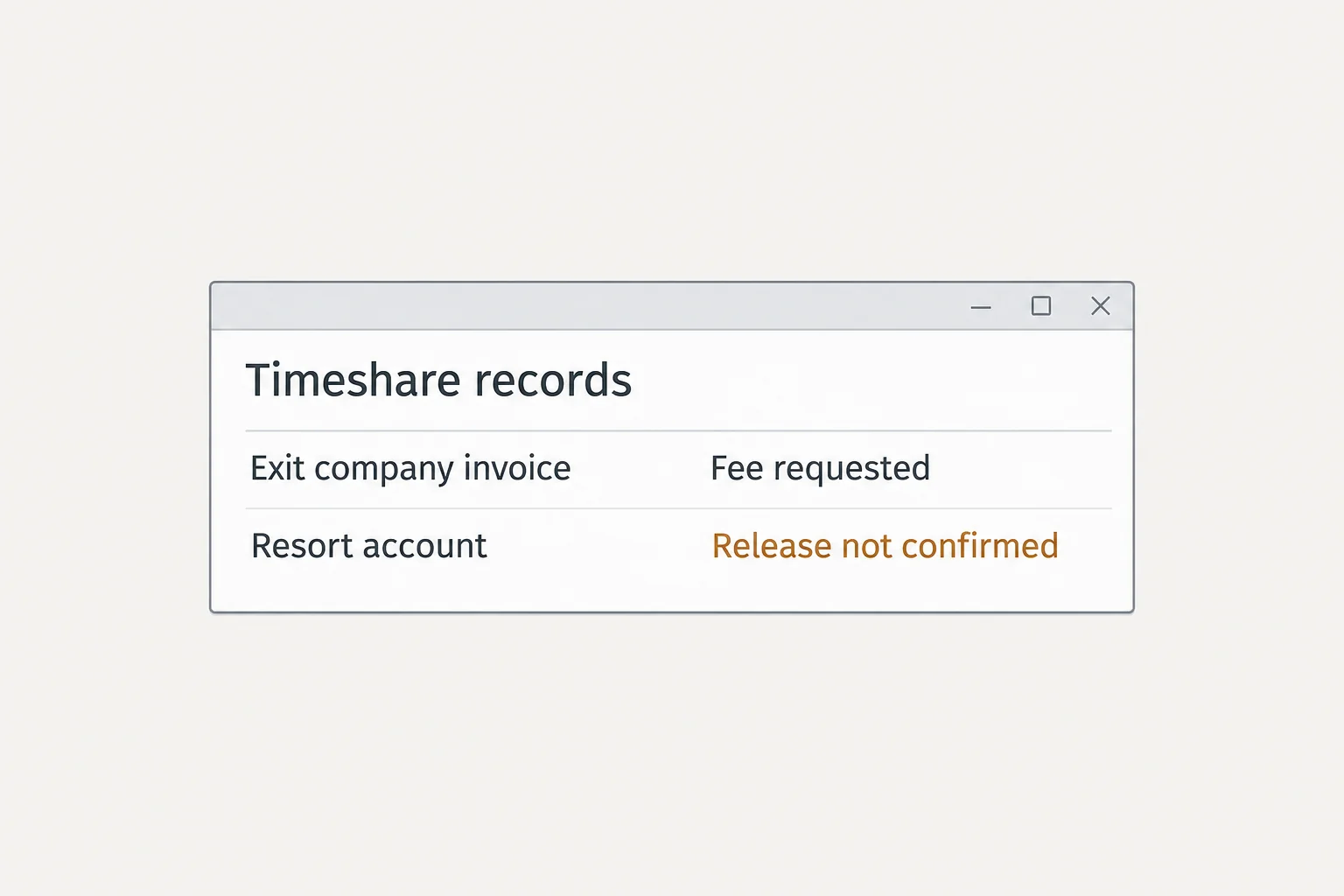
An exit service cannot prove a release with its own invoice
A paid invoice from an exit company shows you bought a service. It doesn’t show that the developer, resort, loan servicer, or applicable records reflect any change.
Scammers count on this confusion when asking for one more payment. A new fee may sound like the last step even if no authorized party has approved an exit.
Three records answer three different questions
Start by dividing your evidence by who issued it. That keeps a payment disagreement with a third party from obscuring an active obligation with the timeshare provider.
- Your original ownership or membership documents show what you agreed to.
- Written confirmation from the appropriate parties helps establish what changed and when.
- The exit company’s contract and payment records show what it promised and what you paid.
Verify the claim with the party able to confirm it
The FTC recommends contacting the developer or resort directly before paying an exit service. Some companies offer a process that owners can explore without hiring the caller.
An exit route can depend on the property, contract, loan, and jurisdiction. There isn’t a universal release document or a shortcut that applies to every ownership type.
What to Do If You Paid or Were Asked for Another Exit Fee
- Pause new payments to the exit company until the claim is independently verified. Don’t cancel payments under the original contract just because the company tells you to.
- Open your existing resort account or call the number on a genuine earlier statement. Ask whether the resort received a request and whether your ownership or membership is still active.
- Contact the lender or loan servicer separately if you financed the purchase. Ask for the loan status, outstanding obligations, and anything it would need to confirm a release.
- Request a written status from the real parties and save the exit company’s contract, proof of payment, and fee demands. Keep all deadlines visible while the dispute is being checked.
- If the fee appears fraudulent, contact the bank or payment service and report it through FTC ReportFraud. Ask a qualified local adviser about the existing contract if necessary.
Give the bank the actual transaction reference and payment method. Pay attention to whether it is investigating a fraud report, opening a dispute, or trying to recall a transfer.
For a recently signed agreement, check cancellation language and deadlines immediately. The clock on one agreement may have nothing to do with the clock on another.
Check a Timeshare Exit Claim With the Resort
Use the developer or management company listed on a known statement, owner portal, or original paperwork. Don’t call a substitute contact sent by the exit business.
Say what you need confirmed: whether a request was received, whether it was accepted, and which account, ownership interest, or use rights the decision covers.
Ask whether it has a written surrender or transfer policy and what current eligibility requirements apply. Before sending documents, confirm the office that handles owner exits.
If its staff finds no request, record who you spoke to and ask what they can provide in writing. That is more useful than arguing about a sales promise.
If an exit request is pending, ask what action it still needs from you and which fees, if any, come from the resort itself.
Avoid creating a second request before checking the first.
The loan and the resort account can have different answers
Find the name of any lender or servicer on your own statement. Check whether the loan is active, who can authorize a change, and how it would be documented.
A resort employee can help with its own records, but may not be able to confirm a separate lender’s release. Obtain each answer from the appropriate party.
If you see a delinquency notice, don’t wait for the exit company to reply before checking it. Preserve the notice and get qualified advice about the deadline and your options.
An offer to take over your timeshare isn’t automatically an offer to pay your outstanding loan. Ask exactly which obligations the deal would leave behind.
Check which interest is actually being transferred
A deeded interest and a membership or right-to-use contract may have different procedures.
The answer should identify which one you own rather than relying on a generic exit letter.
If you own more than one week, membership, or account, make sure the confirmation identifies the one you’re trying to exit. One release isn’t evidence that all accounts were closed.
Ask about co-owners and signatures before treating a request as complete.
If an owner died or ownership changed through an estate, independent advice may be needed to identify who can act.
If a transfer is said to be complete, ask when it took effect and where the change can independently be confirmed.
Do not assume every transfer requires the same public record.
Read the Service Agreement as a Separate Contract
Look for the legal name of the service you hired, what it agreed to deliver, the conditions for a refund, and whether it acknowledged any deadline.
A promise to negotiate on your behalf isn’t the same thing as a written release.
If a contract only promises calls or letters, don’t use it as evidence that ownership ended.
If you are still within any applicable cancellation period, follow the instructions for that particular agreement, including address, delivery method, and proof of receipt.
Don’t use a generic cancellation template before checking those details. A notice sent to the wrong party or address may not accomplish what you expect.
Write down the purchase and notice dates, and keep a copy of anything you send. If the terms are disputed or unclear, seek independent local advice quickly.
Test the next fee against independent information
Ask what the bill pays for, who receives it, and where that obligation appears in the contract or the verified provider’s instructions. Don’t send money just to get an answer.
If someone calls a fee “refundable,” identify the entity promising the refund, the conditions that trigger it, and whether you can verify that entity independently.
In its warning about resale offers, the FTC describes supposed buyers whose sellers are asked for taxes or closing funds that will supposedly come back later.
An exit arrangement can be different from a resale.
One seeks an end to your obligations; the other seeks a buyer.
Ask which outcome the alleged fee is meant to accomplish.
A license search can confirm an actual professional’s registration, not the identity of a person using their name in an email. Contact the firm through independently established details.
A fee for professional work is not automatically fraudulent
A professional you hire independently may have a fee agreement. The question is what they agreed to do, why the fee is due, and who can verify the engagement.
Do not treat an upfront wire to a stranger as equivalent to a documented engagement with a licensed adviser. Check the professional’s status and the actual destination separately.
If you are considering surrender or resale without an outside company, ask the real resort for a written explanation of what it offers.
Different ownership types can have different eligibility rules.
When Someone Offers to Recover the First Payment
The FBI’s advisory about scams involving timeshares in Mexico describes follow-up solicitations by supposed recovery businesses. That example documents a pattern, not the origin of every call.
A person claiming to work for a regulator or law firm may already know how much you paid. Familiar case details do not establish that the first payment was recovered.
Say that you will contact the organization through its own listed office. Do not send an identity document or pay a processing charge to get a supposed case number.
If there is a real restitution or refund program, start from the regulator’s announced instructions or an independently verified administrator. Don’t use the number given by the person requesting money.
The MalwareTips report on fake timeshare buyers and exit firms explains the initial pitch. Follow-up pressure is a reason to protect the existing records, not approve another payment.
Keep the evidence useful to more than one office
Organize the records by recipient: resort, lender, exit service, supposed buyer, or recovery contact. A short payment timeline can help an investigator distinguish separate transactions.
Include the exact legal names as presented without assuming that they are real or connected. Save promises about cancellation, releases, and refund deadlines in the form you received them.
Don’t circulate deeds or identity documents in public to ask whether the company is legitimate. Preserve complete copies privately and share only the relevant details through verified channels.
What the FTC’s 2026 court announcement does and doesn’t show
In April 2026, the FTC announced a $140 million court order against a key operator of an exit scheme. It also reported a permanent ban on marketing similar services.
That order is not a notice that everyone who paid any exit service can get a refund. If someone cites the case, verify the actual program before sharing anything.
The case also doesn’t identify the person who called you. Compare names and documents through independent channels rather than relying on someone who mentions an enforcement action.
Put the answer you need into an email or owner portal message
Identify the relevant ownership number privately and state that a third party claims it obtained a release. Ask the resort to confirm the current status and effective date.
Ask whether your next scheduled bill is still due and whether there are documents it needs to process any pending request. Do the loan check with the servicer separately.
If the reply says only that your inquiry was received, don’t record that as an approved exit. Ask which decision or document would signify that the release was final.
Save the response from a verified channel and compare the names and account against your original paperwork.
If the confirmation covers a different membership, ask the resort to correct the discrepancy.
Decide what to do while the result is pending
If payments are already overdue, look for the next dated notice and call the verified issuer. Ask what can be discussed without treating the exit proposal as established.
If you have a court filing, collection notice, or planned sale, give those deadlines to a qualified adviser. An open resort inquiry doesn’t necessarily halt other proceedings.
If your credit card funded the exit service, tell the issuer which work was promised and what you received. A merchant dispute is different from a transaction you never authorized.
If you wired an alleged fee, give your bank the reference for that wire and ask about available options. Do not pay a second party to move the funds again.
A release should answer more than “your account is closed”
Check whether the status refers to booking access, annual dues, an ownership interest, or the loan. Those records can have separate closure and effective dates.
Ask how you can verify any future statement that contradicts the release. Keep the written answer instead of relying on access to an owner portal that might later be removed.
Frequently Asked Questions
Does a letter from the exit company prove I am no longer an owner?
Not by itself, because it only shows what that company claims. Ask the appropriate resort, servicer, or record authority to confirm the change and effective date for your specific interest.
Should I stop paying maintenance fees if the company tells me to?
Do not rely on that instruction alone. Check your obligations through the real resort and get independent advice, particularly if a bill or delinquency deadline is approaching.
Can I cancel the timeshare because I paid an outside company?
The outside service and your original contract are separate. Ask the developer what exit options actually exist and investigate the service fee through its own contract and payment records.
Is a resort’s oral confirmation enough to rely on?
Ask for written confirmation showing which account or interest was affected and when. Check the lender separately if you have an outstanding loan.
Can a refund company recover the fee for another payment?
Don’t pay an unsolicited recovery company based on its promise. Verify any claimed official program independently and contact the financial provider that handled the original payment.
What if my timeshare is in another country?
Confirm the resort and any lender independently and consult an adviser familiar with that jurisdiction. Don’t assume procedures for US property or contracts apply to your ownership.
The Bottom Line
Don’t pay another exit fee or stop existing payments based on a sales promise. Verify the status with the resort and any lender, and get the answer in writing.
If you paid for an exit that wasn’t delivered, preserve the agreement and payment records. Contact the payment provider and address the underlying timeshare obligations separately.

Join the discussion
0 commentsShare your experience or ask a question about this article.
Community experiences
Did this happen to you?
Your experience could help someone recognize the same scam. Submit a private report for our team to review.
I experienced this tooReports are reviewed before publication. Sharing publicly is always your choice.
Discussion
Start the conversation
Have a question or something useful to share? Add the first comment.