


The truck is at your new home, but the crew says your belongings stay inside until you pay a different bill. That is a hard moment to sort out paperwork.
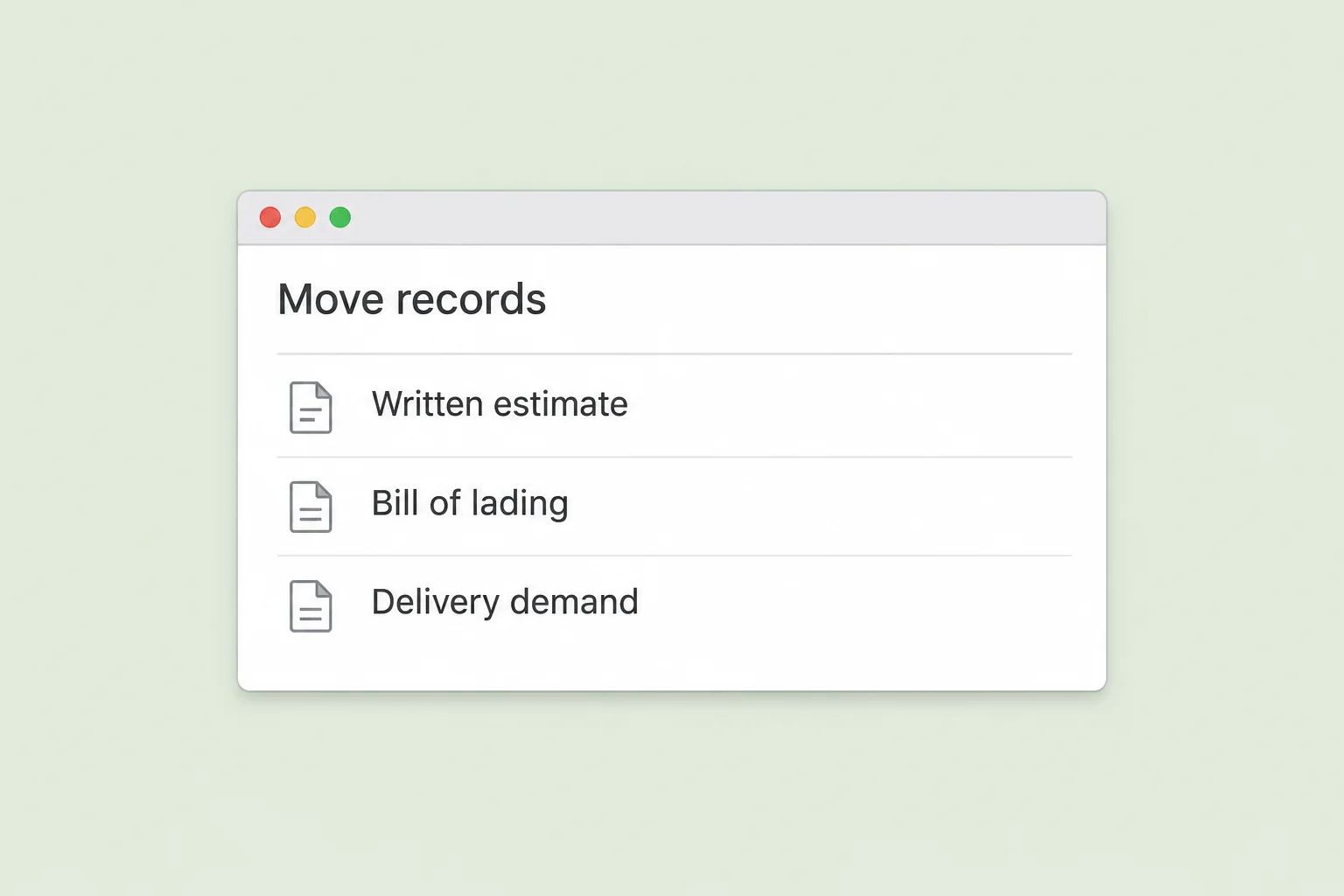
Start with the estimate and the bill of lading, not the new total. Those records help you describe the dispute and find out what can be collected at delivery.
Overview
A higher final bill and withheld goods are different problems
On a US interstate move, the final total can exceed an estimate in some circumstances. What a mover can demand before it unloads is a separate question.
If the crew refuses to deliver after a proper payment offer, save that evidence. A disputed invoice alone does not show that the mover unlawfully held the shipment.
Find the paperwork that controls the discussion
The booking email might come from a broker, while another company is physically carrying the shipment. Keep records for both so you can reach the right business.
- Save the signed estimate and any revisions made before loading.
- Find the bill of lading and identify the carrier and delivery terms.
- Keep proof of the payment you made or offered and any refusal to unload.
The federal guidance covers interstate household moves
The Federal Motor Carrier Safety Administration explains what can be collected at delivery for covered moves. An in-state move can follow different state rules.
Use the guidance as a way to identify what needs checking, not as a reason to confront a crew. Keep people safe, document the demand, and escalate through verified channels.
What to Do If Movers Refuse to Unload
- Step away if the situation feels unsafe. If someone threatens you, contact local emergency services as appropriate. Don’t block the truck or try to retrieve goods yourself.
- Ask for the new amount and an itemized bill in writing. Request the carrier name, shipment location, and delivery conditions from the dispatch office listed on your documents.
- Compare the demand with your signed estimate, documented changes, and the required payment method. Preserve evidence that you offered an appropriate payment if you made one.
- For a covered interstate move, use FMCSA’s moving complaint route or call 1-888-368-7238. Say if the carrier still has your goods or won’t disclose their location.
- If you already paid, keep the receipt and contact the payment provider about the disputed charge. Get a complaint reference and continue documenting any promise to release the shipment.
If you are still at the property, consider where you can wait safely while getting advice. Keep medication, IDs, and essential records out of the dispute whenever possible.
A police report, when appropriate, documents events and any threat.
It does not replace the shipping paperwork, and an officer may not be able to settle the billing issue on site.
The Documents That Identify the Carrier
The written estimate describes the services and how the price is calculated. A quote repeated over the phone isn’t a substitute for the signed terms that govern the move.
The bill of lading is the carrier’s transportation contract. Look for the carrier’s identity, the shipment reference, the planned delivery, and the amount and payment method shown in the paperwork.
Save separate versions if you received different documents over time. Leave filenames, emails, and dates intact so you can identify which agreements were in place before the truck was loaded.
If you don’t have the signed paperwork, ask the carrier for copies. Tell the agency what is missing rather than filling in details you cannot reconstruct.
A broker’s quote does not identify the truck on its own
The company that booked the job may be a broker arranging carriage. The company on the bill of lading is the starting point for finding the carrier responsible for delivery.
Use FMCSA’s mover selection resources to reach its mover search. Look up the exact business name or USDOT number on your documents and check its authorization.
A registration number alone isn’t a pass. FMCSA notes that a registered business might still lack authority to move household goods.
Compare names on the estimate, bill of lading, payment demand, and the official record. If they differ, ask which entity arranged the shipment and which entity has possession.
An unexpected truck or subcontractor is a reason to pause and verify, not proof of fraud on its own. Ask dispatch to confirm who has authority to collect money.
Put any text messages in order
Save the quote, confirmation, and later messages as they were sent. If the driver says the truck is going to storage, ask for the date, address, and pickup conditions.
Make a short timeline showing what changed before loading and what was first demanded after the carrier had your goods. That distinction matters in a pricing dispute.
Don’t post the truck driver’s ID or a full bill of lading publicly. Save complete evidence for the carrier, regulator, payment provider, or police through their verified routes.
Work Out the Amount Due at Delivery
If the estimate was binding
For a covered interstate move, the binding estimate generally covers the items and services it lists at the price agreed. A change in services may have separate consequences.
FMCSA’s delivery guidance describes the limits and exceptions for additional services requested after signing and for eligible impracticable operations, such as certain unexpected access problems.
Ask which services were in the signed agreement and which were requested separately. Require more than a new total labeled “adjustment” before accepting the explanation.
If the estimate was nonbinding
FMCSA’s estimating guidance says the starting limit for the estimated services at delivery is 110% of the nonbinding estimate. The remaining balance is handled separately.
For example, 110% of a $2,000 nonbinding estimate is $2,200. That example assumes no separately requested services or allowable access charges that are collectible at delivery.
The rule isn’t a promise that $2,200 is the final price. Ask for the amount due now, the amount billed later, and the basis for any separately collectible item.
The same guidance describes extra services you requested after the contract and limits what can be collected at delivery for access problems known as impracticable operations.
For covered interstate moves, the limit for those operations at delivery is 15% of the other charges due then. Ask how the carrier calculated that amount.
If the final bill is higher than the permitted delivery payment, FMCSA says the mover must defer billing the remaining amount for at least 30 days under the stated rule.
If the mover cites an exception and you cannot tell whether it applies, ask FMCSA or an independent adviser to help interpret the estimate and itemized charge.
Which payment methods change the conversation
Look at the acceptable payment methods in your paperwork. Offering a card when your contract calls for another form may not establish that you offered payment on the agreed terms.
If the crew wants money sent to a personal account, don’t treat that as a routine substitution. Ask the verified office who is authorized to collect and in what form.
Keep a dated record of your payment offer and how the carrier responded. If you do pay, get an itemized receipt identifying the company and the shipment.
Avoid signing language that says every item arrived in good condition or releases all claims if that is not accurate. Ask for a receipt that reflects what actually occurred.
File a Complaint That Distinguishes a Hold From a Billing Dispute
FMCSA lists the records needed for a household goods hostage complaint. The list includes the estimated charge, shipping document, payment evidence, refusal, and amount the mover demands.
The useful account is specific: when the carrier took possession, what it offered to deliver, what you offered to pay, and whether it gave a location for the goods.
On the FMCSA complaint page, choose the consumer complaint route for household goods. When the online route doesn’t fit, use the phone option and explain what documents are missing.
If the mover did deliver but there is still a price dispute, say that.
If you don’t know where the goods are, identify that separately instead of guessing at a destination.
Get an intake number, save the submitted complaint, and update the case when you learn where the property is. A complaint does not promise an immediate return or award.
For a move entirely inside one state, check that state’s consumer protection or moving regulator. Confirm where it accepts complaints before posting private documents in a public forum.
If your things were released but some are missing
Compare what arrived with the inventory when you can safely unpack. Take photos of visibly damaged items and note which items you cannot account for.
Ask the carrier for its written loss or damage claim process and deadline. A lost item claim may need its own documentation even after you reported the delivery dispute.
Keep copies of what you send. If the carrier proposes payment in return for signing a release, read the proposed terms before treating it as the end of the dispute.
Protect the Next Move Before You Book It
Get a written estimate for the actual inventory and services. Confirm whether the company is arranging the move or carrying it before you hand over a deposit.
Ask about stairs, elevators, the distance from the truck to your door, parking restrictions, and storage. Write down how a change to each affects the agreed price.
Check the proposed payment method and delivery terms before pickup. Make sure you can access the signed records after your belongings are on the truck.
Keep the items you can’t reasonably replace with you. If you’re moving with a partner, agree in advance who handles delivery paperwork while the other person keeps the records accessible.
Before pickup, reconcile a change in inventory
If you add boxes or furniture after the estimate, tell the carrier while the items are still at your old home. Ask how the change affects the written estimate.
If the mover needs to revise the estimate, get the revision in writing before loading and compare what changed. Keep the earlier document so the sequence remains clear.
Do the same for separate services you request, such as extra packing. Ask when each service will be billed and which charges the crew can collect in person.
Photograph your inventory where appropriate without capturing other residents’ private details. Save any written acknowledgment of the important items that belong on the truck.
If the carrier claims the shipment is in storage
Ask whether storage was in the original agreement or was introduced after the dispute. Request the facility name, release conditions, and an itemized description of any storage charges.
If the carrier says another business holds your goods, ask how you can verify the location. Don’t go to a warehouse based only on a message from an unfamiliar number.
A new deadline or fee should be added to your timeline. Update your complaint if the operator refuses to disclose the location or changes the release terms again.
If you need immediate access to essential belongings, explain what is missing to the appropriate authorities. Plan for replacement medication or documents through their real issuers when possible.
Keep the bill and claim timelines distinct
Note when the carrier says it will send an invoice for any deferred amount. Keep that date separate from the due date for a complaint or a damage claim.
If you dispute a card charge, describe your actual authorization and the billing disagreement. Avoid claiming you never made a payment unless that is what happened.
Ask whether later correspondence changes the delivery plan or simply repeats the charge. Save the answer so you can tell the regulator where the shipment stands now.
Frequently Asked Questions
Does any moving bill above the original quote prove a scam?
No, because lawful charges can change in some circumstances. Ask which part is due for delivery and which part can be billed afterward, then compare the demand with your documents.
Does the 110% rule cover a move within one state?
It addresses covered US interstate household moves with a nonbinding estimate. If your trip was entirely within one state, ask the appropriate state agency about its rules.
Can an interstate mover collect more than a binding estimate?
Some separately requested services or allowable access charges can affect what is due. Check the itemized demand against the signed agreement and the applicable federal delivery rule.
Who should I contact if I booked through a broker?
Contact both the broker and the carrier holding the goods through verified channels. Use the bill of lading to identify the carrier, and keep separate notes of each response.
What if the mover says it won’t tell me where my belongings are?
Save that response and report it to the appropriate regulator. Give the last confirmed location and carrier identity rather than risking a confrontation or claiming you know where it went.
Should I dispute the charge after my goods are delivered?
If the amount remains disputed, contact the carrier and payment provider and keep the delivery record. Ask about applicable deadlines and don’t assume the delivery closed every claim.
The Bottom Line
Don’t accept a new delivery demand without checking it against the signed estimate, contracted services, and applicable rule. Keep your evidence and protect your safety while you verify the charge.
If the mover still has your goods, document any valid payment offer and refusal, then contact the appropriate regulator with the shipment records. If you already paid, save the receipt.

Join the discussion
0 commentsShare your experience or ask a question about this article.
Community experiences
Did this happen to you?
Your experience could help someone recognize the same scam. Submit a private report for our team to review.
I experienced this tooReports are reviewed before publication. Sharing publicly is always your choice.
Discussion
Start the conversation
Have a question or something useful to share? Add the first comment.