

Changing careers often starts with a late-night search and a very appealing promise: learn a skill, then get help finding work.
TripleTen puts a money-back guarantee beside that promise. Before paying tuition, it is worth understanding which clock starts when and what participation requires.

Overview
What TripleTen actually offers
TripleTen runs online career-training programs in fields such as quality assurance, data analytics, cybersecurity, and software engineering. Its site describes projects, coaching, and job-search support.
This is a real educational service, not an invented school. The buyer question is whether the advertised protection matches the personal circumstances of each student.
Two different paths to money back
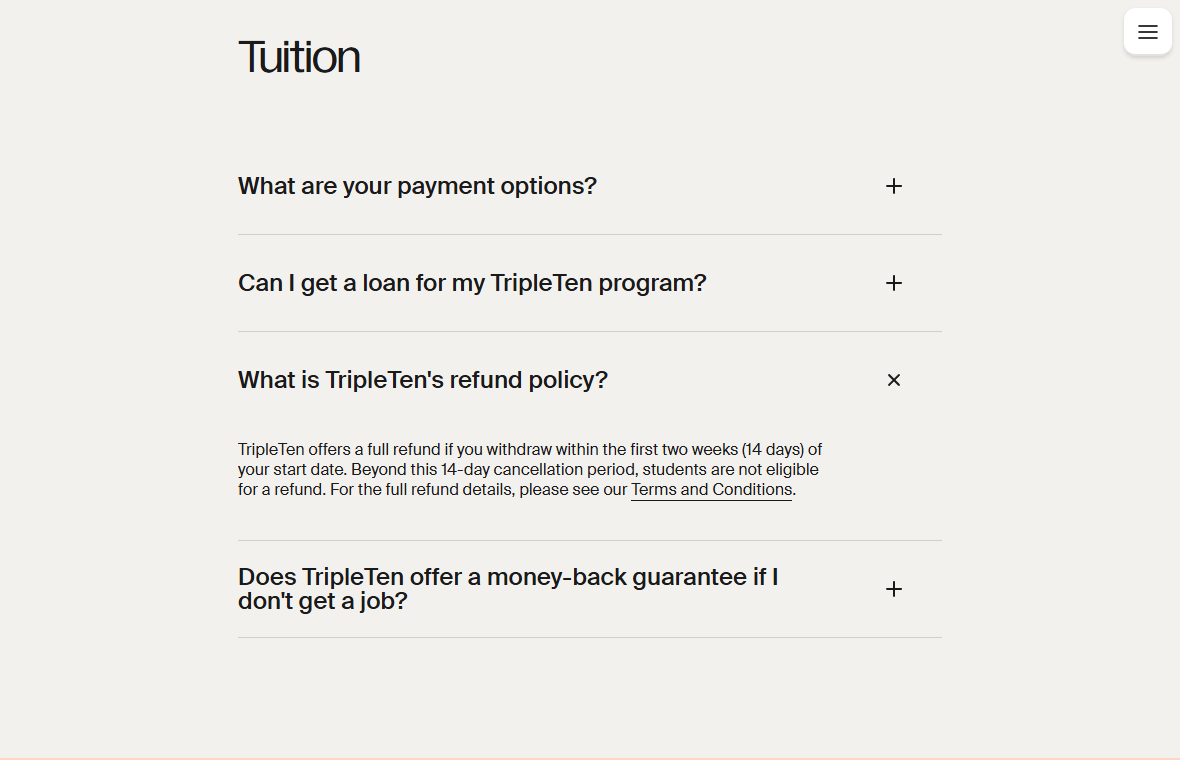
The FAQ says students can withdraw for a full refund within 14 days of their start date. Beyond that ordinary cancellation window, it says no refund is available.
A separate job guarantee may return tuition if an eligible graduate remains unhired after 10 months and follows the required job-search roadmap.
The important conclusion
The 10-month guarantee is conditional, not a blanket promise that any unhappy student can recover tuition later. The 14-day cutoff is the immediate deadline.
- Ordinary withdrawal: request within 14 days from the stated start date.
- Job guarantee: complete the program and required career activities, then document an active qualifying search.
- Location: the FAQ limits the guarantee to U.S. residents.
- Price: advertised upfront tuition varies by program, with financing creating its own obligations.
Our concern is clarity before an expensive commitment. We found no basis to call the training provider a scam merely because the guarantee has conditions.
The 14-Day Refund Rule and the 10-Month Guarantee Are Not the Same
Suppose a student begins a course and discovers the schedule does not fit around work. That problem belongs to the ordinary withdrawal window.
TripleTen’s FAQ says a full refund is available when a student withdraws within the first two weeks, measured as 14 days from the start date.
After that period, the public FAQ says students are not eligible for a refund through ordinary cancellation. A difficult course or changed plan does not automatically reopen it.
The job guarantee is a different contractual route, tied to graduating and seeking employment. It does not begin simply because the student paid tuition.
According to the FAQ, eligibility involves completing the program, career counseling, and an Active Job Search period. The graduate must apply to relevant roles and track applications.
The FAQ also lists U.S. residence. Someone taking classes from another country should not assume the marketing headline applies in the same way.
A 10-month measurement follows graduation, not enrollment. A five-month course plus a search period is a much longer commitment than the headline alone may suggest.
Full details are in the linked terms, which may add definitions, evidence requirements, and deadlines beyond the short FAQ summary.
Read the version tied to your enrollment, not a screenshot from another student’s year. Terms can be revised and program-specific promotions can differ.
The distinction matters financially. Once the ordinary cancellation window closes, a student cannot rely on the job guarantee unless they later satisfy its separate conditions.
That makes the first 14 days a real decision period. Test the learning platform, schedule, support, and course fit while the normal exit remains available.
How the TripleTen Guarantee Works in Practice
Step 1: Choose a program and document the actual offer
TripleTen markets several career tracks with different lengths and costs. Its FAQ lists upfront tuition ranging from $4,935 to $12,600, depending on program.
A discount or payment plan can change the checkout figure. Save the program name, tuition, promotion, enrollment agreement, and guarantee version you were offered.
Do not let a “book a call” conversation substitute for written terms. Ask an advisor to send any special promise by email before signing.
Career training is a serious purchase. Compare curriculum depth, project reviews, instructor access, and the time you can actually commit each week.
Step 2: Mark the start date and 14-day cutoff
The FAQ measures ordinary withdrawal from the start date. Confirm whether that means enrollment, platform access, orientation, or the first course day in your agreement.
Put the deadline on a calendar immediately. Do not wait until day 14 to learn whether a form, email, or adviser contact is required.
During the first week, complete enough material to judge the pace. Ask a support question and see whether the response meets your needs.
If the course is wrong for you, submit a clear written withdrawal request before the deadline. Keep the timestamp and confirmation.
Step 3: Complete the coursework and career components
The guarantee is attached to program completion, not partial attendance. Projects, deadlines, and career-counseling participation may all matter under the detailed terms.
TripleTen describes courses lasting roughly four to nine months, with an average 15-to-20-hour weekly commitment. Individual tracks differ.
That workload may be manageable alongside a job for some students and difficult for others. Estimate your calendar honestly before the refundable period ends.
Keep records of finished projects, mentor feedback, coaching appointments, and approved extensions. If eligibility is later questioned, activity logs matter.
Step 4: Enter the documented job search
A graduate does not simply wait 10 months and request a check. The FAQ describes applying to relevant roles and tracking those applications.
Ask what qualifies as a relevant role for your program. A broad job title, location restriction, salary expectation, or remote-only preference can affect eligibility.
Maintain a spreadsheet or portal history of applications, dates, employer names, role descriptions, interviews, and follow-up. Save rejection notices when available.
Participate in scheduled career services and ask immediately if illness, caregiving, relocation, or another interruption could affect your guarantee.
Step 5: Reach the 10-month review with records ready
If no qualifying job materializes within the stated period, check the precise claim procedure in the enrollment terms. The FAQ’s headline alone is not the application.
Gather proof of graduation, residence, career-program participation, and the active search. A request without records may be harder to evaluate.
Ask TripleTen which conditions it considers satisfied or missing, and request a written decision. That clarifies whether a disagreement is about facts or interpretation.
Do not assume every offer counts as employment or that every rejection is irrelevant. The contract’s definitions should settle those questions.
Step 6: Handle financing separately from tuition disputes
TripleTen advertises upfront payment, installments, and financing. Its payment page describes several ways to spread the cost.
A lender agreement may survive a dispute with the school unless a cancellation or refund is processed according to its terms. Do not stop payments casually.
Read the total repayment amount, interest or fee terms, deferred-payment triggers, and the effect of withdrawing. Ask both the school and lender for written answers.
When a refund is approved, request confirmation of where the funds go and whether your financing balance has been adjusted.
What the Marketing Headline Leaves Out
“Get hired or your money back” is memorable. It compresses a long academic and job-search journey into one sentence.
The program does not control a local labor market or a student’s interview performance. That is why the guarantee attaches to specific behavior and eligibility.
TripleTen’s public FAQ says nearly two-thirds of graduates landed jobs within 10 months. That is the school’s reported figure, not an independent prediction for you.
A success percentage may use a defined group of graduates. Ask whether it includes everyone enrolled, only graduates, or graduates actively seeking relevant work.
Ask how “hired” is defined. Full-time employment, contract work, unrelated roles, and self-employment may be treated differently under formal terms.
Even a valid tuition refund would not restore months of time or automatically repay interest paid to a lender. Those costs deserve attention up front.
Likewise, the phrase “no refund after 14 days” should not be read as wiping out every other right. A dispute about a specific broken promise is a different question.
Rather than speculate about legal outcomes, document the representation and ask the provider to apply the contract you signed. Seek local consumer advice if needed.
Company, Address, and Checkout Checks
Identify the entity named in your agreement
TripleTen provides public course pages, a FAQ, payment information, and linked terms. These make it possible to inspect the offer before giving card details.
Still, record the exact legal party on the enrollment contract and financing agreement. A course brand and a lender may be separate organizations.
If an admissions representative claims a special exception, require it in a document that identifies the contracting entity and applies to your program.
Check contact methods before committing
Book an admissions call if helpful, but use it to ask difficult questions, not just to hear a sales presentation. Request the answers in writing afterward.
Ask how to withdraw within 14 days, how receipt is acknowledged, and how long a refund takes. An answer without a submission route is incomplete.
Also ask who decides job-guarantee eligibility and how a student can appeal a disputed finding. Those details matter more than an enthusiastic review excerpt.
Distinguish the school address from course delivery
TripleTen’s programs are online, so a mailing address does not tell you where instruction, support, or financing decisions occur.
For a service purchase, the important documents are the agreement, support channel, payment schedule, and jurisdiction stated in the applicable terms.
Do not send withdrawal requests to an address found in an unrelated directory. Use the contractual route and preserve a time-stamped copy.
Understand the payment trail
Compare the advertised tuition with the final order, promotion, installment total, and any external loan disclosure. A smaller monthly payment may mean a larger total.
Save every installment receipt. If a withdrawal is accepted, confirm whether future debits stop and whether earlier payments return to the same account.
If a third-party lender is involved, contact that lender directly about a refund or cancellation. School support cannot always alter a separate credit contract alone.
How to Decide Whether the Course Fits You
First, look at the job you want rather than the guarantee. Read several real local job postings and compare their requirements with the course syllabus.
Second, review the project portfolio. Ask whether you will build work you can show employers or merely follow examples that thousands of applicants share.
Third, assess your available hours. A part-time course still needs consistent evenings or weekends, especially near project deadlines.
Fourth, check support hours against your time zone. Access to instructors has little value if sessions occur while you are working.
Fifth, examine outcomes for the specific track, not a blended headline covering several fields. Hiring conditions differ for quality assurance and machine learning.
Sixth, calculate your downside. If you leave after day 14 without graduating, what amount remains due under the school and lender agreements?
Finally, picture the required job search. If you cannot meet application and tracking duties, do not price the guarantee as if it were automatic insurance.
A program can be worthwhile while still being wrong for a particular student. The useful decision is personal fit, not a blanket yes-or-no verdict.
What to Do if You Enrolled and Have Concerns
- Find the governing agreement. Save the enrollment terms, program name, price, guarantee version, and any financing document you accepted.
- Calculate your 14-day deadline. Confirm the contractual start date and submit a written withdrawal request promptly if the course is not right.
- Ask for a dated acknowledgement. Keep your email, form receipt, or support ticket. Request the expected refund amount and processing method.
- If continuing, track participation. Save project completions, coaching attendance, approved extensions, and job-search records as you go.
- Clarify eligibility early. Ask whether your residence, target role, availability, and search plan satisfy the guarantee before graduation.
- Speak with the lender if financed. Request a separate accounting of your balance and any effect of a withdrawal or school-issued refund.
- Escalate a specific unresolved issue. If written terms are not followed, provide a factual timeline to the provider, lender, or appropriate consumer adviser.
Feeling overwhelmed by a course is common and does not mean you failed. The practical move is to ask for support while a clear exit route still exists.
If you are already outside the ordinary withdrawal period, focus on available extensions, the program’s written obligations, and the guarantee’s exact requirements.
Frequently Asked Questions
Is TripleTen a scam?
TripleTen offers real online training. The concern here is whether applicants understand the conditions and deadlines behind its refund and employment guarantees.
Can I get a full refund after starting?
The public FAQ says a full ordinary refund is available for withdrawal within 14 days of the start date. It says no ordinary refund after that period.
Does every graduate qualify for the job guarantee?
No. The FAQ lists completion, career-service participation, an active documented search, and U.S. residence. Read the full terms for additional definitions.
When does the 10-month period begin?
The published guarantee is described in relation to graduation and the ensuing job search. It is not simply 10 months from the first tuition payment.
Does a guarantee cancel a student loan?
Do not assume so. Financing may be governed by a separate lender agreement. Confirm in writing how any approved tuition refund affects the balance.
What should I ask an admissions adviser?
Ask for the exact guarantee terms, withdrawal method, course workload, relevant job definition, financing total, and written answers to any exceptions you need.
The Bottom Line
TripleTen is a real training provider, but its job guarantee is a conditional route, not a substitute for reading the enrollment agreement.
The decisive action is simple: test the course within the 14-day refund window. If you stay, document every academic and job-search requirement from the start.

Join the discussion
0 commentsShare your experience or ask a question about this article.
Discussion
Start the conversation
Have a question or something useful to share? Add the first comment.