


A message about your voter record arrives while you’re doing something else. It names Brazil’s electoral authorities and suggests there’s a problem you should settle quickly.
The notice looks official enough to make you hesitate. Before you open its payment page, a few details deserve a closer look.
Overview
What the notice asks you to believe
The TSE electoral fine scam borrows the identity of Brazil’s Tribunal Superior Eleitoral or the wider Justiça Eleitoral to make a private demand look governmental.
The hook concerns something important: your electoral record, an alleged outstanding fine, or a supposed problem that needs regularization.
That can sound plausible even to a careful reader. People miss elections, forget administrative requirements, and worry about discovering an unresolved problem too late.
The message supplies its own solution, usually a link or instructions. Following that route gives the sender control over what you see next.
What Brazil’s electoral authorities actually warned about
An official TSE warning describes criminals impersonating electoral authorities, copying official pages, and seeking personal information or improper payments.
The distinction matters: electoral authorities can send genuine communications, and genuine electoral fines exist. Neither WhatsApp nor Pix automatically makes a notice fraudulent.
The useful question is whether your actual electoral record confirms the obligation and whether the payment belongs to the genuine official process.
The details that deserve an independent check
Set the message aside and separate these questions before doing anything with the proposed payment:
- Does the alleged issue appear when you independently access an official electoral service?
- Is the sender offering help through an address or account confirmed by that authority?
- Who would receive the payment shown inside your own banking app?
- Is the message demanding information or an app installation unrelated to the alleged fine?
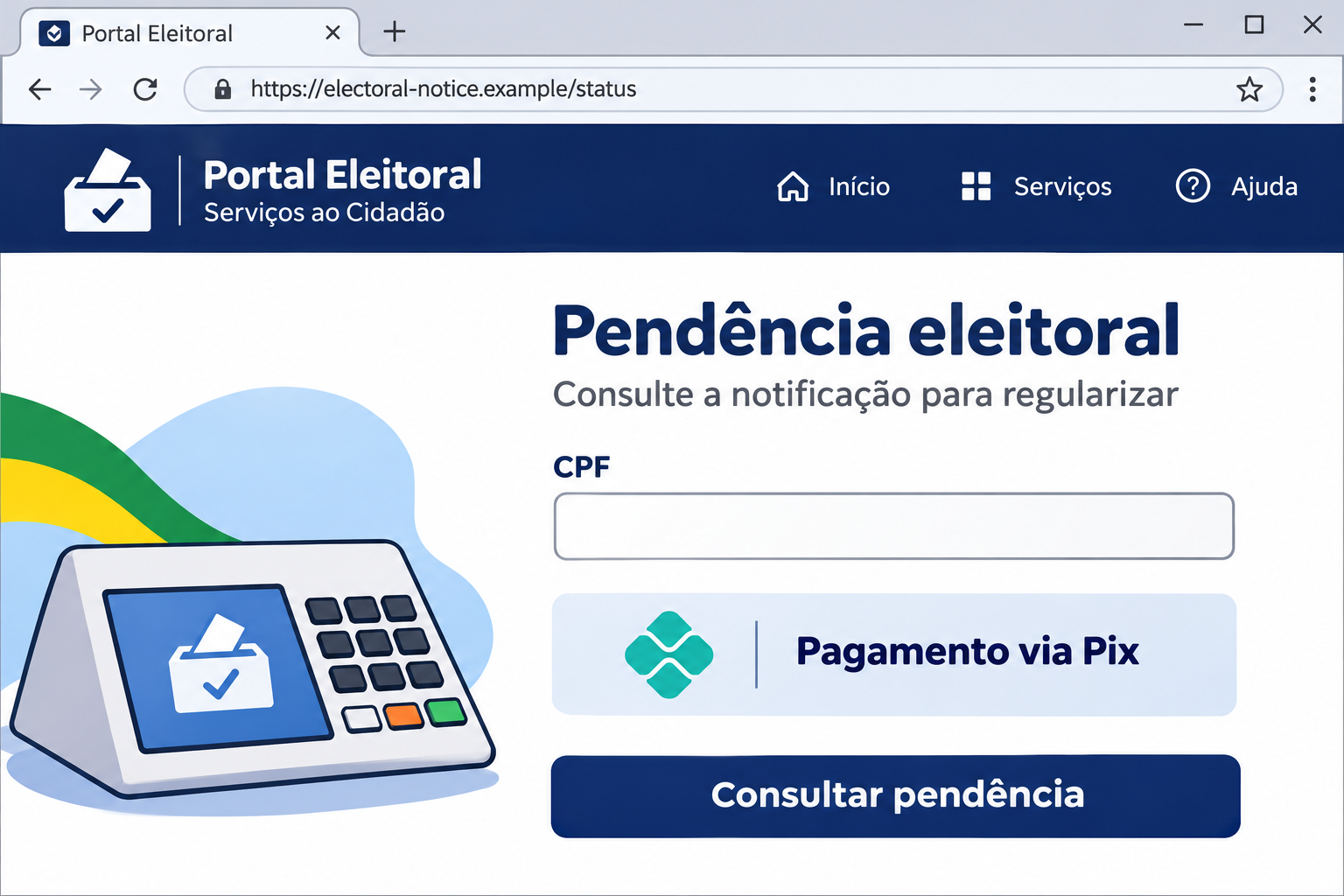
The portal pictured above is a fictional illustration with an example address. It shows the type of request, not a captured TSE message or functioning payment page.
Why a Small Electoral Problem Can Feel Like an Emergency
An administrative notice doesn’t have to promise a huge penalty to get attention. The possibility of a suspended record can be enough to interrupt your judgment.
You may have documents to renew, a job application underway, or a family member who depends on your help with official services.
An unexpected notice lands inside that existing worry. The sender wants you thinking about the inconvenience of ignoring it rather than checking who sent it.
The small-payment version has another advantage. A modest amount can feel easier to pay than to investigate, particularly when the page looks familiar.
But the price doesn’t authenticate the debt. A tiny transfer to the wrong recipient still doesn’t settle an electoral fine.
Nor does a correct name or CPF prove the sender has access to an official electoral case. Treat familiar details as information to verify, not credentials.
If someone else helps manage your paperwork, ask them before paying. They may already have a receipt or know that no such request is pending.
There is no benefit in racing a stranger’s countdown while the actual authority’s records remain unchecked.
How the TSE Electoral Fine Scam Works
Step 1: An official-looking notice creates the problem
The first contact presents itself as electoral administration rather than an ordinary commercial offer. Its purpose is to make the request feel compulsory.
It might refer to a pending issue or use the language of regularizing a record. The exact wording can change without changing the mechanism.
The sender doesn’t need to prove the problem immediately. It needs you to accept the message as the starting point for solving it.
That is why the first decision matters: checking through the notice means checking inside a route the stranger supplied.
Step 2: A copied portal makes the claim look established
A linked page can repeat civic colors, institutional names, and familiar form labels. Those elements make the transition from message to payment feel routine.
The presence of a form is not confirmation that a case exists. Anyone controlling a website can display a pending status beside information you enter.
Before typing your CPF, ask what you expect the page to prove. If the page itself invented the obligation, its own result proves very little.
An address containing official-sounding words also needs scrutiny. Read the actual website address, then leave it and open the authority through a trusted route.
You don’t need to solve a confusing address while under pressure. Starting again independently is often easier and safer.
Step 3: The supposed fix becomes a payment or data request
Once the notice has your attention, the requested action becomes the important part. It may involve submitting personal details or making an improper payment.
A real name on a page doesn’t authorize that collection. Only provide information after establishing that you are dealing with the genuine service.
If a payment screen opens, inspect it before approval. A familiar-looking page outside the bank cannot override the recipient details inside the bank.
Don’t send a test amount to see whether the process works. A successful transfer would demonstrate that money moved, not that a fine was settled.
Step 4: Pressure discourages a separate check
A threat involving access to other services can make the request feel bigger than an electoral issue. That is a reason to stop, not hurry.
The TSE warning also identifies impersonators invoking a nonexistent customer-service department and promoting an app called Soluciona Pendência.
Treat a demand to install an unfamiliar application as a separate exposure. You do not need to install it to find out whether your electoral record is regular.
Do not grant permissions or share banking access to let a supposed attendant handle the payment for you.
Step 5: The sender’s receipt substitutes for official confirmation
After a transfer, a message saying the problem is resolved can feel reassuring. It still comes from the same unverified party.
The relevant confirmation belongs in the genuine electoral service or an answer from the actual authority, reached independently.
Keep the receipt if you paid. It can help your bank trace the transaction even when it does not prove that any electoral obligation was discharged.
Pix Is a Payment Method, Not an Authenticity Test
An especially misleading shortcut is to assume that electoral authorities never accept Pix. Genuine electoral fines can be paid through official payment options, including Pix.
That makes the destination important. The TSE identifies the National Treasury, Tesouro Nacional, as the recipient for genuine electoral-fine Pix payments.
A request directing an electoral-fine payment to an individual’s account does not fit that official guidance. Don’t approve it because the chat insists it’s normal.
Likewise, a sender calling itself an intermediary must be verified independently. A friendly explanation cannot substitute for the official payment process.
Check the obligation first and generate any required payment through the real service. Avoid comparing only the amount or a copied logo.
If a banking app displays a recipient you cannot reconcile with the official instructions, cancel before approval and ask the actual authority.
Do not post the full payment code or another person’s account details publicly while asking for help. Share sensitive transaction information privately with your bank.
Check Your Record Without Feeding the Message
Open e-Título if you already use the genuine app, or start from the official TSE website and its electoral self-service options.
Use your own saved access or locate the service independently. Don’t use a login button, phone number, or search link provided by the suspicious sender.
Read what your record actually says. A notice about updating information is different from an unpaid fine, and the required action may differ.
If the message and the official record disagree, retain that discrepancy. It helps explain why you believe the demand was fraudulent.
If a real issue exists, handle it through the genuine service. A real outstanding obligation doesn’t validate the stranger who happened to mention it.
Take particular care when helping an older relative. Sit with them through the independent check rather than forwarding the notice to another family group.
Forwarding an alarming demand can give it a second layer of trust: people recognize you, even when they don’t recognize the original sender.
If clarification is needed, contact the electoral authority using details found on its official site. Describe the message without opening new attachments.
You should be able to explain the alleged issue in ordinary words before authorizing a payment. Confusion is a reason to get help, not approve faster.
What to Do if You Have Fallen Victim to This Scam
- Stop interacting with the sender. Don’t send another transfer for a correction, release, confirmation, or refund. Keep the conversation before blocking the account.
A promise to fix the first payment can draw you into a second one. Handle recovery through your own financial provider instead.
- Contact your bank immediately after a fraudulent Pix payment. Explain that you were deceived by electoral-authority impersonation and ask about the Mecanismo Especial de Devolução, or MED.
The Banco Central explains Pix security and recovery. Fraud-related MED requests have an 80-day window, but you should report immediately rather than wait.
Recovery depends on the case and available funds. Asking for MED starts a review; it does not guarantee the transfer will be returned.
- Save the transaction details privately. Retain the receipt, transaction identifier, recipient, amount, date, message address, and the page you were sent to.
Keep originals when available. A cropped image of the official-looking heading tells your bank less than the complete demand and payment destination.
- Check the actual electoral situation separately. Use the official service or electoral authority to establish whether any genuine obligation remains outstanding.
Don’t assume the fraudulent payment fixed it. If a legitimate fine exists, ask how to handle it without relying on the scammer’s instructions.
- Protect any account credentials you disclosed. Change an exposed password through the genuine service, and replace reused passwords on other accounts.
If you shared banking codes or approved something you didn’t understand, tell your bank exactly what happened. Don’t minimize the disclosure out of embarrassment.
- Match the response to the information supplied. Providing a CPF is different from providing a bank password, payment approval, or identity-document image.
Tell your bank whether you entered a password, approved a transfer, or shared a document. Those details determine which protections you need.
- Report the impersonation through legitimate channels. Contact local police where appropriate and notify the electoral authority using contact information found independently.
Supply the same short timeline to each organization. Include what was requested, what you sent, and whether money left your account.
- Get trusted help if you installed an unfamiliar app. Stop following the sender’s setup instructions and explain the installation to your bank if financial access was involved.
A payment-demand report does not identify a particular malware family. Have the device assessed rather than downloading another supposed repair supplied by the same account.
If a Relative Paid, Help With the Next Call
The useful first question is what happened, not why they believed it. Ask which message arrived, which page opened, and whether a transfer was approved.
Help find the receipt and contact the bank through its actual app or established number. Let the account holder describe the deception accurately.
Separate an authorized transfer induced by fraud from a payment they never approved. Both deserve attention, but the bank needs the correct facts.
If the account is shared, review recent activity together. Look for an additional request waiting for approval rather than concentrating only on the first loss.
Avoid arguing with the impersonator to obtain a confession. That can delay reporting and expose more personal information without improving the recovery request.
After the urgent steps, warn family members who received the forwarded notice. A brief correction can prevent another transfer without sharing the victim’s private financial details.
Frequently Asked Questions
Does the TSE ever send WhatsApp messages?
Yes, genuine electoral communications can use messaging channels. Authenticate the specific request independently instead of treating the channel alone as proof either way.
Are all electoral services paid?
No. Electoral regularization services are free, while genuine electoral fines can exist. Check your actual record to distinguish a service from a fine.
Is a Pix request automatically a scam?
No. Official electoral-fine payments can use Pix. The confirmed obligation, official route, and correct recipient matter more than the payment method’s name.
Does a correct CPF make the notice genuine?
No. Recognizing your own information doesn’t authenticate the sender. Verify the alleged issue through the actual electoral service before submitting more information.
Can a completed Pix transfer be recovered?
Ask your bank immediately about fraud recovery and MED. Availability depends on the circumstances and funds; there is no guaranteed refund just because you report.
Should I pay a second time to unlock a refund?
No. Don’t send money to the impersonator to recover an earlier transfer. Work with your bank and retain both the original demand and refund request.
The Bottom Line
Do not pay an electoral demand through an unverified message. Check your record through the genuine TSE service and use only its official payment process.
If you already transferred money, contact your bank now about fraud recovery. Keep the evidence, verify any real electoral obligation separately, and stop dealing with the impersonator.

Join the discussion
0 commentsShare your experience or ask a question about this article.
Discussion
Start the conversation
Have a question or something useful to share? Add the first comment.