


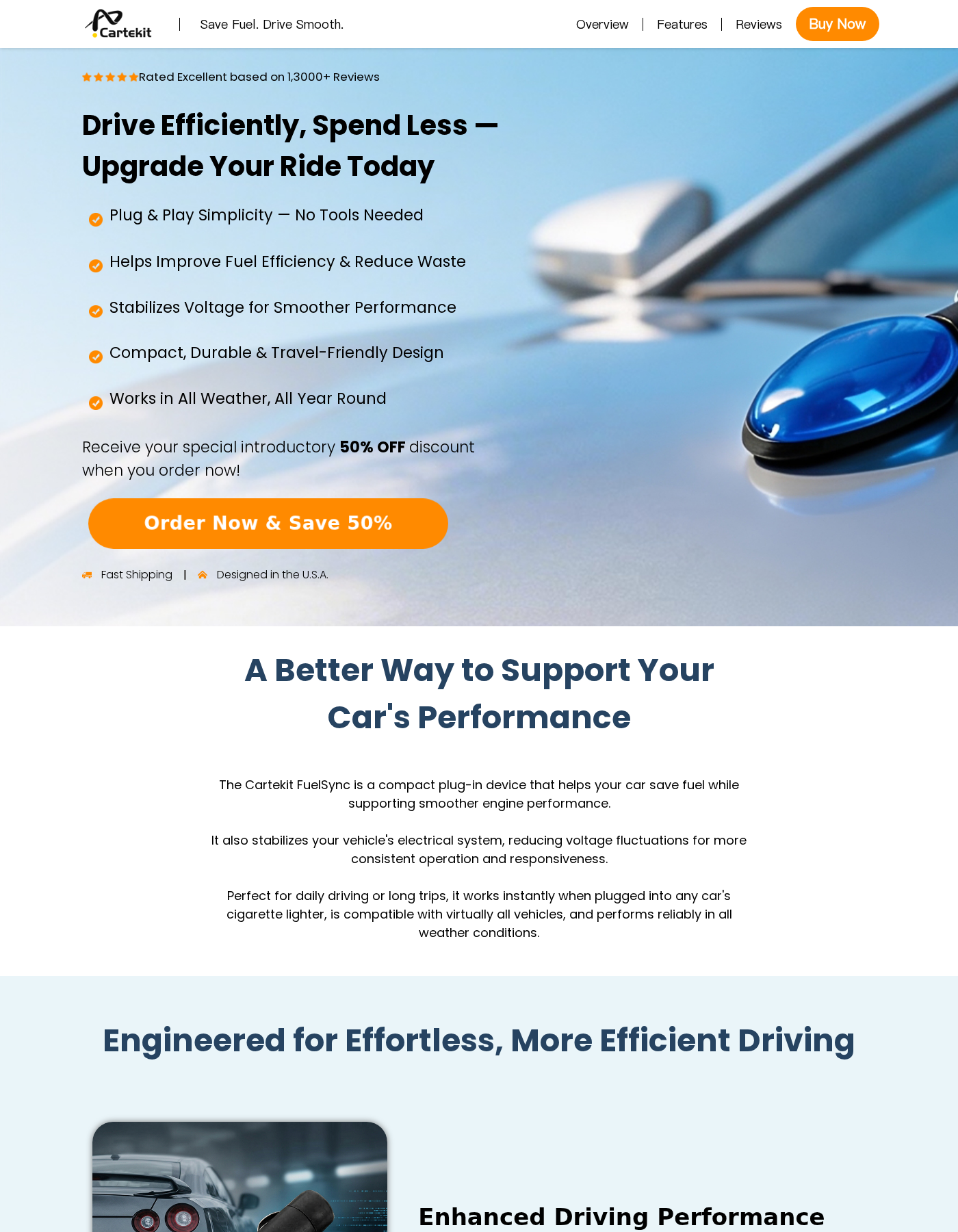
Cartekit FuelSync Optimizer promises smoother driving and less money spent at the pump. The pictured blue plug is supposed to work through a cigarette-lighter socket.
The pitch makes saving fuel sound effortless. Before buying one, follow the connection into the car, then follow the purchase button into the checkout.
Overview
A power-socket accessory sold as an engine improvement
Cartekit FuelSync is advertised as a voltage-stabilizing plug that immediately improves fuel efficiency, acceleration, and engine behavior across different vehicle types.
The photographed connector fits a 12V accessory socket. It is not the multi-pin diagnostic connector used by genuine OBD equipment.
A power connection is not an engine-calibration interface. The seller needs convincing engineering and controlled fuel-consumption evidence, not just a description of smoother driving.
The loaded checkout selects three units
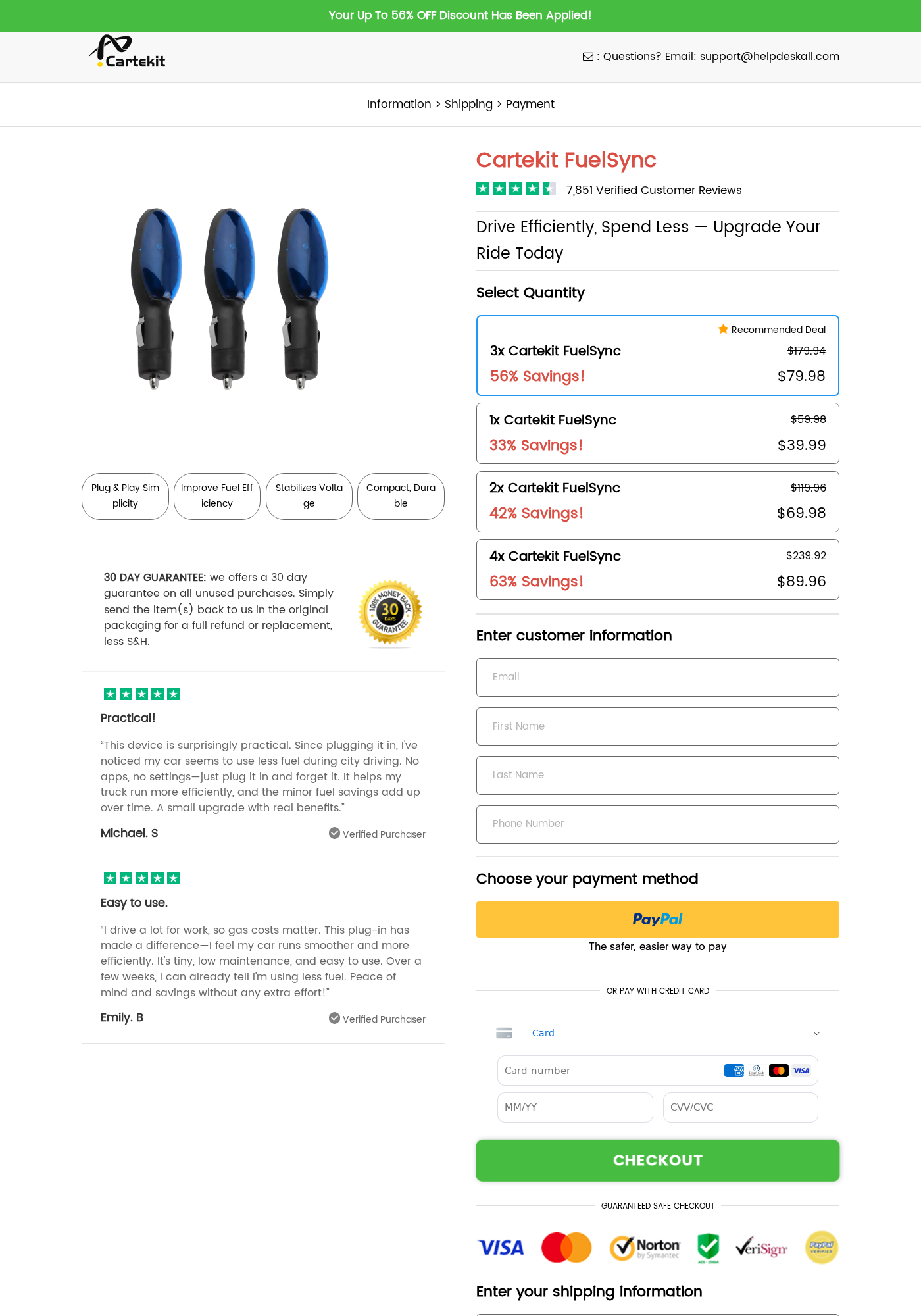
The dedicated fuel-device checkout highlights three Cartekit FuelSync plugs for $79.98. The separate single-unit option displays $39.99.
A buyer expecting one device needs to change that selection and review any shipping or protection charges before authorizing payment.
- The central promise is fuel savings through a power socket, not a repair carried out by a mechanic.
- The sales page promises satisfaction, while checkout limits its guarantee to unused purchases.
- The refund policy makes the buyer responsible for return postage.
- The legal page names a Hong Kong business address despite American-owned promotional wording.
The right decision is not to buy the fuel-saving claim
This offer provides no adequate basis to recommend the device as an efficiency upgrade. The proposed benefit and restrictive trial conditions are both substantial problems.
The investigation concerns Cartekit’s current fuel-plug offer. Its dashcam at the main domain is a different product, and older FuelSync billing claims require separate evidence.
What the Plug Can and Cannot Connect To
A conventional cigarette-lighter socket provides electrical power and ground. It does not give this accessory the diagnostic data connection used to communicate with an engine controller.
That is the central mismatch behind the instant-optimization pitch. No cable reaches a fuel injector, air intake, oxygen sensor, or vehicle diagnostic port.
A voltage-conditioning claim is a different proposition from reprogramming an engine. It would need measured electrical effects and a demonstrated connection to lower fuel use.
Cartekit’s page moves from voltage stability to smoother acceleration and reduced consumption without supplying that chain of evidence.
Nor is a universally compatible plug a vehicle-specific calibration. Gasoline and diesel engines, different electrical architectures, and different operating conditions do not become identical.
For a meaningful efficiency claim, look for identified vehicles, controlled conditions, repeated comparisons, measured fuel consumption, and access to the complete test method.
A dashboard estimate or a driver’s impression of filling up less often is not enough. Route, traffic, weather, loading, and driving habits can all change consumption.
A light illuminating when plugged in proves only that something is receiving power. It cannot demonstrate improved combustion or savings at the pump.
If your vehicle actually has unstable electrical supply, have the battery, charging system, and connections assessed. A mystery plug is not a diagnosis of the fault.
A Familiar Blue Pod Under Another Name
The blue-topped pod resembles the long-running Fuel Shark and NeoSocket style of socket gadget. The product category predates Cartekit’s current promotion.
That is a design and mechanism comparison, not evidence that every blue housing comes from one factory or contains an identical board.
PerformanceChipGuide’s teardown of a NeoSocket/Fuel Shark sample documented a basic circuit containing a capacitor, resistors, and a light rather than an engine-control interface.
Those findings concern the examined sample, not a Cartekit unit tested here. They help explain why a familiar shell and technical-sounding label are insufficient.
Another historical example, Fuel Doctor, promoted electrical conditioning. Car and Driver’s follow-up testing did not substantiate its claimed noise filtering.
A new seller needs new supporting results, not the benefit of the doubt because the name changed. Renaming an accessory does not resolve the engineering question.
MalwareTips has also covered the wider FuelSync plug-in fuel-saver campaign. This Cartekit offer adds its own checkout selection and merchant terms.
Do not transfer every older campaign promise into this one. The captured Cartekit page does not need a dramatic mileage percentage to make an unsupported fuel-saving pitch.
The Sales Page’s Credibility Problems
The page repeatedly promises immediate operation across cars, trucks, SUVs, and diesel engines. Broad compatibility is not independent evidence of meaningful results.
Its technology description stays general, relying on voltage stability and improved performance. There is no adequately identified comparative vehicle test on the captured offer.
The page’s specifications area also contains unrelated language about omnidirectional tires, a long-lasting battery, and lights and music. Those are not useful specifications for this plug.
That leftover material is a concrete sign of reused sales-page content. It should lower confidence in the care taken to document the actual product.
Reviews are presented as reassurance, but their wording describes perceived improvements rather than measured, controlled fuel savings. A testimonial cannot isolate the plug’s effect.
The checkout displays green review-style stars and 7,851 verified customer reviews. Their appearance alone does not authenticate an independent rating or establish the verification method.
A proper review link should identify the exact merchant and product. Otherwise, the graphic remains a claim controlled by the sales page itself.
Payment and security logos address a different question. A checkout accepting a familiar payment service can still sell an accessory with unsupported performance claims.
How the Cartekit FuelSync Offer Works
Step 1: A simple plug is framed as immediate savings
The landing page combines attractive car imagery with promises of reduced waste, improved responsiveness, and effortless installation. It makes a technical purchase feel uncomplicated.
The work has supposedly been reduced to plugging something in. That convenience should increase the demand for evidence, not excuse the missing mechanism.
Step 2: The purchase button opens a recommended bundle
The initial checkout promotes three devices at $79.98. One is $39.99, two are $69.98, and four are $89.96 in the captured version.
Those amounts are package prices, unlike a per-bottle supplement promotion. Confirm which quantity is selected rather than applying assumptions from another store’s checkout.
The small price difference between packages encourages extra units. More unsupported devices do not produce better evidence or a more useful automotive upgrade.
Step 3: Extras and discounts compete for attention
The form contains shipping and package-protection lines, while an additional coupon popup offers another discount. These can distract from the actual order composition.
Read the full total and the selected extras before paying. Do not assume the amount on the product card includes everything the form later adds.
No payment details were entered or purchase completed for this article. Post-payment offers and actual fulfillment were therefore not tested.
Step 4: The satisfaction promise meets an unused-item rule
The landing page invites dissatisfied buyers to return within 30 days. The checkout guarantee specifically refers to unused purchases in original packaging, less shipping and handling.
The separate refund policy likewise requires an unused item. That is a serious problem if you expected to try the device and then reject its performance.
Do not assume a money-back badge authorizes a meaningful fuel-economy trial. Obtain the actual conditions before purchasing, not after using the plug.
Three-unit checkout and unused-return warning
The captured order form selects three plugs for $79.98. Check the quantity, shipping, and protection lines before authorizing any charge.
A satisfaction promise is undermined by the unused-item restriction. Do not buy expecting a cost-free road test followed by an unconditional refund.
The Business, Address, and Refund Trail
The legal page deserves more weight than patriotic marketing
The checkout promotes American ownership and operation. Its terms identify Cartekit Technology International Co., Limited and a Hong Kong address.
A Hong Kong registration does not by itself disprove American ownership. However, buyers should be told clearly which legal business contracts with them.
The captured wording is a company statement, not independent registry verification. Match it against the business named on the receipt before pursuing a complaint.
The stated address is not an automatic return destination
The terms give Office No. 12, 19th Floor, Ho King Commercial Centre, 2–16 Fa Yuen Street, Mongkok, Kowloon, Hong Kong.
That address does not establish where your parcel was dispatched, where the plug was manufactured, or which depot accepts authorized returns.
Request the correct destination and instructions from the merchant. Do not pay international postage to a guessed office address because it appeared in legal text.
Support uses a different domain from the brand
The order page publishes support@helpdeskall.com. A shared-looking support domain is not proof of common ownership with every other product using similar customer-service arrangements.
It does make recordkeeping important. Keep the brand, order number, sender address, and transaction descriptor together so the correct purchase can be identified.
No response test was performed. Whether support resolves a particular problem needs evidence from the customer’s own correspondence, not an assumption that all messages fail.
The refund wording contains a deadline ambiguity
The policy mentions the tracking record’s delivery date but also says the request must be within 30 days of purchase. Those are not necessarily the same deadline.
Ask for written clarification immediately if delivery took time. The page also assigns return-postage costs to the buyer and excludes shipping reimbursement.
Its unused-condition requirement may conflict with the impression created by the satisfaction pitch. Preserve both versions if the seller rejects a performance-related return.
Do Not Confuse This Checkout With Older Membership Funnels
Some earlier FuelSync promotions involved separate membership charges. MalwareTips has documented one in its previous Fuel Sync billing investigation.
That history is a reason to inspect your own order, not proof that Cartekit has imposed the same $49.99 arrangement. No such charge was established here.
The current documented risks are sufficient: an unsupported fuel-saving benefit, a three-unit default, unclear merchant presentation, and restrictive return conditions.
If an unfamiliar recurring charge appears, match it to the receipt and any additional service. Report the specific transaction rather than guessing from another campaign.
Why Fewer Fill-Ups Can Mislead
Fuel economy requires distance and fuel used together. Driving 350 miles on 14 gallons and 400 miles on 16 gallons both work out to 25 mpg.
The second trip goes farther, but it does not demonstrate improved efficiency. Comparing only the interval between visits to a gas station misses that difference.
Even calculated mpg can vary across individual tanks. Filling technique, route mix, idling, weather, and vehicle load should be accounted for in a serious comparison.
That is why a customer’s impression is weaker evidence than repeatable controlled testing. It also explains why a dashboard change immediately after installation proves little.
Do not spend the entire refund period trying to reproduce an advertising promise. The merchant’s unused-item condition makes that assumption particularly costly.
The burden belongs on the seller to substantiate its advertised benefit before the sale, not on a disappointed driver to fund a lengthy experiment afterward.
What to Do If You Ordered Cartekit FuelSync
-
Check the order before trying the product. Record the number of plugs, product subtotal, delivery fees, protection, and any later charge you did not expect.
-
Save the performance promise. Preserve the landing page’s immediate fuel-saving description, the checkout guarantee, and the separate unused-item policy.
-
Request a written remedy promptly. State whether you want cancellation, correction of an unwanted bundle, or a return. Ask for the full refund calculation and destination.
-
Photograph the received accessory. Keep labels, packaging, connector, and any model information. Do not dismantle live electrical equipment to prove a complaint.
-
Contact your payment service if unresolved. Explain misleading description, unauthorized quantity, or non-delivery accurately. Ask about evidence requirements and deadlines before they lapse.
-
Address real vehicle faults properly. Unplug an overheating or damaged accessory when safe. Consult an appropriate mechanic for electrical warnings, poor running, or unexpectedly high consumption.
Frequently Asked Questions
Does Cartekit FuelSync reprogram the engine through the lighter socket?
The pictured plug connects to accessory power, not a diagnostic data interface. The captured offer does not demonstrate engine reprogramming or a controlled fuel-saving result.
Is it the same type of gadget as Fuel Shark?
Its blue pod-shaped socket design and claimed mechanism resemble that longstanding category. That comparison does not authenticate an identical circuit, factory, or seller.
Why does the Cartekit checkout show three devices?
The loaded order form selects its three-unit Recommended Deal at $79.98. A one-device option is separate; verify the quantity and final charges before payment.
Can I use it and then claim the 30-day guarantee?
Do not rely on that assumption. The checkout and refund terms require an unused item, despite the sales page’s broader satisfaction language.
Does this order include the older $49.99 FuelSync membership?
That specific membership was not established in Cartekit’s captured offer. Review your own receipt and later transactions instead of transferring terms from another campaign.
What actually helps reduce fuel use?
Appropriate maintenance, correct tire pressure, smoother driving, and avoiding unnecessary idling can help. Use the vehicle manufacturer’s guidance rather than an unsupported plug-in promise.
The Bottom Line
Do not buy Cartekit FuelSync as a fuel-economy upgrade. The power-socket connection and unsupported performance pitch do not justify spending money on one plug or a bundle.
Already ordered? Check the quantity, preserve the satisfaction promise and unused-return restriction, and request a remedy promptly. Escalate unresolved transaction problems before your payment-provider deadline.

Join the discussion
0 commentsShare your experience or ask a question about this article.
Discussion
Start the conversation
Have a question or something useful to share? Add the first comment.