


The appeal sounds like the campaign messages you’ve seen all week. A familiar name, an important cause, and one more request to contribute.
You may already know where you stand politically. The question worth answering before you pay is who is actually asking for your money.
Overview
The donation request borrows someone else’s authority
The ScamPAC donation scam starts with a false claim of affiliation. Someone says they’re collecting for a real political committee or candidate without permission.
You intend to support that organization. The impostor intends to collect the payment, keeping the benefit of a reputation it didn’t build.
This is different from disliking a committee’s politics, fundraising costs, or campaign strategy. The deception concerns who authorized the solicitation and where your contribution goes.
The FBI warning describes a specific fraud
The FBI’s ScamPAC warning identifies people falsely collecting for real PACs, Super PACs, or candidate committees and retaining the proceeds.
It does not label every political fundraiser fraudulent or identify a particular current committee in every unsolicited message you might receive.
A real organization can be impersonated. Finding its registration therefore answers only part of the question; you still need to authenticate the actual collection request.
What you should verify before contributing
Treat a donation as a transaction with a particular recipient, rather than an expression of support that needs no further checking.
- Find the genuine committee through an independent source.
- Check whether it authorizes the sender and the payment route.
- Read the receiving entity and any recurring-payment selection.
- Keep the receipt and compare it with what you intended to authorize.
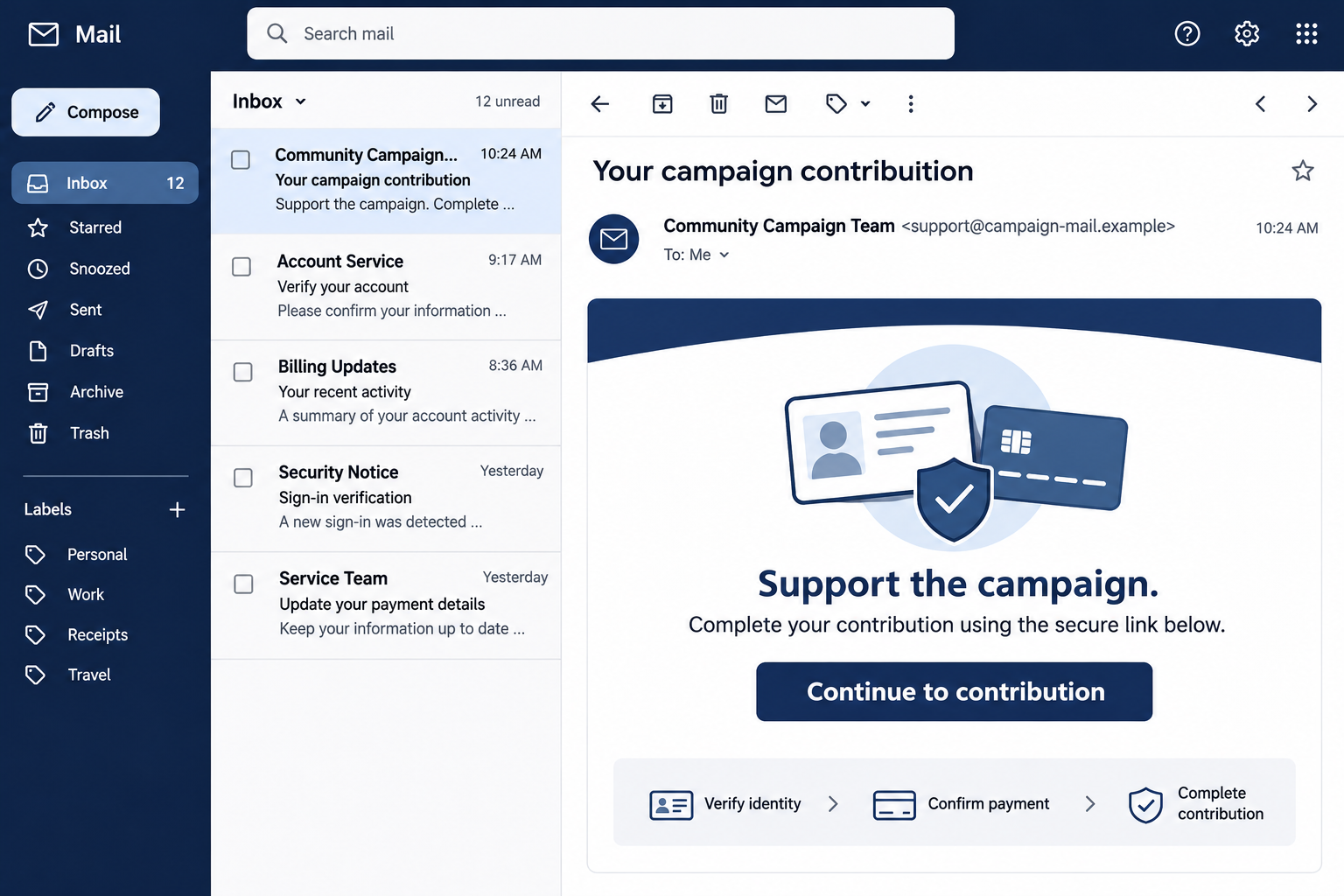
The email illustration above uses a fictional sender and example address. It is not evidence against a real campaign, candidate, or payment provider.
A Familiar Candidate Doesn’t Identify the Collector
A photograph, campaign phrase, or committee name can make a message feel familiar. None tells you who controls the receiving account.
Imagine a stranger outside an event wearing a campaign shirt and collecting money. You would still want to know whether the campaign sent them.
The same question belongs online, even when the collection page looks more polished than a person holding a bucket.
A donor may concentrate on whether the cause is worthy and overlook whether the collector is genuine. Those are different decisions.
Someone can also borrow a committee’s publicly available details. Copying an address or identifier doesn’t require permission from the organization listed there.
That means a convincing answer to one easy question, such as whether the committee exists, cannot settle the harder question of whether this request belongs to it.
Keep the suspicious appeal for your records. If you still want to contribute, open the real organization’s donation page independently.
Doing that preserves your intended political choice while refusing to let an unknown sender determine where your money goes.
How the ScamPAC Donation Scam Works
Step 1: The appeal connects a payment with a real political cause
The approach gives your contribution an apparent destination: a candidate, PAC, Super PAC, or committee you recognize or can look up.
The emotional argument may fit your views perfectly. That fit doesn’t establish the sender’s authority to collect on anyone’s behalf.
Focus on the factual claim underneath the appeal. Who says they’re receiving the contribution, and who says they authorized the request?
Step 2: Public details make the affiliation appear credible
A copied committee name can survive a quick search because the committee itself is real. The search result reassures you about the wrong thing.
An official-looking identifier adds the same distraction. A public record can describe a legitimate organization while the message comes from an unrelated account.
Don’t ask only whether the name exists. Ask whether the exact sender, website, and payment destination connect to that organization through its own channels.
If the sender supplies a confirmation number or reassuring document, verify it elsewhere. Materials supplied by the collector cannot independently authenticate the collector.
Step 3: The collection route replaces the real donation route
The fraud takes effect when the request sends money somewhere the actual committee hasn’t authorized, despite claiming to collect for that committee.
The wrong destination can sit behind a respectable-looking button. A smooth checkout process shows that a payment can be processed, not that the affiliation is genuine.
Before approving, read the recipient information available to you. If it differs from what you expected, stop and clarify through the real organization’s office.
You shouldn’t need to explain away an unfamiliar receiving party because an urgent message tells you to trust it.
Step 4: A completed payment hides the missing contribution
A transaction receipt confirms that a payment occurred. It doesn’t necessarily establish that your intended committee received the funds.
Keep the receiving details as well as the promotional message. The difference between those records may be central to explaining the deception.
If the actual committee cannot locate the contribution, contact your payment provider promptly. Don’t wait for the unknown collector to provide repeated assurances.
Step 5: Further contact can prolong the confusion
An impostor can ask for more time, another payment, or a new route to resolve the first transaction. None independently verifies the original affiliation.
End the collection conversation and move to the institutions that can check the facts: your provider, the genuine organization, and the appropriate reporting authority.
You can still support the real cause later. Recovering from a deceptive request should not require another transfer to the same stranger.
What an FEC Search Can Tell You
For federal political committees, the Federal Election Commission’s research guide explains how to examine public committee records.
Those records can include a committee’s name, address, treasurer, registration information, receipts, disbursements, and reported political activity.
Start with the exact committee name or identifier. Similar names are easy to confuse, particularly when you are reading a short message on a small screen.
Then compare the record with the organization you actually meant to support. Don’t stop because the first result contains a familiar candidate’s surname.
Record the committee identifier for your own notes. It helps you describe which organization you intended to support if the solicitation used an ambiguous name.
The FEC committee database is a research tool, not an approval badge for a payment link circulating elsewhere.
Its presence in a message does not prove that the FEC authenticated the sender. The database cannot tell you who currently controls a private social account.
For state or local activity, consult the relevant campaign-finance authority. A missing federal record alone doesn’t prove that every local political organization is fraudulent.
And don’t turn technical labels into criminal accusations. An unauthorized or nonconnected committee designation has a regulatory meaning, not a built-in finding of fraud.
Ask About the Particular Request, Not Just the Organization
Find the genuine organization’s contact details without using the suspicious message. Explain that someone is claiming to collect on its behalf.
Give the exact sender address, account handle, and destination website. Ask whether those specific details are authorized, rather than asking whether the campaign accepts donations.
A general yes to fundraising doesn’t authenticate the person who contacted you. The committee needs enough detail to identify the request you received.
You can redact unnecessary personal information from an initial inquiry. There is no need to send your complete financial statement to establish a sender’s affiliation.
If you already paid, the receipt’s transaction reference can help locate the contribution. Supply it privately through a genuine support route when appropriate.
If nobody can confirm the route, don’t pay through it. A lack of confirmation is sufficient reason to choose a different, independently verified path.
Avoid asking the suspect account to send a second website as proof. That leaves the same person choosing both the claim and its supposed verification.
Treat a friend forwarding the appeal kindly, but independently check the underlying request. Their good intentions don’t authenticate the collector either.
What This Warning Does and Doesn’t Cover
A fundraising expense isn’t automatically theft
A donor can reasonably dislike how an organization spends money. That concern is different from an impostor pretending to collect for a real committee.
Use filings and the organization’s explanations to assess spending. Do not infer criminal fraud merely from an expense ratio you find disappointing.
This warning concerns false affiliation and diverted contributions. Keeping that definition clear protects both donors and legitimate organizations being impersonated.
An unwanted recurring donation needs its own review
Check whether you selected a recurring contribution and what the receipt says. A billing disagreement doesn’t automatically establish the ScamPAC impersonation mechanism.
If the organization and payment were genuine, request cancellation through that organization’s actual process and document the request.
If the recipient was an impostor, explain the false affiliation to your provider. Accurate descriptions make the problem easier to investigate.
An investment pool makes a different promise
Be especially wary if someone changes the appeal into a promise that you’ll personally earn money when a candidate wins.
That adds a financial-return claim rather than an ordinary donation. Keep any payout or recruitment terms if that is the offer you received.
A ScamPAC contribution appeal doesn’t need a profit promise to be deceptive. Falsely claiming to collect for someone else is already the central problem.
What to Do if You Have Fallen Victim to This Scam
- Stop further payments to the collector. Don’t send an extra fee to confirm the contribution, move it to the right committee, or release a refund.
If a payment is still pending, ask the provider whether cancellation is possible. Don’t approve a replacement while waiting for an answer.
- Report the actual transaction to your payment provider. Explain that the recipient falsely claimed affiliation with a political organization you intended to support.
Ask about a dispute, recall, or other available recovery process. Be clear whether you authorized the payment after deception or never authorized it at all.
- Build one short evidence file. Keep the solicitation, sender details, destination address, receipt, receiving name, amount, and any claim of committee authorization.
Note which real organization you intended to support. That connection is more useful than a general statement that the message looked political.
- Notify the genuine committee independently. Its staff may be able to confirm that the collector was unauthorized and warn other potential donors.
Do not demand that the impersonated organization refund a transfer it never received. Ask it to verify the facts and retain any answer.
- Submit an internet-fraud report to IC3. Use the official Internet Crime Complaint Center and describe the impersonation and payment route.
Include transaction identifiers privately rather than posting them beneath a public campaign page. Retain the acknowledgment with your records.
- Secure credentials if you entered them on a false page. Change exposed passwords through the genuine account and review unfamiliar sessions or changes.
If you submitted card information, tell the issuer what you disclosed and ask how to protect against further transactions.
- Check for a second exposure. Review whether the page also enrolled you in recurring payments or asked you to approve something beyond the donation.
Preserve the relevant terms and receipts. Don’t assume every extra charge is a subscription, but do investigate entries you don’t recognize.
- Warn people who received your forwarded appeal. Tell them that the collector’s affiliation couldn’t be authenticated or was denied, depending on what you established.
Keep the correction factual. Avoid naming an innocent committee as the scam operator merely because its identity appeared in the message.
Keep Your Politics Out of the Recovery Argument
Your bank doesn’t need a defense of the candidate you supported. It needs an accurate account of the promised recipient and the actual payment.
Write the timeline in that order: who contacted you, which affiliation they claimed, what you authorized, and what later revealed the deception.
If embarrassment is slowing you down, ask someone you trust to sit with you while you gather records. You can seek help without discussing your views publicly.
Don’t pay an unsolicited recovery service claiming special access to campaign accounts. A second confident promise can exploit the same loss.
Follow up with existing report references rather than starting a new conversation with every account offering assistance. Keeping records together makes discrepancies easier to spot.
Frequently Asked Questions
What does ScamPAC mean here?
It describes a false claim of collecting for a real political committee or candidate while keeping the money. It doesn’t mean every PAC is fraudulent.
Does a genuine committee registration make a donation link safe?
No. Public details can be copied. Confirm that the actual organization authorizes the particular sender and receiving route.
Is a committee fraudulent because it spends heavily on fundraising?
Not automatically. Spending concerns require their own assessment. This warning concerns false affiliation and diverted payments, not a blanket verdict about fundraising expenses.
Can a legitimate group use an outside payment processor?
Yes. An outside processor isn’t sufficient proof of fraud. Verify the relationship through the genuine group’s own independently located donation or support route.
Should I report even a small loss?
Yes. The receiving account and message can help connect related complaints. Keep the transaction details even if the amount seems too small to pursue.
Can the real candidate get my money back?
The candidate may not have received it. Contact your payment provider first and ask the actual committee to verify the solicitation separately.
The Bottom Line
Do not contribute through an unverified collector claiming to represent a real political organization. Authenticate the specific payment route through the genuine committee.
If you already paid an impostor, stop further transfers, contact your provider, and report the false affiliation. Keep the accusation attached to the impersonation, not the stolen identity.

Join the discussion
0 commentsShare your experience or ask a question about this article.
Discussion
Start the conversation
Have a question or something useful to share? Add the first comment.