

In the world of skincare, miracle products are everywhere—but so are scams. The Turonu Botox Bee Venom Firming Serum Stick is one of the latest products making waves across social media, claiming to eliminate wrinkles, tighten sagging skin, reduce cellulite, and even enhance breasts—all with a simple glide of a stick.
Backed by bold testimonials, dramatic before-and-after photos, and supposed endorsements from dermatology institutions, Turonu™ seems like the ultimate anti-aging breakthrough. But is this product truly a skin-smoothing miracle—or just another cleverly disguised scam?
This in-depth report uncovers the truth behind Turonu™, breaking down its marketing tactics, exposing false claims, and offering a clear action plan if you’ve already fallen for it.
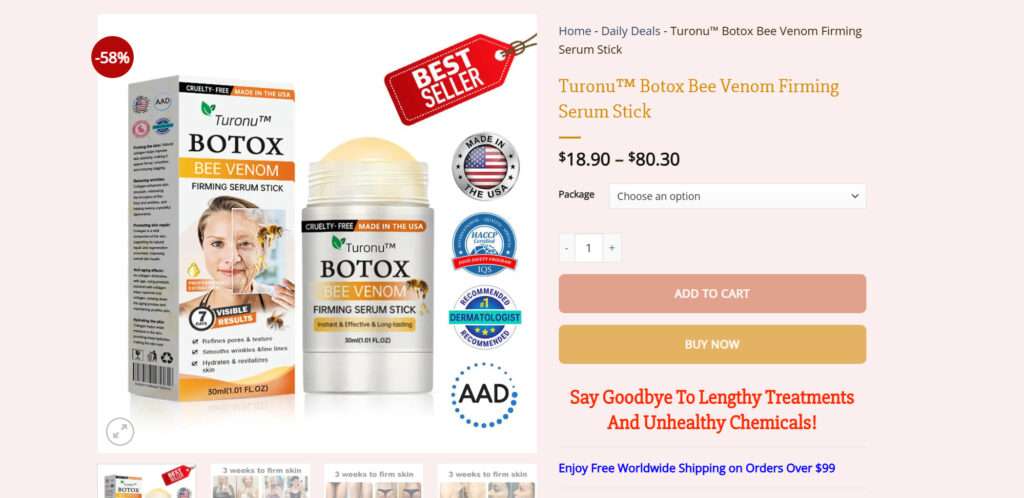
What’s Really Going On with Turonu™
Turonu is advertised as a revolutionary wrinkle-reducing and skin-firming serum stick formulated with bee venom peptides, botulinum toxin, and other high-impact ingredients. Its marketing promises visible results within just 7 days. Claims include:
- Approved by the American Academy of Dermatology (AAD)
- Clinically proven to lift and tighten skin
- Treats everything from sagging arms and wrinkles to cellulite and stretch marks
- Suitable for full-body use, including the face, breasts, stomach, and thighs
- Safe for sensitive skin and 100% plant-based
While these features sound promising, many of them are false, misleading, or unverified.
No Verified AAD Endorsement
One of the most concerning claims is that the serum has been approved by the American Academy of Dermatology. As of now, there is no public record or official press release indicating that AAD has endorsed or approved Turonu™ or any of its ingredients.
This false endorsement is a red flag—scammers often use the names of trusted medical institutions to gain legitimacy.
Dubious Testimonials and Stock Images
Many of the “real customer” testimonials found on the product’s website and ads appear to be fabricated or copied from other scam skincare brands. A reverse image search reveals several user photos used in multiple unrelated product listings.
This suggests the feedback isn’t authentic and is part of a broader deceptive marketing effort.
Overstated Ingredient Benefits
Turonu™ repeatedly claims its bee venom peptides mimic Botox and that botulinum toxin in a topical form can smooth deep wrinkles. While bee venom may have some minor skin-stimulating properties, there is no clinical evidence that topical applications deliver Botox-like results. In fact, botulinum toxin must be injected to have any effect on muscle movement and facial lines.
These exaggerated claims create false hope and lure consumers into spending on an ineffective product.
No Professional Oversight or Contact Info
Despite heavy claims of being “dermatologist-approved” and “clinically evaluated,” the product:
- Lists no manufacturer address
- Has no published clinical trials
- Offers no transparent return or refund policy
- Fails to disclose its exact formulation or concentrations
These are all signs of an unregulated product sold under false pretenses.
How the Turonu Scam Works
Scams like Turonu™ Botox Bee Venom Firming Serum Stick are not isolated incidents. They follow a predictable and repeatable formula, designed to convince, convert, and cash in on vulnerable consumers seeking solutions to common beauty concerns like wrinkles, sagging skin, or cellulite.
Let’s break down exactly how this scam operates from start to finish.
Step 1: Eye-Catching Ads on Social Media Platforms
It all starts with visually stunning ads plastered across platforms like Facebook, Instagram, and TikTok. These ads typically:
- Showcase dramatic before-and-after photos
- Claim dermatologist backing or FDA registration
- Use trending hashtags like #AntiAging, #FirmSkin, #BeeVenom, or #WrinkleFree
- Push limited-time promotions or discounts
This creates a sense of urgency and targets consumers who may already be frustrated with traditional skincare routines.
Step 2: Fake Authority and Pseudo-Science
Once clicked, the ad brings you to a landing page loaded with pseudo-medical jargon. It might include:
- Made-up quotes from “Dr. Sophia L. Williams, Board-Certified Dermatologist”
- Mentions of the “American Academy of Dermatology approval”
- Medical diagrams and lab photos that suggest clinical testing
None of these claims are verifiable. There are no real clinical trials, peer-reviewed studies, or scientific endorsements. Instead, they rely on borrowed trust from real institutions to sound convincing.
Step 3: Manipulative Customer Testimonial
Turonu’s product pages use emotional storytelling and fabricated reviews. Common red flags include:
- Reviews using common Western names and ages (Olivia Taylor, Ashley Davis, etc.)
- Photos that are stock images or AI-generated faces
- Testimonials written in overly dramatic, perfect prose
You’ll often see reviews from people claiming their stretch marks disappeared, their saggy neck became tight again, or their “mommy belly” was gone in just five days. The too-good-to-be-true narratives are designed to resonate emotionally with readers, especially those dealing with aging, post-pregnancy changes, or low body confidence.
Step 4: Promises of Ethical Sourcing and Cruelty-Free Standards
Modern consumers care about sustainability, which is why Turonu™ markets its bee venom extraction as “100% cruelty-free.” It claims:
- “Bees are not harmed in the making of this product”
- “Approved by the American Humane Association”
However, no certification documents or external links are provided to back this up. These claims are virtually impossible to verify and exist mainly to pacify ethical objections.
Step 5: Confusing Pricing Tactics
On checkout pages, you’ll often see offers like:
- “Buy 2, get 2 free + free shipping”
- “Free gift if you order within 5 minutes”
- “Only 9 left in stock!”
These offers create urgency and push customers to buy in bulk. Once the order is placed, several things may happen:
- The actual product may be completely different than advertised (e.g., low-quality cream in generic packaging)
- You may be signed up for recurring billing without your consent
- You might never receive the product at all
Step 6: No Real Company or Customer Service
After your credit card is charged, support becomes non-existent. Here’s what many customers report:
- No phone number or address listed
- Emails go unanswered
- Refunds are denied or “processing” indefinitely
- Website disappears or rebrands under a new product name
Some sites rotate between selling “firming serum sticks,” “anti-wrinkle rollers,” or “instant eye-lift patches” using the same scam infrastructure and testimonials.
Step 7: The Product is Useless or Potentially Harmful
If you do receive the product, it typically:
- Arrives in unbranded packaging
- Contains a suspicious ingredient list or none at all
- Smells artificial or chemically potent
- Has no safety seal, usage instructions, or return slip
Some users even report adverse effects like skin irritation, allergic reactions, or burning sensations. Remember: bee venom is an allergen and should not be applied without dermatologist supervision—especially in unknown concentrations.
What To Do If You’ve Fallen Victim to the Turonu Scam
If you’ve already purchased the Turonu™ Botox Bee Venom Firming Serum Stick and suspect you’ve been scammed, don’t panic. You’re not alone—and there are actionable steps you can take right now to protect yourself and potentially recover your money.
1. Contact Your Bank or Credit Card Provider Immediately
- Dispute the charge: Explain that the product was misrepresented or never arrived. Use terms like “fraudulent transaction” or “unauthorized recurring billing” if applicable.
- Request a chargeback: Most credit card companies offer protection and allow chargebacks within 60–120 days.
- Freeze further charges: Ask your provider to block any future transactions from the merchant or their processor.
2. Collect and Document All Evidence
- Take screenshots of the product page, order confirmation, testimonials, and claims.
- Save all emails and shipping notifications, even if they’re automated or generic.
- Photograph the product you received, especially if it looks different from the ad or has no labeling.
This documentation will be helpful when filing disputes with your bank or reporting to authorities.
3. Report the Scam to Consumer Protection Agencies
Reporting the scam helps create awareness and aids in investigations against these fraud networks. Start with:
- FTC (Federal Trade Commission) – reportfraud.ftc.gov
- Better Business Bureau Scam Tracker – bbb.org/scamtracker
- IC3 (Internet Crime Complaint Center) – ic3.gov
- Econsumer.gov (for international complaints) – econsumer.gov
Be as detailed as possible with your report, including URLs, screenshots, and transaction details.
4. Warn Others by Sharing Your Experience
Scam sites rely on secrecy. Help stop the cycle by:
- Posting your experience on Reddit (e.g., r/scams, r/skincareaddiction)
- Leaving reviews on ScamAdviser, Trustpilot, or SiteJabber
- Commenting on the social media ads that led you to the product
The more visibility a scam gets, the harder it is for it to keep deceiving new customers.
5. Protect Your Identity and Online Accounts
If you provided your name, address, or payment info:
- Change your passwords, especially if you created an account on their site
- Enable two-factor authentication on your financial apps and email
- Monitor your bank account for unauthorized activity
- Consider using a credit monitoring service or placing a fraud alert on your credit file
Scammers often resell your information to other fraudulent networks, so stay alert.
6. Dispose of the Product Safely
If you received the serum and suspect it’s unsafe:
- Do not apply it to your skin, especially if you have sensitive skin or allergies
- Check with your local pharmacy or waste management for safe disposal guidelines
- Consult a medical professional if you’ve experienced irritation or side effects
The Bottom Line: Is Turonu a Legit Skincare Innovation or a Beauty Scam?
The answer is clear: Turonu™ Botox Bee Venom Firming Serum Stick is not the miracle skincare solution it claims to be. It is part of a well-orchestrated scam operation that relies on deceptive marketing, fake testimonials, made-up medical endorsements, and emotionally manipulative tactics.
The Biggest Red Flags Recap:
- Falsely claims endorsement from the American Academy of Dermatology
- Uses stock photos and generic testimonials
- Contains no verified ingredients list or clinical testing
- Operates without a known manufacturer or return policy
- Disappears or rebrands frequently after enough complaints pile up
It fits the mold of dozens of similar “serum stick” scams that pop up and vanish, leaving victims with broken promises and empty wallets.
Final Advice
If a product claims it can:
- Mimic Botox
- Lift and enhance your breasts
- Erase cellulite and stretch marks
- Tighten your belly without diet or exercise …all for under $50 and without medical supervision, it’s a scam.
Real skincare takes time, science, and professional oversight. Don’t gamble with your health or your hard-earned money. Instead, consult with a licensed dermatologist, use clinically backed products, and always research before purchasing anything promoted through a viral ad or influencer.

Join the discussion
0 commentsShare your experience or ask a question about this article.
Discussion
Start the conversation
Have a question or something useful to share? Add the first comment.