


Ujersey sold NFL, NBA, MLB, NHL and college jerseys for $39.99, next to crossed-out prices as high as $384.99. For a fan shopping before kickoff, that looked like a steal.
Type ujersey.shop into a browser today and you land on a court notice instead of a store. Here’s what happened, what buyers reported and what to do if you ordered.
Overview
What the Ujersey shop sold
Ujersey.shop was an online jersey store with menus for pro football, baseball, basketball and hockey teams, MLS clubs, WNBA teams and dozens of college programs. It also offered custom jerseys.
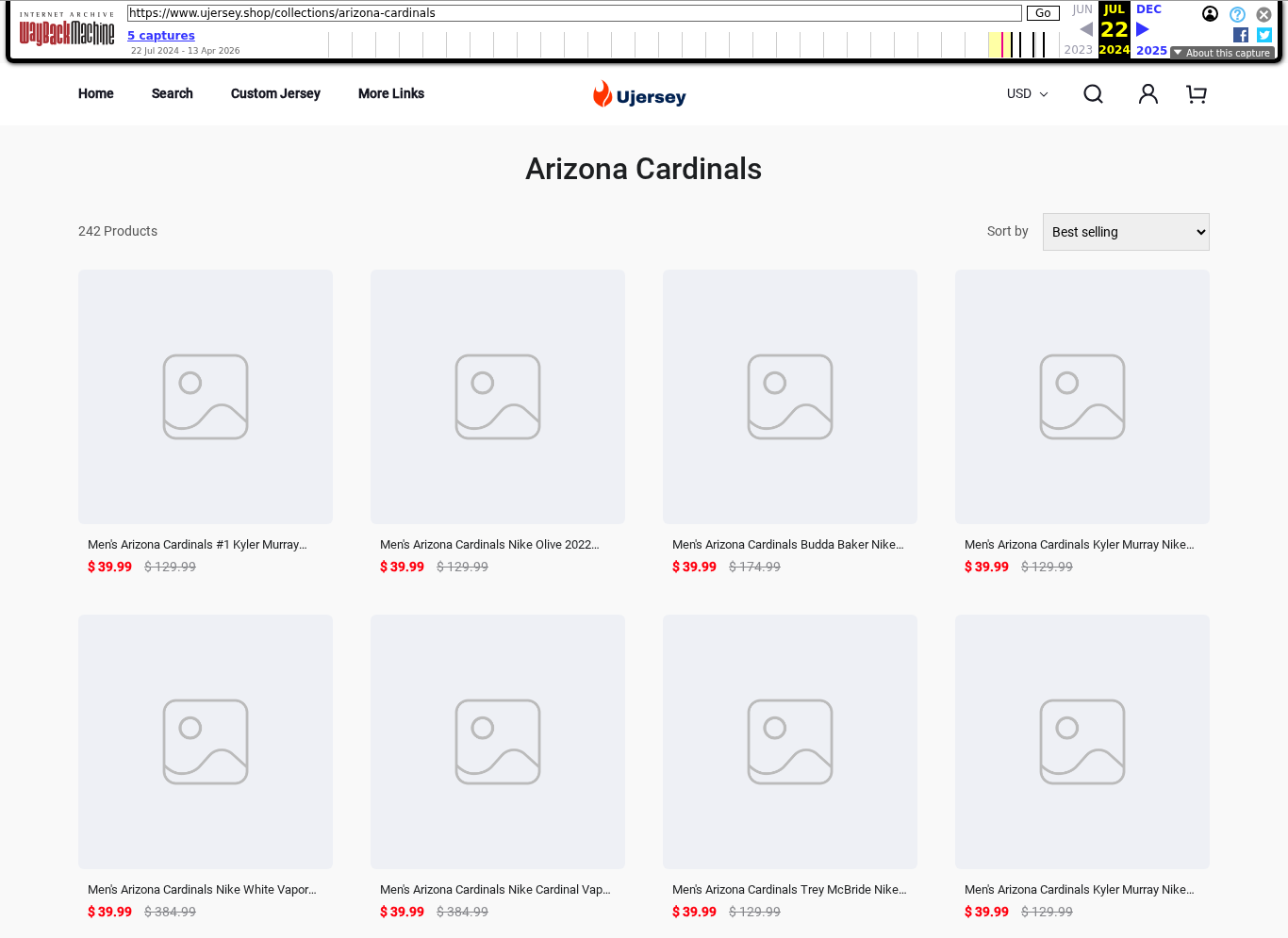
An archived Arizona Cardinals page from July 2024 lists 242 products. Nike-labeled jerseys sit at $39.99, set against crossed-out prices of $129.99, $174.99 and $384.99.
Why ujersey.shop no longer opens a store
On December 31, 2025, adidas sued the operator behind ujersey.shop and ten related store names in federal court in Florida, accusing it of trademark counterfeiting.
The operator never answered. On March 30, 2026, the judge entered a default judgment, awarded adidas $1,000,000 and ordered the store names transferred.
The Wayback Machine saved the working store as late as April 13, 2026. The domain record changed on April 27, and the address now opens the case notice.
Is Ujersey a scam?
Ujersey had no adidas license, and a federal court has ruled against its operator. Some buyers got jerseys, while others describe missing orders and silence. The key facts:
- Court: a default judgment for trademark counterfeiting and infringement, with $1,000,000 in statutory damages.
- Price: a flat $39.99 for jerseys that licensed shops sell for well over $100.
- Identity: a “Ujersey Co., Ltd.” footer with no address, registration number or call line.
- Policies: exchanges only, all sales final and a warning of legal action over payment disputes.
- Reviews: 2.1 out of 5 on PissedConsumer from five rated reviews, mostly about delivery and refunds.
Adidas v. Ujersey: What the Court Ordered
The plaintiffs were adidas AG, adidas International Marketing B.V. and adidas America. They filed in the US District Court for the Southern District of Florida, case 1:25-cv-26168.
The complaint treats eleven store names as one defendant: ujersey.store, ujersey.cc, ujersey.online, ujersey.shop, u-jersey.store, ujersey.vip, ujersey2025.com, ujerseyinc.com, ujerseylogin.com, ujerseyshop.com and ujerseyus.com.
Adidas alleged that the stores shared identical email and phone contact data, sold goods using counterfeits of its marks and were never licensed to use them.
The court allowed service by email and by a notice website, because adidas said it couldn’t find a valid physical address for the defendant.
The case moved quickly. It took 89 days from filing to final judgment, because nobody appeared to defend the stores.
The clerk entered a default on February 24, 2026. Judge Roy K. Altman granted final default judgment on March 30, 2026, and the judgment was docketed on April 1.
On adidas’s request, registrars must transfer the store names, search engines delist them, email providers suspend the store’s addresses and payment firms such as PayPal and Stripe freeze its funds.
Adidas’s complaint asked for $2,000,000 per counterfeit mark used and product type sold. The court awarded $1,000,000 in total.
Frozen money goes to adidas, up to the judgment amount. The case doesn’t create a refund fund for shoppers, so buyers still need their own bank or card dispute.
The page ujersey.shop now opens is the plaintiffs’ notice site. It posts the complaint, the orders and the final judgment, which is how the operator was served online.
Its heading names a different defendant, ATSOCCERJERSEY.COM, but the case number and the posted complaint, orders and judgment all name the Ujersey stores.
A default judgment means the operator didn’t contest the claims. The court found that the complaint adequately pleaded trademark infringement, false designation of origin and unfair competition.
How Ujersey Sold Its Jerseys
From late 2023 to April 2026, the store ran the same simple routine. Each step made the deal look safer than it was.
Step 1: Every team in one menu
The menus listed all 32 NFL teams, nearly every MLB, NBA and NHL club, MLS sides and a long run of college programs, so almost any fan found a team.
Step 2: One price against big crossed-out numbers
Jerseys sat at $39.99 beside “original” prices of $129.99 to $384.99. For comparison, the Pro Football Hall of Fame shop sells a 2026 Nike men’s Game jersey for $154.99.
Step 3: Checkout in several currencies
Prices defaulted to US currency, with euro and pound options and, by 2026, Chinese yuan. One reviewer’s bank statement showed different company names for two identical orders.
Step 4: Airmail and slow updates
The shipping page promised dispatch in two to three business days and airmail in 12 to 21 days. Eight of 11 PissedConsumer reviewers describe late, missing or unconfirmed orders.
Step 5: Exchanges only, plus a warning about disputes
Exchanges were allowed only for defects or wrong items reported within 3 days. All sales were final, and the policy threatened legal action over a “malicious refusal to pay.”
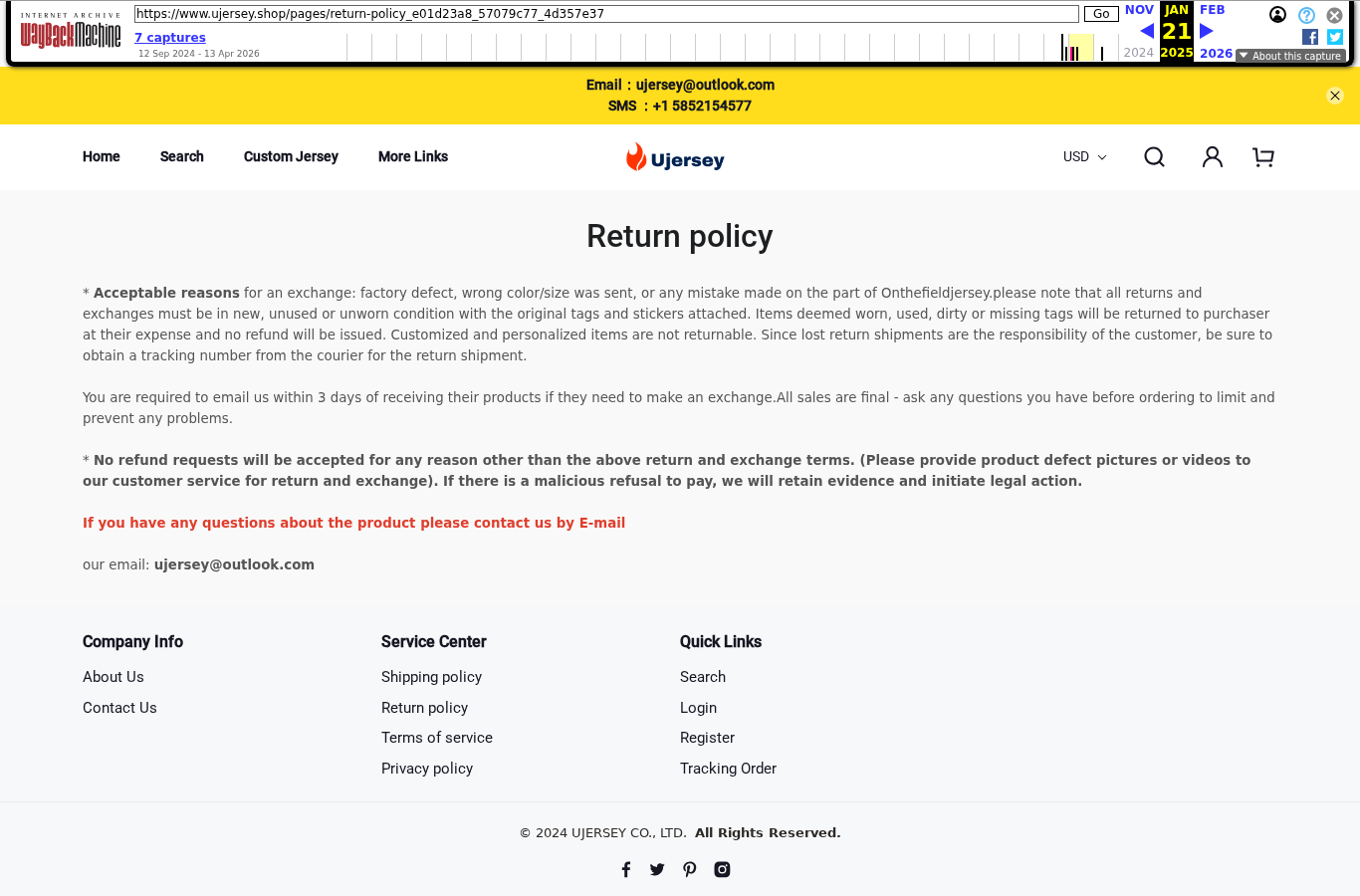
The policy also names Onthefieldjersey, a different store, as the party whose mistakes qualify, which suggests copied text. The shipping page promised 7-day returns instead.
Step 6: Many names behind one storefront
Adidas told the court one operator ran at least eleven store names with shared contact details. A dead domain doesn’t stop the storefront from returning under a new name.
What Ujersey’s Policies Meant for a Wrong-Size Jersey
Say a jersey arrives too small, as one 2026 reviewer describes. Exchanges covered only defects or a wrong size or color sent by the store, not your own sizing.
You then had 3 days from delivery to email the store. It wanted photos or videos of the problem, and said it would accept no refund request outside those terms.
Items had to come back unworn, with tags attached, or they’d be returned at your expense. Lost return parcels were your problem too, so tracking mattered.
Custom jerseys were stricter. Once a name or number was printed, the shipping page ruled out refunds or exchanges unless the shirt was faulty, even after a trade.
The shipping page did promise no extra charges at delivery. That didn’t help once a jersey had to be mailed back at your cost.
Put together, a buyer with a fit problem faced a short email window, a proof requirement and return postage. That’s why a card dispute is usually the more practical route.
Who Is Behind Ujersey?
The store never named a person, a registered company number or an address of its own. What it did publish points away from a real, traceable business.
A company name with nothing attached
The footer read “Ujersey Co., Ltd.” with a 2024 copyright. No page gave a registration number, a director or an office for that company.
The terms left the governing-law clause blank. The privacy policy asked shoppers to consent to data use by Subside Sports, an unrelated UK retailer, and gave its Devon address.
A Hong Kong story with no address to serve
The About Us page said the business was based in Hong Kong, founded in August 2013 and one of the world’s largest football shirt wholesalers.
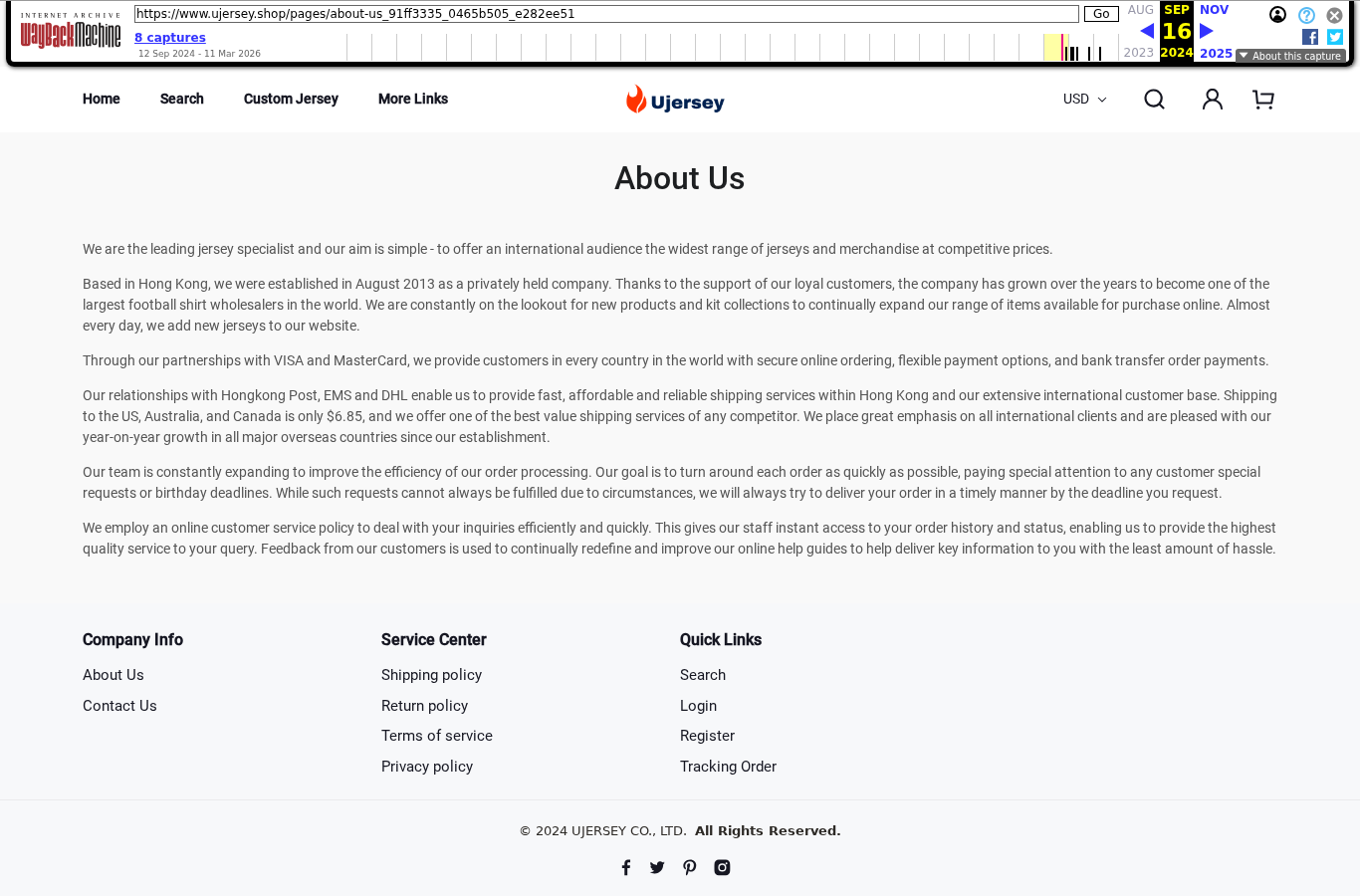
The same page promised shipping to the US, Australia and Canada for $6.85. The shipping policy offered airmail or FedEx but never listed that price.
The domain ujersey.shop was registered in July 2023, ten years after that claimed founding date. Its sister contact domain, ujersey.store, followed in September 2023.
Adidas’s lawyers, who tried to serve the operator, told the court they couldn’t identify a valid physical address. The Hong Kong story never came with one.
Support ran through email and text messages only
The contact page listed only ujersey@outlook.com. Other pages added service@ujersey.store and a +1 number for text messages, but never a call line or a return address.
The court order lets adidas ask email providers to suspend those addresses, so messages to them may now go nowhere.
Branded jerseys without a license
Adidas said it never licensed its marks to the operator. Yet Ujersey’s menus included MLS clubs, whose jerseys adidas supplies.
They also listed Nebraska and Texas A&M, which the complaint names as long-term adidas partners.
The NFL listings carried Nike labels. Nike wasn’t part of this case, but an anonymous store charging a quarter of licensed prices offers no way to check authenticity.
Ujersey Reviews and Buyer Complaints
Trustpilot has no profile for ujersey.shop or ujersey.store. PissedConsumer lists 13 reviews for Ujersey Shop, five of them rated, for an average of 2.1 out of 5.
Two 2024 reviewers say the store sent fake tracking numbers. One received a number for a parcel already delivered in Arizona, while the buyer lived in Florida.
A buyer who ordered three jerseys on April 24, 2025, with faster shipping was still waiting a month later. In June, they reported the jerseys had arrived.
A September 2025 order never arrived, according to an October review that included a USPS tracking number.
A November 2025 order brought no reply to emails, though the card was charged.
In late April 2026, one buyer placed two orders of $64.89 each, five days apart. Neither produced a confirmation email, and the bank statement showed different company names.
In June 2026, another shopper tried to cancel an order half an hour after placing it and still had no confirmation email.
An October 2026 reviewer received a jersey that ran small, with a Super Bowl logo peeling off the front instead of being stitched down.
The June and October reviews were posted after ujersey.shop stopped working, and PissedConsumer doesn’t show which website took the orders.
Two reviewers praised the jerseys, including a five-star buyer who had ordered three times. Overall, some parcels arrived, others didn’t, and support was slow or silent when problems arose.
Other Ujersey Names and Similar Jersey Stores
Four names from the court list, including ujersey.shop and ujersey.store, now forward to the notice page. The other seven no longer load or show a parked page.
Similar names keep surfacing. We reported on ujersey2026.com in May 2025 and ujerseynfl2025.com in October 2025. Neither appears in the court’s list.
That doesn’t prove a link either way. Give any store selling every league’s jerseys at one low price the same scrutiny, as with Wejersey.shop and the Jerseys Factory Store.
If a new jersey site shows the same team menus, a flat $39.99 price or the ujersey@outlook.com address, treat it with the same caution.
For a real jersey, buy from the league’s official shop, the team’s own store or a licensed retailer, and expect to pay well over $100 for a current player jersey.
How to Spot Fake Jersey Stores
Fraudulent shopping websites often share common patterns that make them easier to detect once you know what to look for. Before entering personal information or making a payment, take a few minutes to check for these warning signs:
- Unrealistic prices and discounts
If a website offers products at prices far below trusted retailers, it’s often a red flag. Many of these sites advertise luxury or high-demand products at massive discounts to create a sense of urgency. A $300 product listed for $49.99 should immediately raise suspicion. - Recently registered or suspicious domain names
Many fraudulent websites operate on newly created domains that disappear after a few weeks. Look for signs like random characters in the URL, misspellings of well-known brands, or hyphenated domains.
You can check a site’s age with a WHOIS lookup, or run it through our free Scam URL Scanner. - Missing or vague company details
Legitimate businesses clearly display their company name, tax information, phone numbers, physical address, and return policies. Fraudulent sites often provide incomplete, fake, or no company details at all. A lack of verifiable contact information is a major warning sign. - No reliable customer service
Real businesses provide clear ways to contact support—email, phone, live chat, or physical return addresses. Fake stores often list nonfunctional contact forms, invalid phone numbers, or reply with generic automated messages. - Poor website quality and structure
Many fake stores are set up quickly with low-effort templates. Look for poor grammar, spelling errors, low-resolution product images, broken links, or missing legal pages (Terms of Service, Privacy Policy, Return Policy). A sloppy website often signals something isn’t right. - Copied product descriptions and images
Fraudulent sites often lift product listings directly from real retailers or marketplaces. If you reverse image search a product photo and find it on multiple unrelated websites, the listing is likely not original. - Lack of credible reviews or suspicious review patterns
A real store will usually have a mix of customer reviews across different platforms. Warning signs include no reviews at all, obviously fake five-star reviews, or multiple identical reviews posted on the same day. Searching “[website name] reviews” or “[website name] scam” on Google often reveals warnings from other consumers. - Unclear or unfair return and refund policies
Fake stores often use vague language around returns and refunds—or avoid the topic entirely. If you can’t easily find clear instructions for how to return an item or get a refund, proceed with caution. - Aggressive urgency and pressure tactics
Fraudulent websites commonly use fake scarcity (e.g., “Only 2 left in stock!”) or countdown timers (“Sale ends in 10 minutes!”) to push you to buy before you think it through. Legitimate stores don’t rely on fabricated urgency to make sales.
Quick Steps to Verify a Website’s Legitimacy
Before entering payment or personal details on a new shopping website, take a few simple precautions:
- Search for the store’s name along with words like “reviews” or “complaints” on Google and Trustpilot.
- Check the website’s domain registration using Whois.com.
- Use trusted tools to scan for malicious or fraudulent links:
- Malwarebytes ScamGuard – detect scams and unsafe links before they reach you on Android and iOS phone.
- Malwarebytes Browser Guard – block dangerous or fake websites on Windows and macOS browsers.
- Verify the business address on Google Maps to ensure it’s a legitimate location.
- Review the store’s accepted payment methods – credit cards and PayPal are traceable and safer than cryptocurrency or bank transfers.
- Trust your instincts; if something feels off, it’s better not to proceed.
How to Spot Similar Scams on Social Media
Many fraudulent shopping websites rely heavily on sponsored social media ads to draw in large numbers of potential buyers. These ads often promise extraordinary discounts—sometimes up to 90% off—and use emotionally charged language to push users into buying immediately.
They frequently appear on Facebook, Instagram, and TikTok, blending in with legitimate content. However, these ads follow predictable patterns that make them easier to identify once you know what to look for.
Spotting Fraudulent Facebook Ads
Facebook’s advertising platform is a favorite tool for fake online stores because of its massive reach. These ads often feature “unbelievable” offers designed to create urgency and bypass critical thinking. Warning signs include:
- Extreme, unrealistic discounts such as “90% OFF,” “Store Closing Sale,” or “Final Liquidation.” Real retailers rarely discount new products this aggressively.
- Poor grammar, awkward phrasing, or inconsistent language throughout the ad or website, indicating low-effort, mass-produced content.
- Generic stock photos or images with watermarks, suggesting the images were taken from legitimate brands or stolen from other sources.
- Recently created Facebook Pages, which is common for temporary fraudulent campaigns. Check the “Page Transparency” section to see when the page was created.
- Limited or no engagement from real customers. Authentic brands usually have reviews, comments, and visible user interaction.
If an ad raises doubts, search for reviews of the website or reverse image search the product photos to see if they’re copied from elsewhere. Never provide payment information until the site is verified.
Spotting Fraudulent Instagram Ads
Instagram is another major platform used to promote fake shopping sites through eye-catching visuals and short-lived “flash sale” captions. Warning signs to look for:
- New or disposable accounts with few posts and followers, often created just weeks or days before launching ads.
- Lack of tagged users in product posts. Legitimate stores often feature real customers, influencers, or product usage.
- Unsecured checkout pages. If the website linked in the bio does not use HTTPS, do not enter payment information.
- Fake or missing customer reviews. Fraudulent stores rarely have authentic purchase feedback.
- Unclear or restrictive return policies, often hidden or written vaguely to make refunds difficult.
When in doubt, search for independent reviews before buying, and only enter payment details on verified, secure websites.
Catching Fake TikTok Ads
TikTok is increasingly used to promote questionable shopping deals through short, persuasive videos. While many ads look polished, the same red flags apply:
- Links to unknown stores that don’t appear in search results or have no external reputation. Many of these sites are temporary and disappear after a short time.
- No verification badge on the TikTok account. While not every legitimate store is verified, the lack of a badge is one more indicator to check further.
- Aggressive countdown timers or “one-day only” promotions designed to rush decision-making.
- Lack of genuine customer reviews or real user content demonstrating the product in actual use.
- Comment sections filled with complaints or warnings from other users. This is often the first place victims speak up.
TikTok scams often rely on impulse buying. Take a moment to verify the website, read independent reviews, and use trusted browser protection before visiting external links.
What to Do If You Ordered From Ujersey
- Collect your records.
Save the order number, any emails, tracking numbers and the card or PayPal charge. The store is offline, so these records are your evidence.
- Copy the billing name exactly.
One buyer saw different company names on the statement for two orders. Give your bank the exact descriptor, date and amount of each charge.
- Call your card issuer.
Ask about a dispute for an order not received, not as described or counterfeit. Issuers often allow about 120 days, some from the expected delivery date.
- Check the PayPal deadline.
PayPal disputes close 180 days after payment, which has passed for orders before May 2026. If a card funded the payment, ask that card issuer.
- Don’t ship anything back.
The policy only allowed exchanges reported within 3 days, and the store’s email addresses may now be suspended. Don’t pay to mail a jersey back.
- Don’t let the legal warning stop you.
Ujersey’s return policy threatened legal action over payment disputes. A dispute filed through your own bank is a standard consumer step.
- Watch for charges you don’t recognize.
If you paid by card, check each statement. If unfamiliar charges appear, report them and ask your issuer for a new card number.
- Ignore recovery offers.
Anyone promising to recover Ujersey payments for an upfront fee is likely running a second scam. Deal only with your bank or PayPal directly.
- Report the store.
US buyers can file at ReportFraud.ftc.gov. Include ujersey.shop, the billing name, the amounts and your order dates.
Frequently Asked Questions
Is Ujersey a scam?
Ujersey had no adidas license. A federal court entered a $1,000,000 default judgment against its operator for counterfeiting adidas marks, and buyers report missing orders and poor finishing.
Is the Ujersey shop still open?
No. The address now forwards to the notice page for the adidas case, so orders and emails sent to the store are unlikely to get any answer.
Were Ujersey jerseys real?
Adidas told the court the goods used counterfeits of its marks, and the court ruled for adidas by default. A $39.99 branded player jersey is another warning.
Will the adidas lawsuit refund my order?
No. Funds frozen under the judgment go to adidas, up to the amount awarded. Your options are a card dispute, a bank claim and a report to the FTC.
Is there a working Ujersey coupon code?
No code will help now, because the store’s domains were handed over under the court order. Treat any new site using the Ujersey name with suspicion.
What should I do with a jersey I received?
Keep it with the packaging and label as evidence for a dispute. Don’t resell it, because selling goods with counterfeit trademarks can create legal problems for you.
The Bottom Line
Don’t buy from ujersey.shop or any store using the Ujersey name. A federal court ruled against its operator for counterfeiting adidas trademarks and ordered its domains handed over.
If you paid, gather your order emails and card statement and call your card issuer today. PayPal’s 180-day window has already closed for orders placed before May 2026.
For an official jersey, shop with the league, the team or a licensed retailer, and treat a $39.99 price on a current player jersey as a red flag.
This article is for informational purposes only and should not be relied upon for financial or business decisions. We identify potential scams using research, user experiences, and expert analysis. However, all claims should be independently verified. Mistakes may occur, and legitimate products could be flagged. We strive for accuracy but make no warranties regarding the completeness or reliability of the information.

If you are the owner of the website or product in question and wish to offer clarifications regarding your business or website, please reach out to us via our Contact form.

Join the discussion
0 commentsShare your experience or ask a question about this article.
Community experiences
Did this happen to you?
Your experience could help someone recognize the same scam. Submit a private report for our team to review.
I experienced this tooReports are reviewed before publication. Sharing publicly is always your choice.
Discussion
Start the conversation
Have a question or something useful to share? Add the first comment.