


The same green-lit box can show up as an energy saver, a surge protector or a voltage stabilizer. The name on the listing isn’t the best way to identify it.
Look for the model number. A UK recall lists SD008, and a later parliamentary letter shows why an older recall can still matter to a recent buyer.
Overview
Put the recall number beside the model number
Britain’s Office for Product Safety and Standards recalled specific plug-in products sold as electricity savers. The regulator documented fire and electric shock risks in those devices.
Two notices cover devices marked SD008, including Motex. Separate records cover the black-and-gold SD001 and the PS2008D sold as a 30000W electricity-saving box.
Removing a listing didn’t end the problem
A September 2026 House of Commons committee letter identified the SD008 number in two Amazon UK listings it examined. It said the links no longer worked.
Electrical Safety First separately bought 13 devices across three online marketplaces. All 13 failed safety checks. A laboratory fault test caused two of the samples to explode.
Don’t plug one in to check whether it works
Use the outside label, packaging or order photographs to check the model. A light turning on doesn’t measure savings, check a fuse or show whether a plug meets safety requirements.
- If a recall matches your model and listing, stop using the device and contact the retailer or marketplace.
- If the model is missing and the unit looks like these boxes, leave it unused while you ask the seller to identify it.
- If a pin is stuck in a socket, don’t touch it or try to pry it out.
Which UK Energy-Saving Plugs Were Recalled?
Start with the model, then compare the product and seller information in the notice. The same model number can appear under more than one listing title.
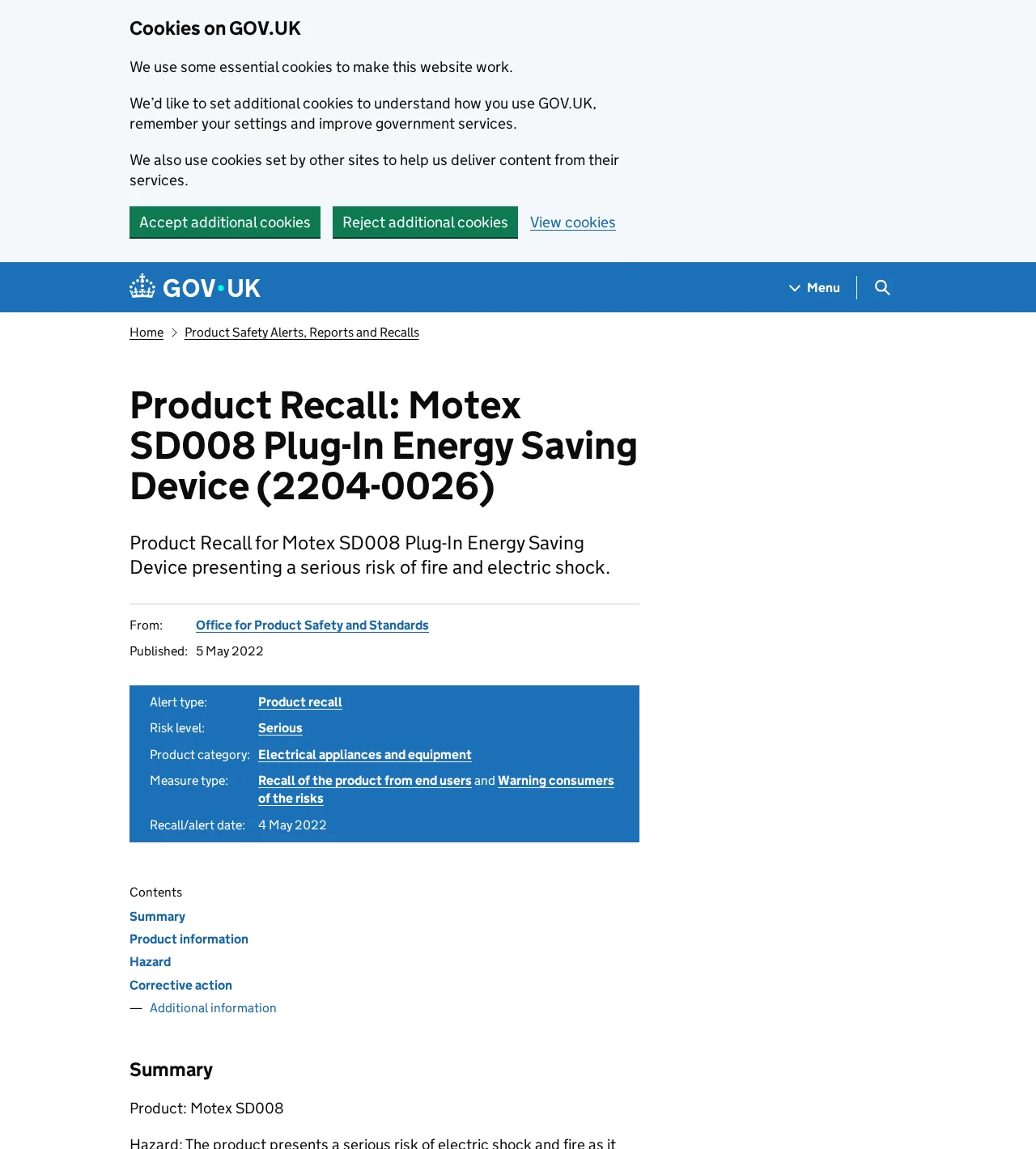
The Motex notice, 2204-0026, identifies a white plug-in unit with a bright green strip and model SD008. The regulator reported weak and undersized pins and required a recall.
Another SD008 notice, 2204-0025, gives eBay item number 403324597469. It describes a two-pack marketed with a 90V to 250V range and a similar white case.
That makes SD008 more useful than the retailer’s marketing name. The notice numbers still matter because they tell you which record includes your seller or specific listing.
The SD001 notice, 2204-0023, describes a black-and-gold Power Factor Saver. That unit didn’t need to resemble the white model to pose a serious electrical hazard.
The PS2008D notice, 2204-0024, identifies a product advertised with a 30000W figure. The number in the headline is part of the listing, not a verified safe rating.
None of these notices establishes that every plug-in box advertised as StopWatt is a recalled UK model. Compare the model and plug instead of assigning a recall by name.
How the Same Model Number Returned Under New Names
A September 24, 2026 House of Commons committee letter to Amazon documents two listings that carried the SD008 number. The committee said they were available through September 14.
Amazon had earlier said it removed the products identified after a June hearing and fixed a classification issue that was preventing automated detection of some of them.
The committee followed up because apparently identical products were still listed after those assurances. It asked what Amazon would do about relisting under different brand names.
One listing described a power-factor saver and voltage stabilizer. The committee found SD008 in the item specifications. You wouldn’t have known from a quick read of its title.
The other listing led with voltage stabilization and spike protection. In that case, the committee could see the number in a close-up of the plug’s label.
Those are two ways a recalled model can be hard to spot. A search for the Motex brand won’t necessarily turn up a listing that never uses that name.
The letter says the two links no longer worked and the products appeared to have been removed from sale in the UK. It doesn’t show that both remain available today.
What the record does show is that model numbers flagged in 2022 appeared again under different descriptions. A safety check shouldn’t end when you fail to find the original listing.
If the seller has changed the title since you ordered, save the current and original versions when you can. One may show the model the other has dropped.
What the New Lab Tests Found Behind the Green Light
Electrical Safety First tested 13 samples bought from AliExpress, Amazon Marketplace and TikTok Shop. Every sample failed basic safety tests. The charity also found none could deliver the advertised savings.
The pins on all 13 fell short of size and strength requirements. A pin that breaks in a socket can put someone trying to remove it at risk.
Two devices blew apart during controlled short-circuit testing. That was a laboratory finding, not evidence of 13 home fires or a test people should repeat at home.
In most of the units examined, a small circuit board powered an indicator light. In some, a part that appeared to be a capacitor or filter was an empty shell.
Other samples lacked proper protection or had unsuitable fuses. A plug can still glow during ordinary use while being poorly equipped to handle a fault.
The test results apply to the samples the charity bought. They don’t identify the contents of every white box or establish the manufacturer of the device in a U.S. advertisement.
Keep the two findings separate. A product can fail to cut energy bills and pose a safety risk. You don’t need to run it for a billing cycle to act.
This wasn’t the charity’s first test. In an earlier round, it bought one unit through GetMotex and three via eBay. All four failed basic electrical safety standards.
Don’t add the later 13 to the earlier four and call them one test. They were separate purchases, and the reports don’t declare every brand or marketplace listing identical.
Who Sold It and Why That Matters to a Recall
The same model isn’t the same sale
The official enforcement record names UAB CommerceCore, trading as Motex, for one SD008 action and the seller jhzloving for the other. Check your own receipt before contacting either.
A model number is strong identification evidence. It doesn’t establish that two stores share a legal owner, stock the same manufacturing batch or handle returns at the same address.
The seller’s location isn’t the place of manufacture
The Motex recall names China as the device’s origin. The enforcement record lists the business trading as Motex in Lithuania. Those descriptions answer different questions about the same notice.
Neither country detail identifies the origin of every StopWatt-style device. The instructions for your purchase should come from its retailer or marketplace, not from a country label alone.
Use the original order to identify the merchant
A marketplace can host an offer without being the company that sold the plug. Save the seller’s name and order number shown in your order details.
If the original store is gone, contact the platform through that order. Include the relevant recall reference and explain why the identifiers match.
A closed listing doesn’t end a safety complaint
A taken-down offer no longer helps you compare the photos. Your order confirmation, label and packaging can still identify what arrived.
Record the model exactly. SD001 and SD008 look similar as text, but they’re not interchangeable. Use the product photograph in the recall notice as another check.
Ask how to return or dispose of the product safely. Don’t accept a replacement without confirming what model it is. A different listing name isn’t enough.
Why an “Energy Saver” Can Be Advertised as a Surge Protector
The sales names sound technical, but the promises aren’t equivalent. A surge-protection claim isn’t proof of lower household energy use, just as a glowing light isn’t proof of surge protection.
The official Motex notice says the device claimed protection against spikes. The regulator found the components selected for that job were incorrectly specified and inadequately protected.
That is why the new names matter. Even a buyer who ignores the electricity-saving promise could be persuaded to plug the same-looking box in for an entirely different reason.
Before buying an electrical product for protection, look for a traceable manufacturer, a readable model and reliable documentation. Don’t rely on the seller’s photos of a conformity mark alone.
If you came here through a celebrity ad, the StopWatt report covers the advertising and refund complaints. These UK notices tell you which labels to check on the physical product.
What an Actual Energy-Savings Claim Would Need to Show
Your domestic bill measures energy use in kilowatt-hours. A single light, change in current or reading on a voltage display doesn’t show that you’ve used fewer kilowatt-hours.
An earlier laboratory report commissioned by the Electrical Safety Council measured a television’s power consumption with and without several plug-in savers. That’s a measurement the indicator itself can’t supply.
To show a meaningful saving, a test has to compare the same job under comparable conditions. Running the heating less because the weather changed doesn’t prove the plug worked.
Compare usage, not just the total charged. A bill can change because rates changed or because it covers more days. Neither change tells you what a device did.
An ad might also use one appliance’s power rating as if it described the whole home. Before-and-after bills with no meter readings or billing periods can’t verify the claim.
Splitting these questions is useful even if an ad offers a money-back promise. A refund policy can’t make the product meet electrical safety standards while you wait.
If your main concern is the size of your bill, start with the usage shown on the bill and the appliances responsible for it. Skip the anonymous plug.
What to Do If You Already Have an Energy-Saving Plug
- Stop using it if a recall matches or you suspect a defect. Keep it unplugged. Don’t open it or reconnect it for a photo.
- Leave a damaged socket alone. If a pin is stuck or the plug looks damaged, don’t touch it or insert a tool. Get a qualified electrician.
- Record the model and order. If the product is safely disconnected, photograph its external label and packaging. Save the listing title, seller and receipt.
- Request instructions through the original order. Tell the seller or marketplace which safety notice applies. Ask about the remedy, collection and safe handling before shipping it anywhere.
- Report an unsafe product even if the listing is gone. Give the reporting service the model, seller and any damage or injury details it requests.
If there’s an active fire, get everyone outside and call 999 in the UK. Don’t stop to unplug the device, take a photograph or pry a pin free.
Even after the device is removed, scorch marks, crackling or heat at the outlet are reasons to stop using that socket and have a registered electrician check it.
The UK reporting page gives separate routes for England and Wales, Scotland and Northern Ireland. Don’t leave your contact details in a public marketplace comment.
If the seller points to an ordinary return deadline, explain you’re raising a product safety issue, not returning a product because you changed your mind.
Keep the recall reference and every reply. Ask the product safety reporting service or your payment provider about the next step if the merchant doesn’t resolve it.
If a marketplace asks why you can’t supply a photograph, tell it the device isn’t safe to handle. Keep the receipt and let an electrician deal with the socket.
Frequently Asked Questions
Is every StopWatt sold online covered by a UK recall?
No. These notices identify specific devices and listings. A similar box or a green light isn’t enough to establish that a particular StopWatt unit is recalled.
What is the difference between SD008 and PS2008D?
They’re separate model identifiers. SD008 appears in two notices, including Motex. PS2008D appears in notice 2204-0024, for a different listing advertised as a 30000W box.
Does a green light mean my plug is saving electricity?
No. The light shows that the indicator is powered. It doesn’t measure your home’s consumption or show that the device has adequate electrical protection.
What if I can’t find the model on my order page?
Check the packaging, saved listing pictures or external label if the device is safely disconnected. Don’t open the case or plug the device in to identify it.
Can I turn the socket back on if a pin broke off?
Don’t use the affected socket or try to remove the pin yourself. Get a qualified electrician to assess it safely.
Can I report an unsafe plug I bought through a marketplace?
Yes. Use the order’s own reporting channel and the official product safety route for your location. Give the listing and model identifiers, even if the offer has disappeared.
The Bottom Line
Don’t buy a plug-in electricity-saving box on the strength of a green light or a renamed listing. Independent testing found devices that didn’t deliver the savings and failed safety checks.
If one is already in your home, leave it unused, match the model to the official notices and contact the retailer or marketplace with your order and recall reference.

Join the discussion
0 commentsShare your experience or ask a question about this article.
Discussion
Start the conversation
Have a question or something useful to share? Add the first comment.