

The email already sounds like a win. A $750 gift card is waiting. Sometimes the same pitch names $1,000, or it swaps the card for Apple Pay, Zelle, Cash App, or Venmo. The tab says UpLevel Rewards. On some visits the same domain answers as Flash Rewards.
That is why people search UpLevel Rewards reviews after dinner. They are not hunting a new hobby. They are trying to collect a prize that already feels like it belongs to them.
This is the same pattern as the other get-paid-to walls that start with a fat prize and end on a deal list. You get a free signup and a survey. Then you hit apps, trials, and subscriptions you pay for. Then an ID check. Then, for a lot of people, a ban right before payout.
Overview
The trap starts with a gift card that already feels like yours. A $750 or $1,000 prize sits in an email, a text, a Facebook clip, or a survey site. Signup is free. A survey sells the lead. Then a deal wall asks for a card and paid trials. Then a claim and ID wall. Then, for a lot of people, a ban right before payout.
This is not a fake store. UpLevel Rewards is a get-paid-to program on uplevelrewards.com. The operator named in the live terms is RewardZone USA, LLC. The company also writes as Level Up. On some visits the same domain answers as Flash Rewards. The same legal pages sit on the About Our Program page, the February 2026 FAQ, and the Terms and Conditions last modified 22 November 2024.
The gift card is the bait
The first contact is rarely a quiet homepage. It is an email, a text, a clip, or a lander that already has your inbox. The prize is specific: $750 on Cash App, $750 at Target, or $1,000 on a Visa. The language is that the Reward is waiting, not that you might qualify if you buy 25 things.
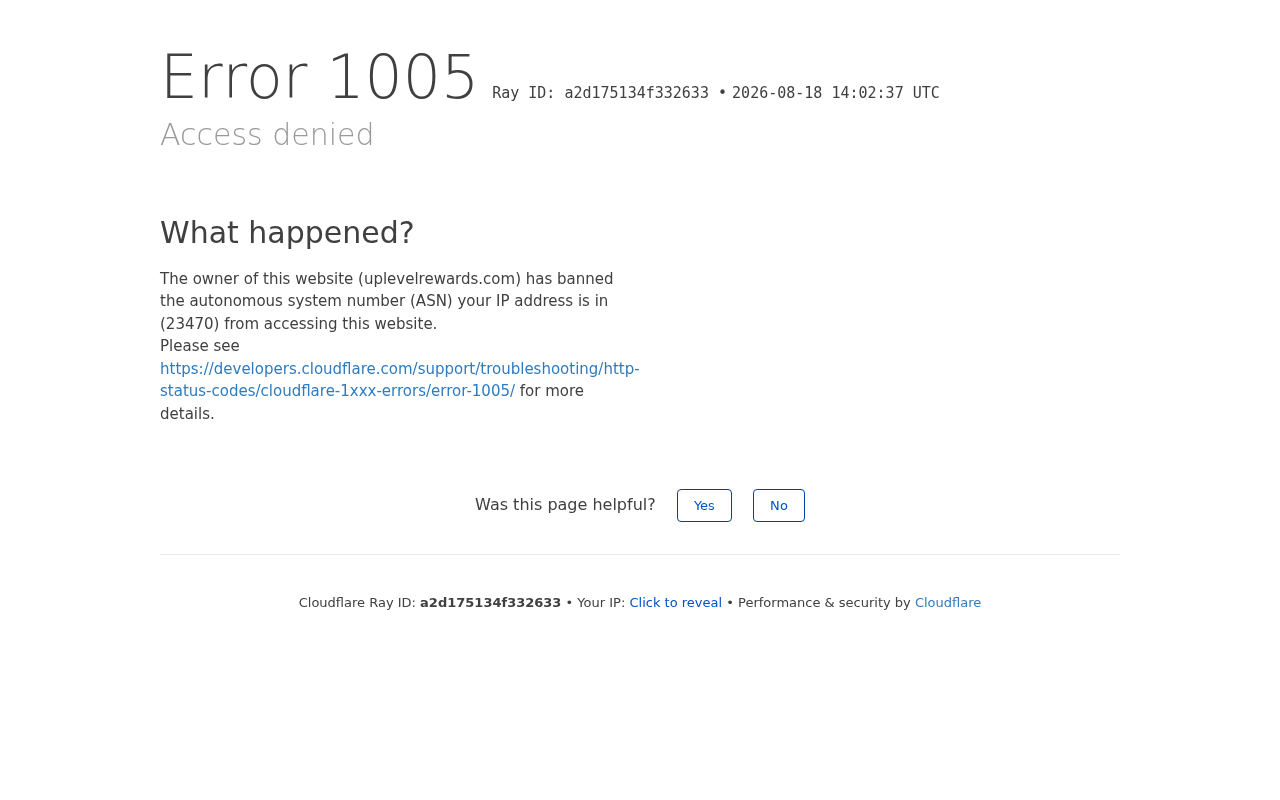
In August 2026 the homepage was a prize wall branded Flash Rewards US, with a $100 gift card in the first line and a $1,000 prize if you finish 25 Deals. Sign up is printed as 100% free. The four steps on the page are Sign Up, Survey and Offers, Deals, then Reward. The homepage did not always load. On some visits the domain showed a Cloudflare error instead of the prize wall.
The footnotes are the honest part. Optional offers are ads. They are not Deals. Completing a survey or an optional offer does not count toward the prize. You may be asked for consent to telemarketing. Deals may include mobile games and apps, subscription products and services, and free trials. Some Deals are free. Many require a purchase.
Then two numbers sit next to each other. Customers who received a $500 Reward only spent around $15. Customers who received $1,000 spent about $49. Last year, about 0.1% of customers who registered received the $1,000 Reward. Total Rewards given out for 2025 is printed as $1,810,000. The FAQ says more than $38 million in Rewards have already been distributed, and that thousands of consumers participate every day. Those two pages are the company talking. They are not a bank statement you can audit.
The official program chart is the same on the About page, the FAQ, the program requirements, and the terms. You pick a Reward value. Then you complete a set number of Deals at each Level. Completing one Deal does not qualify you for anything.
- $5: 2 Deals (Level 1: 1, Level 2: 1)
- $100: 5 Deals (Level 1: 1, Level 2: 1, Level 3: 3)
- $250: 10 Deals (Level 1: 1, Level 2: 1, Level 3: 3, Level 4: 5)
- $500: 15 Deals (Level 1: 1, Level 2: 1, Level 3: 3, Level 4: 5, Level 5: 5)
- $750: 20 Deals (Level 1: 1, Level 2: 1, Level 3: 3, Level 4: 5, Level 5: 10)
- $1,000: 25 Deals (Level 1: 1, Level 2: 1, Level 3: 3, Level 4: 5, Level 5: 15)
The clock is 60 days from your first completed Deal. If a Deal needs a paid month after a trial, the terms add the time that Deal requires, then another 60 days. Once you click Start claim process, you have 30 days to finish ID verification. Miss that window and the claim expires. Cash is narrower than the ads. The FAQ says Cash App, ACH, Venmo, or PayPal only if you registered for a cash Reward and you cash out at that exact value. Exit early, or climb past the value you registered for, and the payout becomes a gift card through Tremendous.
Households are one file. One Reward per person and household per eligibility period. After a Reward of $100 or less, you and anyone at the same address wait 60 days. After a Reward over $100, you wait 12 months. The FAQ says only one person per household, residence, or place of participation can take part in each period. Affiliate landers on the same domain still sell a $750 cash path that opened with Apple Pay, Zelle, cash, and Venmo.
The footer on the homepage still said copyright 2022, then a broken template tag, then All rights reserved. The tags {{entity}}, {{img}}, {{title}}, and ${{value}} were sitting in the public HTML. A finished shop does not usually ship placeholder tokens on the prize page.
The wall is paid trials
Registration cannot be skipped. You give a complete name, date of birth, residential address, email, and phone. U.S. residents, 18 and older, only. The privacy policy last updated 1 November 2024 says non-U.S. residents are not permitted to use the sites. The Continue button agreed to email marketing, the terms (which include mandatory arbitration), the privacy policy, and site visit recordation by TrustedForm and Jornaya.
The terms put the wall in capital letters: COMPLETE THE REQUIRED NUMBER OF DEALS, WHICH USUALLY REQUIRE PAID PARTICIPATION OR PAID SUBSCRIPTION. For a Deal that needs a subscription or a purchase, the advertiser must successfully bill your payment method the number of times the Deal text requires. Many advertisers will not accept prepaid cards. A quick cancel before the stated trial period is also treated as no credit.
The same email and the same registration details have to be used on every paid Deal. A different billing address or a different inbox and the Deal will not credit. You must be a true new user of the app, subscription, or service under any name, email, payment method, or device. Uninstalling and reinstalling does not reset that.
Level 1 can look easy. It might be a newsletter, a free app, or a survey site. The FAQ even says some Deals are completely free. Then the ladder steepens. Levels 4 and 5 are mobile-only for most people. Higher Deals are where the card comes out. Install a game and reach a milestone. Start a free trial and stay long enough for the partner to bill you. Open a shopping or finance account. Deposit into an offer that looks like a casino. Paid participation is the usual path, not the exception.
The homepage’s $15 and $49 spend lines are there so the $1,000 prize still feels like profit. They are averages printed by the seller, about the people who already got paid, not about the people who paid and quit. If a trial forgets to cancel, the second month is yours. If five Deals each need a $10 to $20 start, the out-of-pocket number is not a footnote. It is the checkout.
Credit is not yours when you finish the task. Credit is yours when the advertising partner confirms it. The FAQ splits Deals into Visited, Started, Completed, and Expired. Visited means they recorded the click. If the partner never confirms, credit is refused. There is no appeal that restores a silent partner. That is the trap people describe in reviews. They paid. The partner has their money. The wall still says Visited. Support says the partner did not confirm. The next advice is to try another Deal, which often means another card charge, while the 60-day clock keeps running.
If enough Deals land on Completed, a Claim Reward or Cashout prompt appears. You consent to identity verification, including biometric data. A government-issued photo ID and a live selfie are required. After ID, the FAQ says claims are usually reviewed within 2 business days. The terms say an email about claim status goes out within 72 hours. The homepage says 1 to 3 days. Three clocks. One inbox. Then an email can say the account violated the Acceptable Use Policy: a VPN, a household rule, a device flag, activity that does not look like an average participant. An appeal exists on paper. Once a final resolution is communicated, the FAQ says the decision is final.
The lead is the product
Surveys are optional on paper. Skip the Survey is a real button. If you answer, and if you also consent to telemarketing or email marketing, the terms say those answers may be shared with named Marketing Partners. The privacy file is plainer. RewardZone may share or sell identifiers, commercial data, internet activity, inferences, telemarketing consent records, and, for business purposes, biometric data used in the ID check. Health and money questions can be passed to partners who sell supplements, insurance, or finance products.
SMS is part of the machine. The homepage asks you to sign up for SMS alerts so you can track Deal credits. The terms list short codes 53294, 91982, 27367, 68766, and 411411, with a maximum of 15 messages a month. The privacy file also records TCPA consent sessions so a later call can be defended. If you already shared the file, a later delete request does not pull it back from those partners. You have to chase them one by one.
That lead file is the older version of this model with a federal caption on it. In United States v. Fluent, LLC, docket 9:23-cv-81045 in the Southern District of Florida, the United States named Fluent, LLC and RewardZone USA LLC, also doing business as Up Rewards, The Reward Genius, Flash Rewards, and National Consumer Center. UpLevel Rewards is the current wall brand. It is not one of the doing-business-as names on that caption. The FTC matter number is 1923230. The case closed on 2 October 2023. The stipulated order set a civil penalty of $2,500,000. The July 2023 FTC press release said Fluent obtained and sold more than 620 million telemarketing leads from January 2018 to December 2019, and that the ads used to pull people in included false promises of rewards.
The live homepage still uses the Flash Rewards US label. That is one of the doing-business-as names in the federal caption. RewardZone USA, LLC is the name on the contract. The Better Business Bureau files the company under Marketing Programs in New York, at 99 Wall Street, suite 4330, New York, NY 10005-4301, with a published line of 855-278-1931. Alternate names on that profile include Up Level Rewards and The Reward Wizard. The business is not BBB accredited. The live FAQ still says customer service is a Member Support form only, with no phone support, and a target reply of 3 business days.
The BBB profile for Reward Zone USA, LLC showed 52 complaints closed in the last 12 months and 281 complaints in the last 3 years in the public file in August 2026. The profile carried 3 alerts, including a Pattern of Complaints alert and Government Actions alerts. Customer reviews on that file averaged 1.43 out of 5 from 54 reviews. Trustpilot reviews of uplevelreward.com, notice the missing s, sat at 1.9 out of 5 from 43 reviews on the U.S. page. A 31 January 2026 review said a $100 Reward was disqualified for a terms violation after the writer used real information and no VPN. A 14 March 2026 review said a game Deal stayed on visited with no credit.
The terms still send disputes to New York law, mandatory AAA arbitration, and a class-action waiver. If you go to arbitration against them, you pay the AAA filing fee. Their total cumulative liability is capped at the lesser of the Reward you registered for, $1,000, or the actual dollar amount you spent completing Deals. Read that next to the lead sale. The $750 graphic is cheap to serve. The identity stack and the subscriptions are the product.
How The Rewards Wall Works
1. The bait finds you first
The first contact is rarely a quiet homepage. It is an email, a text, a Facebook clip, or a survey site that already has your inbox. The prize is specific: $750 on Cash App, $750 at Target, or $1,000 on a Visa. The language is that the Reward is waiting, not that you might qualify if you buy 25 things.
Affiliate links do the rest. The landers carried Flow IDs, offer IDs, and sub-affiliate tags. Someone gets paid if you register. The prize graphic is the hook. Tracking is already in the URL.
2. The free signup is not the product
Get a Quick Start is the button. Sign up is 100% free is the line under it. That is true in the narrow sense. Nobody charges you a membership fee to type your name. The product is the identity you just handed over, and the Deal wall that comes next.
You pick a Reward. You confirm an email. You agree to terms you will not finish reading on a phone. Those terms include mandatory arbitration and a class-action waiver. The Continue button on the $750 cash lander also agrees to email marketing and to TrustedForm and Jornaya recording the visit. That record is there so a later text or call can be tied back to a click.
3. The survey sells the lead
Before the Deal wall, the path shows a survey and optional offers. The company says those steps are optional and do not count toward the prize. The privacy file still lists the categories it may share or sell: name, address, phone, email, date of birth, gender, education, employment, financial answers, medical and insurance answers, device data, and inferences about your preferences.
If you consent to calls or texts, Marketing Partners can use that consent. If you already shared the file, a later delete request does not pull it back from those partners. You have to chase them one by one. That is how a free Reward signup becomes a week of spam. It is also how the 2023 Fluent case described the older version of this model: a prize page in front, a lead file in back.
4. The deal wall asks for a card
Level 1 can look easy. It might be a newsletter, a free app, or a survey site. The FAQ even says some Deals are completely free. Then the ladder steepens. Levels 4 and 5 are mobile-only for most people. The desktop page shows a QR code. You may use one desktop and one mobile device. Switch phones and the account can be flagged.
Higher Deals are where the card comes out. Install a game and reach a milestone. Start a free trial and stay long enough for the partner to bill you. Open a shopping or finance account. Deposit into an offer that looks like a casino. The terms are not shy about this. Paid participation is the usual path, not the exception.
The homepage’s $15 and $49 spend lines are there so the $1,000 prize still feels like profit. They are averages printed by the seller, about the people who already got paid, not about the people who paid and quit. If a trial forgets to cancel, the second month is yours. If five Deals each need a $10 to $20 start, the out-of-pocket number is not a footnote. It is the checkout.
5. Tracking can fail after you pay
Credit is not yours when you finish the task. Credit is yours when the advertising partner confirms it. The FAQ splits Deals into Visited, Started, Completed, and Expired.
Visited means they recorded the click. For a one-step signup or purchase, the Deal stays on Visited for up to 5 days. If the partner never confirms, credit is refused. There is no appeal that restores a silent partner. For a multi-step app, Visited becomes Started after the first tracked action, then Completed only after the milestone. All of that has to happen inside 60 days. Expired Deals cannot be reinstated.
The list of reasons credit can fail is long on purpose. You were not a new user. Tracking permission was off. You used a VPN, a proxy, private browsing, or iCloud Private Relay. You switched devices. You signed up on the partner site instead of through the wall. You uninstalled too soon. You canceled too soon. You used a prepaid card. The Deal description did not tell you to send proof, so a ticket cannot start an investigation.
That is the trap people describe in reviews. They paid. The partner has their money. The wall still says Visited. Support says the partner did not confirm. The next advice is to try another Deal, which often means another card charge, while the 60-day clock keeps running.
6. The claim and the ID wall
If enough Deals land on Completed, a Claim Reward or Cashout prompt appears. You fill a claim ticket. You consent to identity verification, including biometric data. A government-issued photo ID and a live selfie are required. Digital IDs, scans, and photos of photos are refused. Temporary IDs are refused. The work has to be done on a mobile camera. A desktop session shows a QR code.
The company says the ID and selfie are used to enforce the household waiting period and to stop fraud. Biometric data is kept for 6 months unless you ask for earlier deletion. Residents of some states can refuse the biometric path and use an alternate check. Everyone else has to pass it. Fail twice and you are told to stop and write support. Too many failures can block the claim as a security flag.
After ID, the FAQ says claims are usually reviewed within 2 business days and that approved Rewards arrive by email within 7 business days. The terms say an email about claim status goes out within 72 hours, and a redemption link follows in 7 to 10 business days. The homepage says 1 to 3 days. Three clocks. One inbox.
The redemption link expires in 6 months. Lost or stolen Rewards are not replaced unless the company decides the mis-delivery was its error.
7. The ban at the finish line
This is the step the one-star reviews keep naming. The Deals are done and the claim is open. Then an email says the account violated the Acceptable Use Policy. The reasons listed in the FAQ include multiple accounts, VPNs, shared or extra devices, a new-user claim that was not new, a fast cancel, a prepaid card, inaccurate registration, or activity that does not look like an average participant. Abusive tickets after a final decision are also on that list.
An audit freezes Rewards and Deal credits until the audit team is done. An appeal exists on paper. Once a final resolution is communicated, the FAQ says the decision is final. You cannot open a second account. Nobody else at the same place can open one without prior written authorization from management.
Read that next to the liability cap. If you spent $80 on trials to chase a $250 card, and the account is closed, the contract already tried to limit what you can recover. Arbitration is individual. Class actions are waived. Support is a form. The phone number on the BBB profile is not the door the FAQ tells you to use.
8. Getting out is slower than signing up
By the time someone searches how UpLevel Rewards actually pays, they have usually already given a Social Security-adjacent identity stack: full name, birth date, address, phone, email, a card on file at three or four partners, and often a selfie next to a driver’s license. Canceling the Reward path does not cancel those subscriptions. Each partner has its own bill and its own chat bot.
Email opt-out is a footer link. Partner email is a different footer. Texts need STOP. Calls need a verbal do-not-call. Sale of the file needs a Do Not Sell request or a OneTrust form. If the data already moved, you write the partners yourself. Delete requests can take up to 45 days, and archive copies can stay for legal reasons.
That is why the free signup is the expensive part. The $750 graphic is cheap to serve. The subscriptions are not cheap to unwind.
What To Do If You Already Signed Up
If you already typed a card into a Deal, work the charges first. Do not wait out a 60-day Deal clock if you already want the whole path gone.
- Save the evidence. Screenshot the lander, the Reward value you picked, the Deal names, the Visited or Completed statuses, the claim email, and the disqualification note if you got one. Write down dates, amounts, and the merchant name as it printed on the card for every trial or app. Keep the confirmation emails from those partners.
- Cancel the paid Deals at the source. UpLevel Rewards says it cannot modify or cancel a partner Deal. Use the partner’s own account page, the number on the statement, or the confirmation email. Say you want the trial or subscription stopped and no more charges. Ask for written confirmation. Do this even if the Deal never credited.
- Write the rewards support form, do not only wait. Use the same email you registered with. List the Deal names, the dates, the amounts you paid, and the Reward you were chasing. Ask whether the account is open, closed, or under audit. If they already denied the claim, ask for the specific rule in writing. Do not argue the game score in that ticket. Argue the charge and the missing credit.
- Stop the mail and the file. Unsubscribe from UpLevel emails. Reply STOP to the short codes. Use the Do Not Sell and OneTrust links in the privacy policy if you want sharing turned off. Know that partners who already bought the lead will not hear that request unless you write them too.
- Read the next two or three statements. Look for a second trial charge, a $1 hold that became a monthly bill, or a similar amount under a different merchant name. Dispute anything new quickly. A forgotten trial is how a $15 start becomes $40 or $60.
- Call the bank if they stall. Ask about a chargeback for a subscription or app purchase that was sold as a step toward a gift card you did not receive, or for billing after you canceled. Send the screenshots. Chargebacks have deadlines. If charges keep hitting, ask about blocking the merchant or replacing the card.
- If you used PayPal, Cash App, Venmo, or another buyer-protection checkout on a Deal, open that dispute too. Do not wait on a form that says the partner did not confirm. Upload the Deal text, the Visited status, and the Reward page that told you a purchase was required.
- Report it, then cut the ads. File at ReportFraud.ftc.gov. File with the BBB against Reward Zone USA if you want it on the public file. Report the email or the clip on the platform that sent it. Install Malwarebytes and run a full scan. Use AdGuard so the next $750 gift-card ad is less likely to follow you. Neither tool issues a Reward. They cut the junk that often rides along with this kind of click.
If a relative forwarded you the $750 email, send them this page instead of the signup link. These walls travel in family chats. That is part of how a gift card starts to feel like a group decision.
The Bottom Line
UpLevel Rewards is a RewardZone USA, LLC deal wall on a domain registered 6 July 2021. In August 2026 the live homepage called itself Flash Rewards US, printed a $100 to $1,000 ladder, said 0.1% of registered customers received $1,000, and said those $1,000 winners spent about $49.
The contract says most Deals require paid participation or a paid subscription. Support is a form. Disputes go to arbitration in New York. RewardZone USA LLC was a named defendant in the 2023 Fluent case that closed with a $2,500,000 stipulated civil penalty. UpLevel Rewards is the current rewards-wall brand, not a name on that caption.
Some people have been paid. The BBB file and the Trustpilot page also show people who paid, waited, and were told they used a VPN, broke a household rule, or never got credit for a Deal the partner already billed. If you have not registered, leave it. If you already paid, keep the screenshots, cancel the trials at the source, and take the charges to the bank before the 60-day clock is used against you.

Reviews & discussion
0 commentsShare a firsthand experience, or ask a question.
Community reviews
UpLevel Rewards
Moderated reader experiences, not an editorial verdict.
Start the conversation
Have a question or something useful to share? Add the first comment.