

You see it in an ad while scrolling at night: a tall, elegant column of fire, glowing like a modern outdoor candle. The name sounds premium. The photos look cinematic. The product page promises an impressive 1.5 m flame, “eco-friendly” pellets, and a stainless steel build that supposedly turns any patio or rooftop into a luxury lounge.
And then you notice the pressure: big discounts, bundle offers, “free shipping today only,” and social proof everywhere.
So should you buy the TryVeeno Veeno LuxFlare Pellet Torch, or is it one of those heavily marketed products that looks better on a landing page than it does in real life?
This review breaks it down carefully, with a focus on what the page claims, what it does not explain, and the red flags that matter most when you are buying something that involves an open flame.
Overview
The Veeno LuxFlare Pellet Torch is marketed as a modern, stainless steel pellet torch designed to produce a tall, eye-catching flame for outdoor spaces. The product page leans hard into a specific vibe: minimalist design, quick setup, and a “cleaner” burn compared to traditional firewood.
On the page, the positioning is clear:
- It is presented as a premium-looking flame feature, not a rustic fire pit.
- It is framed as simple and low maintenance, ready within minutes.
- It is marketed for patios, gardens, rooftops, camping trips, and gatherings.
Those are all reasonable use cases for a contained outdoor flame product. The problem is not the idea. The problem is that the sales page uses a familiar pattern where the visuals and claims feel polished, but the details that actually determine real-world performance are either vague or missing.
What the product page claims, specifically
These claims stand out:
- “#1 Durable Stainless Steel Pellet Torch Designed for a Strong 1.5 m Flame”
- A rating display: “4.8 Rated, 4,476 Reviews”
- Benefit bullets like:
- Low-maintenance design for daily use
- Heavy-duty build for long-term durability
- Uses cleaner, eco-friendly fuel
- Produces a tall, eye-catching flame
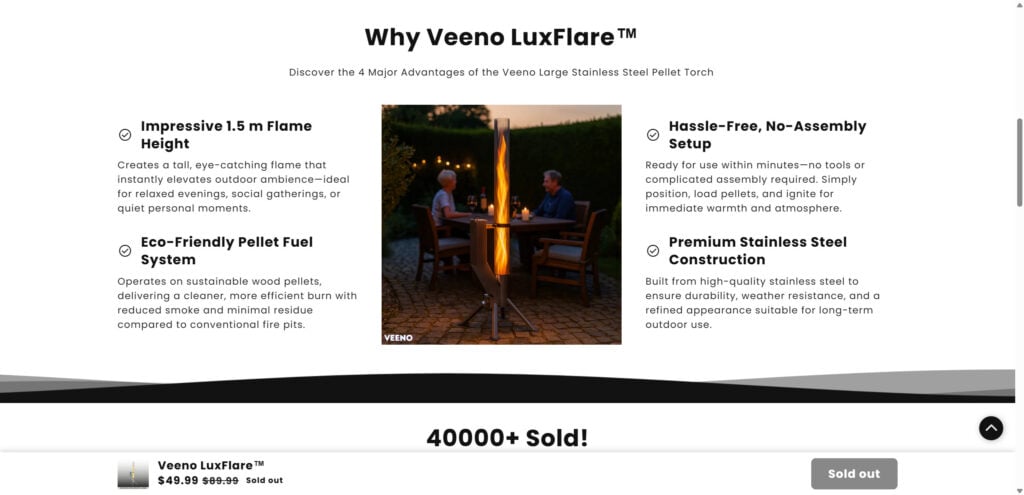
- A section titled “Why Veeno LuxFlare,” listing four “major advantages”:
- Impressive 1.5 m flame height
- Eco-friendly pellet fuel system
- Hassle-free, no-assembly setup
- Premium stainless steel construction
- A claim of “40000+ Sold!”
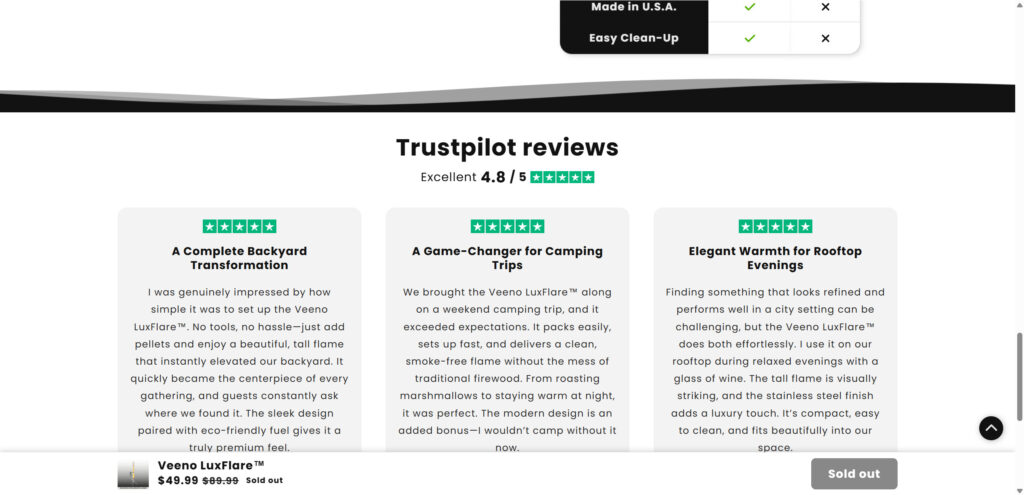
- A “Trustpilot reviews” section that shows “Excellent 4.8/5” and multiple 5-star style review cards
- Aggressive pricing bundles such as:
- Buy 1 for $49.99 (struck-through higher price shown)
- Buy 2 + extra 20% off for $79.99
- Buy 3 + extra 30% off for $104.98
None of that proves the product is good or bad by itself. But it sets expectations. If a company is confident enough to claim tens of thousands sold and display thousands of reviews, it should also be confident enough to provide the critical operating and safety details in plain language.
That is where the page starts to feel thin.
The biggest concerns right away
You highlighted several concerns, and they are the same ones experienced reviewers focus on because they correlate strongly with disappointing purchases and difficult refunds:
- Trustpilot rating claims that do not appear to match reality.
A page can embed a “Trustpilot-style” section and show stars, but that does not guarantee a real Trustpilot profile exists, or that the reviews are accessible on Trustpilot. - Aggressive marketing and urgency tactics.
“Free shipping today only,” large discounts, bundles, “most popular” tags, and big crossed-out prices are designed to create urgency. That does not automatically mean it is a scam, but it does increase the odds you are looking at a direct-response dropshipping funnel rather than a mature brand with strong support. - Missing safety and control information.
For any open-flame product, buyers need to know how flame intensity is controlled, how it is extinguished, and what safety features exist. If the page is vague here, that is not a small omission. It is one of the most important parts. - On-site reviews that look repetitive or too perfect.
When every review reads like marketing copy, lacks real-world negatives, and feels similar in structure, it often means the reviews were curated, generated, or selectively displayed. - Dropshipping patterns and return friction.
Many of these funnels ship from China even if the branding feels Western. Returns can be “possible” on paper but practically painful due to international shipping costs, return address requirements, or slow response times.
If you are deciding whether to buy, you should treat those as decision-grade signals, not minor nitpicks.
What a real pellet torch needs to explain (but this page does not clearly cover)
This is the heart of the issue. A tall flame column looks great in a photo. In real life, performance depends on specifics:
1) What pellets are required, exactly?
“Eco-friendly pellet fuel” is not a specification. Pellets vary by:
- Wood type and density
- Moisture content
- Pellet diameter and length
- Additives and binders
- Heat output consistency
If the product is tuned for a certain type of pellet and you use something else, you might get:
- Weak flame height
- Excess smoke
- Pellet jams or incomplete combustion
- Excess ash and residue
- Soot on the stainless steel body
A trustworthy listing usually clarifies pellet type, recommended brands, and whether hardwood cooking pellets are appropriate.
2) How is airflow managed?
Tall flames come from efficient combustion and stable airflow. For a “torch” style flame column, airflow matters even more because:
- The flame is vertical and concentrated
- Wind can destabilize it
- Pellet burn rate can spike if airflow increases
If there is no clear mention of adjustable airflow, internal baffles, or a designed draft path, you do not know if the 1.5 m flame is:
- Consistent
- Achievable only in perfect conditions
- A brief “startup” moment used for marketing clips
3) How do you extinguish it safely?
This should be simple and clearly explained. Buyers should know:
- Is there a snuffer cap?
- Is there an airflow shutoff that stops combustion?
- Do you wait for pellets to burn out?
- Can you safely stop it quickly if wind picks up?
When a page skips this, it is a serious red flag because it suggests the seller is optimizing for conversion, not safe ownership.
4) What is the burn time and fuel consumption?
A tall flame can also mean fast fuel consumption. Without data, you cannot estimate the real cost of using it.
A credible product page typically includes:
- Burn time per full load
- Fuel capacity
- Average pellet consumption rate
- Whether you can add pellets mid-burn safely
5) What is the real stainless steel grade and thickness?
“Stainless steel construction” can mean many things. Grade and thickness affect:
- Heat warping
- Corrosion resistance
- Weld integrity over time
- Stability and safety
A premium outdoor stainless product often states the grade (for example 304) and gives a sense of material thickness.
The “looks like a brand, acts like a funnel” problem
The Veeno LuxFlare page design is clean and modern, and that is intentional. Many dropshipping operations have gotten extremely good at branding and visuals.
Here is what typically separates a real brand from a funnel:
What real brands usually provide:
- A full company identity: address, phone, support hours
- Clear warranty terms with realistic exclusions
- A real review footprint across multiple platforms
- Detailed specs and safety instructions
- Clear replacement parts and accessories
- Transparent shipping and returns with domestic options
What funnels often provide instead:
- A sleek page with lots of claims and urgency
- A support email and not much else
- Big review numbers that cannot be verified easily
- Broad “satisfaction guarantee” language with hidden friction
- Vague shipping estimates and complicated returns
Your concerns about Trustpilot and repetitive reviews land directly in this pattern.
About the Trustpilot claim
The screenshot shows a “Trustpilot reviews” section with an “Excellent 4.8/5” label and five green star blocks, plus multiple review cards.
If you checked Trustpilot and found no reviews available for the brand or domain, that is a major credibility hit. A real Trustpilot rating is not something you guess. It is linked to a live Trustpilot profile that anyone can browse.
When a site displays Trustpilot-style stars without a verifiable link to a Trustpilot profile, the most cautious interpretation is:
- The site is using Trustpilot branding as visual persuasion, not as a verifiable reputation source.
That does not automatically prove fraud, but it is absolutely enough to pause the purchase.
About the “4,476 reviews” and “40,000+ sold” claims
Those numbers are used to lower your skepticism.
If a product truly sold 40,000+ units at around $49.99 to $104.98, that is significant revenue. With that level of sales, you would expect:
- A broader online footprint
- More independent reviews
- More photos from real customers
- More detailed documentation
When you cannot find that footprint, the numbers begin to feel like marketing props.
The missing flame control issue
This is not a cosmetic complaint. It is a safety and usability issue.
A flame product should clearly answer:
- Can you reduce flame height?
- Can you keep it low for ambience?
- Does it flare up with airflow or fresh pellets?
- What happens in wind?
- What is the safe perimeter distance?
If the page does not clearly describe adjustable airflow, flame control, and extinguishing, you are being asked to buy a fire device based on vibes.
That is not a great deal, even at $49.99.
“Eco-friendly pellets” can be true, but also misleading
Wood pellets can be a cleaner option than random firewood depending on:
- Pellet quality and moisture content
- Combustion efficiency
- Airflow design
- Whether the device burns hot enough for clean combustion
But “eco-friendly” on a landing page often functions as a comfort word. The real questions are practical:
- Does it smoke?
- Does it leave a lot of ash?
- Does it smell strongly?
- Does it soot up nearby surfaces?
- Is it annoying to clean?
The page mentions “reduced smoke and minimal residue compared to conventional fire pits,” but without numbers, conditions, or guidance, you cannot treat that as a guarantee.
“No assembly” and “ready within minutes” can still hide hassle
Even if the unit is physically ready quickly, the ownership experience can still involve:
- Finding the right pellets locally
- Storing pellets dry
- Cleaning ash frequently
- Dealing with inconsistent flame if pellets vary
- Learning safe lighting technique
- Learning how to stop it safely
If a page sells simplicity but avoids operational details, you are more likely to discover the “fine print” after the box arrives.
The pricing and bundling pressure
The bundle area is designed to steer you into buying more than one:
- A “Most Popular” tag on Buy 2
- The “Best Value” label
- Savings claims like “You save 56%” and “You save 61%”
- Large struck-through totals
This is classic conversion psychology. It does not mean the product is fake, but it does reinforce that the page is optimized for impulse buying, not careful evaluation.
What you should assume if this is a dropshipping operation
You stated this is a dropshipping operation with shipping from China and difficult returns. That pattern is extremely common for products sold through single-product landing pages with heavy urgency tactics.
If that pattern applies here, the practical implications are:
- Shipping times may be longer than implied
- Tracking may be inconsistent
- Packaging may be generic
- Instructions may be minimal
- Support may be slow
- Returns may require shipping back internationally at your expense
- Refunds may depend on strict conditions
Even when a return policy exists, “possible” is not the same as “easy.”
So should you buy it?
Based on the concerns you listed and what is visible on the page, this is the cautious conclusion:
If you want a reliable, safe, controllable outdoor flame feature and you care about easy returns, you should not buy this product from this type of landing page unless you can verify reputation and support outside the page itself.
If you still love the concept, a safer approach is to buy a similar category product from a retailer with clear policies, verified reviews, and a support trail you can trust.
How The Operation Works
This section covers two things:
- How a pellet torch like this typically works in the real world
- How this kind of sales operation typically works, step by step, and where buyers get trapped
Part 1: How a pellet torch like Veeno LuxFlare typically works
A pellet torch is usually a vertical combustion chamber designed to burn pellets efficiently and direct flame upward through a chimney-like tube.
Here is the typical process.
Step 1: You load pellets into a chamber
Most designs have an internal burn cup or hopper. Pellets are poured in.
What matters here:
- Capacity: how many pellets fit
- Feed behavior: whether pellets burn evenly or form gaps
- Whether you can safely add pellets mid-burn
If the chamber is small, you might get a dramatic flame for a short time, but frequent reloading.
Step 2: You ignite the pellets
Some products use a starter gel or fire starter. Others rely on a small ignition zone and airflow.
What matters:
- How easy it is to light consistently
- Whether it creates a smoky startup phase
- Whether pellets pop or throw embers
- Whether the design shields ignition from wind
If startup is smoky, the “clean burn” claim can still be technically true after it stabilizes, but your patio experience still includes that smoky phase.
Step 3: Airflow stabilizes combustion and flame height
This is where marketing and reality often separate.
A tall, clean flame depends on:
- Sufficient oxygen
- A stable draft path
- Hot enough combustion to burn off smoke compounds
- The right fuel size and dryness
If airflow is too restricted, flame height suffers and smoke increases.
If airflow is too open, pellets can burn too aggressively and flame can flare, especially with wind.
A good design includes controlled airflow and often has some method to limit or tune the burn rate.
Step 4: The flame rises through the chimney
The “torch” look comes from a vertical flame path.
What matters:
- Tube diameter and height
- Heat shielding and safe exterior temperatures
- Stability of the base
- Wind resistance
A tall flame is visually great, but it also increases risk in wind. On rooftops especially, wind is not a rare edge case. It is the default.
Step 5: Ash builds up and must be removed
Pellets leave ash. Even clean-burning pellets do.
What matters:
- How easy ash removal is
- How often you need to clean
- Whether ash blocks airflow and reduces performance
- Whether ash removal requires disassembly
“Low maintenance” is often true only if cleaning is designed well.
Step 6: Extinguishing happens safely, or it does not
This is the most important step.
If there is:
- No snuffer cap
- No airflow shutoff
- No safe “stop now” method
Then extinguishing becomes “wait until it burns out,” which is not always acceptable.
Any serious outdoor flame device should be honest about this. If it is not, you should assume the least convenient version.
Part 2: How the sales operation works, step by step
Now to the other “operation”: the marketing and fulfillment system that can turn a normal product into a risky purchase.
This is the common flow for dropshipping-style single product funnels.
Step 1: Ads create a cinematic fantasy
The first contact is usually:
- A dramatic flame video
- A couple enjoying wine outdoors
- A clean stainless aesthetic
- A promise of instant ambience
This is not inherently bad. But ads are optimized for emotion, not accuracy.
Step 2: The landing page amplifies urgency
The page adds pressure:
- “Free shipping today only”
- Big discounts
- Struck-through “original prices”
- Bundle deals and “most popular” labels
The goal is simple: reduce the time you spend thinking.
Step 3: Social proof is displayed, but not verified
You see:
- “4.8 rated”
- “4,476 reviews”
- “40,000+ sold”
- “Trustpilot reviews: Excellent 4.8/5”
If those claims cannot be verified on independent platforms, they function more like persuasion graphics than evidence.
This is exactly why the Trustpilot mismatch is such a big deal. Trustpilot is supposed to be third-party proof. If it is not real, it is not proof.
Step 4: Product details stay vague to reduce objections
Instead of answering complicated questions about flame control and safety, the page focuses on:
- Design
- Durability claims
- “Eco-friendly” language
- Lifestyle use cases
The fewer technical details, the fewer reasons someone might hesitate.
Step 5: Checkout captures the impulse
Bundles are pushed because:
- Average order value goes up
- Refund requests become harder to process when multiple units are involved
- Buyers feel they are getting “value,” even if the product disappoints
Step 6: Fulfillment is outsourced
In a dropshipping pattern, the seller often:
- Does not hold inventory locally
- Ships directly from overseas suppliers
- Provides limited after-sale support
That can still be legitimate commerce, but it increases friction when anything goes wrong.
Step 7: The return policy becomes the real product
This is where many buyers regret the purchase.
Common pain points include:
- You must contact support first and wait
- You must ship back internationally at your expense
- You must use the “correct” return address which can change
- You must include specific paperwork
- Refunds can be partial, delayed, or denied
When the cost and hassle of returning exceeds the purchase price, many people give up. That is how bad operations survive even with unhappy customers.
Step 8: Complaints cluster around the same themes
When this goes wrong, the pattern of complaints is predictable:
- “It looked bigger in the ad”
- “The flame is not like the video”
- “Too smoky”
- “Hard to light”
- “Customer support not responding”
- “Return was impossible”
- “Tracking stopped updating”
You already pointed out the missing safety details and likely fabricated reviews. Those are early warning signs that this pattern may apply.
The practical “should you buy” test
If you want a quick way to decide, use this test:
If you cannot clearly find and verify all of the following, do not buy from the funnel:
- A verifiable Trustpilot profile or independent review footprint
- Clear flame control and extinguishing instructions
- Clear shipping origin and realistic delivery windows
- Clear, practical return process with a local return address or easy logistics
- A real support identity beyond a contact form
If even one of these is missing, your risk goes up sharply.
What To Do If You Bought This
If you already purchased the Veeno LuxFlare Pellet Torch, do not panic. Most situations can be improved by acting quickly, documenting everything, and staying calm and organized.
Here is a step-by-step plan.
- Save proof of the listing and all claims you relied on
Take screenshots of:- The product page claims (1.5 m flame, stainless steel, eco-friendly fuel, ratings, review counts)
- The pricing and discount shown
- The Trustpilot rating section
- Shipping promises and delivery time estimates
- Return policy text
- Check the charge on your bank or card statement
Note:- The merchant name that appears on the transaction
- The amount charged in $
- The date and time
- Look for shipping origin and track the parcel early
As soon as you have tracking:- Check where it is actually coming from
- Save screenshots of tracking updates
- Read the return policy carefully, then act within the window
Many sites have short return windows that start at delivery or even at purchase.Look for:- Time limit in days
- Requirement to contact support first
- Restocking fees
- “Unused condition” requirements
- Who pays return shipping
- The return address location
- Email support immediately with a clear, simple message
If you have concerns already, contact them now, not later.Keep it short:- Order number
- What you want (cancel, address change, refund request)
- A deadline (for example: “Please confirm within 48 hours”)
- If it arrives, inspect it before using it
Open the package and document:- The condition on arrival
- Any missing parts
- The instruction manual quality and safety warnings
- Any manufacturer markings or labels
- Material thickness and build quality, as best as you can tell
- Do a safety-first test outdoors only, with precautions
If you choose to test it:- Use it outside only, away from structures
- Keep a fire extinguisher or a bucket of water nearby
- Keep children and pets away
- Avoid wind
- Start with a small amount of pellets
- Do not position under overhangs or near dry plants
- If performance does not match the claims, document it
Record a short video showing:- Flame height under normal conditions
- Smoke level
- Any instability or flare-ups
- Difficulty lighting or shutting down
- Request a refund in writing and attach evidence
When you ask for a refund:- Reference specific claims that did not match reality
- Attach photos or video
- Ask for return instructions and the return address
- If support is unresponsive or returns are unrealistic, escalate
If you paid by card or PayPal, you may have buyer protection options.
General best practices:
- Initiate a dispute within your payment provider’s timeframe
- Provide tracking and delivery proof
- Stick to objective facts
- Leave a review where it helps other buyers
If the Trustpilot rating seems misleading or unverifiable, consider leaving feedback on platforms that matter for consumer discovery, but keep it factual:
- What was promised
- What arrived
- Shipping time
- Support responsiveness
- Return experience
- If you keep it, build a safer usage routine
If you decide it is not worth returning:
- Use only in low wind
- Use consistent pellets stored dry
- Clean ash frequently
- Keep safe clearance from structures
- Never leave it unattended
- Store it securely when not in use
Open flame products can be enjoyable, but only when safety is designed in and practiced consistently.
The Bottom Line
The Veeno LuxFlare Pellet Torch is marketed as a sleek, stainless steel pellet torch that delivers a dramatic 1.5 m flame with easy setup and cleaner fuel. The concept is appealing, and the visuals are strong.
But the credibility issues matter. A Trustpilot-style rating display that you cannot verify, aggressive urgency tactics, repetitive on-site reviews, and missing clarity around flame control and safe extinguishing are not small concerns. They are the exact warning signs that often show up in dropshipping funnels where support and returns become the real problem.
If you want a dependable outdoor flame feature, buy from a seller with verifiable reviews, transparent safety details, and a return process that is genuinely practical. If you already bought it, document everything, prioritize safety, and act quickly if you need to cancel, refund, or dispute the charge.









I probably would not have minded the poor quality if I EVER received the products. I ordered 2, 3 months ago. Nothing yet and the sight is closed down.
Sorry this happened. If the site is now offline and nothing arrived after 2 to 3 months, treat it as a failed or fraudulent transaction.
What to do:
Contact your card issuer or payment provider and dispute as “item not received.”
Save proof: order confirmation, receipts, screenshots of the product page, and any emails.
Ask your bank to block future charges from the same merchant descriptor in case they try again under a related name.