

Vibeourplus Korean Color-Changing Foundation Stick is being promoted as a skincare-infused foundation stick that supposedly adapts to your exact skin tone, gives a Korean “glass skin” glow, provides SPF30 protection, lasts over 12 hours, and works safely for all skin types.
But before ordering, buyers should look closely at the claims, the return policy, the product’s generic appearance, the shipping details, and the fact that very similar color-changing foundation sticks are sold across marketplaces and Chinese supplier sites. This appears to follow the same dropshipping-style beauty funnel seen with many viral skincare and makeup products: exaggerated results, private-label sourcing, social media-style testimonials, confusing guarantees, and returns that may be difficult or not worth pursuing.
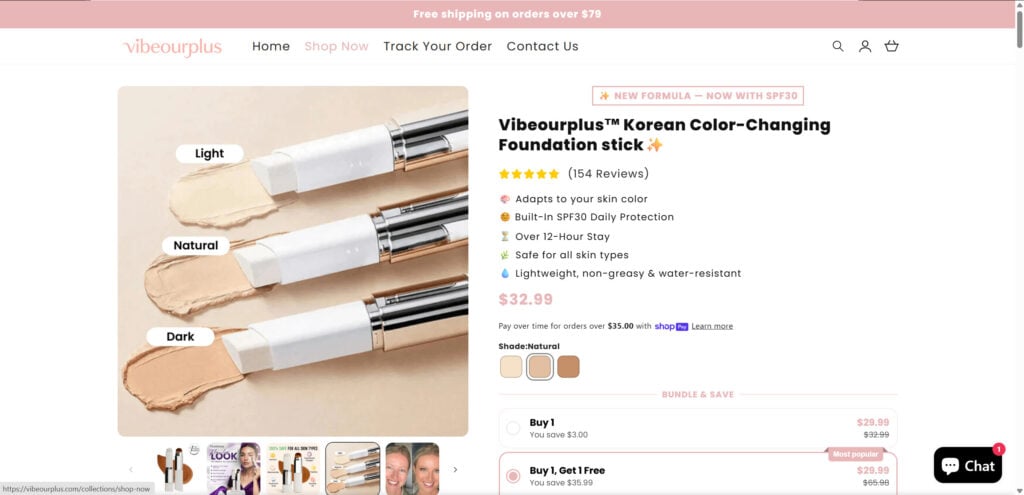
Vibeourplus Color-Changing Foundation Stick Overview
Vibeourplus sells the product as a “Korean Color-Changing Foundation Stick” priced at $32.99. The page claims the stick goes on white and adjusts to the user’s skin tone while blending. It is marketed as a 4-in-1 hydrator, primer, foundation, and skin smoother.
The product page claims it offers:
- Skin tone adaptation in seconds
- Built-in SPF30 daily protection
- Over 12-hour wear
- Lightweight, non-greasy coverage
- Water resistance
- “Korean Beauty glass skin glow”
- Hydration and smoothing with hyaluronic acid
- Brightening with niacinamide
- Firmness support from peptides
- Rosehip oil and vitamin E
- Vegan and cruelty-free positioning
- Suitability for all skin types
- A 60-day money-back guarantee
That sounds attractive, especially for people tired of foundations that look cakey, oxidize orange, settle into wrinkles, or fail to match their shade. The problem is that several claims appear overstated or difficult to verify.
Color-changing foundation is not new. These products typically use pigments suspended in a white or light base. As the product is rubbed into the skin, the pigment capsules break and release color. That can create the appearance of “adapting,” but it does not mean the product intelligently reads or matches every skin tone.
The Vibeourplus page says the product adjusts to a “wide range of tones,” but it also sells shade options such as Light, Natural, and Medium. That undercuts the idea that one product truly adapts to every skin tone. If it were a perfect universal match, multiple shade options would not be as important.
Why Vibeourplus Raises Red Flags
1. “Adapts to your exact skin tone” is likely exaggerated
The product page repeatedly claims that the foundation adapts to the user’s skin tone instantly. It uses phrases like “your exact shade,” “seamless match,” and “no shade guessing.”
That sounds stronger than what most color-changing makeup can realistically do.
These formulas usually rely on encapsulated pigments. They may blend into some skin tones better than others, but they cannot accurately match every undertone, depth, redness, olive tone, golden tone, cool tone, or hyperpigmentation pattern.
The FAQ itself admits that very deep or very fair complexions should apply a thin layer first and build as needed. That is a sign the product is not truly universal.
2. The SPF30 claim needs scrutiny
The page claims “Built-In SPF30 Daily Protection.” That is a major claim because sunscreen products are regulated differently from ordinary makeup in the United States.
If a cosmetic claims SPF protection, buyers should expect proper sunscreen labeling, active ingredient information, Drug Facts-style labeling, broad spectrum information, directions, warnings, and evidence that the finished product was tested.
The Vibeourplus ingredient section mentions titanium dioxide and mica as providing “natural radiance and light sun defense,” but the visible product page does not clearly show full sunscreen-style labeling. That is concerning because “SPF30” is not just a beauty buzzword. It is a measurable sun-protection claim.
Buyers should not rely on a foundation stick as their only sunscreen unless the product has proper labeling and has been tested as a sunscreen product.
3. Similar products are widely available elsewhere
Color-changing Korean-style foundation sticks with built-in brushes are sold across Amazon and other marketplaces. Some listings are priced far below the Vibeourplus offer, including similar products around the $11.99 to $21.99 range.
Wholesale sites also list private-label color-changing foundation sticks, including white foundation sticks that change color and can be customized with private branding.
That suggests Vibeourplus may not be selling a unique breakthrough formula. It may be a generic or private-label beauty product sold through a polished storefront with viral-style claims.
This is a common dropshipping pattern:
- A seller sources a generic beauty product.
- The product is renamed and placed on a Shopify-style website.
- The page uses “Korean beauty,” “glass skin,” and “skin-matching” claims.
- Social media ads drive traffic.
- The product is sold at a markup.
- Returns become the buyer’s problem.
4. The product page contains sloppy technical errors
The product page shows a pricing error: “SAVE Liquid error” and a calculation issue that displays “-Infinity%.”
That kind of visible site error does not prove fraud, but it is a trust concern. A brand selling a skincare or SPF-related beauty product should have a clean, professionally maintained product page.
It also uses awkward product wording such as “Skin Matching Foundationck,” which appears to be a typo. These details suggest the page may be built quickly from a template rather than maintained like a serious cosmetics brand.
5. The review numbers are inconsistent
The product area shows 154 reviews. Later, the page claims the product is rated 4.8/5 by 9,270+ happy customers. It also cites feedback from 1,000 “real customers.”
Those numbers may not be false, but the page does not clearly explain the difference. Are there 154 reviews, 1,000 survey responses, or 9,270 customers? Where are the full verified reviews hosted? Are they independently verified, or only displayed by the seller?
When a sales page uses large review numbers but does not provide transparent third-party verification, buyers should treat the social proof cautiously.
6. The return policy contradicts the “60-day no questions asked” claim
The product page says Vibeourplus offers a 60-day money-back guarantee and “full refund — no questions asked.”
But the refund policy says returns must be initiated within 30 days, products must be in original packaging and free from stains or damage, a maximum of two items per order can be refunded, and a 15% restocking and processing fee applies.
It also says prepaid return labels are not offered and buyers are responsible for sending the product back.
That is a major red flag.
The product page makes the refund sound easy. The actual policy makes it much less appealing, especially for a beauty product that must be opened and tried to know whether the shade works.
7. Beauty products may be non-returnable
The refund policy lists personal care items, including beauty products, among non-returnable items. That creates uncertainty for this foundation stick.
If a customer opens the product, tries it, and finds that it does not match their skin tone, the seller may argue that the item is a personal care product and is not eligible for return.
This is exactly why “risk-free” beauty offers should be treated carefully. If the item must be tried on skin to test the claim, but opened products are difficult to return, the guarantee may not protect the buyer in practice.
8. Returns go to China
The refund policy lists the return address as a returns center in Wuhan City, Hubei Province, China.
That strongly supports the dropshipping/private-label concern. It also makes returns less practical for many buyers, especially if they are in the United States, Canada, Europe, or Australia.
A $32.99 product may not be worth returning internationally after paying shipping, tracking, and a 15% restocking fee. In practice, many buyers may give up.
9. Orders cannot be canceled
The shipping policy and refund policy say orders cannot be canceled once placed because processing begins immediately.
That is another common problem with dropshipping-style stores. Buyers may accidentally order the wrong shade, add a BOGO item, select the wrong quantity, or regret the purchase quickly — but cancellation may be refused.
The buyer is then forced to wait for the product to arrive and attempt a return under restrictive terms.
10. The cart includes add-ons and “subscription” language
The cart page includes a “Shipping Protection” add-on for $3.99. It also displays wording saying “Subscription spot reserved for more minutes,” even though this appears to be a makeup product.
That subscription wording may be a leftover template error, but it is still concerning. Buyers should check the cart carefully for add-ons, shipping protection, subscriptions, VIP clubs, or recurring charge language before paying.
How the Vibeourplus Sales Funnel Appears to Work
Step 1: The ad targets makeup frustration
The product is aimed at people who are tired of foundation that looks fake, orange, cakey, heavy, or mismatched.
That is effective because shade matching is a real frustration. Many buyers want a simple product that works without testing multiple foundation shades.
Step 2: The product is framed as “smart” makeup
The phrase “adaptive pigment technology” makes the foundation sound more advanced than ordinary makeup.
The idea is simple: roll on a white stick, blend it, and watch it turn into your perfect shade.
That visual transformation works well in social media videos because it looks dramatic. But the effect is not necessarily proof of true skin matching. It may simply be pigment capsules breaking open.
Step 3: Korean beauty language creates premium appeal
The page repeatedly uses “Korean Beauty” and “glass skin” language. These phrases make the product feel trendy, modern, and skincare-focused.
But buyers should not assume a product is high quality simply because it uses K-beauty branding. Many dropshipping beauty products use Korean-inspired language even when the actual product may be generic or sourced from China.
Step 4: The page adds skincare claims
Vibeourplus claims the product hydrates, brightens, plumps, smooths fine lines, reduces breakouts, and calms redness.
This turns the product from a simple foundation into a skincare-makeup hybrid.
That increases the appeal, but also increases the need for proof. Cosmetic ingredient names do not guarantee visible results. Hyaluronic acid may hydrate, niacinamide may support tone and barrier function, and peptides may be common in anti-aging skincare, but that does not prove this finished product delivers all the advertised effects.
Step 5: Social proof builds trust
The page uses customer stories, review numbers, survey percentages, before-and-after images, and “verified buyer” labels.
These are meant to make the product feel safe and widely loved. But the review numbers are inconsistent, and the testimonials are controlled by the seller, not a transparent third-party review platform.
Step 6: BOGO and shade suggestions can increase order size
The FAQ mentions a Buy 1 Get 1 Free offer and suggests many customers get both Light and Natural. This can encourage buyers to order more than one product before knowing whether the formula works for them.
If the buyer dislikes the product, the refund policy limits the number of refundable items, applies fees, and requires return shipping to China.
Step 7: Returns become difficult
If the product arrives and does not match the buyer’s skin tone, feels greasy, causes irritation, looks cakey, or fails to last, the buyer may try to return it.
At that point, the actual policy matters more than the sales-page guarantee. The buyer may face a 30-day window, buyer-paid international shipping, a 15% restocking fee, a maximum refund limit, and possible non-returnability because it is a beauty product.
Main Red Flags
- Claims to adapt to your exact skin tone in seconds.
- Sells multiple shades despite claiming broad self-adjustment.
- Claims SPF30 daily protection without clearly visible full sunscreen-style labeling on the product page.
- Uses “Korean Beauty” and “glass skin” marketing heavily.
- Claims hydration, brightening, plumping, smoother fine lines, reduced breakouts, and calmer redness.
- Similar color-changing foundation sticks are sold on Amazon and Chinese supplier platforms.
- The page contains visible “Liquid error” and “-Infinity%” pricing problems.
- Review numbers appear inconsistent across the page.
- The product page promises a 60-day no-questions refund.
- The refund policy says returns are 30 days, not 60 days.
- A 15% restocking and processing fee applies.
- Buyers must pay return shipping.
- Return address is in Wuhan, China.
- Personal care and beauty products may be non-returnable.
- Orders cannot be canceled once placed.
- The cart includes shipping protection and strange “subscription spot reserved” language.
Is Vibeourplus Foundation a Scam?
Vibeourplus may ship a real foundation stick, so this may not be a simple “pay and receive nothing” scam.
The bigger issue is whether the product is being oversold and whether the guarantee is meaningful.
A fair conclusion is this: Vibeourplus Korean Color-Changing Foundation Stick appears to be a high-risk dropshipping-style beauty offer because it combines exaggerated skin-matching claims, SPF30 positioning, generic product signals, inconsistent review and refund messaging, China-based return logistics, and refund terms that may make returns difficult.
The product may work as a basic foundation stick for some users. But buyers should not assume it will perfectly match every skin tone, replace sunscreen, improve skin quality, or deliver the flawless K-beauty results shown in ads.
Why Color-Changing Foundation Claims Should Be Treated Carefully
Color-changing foundation does not actually “scan” or “read” skin.
Most products in this category use pigment capsules suspended in a lighter base. When rubbed into the skin, the capsules break and release pigment. The color may look like it adapted, but in reality it is the pigment being spread and blended.
This can work reasonably for some medium skin tones, but it can fail for very fair, very deep, very cool, very olive, very red, or highly uneven complexions.
Buyers should also remember that shade match is not just depth. It includes undertone, oxidation, coverage level, finish, texture, skin type, and lighting.
A product that looks good in a filtered ad may not match in real daylight.
What To Do Before Buying
1. Compare similar products first
Search for:
- Korean color-changing foundation stick
- white foundation stick with brush
- self-adjusting foundation stick
- color changing cover cream stick
- skin tone adapting foundation
- private label color changing foundation stick
If similar products appear for much less, that is a sign the offer may be a marked-up generic product.
2. Do not rely on the SPF claim alone
If you need sun protection, use a dedicated broad-spectrum sunscreen. Do not rely only on a foundation stick unless the product clearly shows proper SPF labeling and you apply enough product to achieve the claimed protection.
3. Read the refund policy, not just the product page
The product page says 60 days and no questions asked. The refund policy is more restrictive. It says 30 days, buyer-paid return shipping, 15% fee, maximum two refunded items, and China return address.
4. Avoid buying multiple shades first
Do not buy BOGO bundles or multiple shades until you know the formula works for your skin. If the return process is difficult, extra units increase your loss.
5. Screenshot everything
Before paying, save screenshots of:
- product claims
- SPF30 claim
- review claims
- checkout page
- selected quantity
- selected shade
- return policy
- guarantee language
- final total
This helps if you need to dispute the charge later.
What To Do If You Already Ordered
1. Check your order confirmation
Confirm:
- shade selected
- quantity ordered
- whether BOGO was added
- total amount charged
- shipping fee
- shipping protection fee
- merchant name on statement
- whether any recurring or subscription language appears
2. Cancel quickly, but expect resistance
The policy says orders cannot be canceled once placed. Still, email support immediately if you made a mistake. Keep proof of your request.
3. Do not open every item
If you bought multiple units, do not open all of them. Opened beauty products may be harder to return.
4. Patch test first
Apply a small amount to a discreet area before using it on your full face. Stop using it if you notice burning, itching, rash, swelling, breakouts, or irritation.
5. Save packaging
The return policy requires original packaging and return approval. Keep everything until you are sure you want to keep the product.
6. Contact support in writing
If the shade does not match, the product is not as advertised, or you received extra units, ask for:
- refund eligibility
- return address
- prepaid return label
- clarification on the 60-day guarantee
- confirmation of no subscription or future charges
- cancellation of any added shipping protection or upsell
7. Dispute if needed
Contact your bank, credit card issuer, or PayPal if:
- you were charged for more items than ordered
- the item never arrives
- the product does not match the advertised claims
- the seller refuses the advertised guarantee
- return shipping to China makes the refund impractical
- you see unauthorized repeat charges
Use clear wording such as:
- “item not as described”
- “misleading SPF claim”
- “unauthorized quantity charged”
- “merchant refuses advertised refund”
- “return policy contradicts advertised guarantee”
FAQ
What is Vibeourplus Korean Color-Changing Foundation Stick?
It is a roll-on foundation stick marketed as a skincare-infused, color-changing foundation that goes on white and blends into the user’s skin tone.
Is Vibeourplus a scam?
Vibeourplus may ship a real product, but the offer has several dropshipping-style red flags: exaggerated claims, generic product signals, inconsistent review numbers, China return address, restrictive refund terms, and difficult cancellation.
Does the foundation really match every skin tone?
Be cautious. Color-changing foundations usually release pigments when blended. They may work for some users but are unlikely to perfectly match every undertone and skin depth.
Is Vibeourplus really SPF30?
The product page claims SPF30, but buyers should look for proper sunscreen labeling and testing. A foundation stick should not replace dedicated sunscreen unless it is clearly labeled and used correctly.
Is Vibeourplus from China?
The refund policy lists a return address in Wuhan, Hubei Province, China, and the shipping policy says products may ship from warehouses in Asia, the USA, the UK, or Australia. This supports the dropshipping/private-label concern.
Are similar products sold elsewhere?
Yes. Similar Korean color-changing foundation sticks with brushes appear on Amazon and Alibaba-style supplier platforms.
Can I return Vibeourplus?
The product page says there is a 60-day guarantee, but the refund policy says returns must be initiated within 30 days, buyer pays return shipping, a 15% fee applies, and the return address is in China.
Can opened makeup be returned?
That is unclear and risky. The refund policy lists personal care items, including beauty products, as non-returnable. Contact support before opening multiple units.
Can buyers receive multiple units?
That is possible if BOGO offers, multiple shade suggestions, or checkout upsells are used. Always check the final cart and quantity before payment.
Should I buy Vibeourplus?
Be cautious. Compare similar products first, avoid multiple-unit offers, do not rely on it as sunscreen, and understand that returns may be difficult.
The Bottom Line
Vibeourplus Korean Color-Changing Foundation Stick is marketed as a smart K-beauty foundation that adapts to your skin tone, hydrates, smooths, protects with SPF30, and gives a glass-skin glow.
The product may work as a basic foundation stick for some buyers, but the offer carries multiple warning signs: exaggerated “exact shade match” claims, unclear SPF support, generic product similarities, inconsistent review claims, visible website errors, restrictive refund terms, buyer-paid return shipping, and a China return address.
If you are considering it, compare alternatives first, avoid multi-unit offers, screenshot the checkout, and do not depend on it as your only sun protection.

Join the discussion
0 commentsShare your experience or ask a question about this article.
Discussion
Start the conversation
Have a question or something useful to share? Add the first comment.