

Vital Guard is being heavily promoted online as an anti-choking emergency device designed to help during life-threatening situations. The ads often use emotional stories, urgent messaging, and bold safety claims to convince people to buy quickly.
But before purchasing, it’s important to take a closer look at how the product is marketed, what buyers are actually receiving, and whether the company behind it is as trustworthy as it appears. In this review, we’ll examine the main concerns surrounding Vital Guard, including its advertising tactics, customer complaints, return issues, and the risks commonly associated with dropshipping-style products sold through social media ads.
Overview
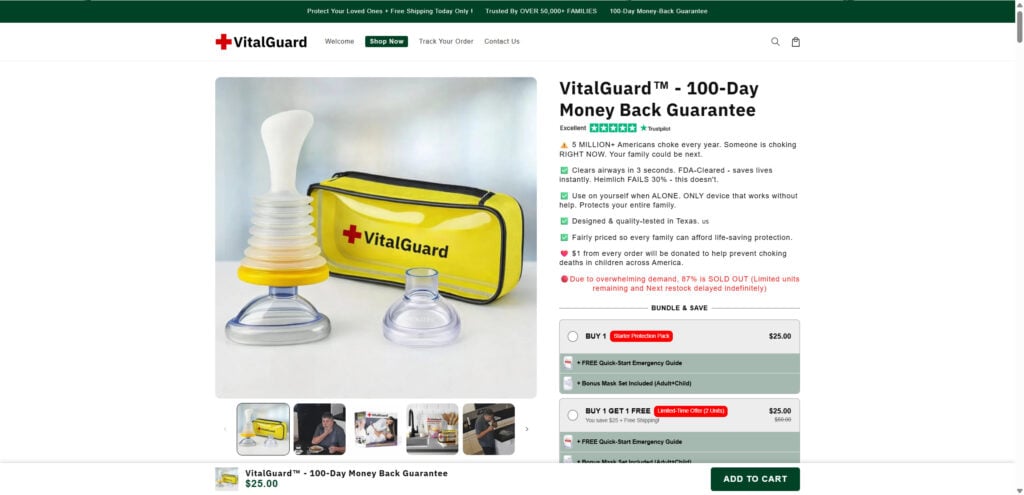
Vital Guard is sold through buyvitalguard.com as an anti-choking rescue device. The product appears to be a suction-style choking aid, similar in appearance to other airway suction devices promoted online. These products are often advertised as simple emergency tools that can be used when someone is choking.
The main issue is not that choking emergencies are fake. Choking is real, dangerous, and requires fast action. The concern is the way Vital Guard appears to be marketed and sold.
The website uses emotionally charged claims designed to make buyers feel they are putting their family at risk if they do not purchase the device. This is common in dropshipping-style emergency product ads. The sales message usually creates a frightening scenario, presents the product as the simple solution, then pushes the customer toward a quick purchase with urgency-based offers.
Several warning signs stand out.
First, the product is tied to big safety claims. The website says VitalGuard can be used for self-rescue and describes it as simple enough to use in a choking emergency. It also presents itself with strong trust language, including “trusted by over 50,000 families” and a 100-day money-back guarantee.
Second, the product category itself is sensitive. Anti-choking devices are not like phone chargers or kitchen gadgets. If they fail, are poorly made, or are used instead of proper first aid, the consequences can be severe. The U.S. FDA has encouraged the public to follow established choking rescue protocols, and the American Red Cross teaches cycles of back blows and abdominal thrusts for adults and children who are choking.
Third, authorities have warned about counterfeit or unbranded anti-choking devices. The UK’s MHRA warned that counterfeit or unbranded anti-choking devices can fail to clear the blockage and may even worsen the situation by pushing the obstruction farther down the airway.
Fourth, there is already at least one BBB Scam Tracker report connected to buyvitalguard.com, categorized as an online purchase complaint and naming “Vital Guard possible imposter.” The report listed a claimed dollar loss of $39.99 and identified buyvitalguard.com as the website involved.
None of this proves every order will fail or that every buyer will lose money. But it does mean the site should not be treated like an established medical device brand with a long track record, transparent ownership, and clearly verified regulatory standing
The bigger concern is the commercial pattern. Products like this are often pushed through social media ads that use fear, dramatic family stories, and exaggerated safety language. Buyers may think they are getting a professionally validated emergency device, but they may instead receive a generic low-cost product shipped from overseas.
Some customers in similar dropshipping schemes report receiving more units than they selected, being charged more than expected, or finding that returns require international shipping at their own expense. In practice, that can make the advertised refund almost useless. When the return address is overseas, shipping can cost nearly as much as the order itself.
This is why Vital Guard should be approached with caution. A choking emergency product should be bought only from a reputable source with clear regulatory documentation, verified brand identity, transparent return terms, and strong customer support.
How the Vital Guard Sales Funnel Appears to Work
1. The ad creates fear
The first step is usually an emotional social media ad. The ad may show a child, grandparent, or family member in danger. It may tell a dramatic story about someone choking at dinner and being saved by a small device.
This type of ad is designed to bypass careful thinking. Instead of asking whether the product is regulated, authentic, clinically supported, or fairly priced, the viewer is pushed to think: “What if this happens in my home?”
That emotional pressure is the core sales tactic.
2. The product is presented as a simple lifesaver
Once the buyer clicks the ad, the website presents Vital Guard as easy, fast, and reassuring. The page claims it can be used in a simple 3-step process and says it can be used on yourself if you are choking alone.
That sounds powerful, but emergency medical claims need careful scrutiny. Choking protocols taught by organizations like the Red Cross focus on back blows, abdominal thrusts, and CPR if the person becomes unresponsive.
A suction device should not be treated as a replacement for learning proper first aid. If a product ad makes the device sound like the main solution, that is a red flag.
3. The page builds trust with broad claims
The site uses trust-building phrases such as “trusted by over 50,000 families” and “100-day money-back guarantee
The problem is that these claims are difficult for buyers to verify. A large number like 50,000 families sounds impressive, but unless there is clear proof, audited sales data, independent reviews, or reliable third-party confirmation, it is just marketing language.
The same applies to refund guarantees. A 100-day money-back guarantee sounds safe, but many dropshipping stores make refunds difficult by requiring unused items, original packaging, slow email approval, or expensive international return shipping.
4. The buyer is pushed into a bundle offer
Many dropshipping funnels use quantity discounts, “buy more, save more” bundles, or post-purchase upsells. This is where customers may accidentally end up with more units than they intended to buy.
A buyer may think they selected one device, but the checkout flow may push multi-pack discounts or add-ons. In some cases, customers only realize after payment that they were charged for multiple units.
This is a common complaint pattern in aggressive direct-response ecommerce: the advertised price gets the customer in, then the funnel increases the order value.
5. A cheap generic product may arrive
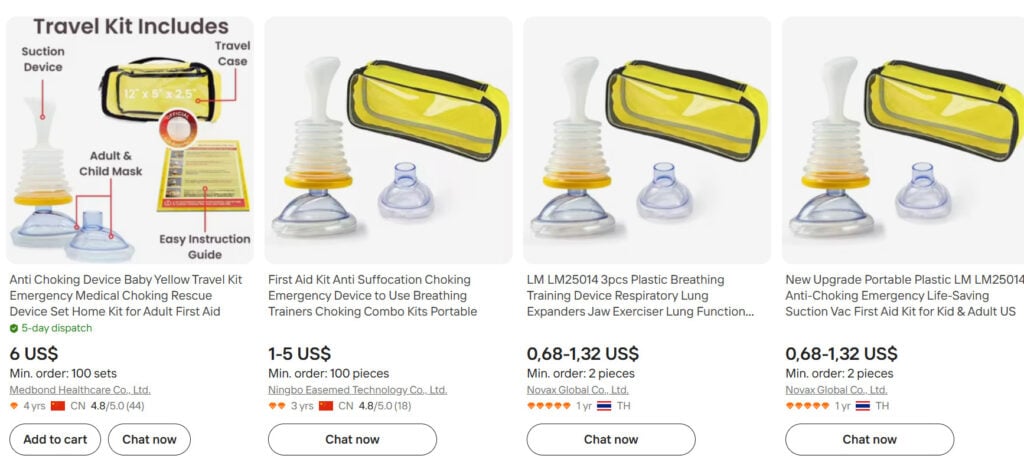
The user-provided details suggest this is a cheap Chinese product sold at a markup. This matches a common dropshipping model: the seller runs ads, collects orders, then ships a generic product from a third-party supplier.
That does not automatically mean the product is fake, but it does raise questions:
- Who actually manufactures the device?
- Does it have valid medical-device registration where it is sold?
- Is it the same product shown in the ad?
- Does it have proper instructions?
- Does it include safety warnings?
- Is it tested by a recognized authority?
- Is the seller authorized to make the claims in the ads?
For an emergency device, those questions matter.
6. Returns may become impractical
The site may promote a money-back guarantee, but the real test is what happens when a customer asks for a refund.
In many similar operations, buyers are told to return the item to China or another overseas address. The customer must pay shipping, provide tracking, wait for inspection, and sometimes deal with support delays. If the product cost $30–$80 and return shipping costs close to that amount, the refund becomes practically impossible.
This is why “money-back guarantee” should not be treated as proof that a store is safe.
Why the Medical Claims Are Concerning
Vital Guard is not being sold as a normal household gadget. It is being sold as something people may rely on during a life-threatening choking emergency. That makes the marketing much more serious.
The FDA has urged the public to follow established choking rescue protocols. The Red Cross teaches back blows and abdominal thrusts for conscious choking adults and children, and CPR if the person becomes unresponsiv
The MHRA has also warned about counterfeit or unbranded anti-choking devices, stating they may fail to resolve the blockage or worsen the situation.
That does not mean every suction anti-choking device is useless. But it does mean buyers should be very careful about unverified brands promoted through social media ads. A product meant for emergencies should not rely mainly on emotional testimonials and urgency marketing.
Red Flags Seen With Vital Guard
Based on the available information, these are the main red flags:
- Sold through a direct-response Shopify-style storefront.
- Promoted with emotional “lifesaver” claims.
- Uses broad trust claims that are hard to independently verify.
- Appears connected to social media ad marketing.
- May be a generic low-cost product sold at a large markup.
- Customers may risk receiving more units than intended through bundle or upsell flows.
- Returns may be difficult or impractical if the seller requires overseas shipping.
- A BBB Scam Tracker report exists for buyvitalguard.com as an online purchase issue.
- Independent site-checking flagged caution signals around the store.
- The product category has known problems with counterfeit and unbranded anti-choking devices.
Is Vital Guard Legit?
Vital Guard may ship a physical product to some buyers, but that does not automatically make the offer trustworthy.
The safer conclusion is this: Vital Guard appears to be a high-risk dropshipping-style anti-choking device offer that should be approached with caution. The combination of emotional advertising, hard-to-verify claims, possible cheap generic sourcing, refund concerns, and a sensitive medical-use category makes it risky.
For a product that could be used in a choking emergency, buyers should look for a reputable, clearly documented device from a verified seller and should also learn proper choking first aid from recognized organizations.
What To Do If You Already Ordered Vital Guard
1. Check your receipt carefully
Look at the order confirmation and payment receipt. Confirm:
- How many units you were charged for
- The total price
- Whether shipping, handling, or add-ons were added
- Whether any subscription or recurring charge appears
- The merchant name on your card statement
Take screenshots immediately.
2. Contact the seller in writing
Email the seller and clearly request cancellation or a refund. Keep the message simple. Ask for:
- Order cancellation if it has not shipped
- A prepaid return label if it has shipped
- Confirmation that no extra units or subscriptions were added
- Written confirmation that no future charges will occur
Do not rely on phone calls only. Written proof matters if you later dispute the charge.
3. Do not pay expensive return shipping without thinking
If the seller asks you to return the product overseas at your own cost, calculate whether the refund is realistic. Many buyers give up because the return cost is too high.
If the return terms were not clearly shown before purchase, save screenshots and include that in your dispute.
4. Dispute the charge if needed
If you were charged for more units than you ordered, never received the item, received a product that does not match the ad, or cannot get a reasonable response from support, contact your bank or credit card provider.
Use phrases like:
- “Item not as described”
- “Unauthorized quantity charged”
- “Merchant refuses reasonable return”
- “Product advertised with misleading claims”
- “Unable to obtain refund despite guarantee”
5. Watch for additional charges
Some aggressive ecommerce funnels include hidden subscriptions, VIP clubs, protection plans, or post-purchase upsells. Monitor your card for at least 60 days.
If you see an unfamiliar charge, contact your bank immediately.
6. Report the store
You can report the website to:
- Your bank or card issuer
- BBB Scam Tracker
- The FTC, if you are in the U.S.
- Your local consumer protection authority
- The platform where you saw the ad, such as Facebook, Instagram, TikTok, or YouTube
Reporting helps ad platforms and consumer agencies identify repeat patterns.
FAQ
Is Vital Guard a scam?
Vital Guard shows several warning signs associated with dropshipping-style ecommerce offers. It may ship a physical product, but the advertising claims, refund concerns, and possible generic sourcing make it risky.
Is Vital Guard FDA approved?
I found no clear evidence from the seller’s page proving that Vital Guard is FDA approved or authorized. For medical or emergency devices, buyers should verify regulatory claims directly through official sources, not just product-page marketing.
Can Vital Guard replace the Heimlich maneuver or first aid?
No. Do not treat any device from a social media ad as a replacement for proper choking first aid. The FDA encourages established choking rescue protocols, and the Red Cross teaches back blows, abdominal thrusts, and CPR when needed.
Why are anti-choking devices risky?
The risk is that an unverified or poorly made device may fail, delay proper first aid, or worsen the blockage. The MHRA has warned that counterfeit or unbranded devices may fail to resolve choking and may make the situation worse
Why do people receive more units than they ordered?
Many direct-response ecommerce funnels use bundle offers, quantity discounts, and post-purchase upsells. Buyers may accidentally approve a larger order, or the checkout may be confusing. Always screenshot the checkout page before paying.
Are the testimonials on the Vital Guard website real?
They are difficult to verify independently. Emotional testimonials are common in ecommerce funnels and should not be treated as proof of safety, effectiveness, or regulatory approval.
What should I do if Vital Guard refuses a refund?
Save all emails, receipts, tracking numbers, and screenshots. Then contact your card issuer and dispute the charge. Explain that the product was not as advertised, the return terms are unreasonable, or you were charged for more than you selected.
Is the 100-day money-back guarantee reliable?
A guarantee is only useful if the seller honors it easily. If the customer must return the item overseas at high cost, the guarantee may be practically worthless.
Should I buy Vital Guard?
I would be cautious. For emergency choking protection, buy only from a reputable source, verify the product’s regulatory status, and learn proper choking first aid from recognized organizations.
What is the safest thing to do for choking emergencies?
Learn proper choking first aid. For adults and children, the Red Cross recommends cycles of back blows and abdominal thrusts. If the person becomes unresponsive, begin CPR according to your training and call emergency services.
The Bottom Line
Vital Guard is marketed as a simple emergency device that could protect your family during a choking incident. But the way it is promoted raises serious concerns.
The product appears to follow a familiar dropshipping pattern: emotional social media ads, exaggerated safety claims, trust badges, urgency offers, possible cheap overseas sourcing, and refund terms that may be difficult to use in practice.
Because this is a product people may rely on in a life-threatening emergency, caution is essential. Do not let fear-based advertising replace proper first-aid training or careful product verification.








