

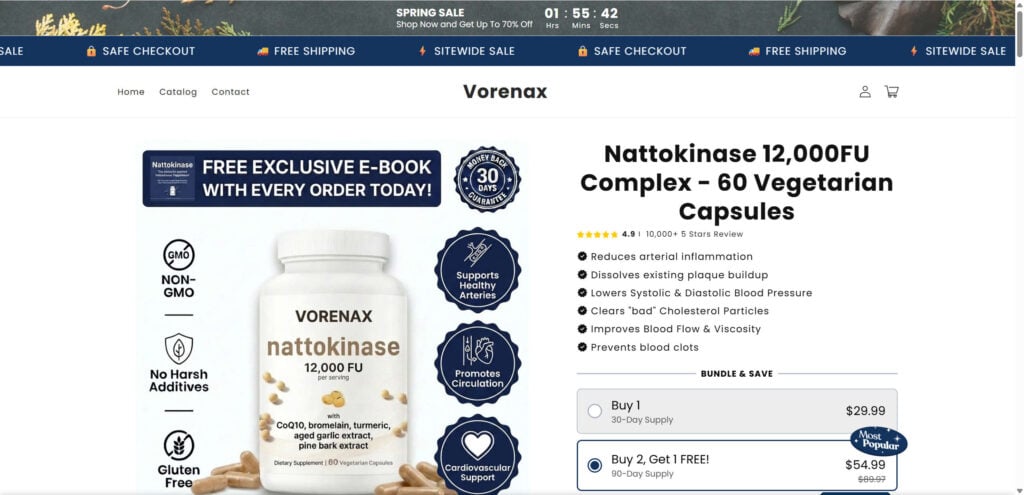
Vorenax Nattokinase is marketed as a powerful cardiovascular supplement that can reduce arterial inflammation, dissolve plaque buildup, lower blood pressure, clear “bad” cholesterol particles, improve blood flow, and prevent blood clots.
Those are not small wellness claims.
They are serious cardiovascular claims tied to arteries, plaque, cholesterol, blood pressure, and clotting. That is why this product deserves careful scrutiny before anyone buys it, especially if they take medication or already have heart, blood pressure, clotting, or circulation issues.
The product may exist. A customer may receive capsules. But the way Vorenax is marketed raises multiple red flags.
Scam Overview
Vorenax sells Nattokinase 12,000FU Complex – 60 Vegetarian Capsules for $29.99 and presents it as a high-strength cardiovascular support formula. The product page claims a 4.9 rating, “10,000+ 5 Stars Review,” and lists benefits such as reducing arterial inflammation, dissolving plaque buildup, lowering systolic and diastolic blood pressure, clearing “bad” cholesterol particles, improving blood flow and viscosity, and preventing blood clots.
The formula is described as a 7-in-1 blend containing:
- Nattokinase – 12,000 FU per serving
- CoQ10
- Turmeric
- Ginger
- Olive leaf
- Bromelain
- White willow bark
The page also says the product uses an MCT oil base, enteric-coated softgels, and third-party testing for purity and potency.
The issue is not that nattokinase is a fake ingredient. Nattokinase is a real enzyme derived from natto, a traditional Japanese fermented soybean food. Memorial Sloan Kettering notes that preliminary studies suggest nattokinase may help prevent clot formation and reduce blood pressure, but it also says human studies are limited and nattokinase may increase bleeding risk when used with blood-thinning drugs.
That distinction matters.
A real ingredient does not automatically make the product’s advertising trustworthy.
What Vorenax Wants Buyers to Believe
The product page suggests Vorenax can:
- reduce arterial inflammation
- dissolve existing plaque buildup
- lower systolic and diastolic blood pressure
- clear “bad” cholesterol particles
- improve blood flow and viscosity
- prevent blood clots
- support long-term arterial flexibility
- improve circulation in hands and feet
- produce doctor-noticed changes in cardiovascular numbers
The page also uses strong urgency messaging, including a low-stock warning, a claim that the product sold out 12 times last year, and a warning not to buy “fakes” on Amazon or eBay.
What it actually appears to be
Vorenax appears to be a standard supplement funnel built around a high-dose nattokinase blend.
It may contain real supplement ingredients. But the sales page pushes the product far beyond ordinary “supports cardiovascular wellness” language. It repeatedly connects the capsules to plaque, clotting, blood pressure, cholesterol, and arterial function.
That is the core concern.
Major Red Flags
1. The claims go far beyond basic supplement support
The most obvious red flag is the claim stack.
Vorenax does not merely say it “supports circulation.” It claims the product:
- dissolves existing plaque buildup
- prevents blood clots
- lowers blood pressure
- clears “bad” cholesterol particles
- reduces arterial inflammation
These are disease-adjacent claims. They may lead consumers to think the product can replace or reduce the need for real medical care.
The FDA explains that dietary supplements may use certain structure/function claims, but they must be truthful and not misleading. The FDA also says supplement claims require a disclaimer stating the product is not intended to diagnose, treat, cure, or prevent disease because only drugs can legally make disease-treatment claims.
Vorenax does include an FDA-style disclaimer at the bottom of the product page. But the front-end claims still create a very strong medical impression.
2. “Dissolves plaque buildup” is a serious claim
The product page says Vorenax “dissolves existing plaque buildup.”
That is one of the strongest and most concerning claims on the page.
Arterial plaque is not a simple dirt-like substance that can be “cleaned out” by a supplement. Plaque buildup is a complex cardiovascular issue involving cholesterol, inflammation, calcium, immune response, and vascular changes.
A supplement page claiming to dissolve plaque should provide strong product-specific clinical evidence. Vorenax does not clearly provide that level of proof on the page.
3. The clotting claims create real safety concerns
Vorenax says the product can prevent blood clots and improve blood viscosity.
That is not a harmless claim.
Nattokinase is associated with fibrinolytic and blood-thinning effects. Memorial Sloan Kettering warns that nattokinase may increase bleeding risk when used with blood-thinning drugs and says people with coagulation disorders or those using anticoagulant drugs should not take it. It also warns daily aspirin users that nattokinase may increase aspirin’s effects and lead to excessive bleeding.
This is especially important for anyone taking:
- warfarin
- Eliquis
- Xarelto
- Plavix
- aspirin
- heparin
- blood pressure medication
- supplements with blood-thinning effects
- medication before or after surgery
For those users, this is not a casual wellness product.
4. The “12,000 FU snowplow” explanation is aggressive
Vorenax claims most supplements contain only 2,000–4,000 FU and says those doses are “fine for prevention, but not enough to reverse existing damage.” It then says the 10,800 FU dose is the clinical strength used in real clinical studies and that Vorenax exceeds that with 12,000 FU. The page compares the dose to a “snowplow” clearing what is already there.
That framing is a red flag.
It suggests lower doses only prevent buildup while Vorenax can reverse existing damage. That is a much stronger claim than ordinary supplement support.
If a company claims a product can reverse cardiovascular damage, it should provide direct, product-specific evidence and clear medical context. Otherwise, this looks like dose-based hype.
5. The review and customer numbers look inflated or difficult to verify
The page uses several large trust signals:
- 4.9 rating
- 10,000+ 5-star reviews
- trusted by 800K+ customers
- rated 4.84/5 with 50,000+ customers
- product sold out 12 times last year
These numbers do not appear to be independently verified on the page. They are presented as part of the seller-controlled landing page.
Large review counts are common in high-conversion supplement funnels because they reduce buyer hesitation.
But seller-controlled social proof is not the same as independent proof.
6. The testimonials imply medical improvement
The page includes testimonials such as:
- “my doctor noticed the difference”
- “my numbers were climbing for years”
- “two months in and my doc asked what I changed”
- “cold hands and feet for years… something was working”
These stories are designed to imply real cardiovascular improvement.
That is powerful marketing.
But testimonials are not clinical evidence. A few dramatic stories cannot prove that most buyers will see better blood pressure, cholesterol, clotting, plaque, or circulation outcomes.
7. The contact page contains unfinished template text
The contact page includes an order tracking section that says: “If your tracking number doesn’t work feel free to contact us at [shop email].” (Vorenax)
That placeholder text is a serious trust issue.
A professional supplement company selling a cardiovascular product should not have unfinished template language on its support page. It suggests the store may have been assembled quickly or carelessly.
The cart area also shows template-like text: “Assign upsell products in block settings.” (Vorenax)
These are not fatal by themselves, but they are exactly the kind of sloppy details often found on quick-build ecommerce funnels.
8. Company transparency appears weak
The visible site navigation is minimal:
- Home
- Catalog
- Contact
The product page and contact page do not clearly show a detailed company background, named leadership, manufacturing facility, full support details, or independent lab reports.
For an ordinary accessory, that might be less concerning.
For a supplement making claims about blood clots, arterial plaque, cholesterol, and blood pressure, it matters.
9. “Third-party tested” is claimed, but proof is not shown clearly
The product page says the formula is third-party tested for purity and potency.
That sounds reassuring. But the page does not clearly provide:
- the lab name
- certificate of analysis
- batch number
- test date
- heavy metal results
- microbial testing
- active enzyme activity verification
- full supplement facts label in searchable text
Without accessible documentation, “third-party tested” is just a trust phrase.
10. Nattokinase is not risk-free
The sales page says nattokinase has over 1,000 years of safe use in Japan and an excellent safety profile.
That is an oversimplification.
Memorial Sloan Kettering says human studies are limited and lists serious warnings and case reports, including bleeding risk with blood-thinning drugs, an internal bleeding death case report, allergic reactions in people allergic to natto, and warnings for patients with deep vein thrombosis history.
That does not mean nattokinase is dangerous for everyone.
It means it should not be marketed like a harmless cardiovascular cleanup tool.
How This Operation Appears to Work
Step 1: Target cardiovascular fear
The page focuses on:
- plaque buildup
- narrowing arteries
- cholesterol
- blood pressure
- clotting
- poor circulation
- cold hands and feet
These are serious concerns, especially for older buyers.
Step 2: Present a simple solution
The product is framed as a daily capsule that can support arterial health at the “source.”
That makes a complex health issue feel simple.
Step 3: Use strong mechanism language
The page discusses fibrin, arterial plaque, blood viscosity, inflammation, cholesterol particles, and circulation.
This makes the product sound more medical than a normal supplement.
Step 4: Add high-dose authority
The 12,000 FU dose is used as the main differentiator.
The page positions lower-dose nattokinase as weaker and implies Vorenax is powerful enough to clear what others cannot.
Step 5: Push urgency and social proof
The page uses:
- low-stock warnings
- sold-out claims
- huge review numbers
- 800K+ customer claims
- viral-style testimonials
This is designed to reduce skepticism and push the customer toward checkout.
Is Vorenax Nattokinase a Scam?
Not necessarily a fake-product scam
Vorenax likely sells a real supplement product. A buyer may receive capsules.
But it is high-risk from a marketing and safety standpoint
The concerns are substantial:
- plaque-dissolving claims
- clot-prevention claims
- blood pressure and cholesterol claims
- aggressive high-dose positioning
- huge unverifiable social proof numbers
- template errors on the site
- weak visible company transparency
- missing publicly visible lab proof
- safety concerns for people on blood thinners or cardiovascular medication
The most accurate classification is:
Vorenax Nattokinase appears to be a high-risk cardiovascular supplement funnel marketed with exaggerated artery, plaque, clotting, and blood pressure claims.
Should You Buy It?
For most people, caution is warranted.
Reasons to avoid it
- The claims are stronger than the proof shown on the page
- It discusses serious cardiovascular outcomes
- Nattokinase can interact with blood-thinning drugs
- The site has trust issues and template errors
- Review and customer numbers are difficult to verify
- The product should not be used as a substitute for medical care
Who should be especially cautious
Do not use this without medical advice if you:
- take blood thinners
- take aspirin daily
- take blood pressure medication
- have a history of blood clots
- have a bleeding disorder
- have had stroke, DVT, pulmonary embolism, or heart surgery
- are scheduled for surgery or dental procedures
- are pregnant or breastfeeding
- are allergic to soy or natto
MSKCC specifically warns that patients with coagulation disorders or those using anticoagulant drugs should avoid nattokinase, and daily aspirin users may have increased bleeding risk. (Memorial Sloan Kettering)
What To Do If You Already Ordered
1. Save the product claims
Take screenshots of:
- “dissolves existing plaque buildup”
- “prevents blood clots”
- “lowers systolic and diastolic blood pressure”
- “clears bad cholesterol particles”
- “trusted by 800K+ customers”
- “10,000+ 5 stars review”
- “sold out 12 times”
- “third-party tested”
- FDA disclaimer
- order confirmation
- checkout total
This matters if you need to dispute the purchase.
2. Do not stop medication
Do not stop or reduce:
- statins
- blood pressure medication
- anticoagulants
- antiplatelet medication
- aspirin
- diabetes medication
- doctor-prescribed treatment
A supplement should not replace cardiovascular care.
3. Ask your doctor before taking it
This is especially important because nattokinase may affect clotting and bleeding risk.
Bring the bottle or product page to your clinician and ask whether it is safe with your medications and health history.
4. Monitor for side effects
Stop use and seek medical advice if you notice:
- unusual bruising
- bleeding gums
- nosebleeds
- black stools
- blood in urine
- dizziness
- chest pain
- shortness of breath
- allergic reaction
- severe headache
- weakness or neurological symptoms
5. Check whether the product matches the page
When it arrives, inspect:
- supplement facts label
- serving size
- actual FU per serving
- expiration date
- lot number
- manufacturer information
- seal condition
- warning label
- country of origin
- third-party testing claim
If the label does not match the sales page, document it.
6. Contact support early if you want a refund
Because the contact page contains placeholder support language, do not delay if you need help. Send a clear written request and keep a copy.
Example:
I am requesting a refund for order #[number]. The product does not match the claims and presentation on the sales page. Please confirm the refund process and return instructions in writing.
7. Dispute the charge if necessary
If support is unresponsive, the product does not arrive, or the product is materially different from what was advertised, contact your bank or payment provider.
Use evidence showing:
- what was promised
- what arrived
- what you were charged
- how support responded
The Bottom Line
Vorenax Nattokinase is not clearly a fake product. It may ship real capsules containing nattokinase and other ingredients.
But the marketing is the problem.
The site makes aggressive claims about arterial plaque, blood pressure, cholesterol, blood flow, and blood clots, while also relying on huge social proof numbers, low-stock pressure, vague third-party testing claims, and template mistakes that weaken trust.
The safest conclusion is simple:
Vorenax Nattokinase looks like a high-risk supplement funnel selling a cardiovascular product with claims that go far beyond what buyers should accept without strong medical supervision and independent proof.

Join the discussion
2 commentsShare your experience or ask a question about this article.
Discussion
I think your impressions are totally bullshit. Ido not take this product but I do take another nattokinase product and after 7 months I have had Zero side effects quite unlike the crap your pharm products create. If you want to write something, you should inform yourself and try to be truthful.
In reply to Joe
That’s a reasonable objection, so let’s separate two things. Nattokinase as an ingredient does have published research behind it, and nobody here is defending pharmaceutical products or claiming supplements are worthless – your seven months without side effects is your own experience and I’ve no reason to doubt it. What the review examines is this particular seller: the endorsements it uses without permission, the medical claims it makes for specific conditions, the pricing that only works as a recurring subscription, and the guarantee that turns out to be administered by the seller. A decent ingredient can be sold by a dishonest operation, and that’s the distinction being drawn.