

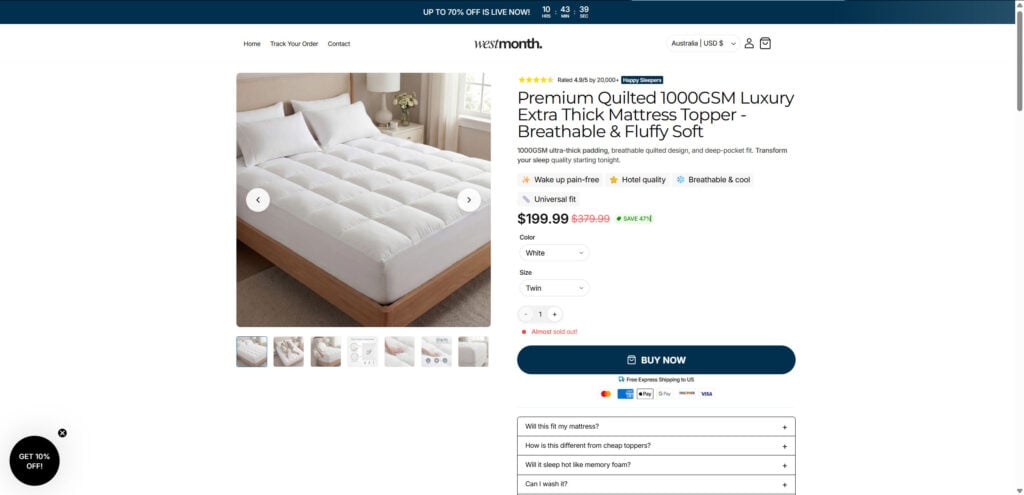
West Month sells its “Premium Quilted 1000GSM Luxury Extra Thick Mattress Topper” as a hotel-quality sleep upgrade that can relieve pain, stay fluffy, sleep cool, and transform an old mattress overnight. The page is polished. The claims are strong. The price is premium.
But once you compare the marketing to customer complaints and the way these products are commonly sourced, the picture gets much worse.
This does not look like a premium sleep brand. It looks much more like a high-risk mattress-topper operation using aggressive claims, inflated social proof, and the same private-label playbook seen across many dropshipping stores.
Overview
West Month follows a familiar pattern.
What the site wants you to believe
The product page says the topper is:
- “Rated 4.9/5 by 20,000+ Happy Sleepers”
- thicker than cheap toppers
- “hotel quality”
- breathable and cool
- capable of “immediate relief” on the first night
- backed by a “30 Day Money Back Guarantee” with “no questions asked.”
What the complaints suggest
Trustpilot complaints describe something very different:
- a topper that allegedly arrived flat or unlike the ads
- corner-band construction instead of the advertised deep-pocket style
- long delivery delays
- refund problems
- return shipping demands to China or conflicting return destinations such as Australia.
That is the core issue with West Month. The product may physically arrive, but multiple complaints say it did not match the presentation and that getting money back was difficult or impractical.
Major Red Flags
1. The site makes oversized comfort and pain-relief claims
West Month says most customers notice “immediate relief” on the first night and repeatedly frames the topper as a fix for pressure points, back pain, stiffness, and poor sleep. It also claims the 1000GSM padding is “3X thicker” than standard toppers and comparable to luxury hotels.
That is aggressive marketing for a bedding accessory. A mattress topper can change how a bed feels, but promising rapid pain relief and “wake up pain-free” language pushes the product into exaggerated territory.
2. The review numbers do not look consistent
The product page says “Rated 4.9/5 by 20,000+ Happy Sleepers,” while the home page says “4.8/5 based on 137,135 reviews” and also mentions “15,000+ customers.” Those numbers do not line up cleanly.
When a store rotates between very large review totals and customer counts without explaining the difference, that is a trust issue. It suggests the social proof is being used as a sales lever more than as a transparent metric.
3. Trustpilot complaints hit the most important failure points
The most serious complaints are not just “I didn’t like it.” They focus on the exact issues that matter most in dropshipping cases:
- item allegedly not matching the advertised design
- cheap polyester feel
- shipping delays
- nonresponsive support
- expensive return shipping requirements
- refund resistance despite the site’s money-back promise.
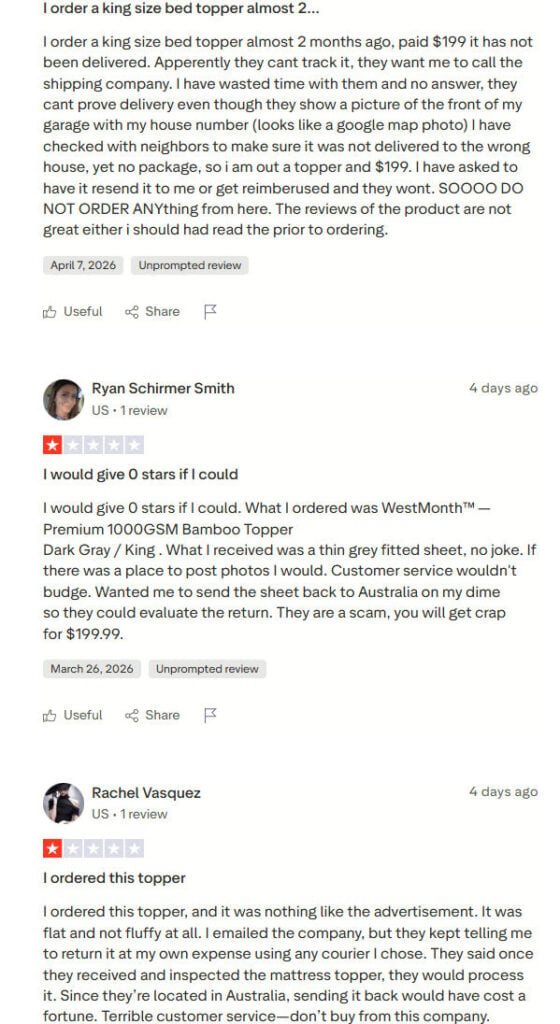
One complaint says the product received was not a deep-pocket cover at all but a topper with four corner bands. Another says the item was vacuum packed, not as advertised, and that return shipping to China would cost nearly as much as the topper itself. Another says the guarantee was not honored after they asked to return it.
4. The return promise may look better on the front end than in practice
The site prominently advertises a 30-day money-back guarantee and says returns are “no questions asked.”
But several Trustpilot complaints say that when customers actually tried to return the topper, they faced high overseas return costs or difficulty getting a refund response at all. That does not prove every refund fails, but it is a major warning sign when the marketing sounds effortless and the reported experience sounds expensive and difficult.
5. The product presentation looks like a typical high-conversion store
The site uses nearly every classic pressure tactic:
- “UP TO 70% OFF IS LIVE NOW!”
- countdown timer
- “Almost sold out!”
- emotional claims about pain-free mornings
- “internal studies and customer feedback surveys”
- repeated “premium quality,” “fast shipping,” and “easy returns” banners.
None of those elements prove fraud by themselves. Together, they fit the pattern of a conversion-first storefront trying to close the sale before the buyer slows down and compares alternatives.
6. The product may be marketed as more unique than it really is
West Month presents the topper as a premium original. But the broader market for quilted microfiber or polyester-filled toppers is full of similar commodity products sold under many labels. Based on the complaint pattern and the alleged mismatch between advertising and delivered item, the bigger risk is not that toppers do not exist, but that a generic version may be sold with premium claims and premium pricing.
What Buyers Say Went Wrong
The recurring complaint pattern is clear.
Product mismatch
Some reviewers say the topper they received was flatter, cheaper, and structurally different from the one shown in the ads, including corner straps instead of a deep-pocket encasement style.
Return friction
Some reviewers say they were told to send the product back overseas at high cost, making the refund process unrealistic. Complaints mention China and, in at least one case, conflicting instructions involving Australia.
Delivery delays
Some reviewers reported long waits, tracking problems, or no delivery for weeks. One later updated that delivery eventually arrived, which suggests the issue is not always “nothing ships,” but that fulfillment can be slow and inconsistent.
Guarantee concerns
Several complaints say the 30-day guarantee did not feel real in practice once they actually tried to use it.
Is It a Scam or Legit?
The most accurate answer is: real product, high-risk operation.
This does not look like a pure phantom-product scam where nothing exists. There are positive reviews on Trustpilot, and at least some buyers say they received the topper and liked it. Trustpilot itself summarizes the feedback as ambiguous, with praise for thickness and comfort from some users.
But that does not cancel out the red flags.
The stronger conclusion is that West Month looks like a risky bedding storefront where:
- the marketing is more polished than the trust signals
- the guarantee may be harder to use than advertised
- some customers say the delivered product did not match the presentation
- return logistics may be stacked against the buyer.
Should You Buy It?
Caution is justified.
Reasons to avoid it
- oversized claims about pain relief and instant results
- inconsistent review totals and customer counts
- repeated complaints about item mismatch
- complaints about expensive overseas returns
- premium pricing for a product category that is widely commoditized.
If someone still buys it
They should buy it with realistic expectations:
- it may arrive vacuum packed
- it may need time to loft
- it may not look as thick as the ads imply
- they should assume the refund process could be difficult if the product disappoints.
What To Do If You Already Ordered
Save everything
Keep screenshots of:
- the product page
- the guarantee language
- the “deep pocket” claims
- the review totals
- your order confirmation and tracking.
Inspect the topper immediately
Check:
- whether it is actually deep-pocket fitted or just corner straps
- whether the loft and thickness resemble the advertising
- whether the material feels consistent with what was promised.
Start the refund request early
Do not wait until the 30-day window is almost over. If it is not as advertised, contact support in writing right away and ask for full return instructions.
Be ready to dispute the charge
If the seller refuses a reasonable refund, becomes unresponsive, or requires impractical overseas return shipping, document everything and contact your card issuer.
The Bottom Line
West Month Mattress Topper does not clearly look like a completely fake nonexistent product.
What it does look like is a high-risk, heavily marketed topper operation that uses oversized comfort claims, inflated social proof, urgency tactics, and a front-end guarantee that some buyers say becomes much harder to use after purchase.
The product may arrive.
That is not the same thing as getting what the ads led you to expect.









Very disappointed with the quality of this mattress topper and the shipping packaging was so tight and
poor quality as well.! I would defiantly say this a scam and buyer beware of the FB ads! If you want to purchase mattress toppers do your research and use Wayfair or Amazon. They got my money but I wont be purchasing anything from them again and I ‘ll spread the word for poor quality!!
Thanks for the warning, H Smith. Compression packing that ruins the product is common with these drop-shipped toppers, because shipping cost is the only thing the seller optimises for. If the purchase is recent, your card issuer can still help: dispute it as not as described and include photos of the packaging and the item. It is also worth reporting the ad inside Facebook, since advertiser accounts do get pulled when enough reports land. And your closing advice is the right one – for bedding, buy where returns are actually honoured.
Do not buy from this company. Their return / refund policy is a sham. The cost to return is more than the cost of the mattress topper which is not as described. Their customer service is virtually nonexistent until the credit card company is contact and even then, very inadequate. I too was finally given an address in Australia. Cost prohibitive to ship it back, with no guarantee, that I would receive a refund, leaving me with paying the cost of the product and return shipping costs and no product!
Shame on you West Month. Shame on you!
You have put your finger on the mechanism: a return policy whose shipping cost exceeds the value of the item is not a return policy, it is a way of making the refund theoretically available and practically impossible. With something bulky like a mattress topper it is especially effective, since international freight on it can be several times the purchase price.
And your last line is the most useful thing in the comment – customer service materialising the moment the card issuer gets involved. That is the whole answer for anyone reading: stop negotiating and open the dispute. File it as not as described, mention that the advertised returns policy is unusable because return shipping exceeds the purchase price, and do not accept a partial refund to keep the item, because agreeing to one closes off the chargeback. If they eventually offer a return, insist on a prepaid label with tracking.
Worth reporting at reportfraud.ftc.gov and to your state Attorney General too – an unusable refund policy advertised as risk-free is a straightforward deceptive-practice complaint.
I accidentally ordered two of the same mattress topper. When I attempted to correct my mistake, there was no mechanism to do so. When I received the two toppers, I went to FedEx to ship the extra one back as a return. FedEx informed me that the return cost (to Australia) would be 3 times the cost of the topper itself. No one ever explained they were shipping to and from Australia. I give them a zero rating.
FedEx telling you at the counter what the return would cost is the most valuable part of this comment, because it is the moment the policy reveals itself. A returns process whose shipping cost approaches or exceeds the value of the goods is not a returns process; with something as bulky as a mattress topper it is unusable by design, and having no way to correct an order in the first minutes tells you the checkout was built to prevent changes rather than to serve customers.
Do not pay that shipping. Ring your card issuer, dispute the second topper as a duplicate charge you immediately tried to cancel with no mechanism provided, and mention that the advertised return is unusable because the freight exceeds the item’s value. You generally have up to 120 days. Do not accept a partial refund to keep it, since agreeing closes off the chargeback, and if they do offer a return, insist on a prepaid label with tracking.
Keep the unopened one in its packaging in the meantime, and keep the FedEx quote – a written figure from the carrier is unusually good evidence. Worth a report at reportfraud.ftc.gov and to your state Attorney General as well.