

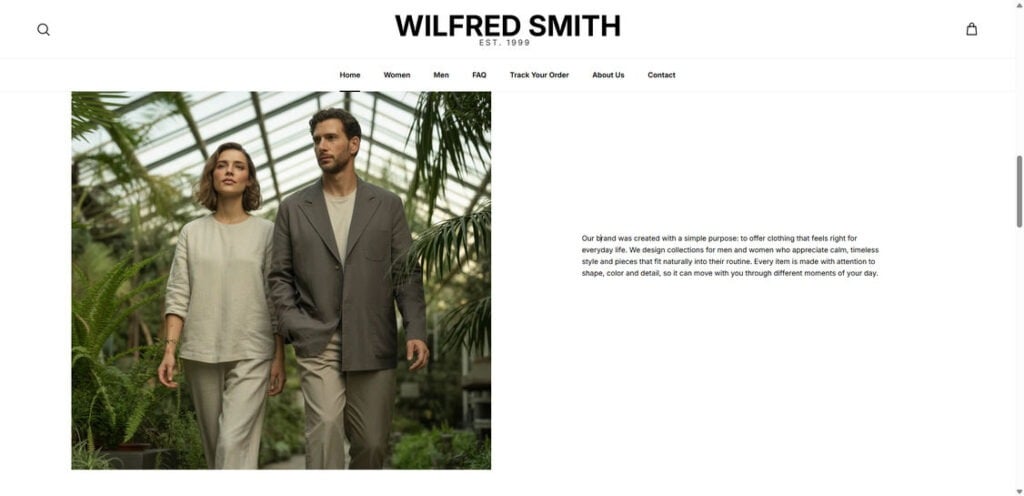
It looks elegant, professional, and trustworthy — a clean website, stylish product photos, and a promise of timeless clothing for men and women. “Established 1999,” the header reads, giving an impression of decades of experience and quality craftsmanship.
But there’s one problem: the brand barely existed a few weeks ago.
Welcome to Wilfred Smith, one of the latest fake online clothing stores designed to trick buyers with sophisticated branding and deep discounts. What looks like a luxury fashion sale often hides a carefully planned e-commerce scam — one that leaves customers with poor-quality items, impossible returns, or no delivery at all.
If you’ve seen Wilfred Smith ads or already placed an order, here’s everything you need to know before it’s too late.
Scam Overview
At first glance, WilfredSmith.com looks like a legitimate minimalist fashion brand. The site presents itself as a refined boutique that focuses on “calm, timeless style” and “attention to shape, color, and detail.” It even claims to have been established in 1999 — a date meant to build instant credibility.
However, a quick background check reveals a very different story.
Newly Registered Domain
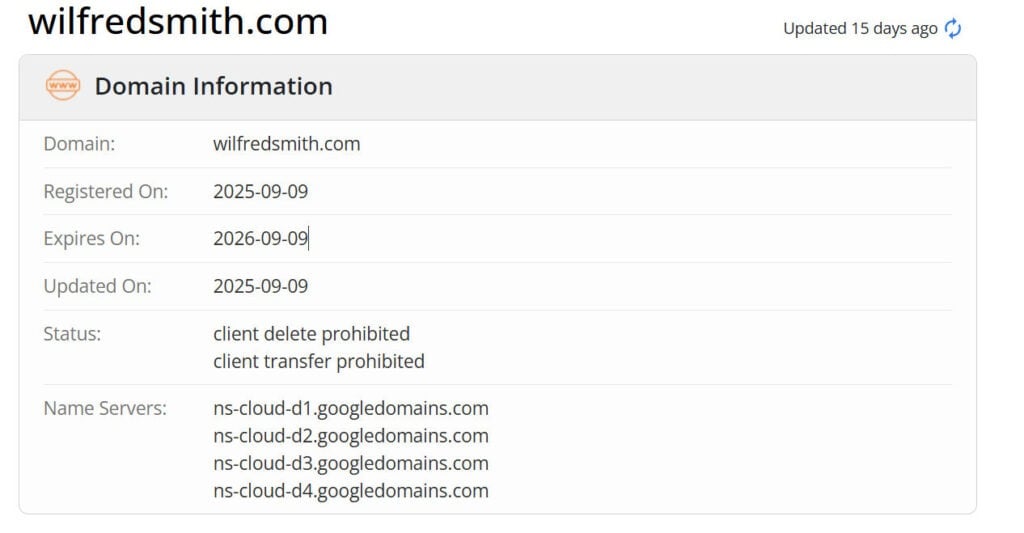
Despite its claim of long heritage, public WHOIS records show the domain wilfredsmith.com was registered only recently — on September 9, 2025 — and updated the same day. That’s a red flag. Real fashion houses with 20-plus years of history don’t appear overnight with brand-new websites.
The short domain lifespan (set to expire in 2026) strongly suggests a short-term scam setup rather than an established company.
Typical Fake Boutique Branding
The Wilfred Smith website follows a pattern that has become familiar across a wave of fraudulent “boutique” stores:
- A clean, minimalist design using Shopify or similar templates
- Generic but elegant product images sourced from other sites or AI tools
- A fake founding story mentioning decades of expertise
- Prices slashed by 40–60% across the entire catalog
- Empty promises like “Free Shipping” and “30-Day Returns”
Everything about the presentation is built to appear premium and local, yet the operational fingerprints — domain age, vague contact info, and lack of real business registration — suggest otherwise.
Fabricated Brand Story
The About Us section reads like it was written by a marketing AI rather than a human founder. It speaks of “collections for men and women who appreciate calm, timeless style” and “attention to color and detail,” yet never provides:
- The company’s legal name
- Any physical address
- Registered business number
- Social media profiles older than a few days
This “soft” storytelling style is intentionally vague. It mimics the tone of real lifestyle brands like Everlane or COS, but removes any verifiable corporate or manufacturing information.
Fake Discounts and Artificial Pricing
A closer look at the listings reveals another pattern: artificially inflated “original prices” and dramatic markdowns such as:
- $209.95 → $104.95 (50% off)
- $179.95 → $89.95 (50% off)
- $249.95 → $149.95 (40% off)
These are standard pricing tactics used by fraudulent stores. There’s no evidence these items were ever sold at the higher price, and the identical templates have appeared across dozens of similar scam stores since mid-2024.
The Same Network of Scam Templates
Wilfred Smith isn’t unique — it appears to be part of a repeating network of cloned websites that recycle identical layouts, fonts, product images, and fake histories.
Other sites in this pattern have included names like “Vera California,” “Ava & June,” and “Harrison London.” Each presents a fake origin story, a “once-a-year” sale, and domain registrations just weeks before launch.
How The Scam Works
Fraudulent “fashion sale” websites like Wilfred Smith operate through a highly optimized system. It’s not a random scam; it’s a repeatable business model designed to extract quick profits before disappearing or rebranding.
Here’s how the full process typically unfolds.
Step 1: Launching the Illusion of a Premium Brand
The scammers start by creating a professional-looking Shopify or WooCommerce site with a Western-sounding name — in this case, “Wilfred Smith.” The name choice is deliberate: it sounds like an old British or American designer brand.
They add subtle touches like “EST. 1999,” muted colors, and elegant typography to evoke trust and prestige.
Everything on the site — from the logo to the copy — is designed to make you believe this is a legitimate lifestyle label, not a pop-up e-commerce operation.
Step 2: Buying Social Media Ads to Trigger Urgency
Once the site looks polished, the scammers launch aggressive social media campaigns. They buy ads on Facebook, Instagram, and occasionally TikTok, often featuring text such as:
- “Final Winter Clearance — Up to 60% Off”
- “Closing Sale — Free Returns!”
- “Luxury Menswear for Less — Limited Time”
The goal is to create emotional urgency. Many users click impulsively, assuming the sale is legitimate because of the brand-like visuals.
Step 3: Inflating Prices to Fake Discounts
On the site, every product appears discounted by 40–60%. This “anchor pricing” technique creates the illusion of savings while hiding the fact that the “original” prices were never real.
Most of the listed products are low-cost items from wholesale platforms like AliExpress or DHgate, often sold for $10–20 each. By marking them as $200+ retail, the site can claim a huge markdown and still earn massive profit.
Step 4: Collecting Orders Before Any Fulfillment Exists
As orders pour in, the website collects credit card payments through third-party processors or Shopify Payments. During the first few weeks, there’s often no actual stock — the site is primarily a funnel for cash collection.
Some buyers receive tracking numbers from Chinese couriers, while others receive nothing at all. The few who get packages often find cheap, unbranded garments that look nothing like the elegant photos.
Step 5: The Refund and Return Maze
When customers complain, they encounter the classic return trap:
- Replies arrive slowly or not at all
- The store offers small “compensation” (usually 15–30%) to keep the item
- Full refunds require shipping to an overseas warehouse — always at the buyer’s cost
This tactic discourages returns, since sending a $90 jacket back to China can cost $40–60 in postage. Many people give up, which is exactly what the scammers want.
Step 6: Domain Rotation and Rebranding
Once too many complaints accumulate, the operators shut down the website or stop responding.
Then, a few weeks later, an almost identical site appears — new name, new domain, same layout, same photos, same tactics.
Wilfred Smith’s structure, tone, and pricing model align closely with this ongoing rotation pattern. The “EST. 1999” claim appears repeatedly across different store names, used purely for credibility.
How To Spot and Avoid Scams Like Wilfred Smith
Here’s how you can detect similar fake boutique websites before buying.
1. Check Domain Age
Use a WHOIS lookup tool. If the site claims decades of history but was registered only recently, it’s fake.
WilfredSmith.com, for instance, was registered September 9, 2025 — yet the homepage claims “Established 1999.”
2. Look for Missing Company Info
Legitimate businesses list full contact details: physical addresses, business registration numbers, and support phone lines. If all you find is a contact form or a Gmail address, treat it as suspicious.
3. Reverse Search Product Photos
Copy image URLs and search them on Google Images or Yandex. You’ll often find the same items on AliExpress or other stores — proof that the site doesn’t produce its own clothing.
4. Analyze the Writing Style
Fraudulent stores often use overly generic copy like “Our mission is to make you feel confident” or “Designed with love and detail.” These phrases mean nothing and are reused across hundreds of scams.
5. Verify Social Media Presence
Check how old their accounts are. Real brands have years of organic posts and follower interactions. Fake ones either have no profiles or new pages with a handful of stock photos.
6. Scrutinize the Return Policy
Watch for:
- No mention of a return address before purchase
- Policies requiring you to ship items “to the warehouse” without specifying where
- Language like “customer must pay all return costs”
These are designed to block refunds.
What To Do If You Have Fallen Victim to This Scam
If you already placed an order or shared payment details with Wilfred Smith or a similar site, take these steps immediately.
- Save all communication and receipts
Keep screenshots of the website, product listings, checkout page, and emails. - Contact your bank or card provider
Report the transaction as a fraudulent or “item not as described” purchase. Ask for a chargeback or dispute under consumer protection laws. - Do not ship returns internationally
Many victims are told to return items to China or Hong Kong at their own cost. These returns are often rejected or go missing. Request a refund through your payment processor instead. - Monitor your account for extra charges
Some victims report secondary transactions after purchase. If you notice anything unusual, cancel your card. - Report the website and ads
- Report the website to FTC.gov (U.S.), Action Fraud (U.K.), or your national cybercrime authority
- Flag the Facebook or Instagram ads where you saw the offer
- Warn others
Leave honest reviews on scam-reporting sites and consumer forums to help future buyers avoid the same trap.
The Bottom Line
The Wilfred Smith Sale Scam is another example of a growing online trend — fake boutique clothing brands that appear professional but are actually dropshipping or bait-and-switch operations.
The formula never changes:
- A “heritage” name that sounds established
- A sleek, minimalist design claiming decades of experience
- Heavy discounts that seem too good to be true
- Poor-quality products or no delivery
- Returns that lead nowhere
While the website claims “Wilfred Smith, Established 1999,” the facts show a newly created domain from September 2025, with no verified business registration or legitimate customer history.
If you haven’t ordered yet — don’t. If you already have, act quickly to dispute the charge and secure your refund.
The safest strategy is simple: always verify before you buy. Real fashion brands have traceable histories, long-term domains, transparent contact details, and authentic customer reviews.
Everything else, no matter how stylish the design or convincing the story, deserves a second look.









I or
dered from Wilfred Smith, and the site and the item is a scam!!
The outfit is very sheer and extremely small!!!
Furthermore, the item smells bad and is shedding feathers!!
They answered the email at first, but they didn’t respond with return label or anything else afterwards!!
Very unprofessional
Hi Angela, thank you for sharing your experience.
What you described matches a very common scam-store pattern: the item that arrives is poor quality, far smaller or different than advertised, and once you ask for a return, the seller either delays, ignores you, or stops responding entirely. Bad smell, shedding materials, and no proper return support are all major red flags.
If you paid by card or PayPal, I would suggest disputing it as item significantly not as described and seller refusing to provide a return solution. Your comment will help other readers avoid the same mistake.
I baught from this company (stupid of me without checking) and I paid for it.
Advertising was very professional, and classy (don’t be fooled). Classic button down shirts with long sleeves with no cuffs . Poor quality. and the sizing is way off . Requested a refund. The return on the original package was Melrose Park, Ill, but to return them for a full refund, you pay for the postage to Sham Shui Po, Hong Kong. First they offered me a 10% refund and just keep the product. I said no, I wanted to return the product for a full refund. Well, they would give me 25% back which most customer take because it’s more “cost effective” then the cost of postage back to Hong Kong.
They made money off of me $97.43, and I’m just one person.
You described the exact “return trap” we see constantly: low-quality item, then the seller pushes you to return it internationally (often Hong Kong/China) so it’s expensive and inconvenient, then offers partial refunds to make you give up.
If you paid by card, your strongest option is a chargeback for “item not as described” and “return policy not reasonably usable.” Include screenshots of the return instructions (especially the overseas address), the emails offering only 10% then 25%, and photos of what you received.