

The Wuffy Robot Puppy has recently gone viral across social media platforms, promoted through irresistibly cute videos showing an ultra-realistic, AI-powered toy dog that walks, wags, barks, and learns just like a real puppy. It’s advertised as a technological breakthrough — “Your child’s new best friend” — blending artificial intelligence with lifelike behavior.
But behind the heartwarming scenes and glossy website lies a troubling truth. The so-called Wuffy Robot Puppy from GetWuffy.com is not what it claims to be. Thousands of buyers have reported being misled by fake AI promises, inflated discounts, and manipulative marketing tactics. Instead of a smart robotic dog, customers often receive a basic battery-powered plush toy worth only a few dollars, with no motion sensors, no learning ability, and no AI at all.
This detailed report exposes how the Wuffy Robot Puppy scam works, how the operation is structured, and what you can do if you’ve been caught in the trap. By the end, you’ll understand why GetWuffy.com and similar sites are part of a growing pattern of deceptive online dropshipping schemes — and how to recognize and avoid them in the future.
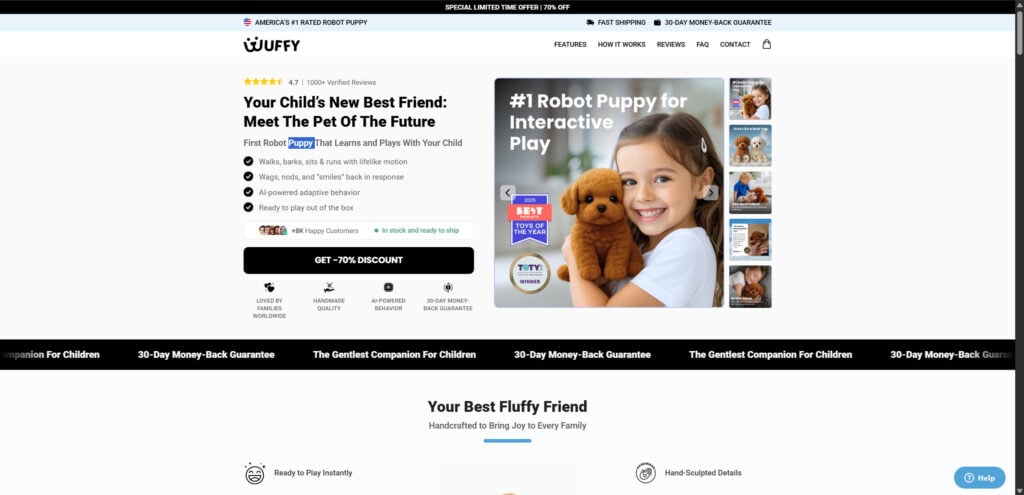
Overview: What Is the Wuffy Robot Puppy Scam?
At first glance, GetWuffy.com looks professional. The website features sleek product photos, glowing reviews, and claims of “German engineering excellence,” “AI-powered intelligence,” and “touch-responsive interaction.” It even lists media logos like Parents Magazine and Best Toys of the Year 2025, implying that the product has been reviewed by trusted outlets.
However, deeper investigation reveals that none of these claims hold up to scrutiny.
1. The Marketing Illusion
The ads you see on Facebook, TikTok, or YouTube often show animated or AI-generated videos of an adorable brown or white puppy walking, wagging its tail, responding to touch, and even “smiling.” These clips are digitally created or borrowed from other toy projects.
The product description boasts that Wuffy is:
- “AI-powered and adaptive”
- “Hand-crafted for lifelike realism”
- “The most advanced robotic puppy ever made”
- “Loved by over 75,000 happy families”
But when customers receive the package, the toy is a simple stuffed animal with a small sound box and on/off switch — not a robot, not AI-driven, and not capable of any of the behaviors shown in the ads.
2. Fake Scarcity and Urgency
The site uses the same aggressive sales techniques seen in other e-commerce scams:
- Countdown timers that reset every time you refresh the page.
- “Only 105 items left in stock!” messages that never change.
- “Your 70% discount expires in 10 minutes” pop-ups to force instant decisions.
This artificial urgency prevents buyers from researching before purchasing — a classic high-pressure conversion tactic.
3. Fake Reviews and Ratings
GetWuffy.com lists thousands of 4.7-star reviews with heartwarming testimonials like:
“Wuffy changed my child’s life! It walks, barks, and even learns new tricks!”
However, reverse image searches show that these “verified buyers” are stock photos or AI-generated faces, not real people.
4. False Claims of AI Technology
The most deceptive part of the scam is the repeated use of terms like “AI-powered behavior” or “adaptive intelligence.” The toy has none. In reality, it’s a mass-produced plush dog with a simple battery pack that may emit one or two sound effects.
There are no microchips, motion sensors, or machine learning components. The “AI puppy” is a marketing fantasy — a way to justify charging $29–$59 for an item that costs less than $3 wholesale on AliExpress or Alibaba.
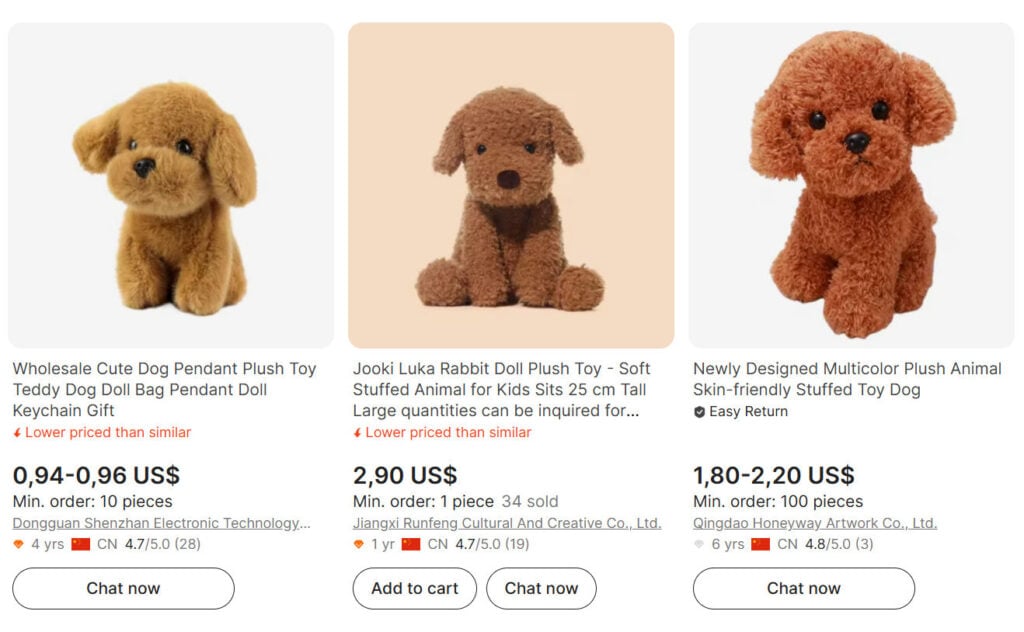
5. Hidden Dropshipping Model
The site is part of a dropshipping network, meaning the sellers never handle inventory. Instead, they list a cheap generic product from Chinese suppliers, mark up the price by 1,000%, and advertise it as an exclusive innovation. When you place an order, they forward it to a third-party warehouse in China for direct shipping.
Because the item ships internationally, returns become practically impossible. Even though the site claims to offer a 30-day money-back guarantee, customers who attempt refunds are told they must ship the item back to China — often at their own cost, which exceeds the item’s value.
6. Multiple Names and Cloned Websites
The Wuffy scam is not unique. It’s part of a larger pattern of “AI pet” scams that reuse the same template under different names. Similar products include:
- Dachy 2.0 – “AI dachshund toy”
- Koaly Bear – “AI companion bear”
- FluffyBot Puppy – “Smart interactive plush”
Each of these sites uses identical layouts, fonts, and marketing language, suggesting they’re run by the same operators. When one domain gets too many complaints, they shut it down and open a new one under a different name — a typical domain-hopping scam cycle.
How the Operation Works
To understand why so many people fall for the Wuffy Robot Puppy scam, it helps to see the entire process from start to finish.
Step 1: Creating Viral Ads
The scammers begin by designing hyper-realistic video ads using CGI and AI animation tools like Midjourney or Runway. These videos show puppies blinking, walking, and wagging tails — behavior that no actual toy can replicate.
They then push these ads on platforms like Facebook, Instagram, and TikTok using catchy captions such as:
- “The world’s first AI puppy that loves your child!”
- “No mess, no allergies, just love!”
- “Over 75,000 families already have Wuffy — get yours before it sells out!”
The videos are deliberately heartwarming, often showing small children cuddling the dog, which appeals strongly to parents and grandparents.
Step 2: The Professional-Looking Website
Clicking the ad leads to GetWuffy.com, which at first glance looks legitimate. The design is minimalist, filled with smiling families, “expert testimonials,” and a FAQ section that sounds convincing.
The site features:
- Fake expert endorsements: A fabricated “Kindergarten Teacher” review with an AI-generated name and photo.
- Comparison charts: Showing Wuffy outperforming “other toys.”
- AI-themed icons: Phrases like “German Engineering” and “AI-Powered Play” are used without proof.
- False media logos: Mentions of awards from “Best Toy of 2025” that do not exist.
The goal is to eliminate buyer hesitation and create trust instantly.
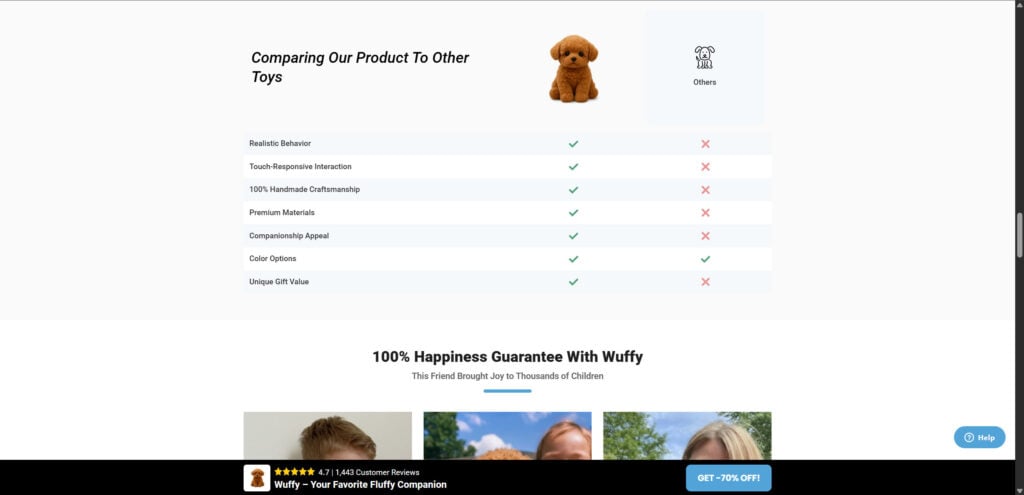
Step 3: Manipulating Emotions
The entire sales funnel is engineered around emotional manipulation. The website text emphasizes empathy, companionship, and family bonding:
“Wuffy teaches kindness and responsibility without the mess of a real dog.”
This kind of messaging makes parents believe they’re giving their child an educational, nurturing experience — not just a toy.
Step 4: Checkout Pressure and Upsells
When buyers reach checkout, multiple upsells appear:
- Buy 2, get 60% off
- Buy 3, get 70% off (auto-selected by default)
- “Your discount expires in 10 minutes” countdown timer
Even if a buyer selects one toy, the cart sometimes automatically charges for multiple units, a common dark-pattern tactic in scam stores. Victims report being billed for three or four Wuffy dogs even after choosing only one.
Step 5: Payment Processing and Data Capture
Payments go through obscure third-party processors with no traceable company name. Once processed, the buyer receives a generic confirmation email without tracking details for several days.
Meanwhile, the scammers collect customer data — names, addresses, emails, and phone numbers — which may be reused in future spam or scam campaigns.
Step 6: Long Delays and False Shipping Updates
After payment, most buyers wait two to four weeks for their package. During this time, the company sends vague updates like “Your order has been shipped!” but no tracking numbers that work on major carriers.
These delays serve two purposes:
- They push the purchase beyond the 30-day chargeback window for some credit cards.
- They make buyers less likely to dispute the charge until it’s too late.
Step 7: The Reality of What Arrives
When the package finally arrives, it’s a shock. Customers report receiving:
- A small, generic plush dog that does not walk or bark.
- A cheap battery-operated toy with a simple squeak or bark sound.
- No AI behavior, no motion sensors, no interactivity.
The product is identical to $1–$3 plush toys sold in bulk on AliExpress and Alibaba, as shown by identical product photos on Chinese supplier pages.
Step 8: Refunds That Never Happen
When customers email support to request a refund, they are told to:
- Return the product to a warehouse in China.
- Pay for shipping themselves (often $30–$40).
- Wait for “inspection” before the refund is processed.
In practice, the company ignores follow-up messages, and no refunds are ever issued. Some customers report that their emails eventually bounce back as the domain is shut down.
Step 9: Rebranding and Relaunching
Once enough negative reviews and chargebacks accumulate, GetWuffy.com will quietly disappear — only to reappear weeks later under a new domain like BuyWuffy.com or FluffyAIpup.com.
This rotation allows scammers to stay ahead of bad press, rebuild ad accounts, and continue selling the same toy under a fresh name.
What to Do If You Bought the Wuffy Robot Puppy
If you’ve purchased from GetWuffy.com or a similar website, act quickly. The sooner you respond, the better your chances of getting your money back.
1. Stop Any Further Charges
If you suspect multiple charges or subscriptions, contact your bank or card provider immediately and block any future payments to the merchant.
2. Request a Chargeback
File a dispute or chargeback through your credit card company or payment platform. Provide them with:
- Screenshots of the ad and product description.
- Photos of what you actually received.
- Copies of your order confirmation and any email correspondence.
Clearly state that the item is “not as described” and provide proof that it was falsely advertised as AI-powered or robotic.
3. Report the Scam
Report the incident to:
- Federal Trade Commission (FTC) if you are in the U.S.
- Action Fraud (UK) or ANPC (Romania) for local consumer protection.
- Your credit card provider’s fraud department.
- Facebook, TikTok, or YouTube, to help remove the misleading ads.
4. Leave Public Reviews
Warn others by posting factual reviews on platforms like TrustPilot, Reddit, or scam reporting forums. Include photos of the product you received — visual evidence is powerful and helps prevent future victims.
5. Monitor Your Personal Information
Scam stores often collect personal data. Be alert for:
- Spam emails pretending to offer refunds.
- Unexpected promotional messages.
- Unauthorized transactions on your card.
Consider using temporary virtual cards or PayPal for safer online shopping in the future.
6. Learn to Spot Dropshipping Scams
Look for red flags before making online purchases:
- Recently created domains (less than 6 months old).
- Unrealistic claims like “AI-powered” or “smart interactive toy.”
- Too-good-to-be-true discounts (50%–80% off).
- Lack of real video reviews from independent sources.
- Return addresses in China despite claiming U.S. operations.
The Bottom Line
The Wuffy Robot Puppy is not an AI-powered companion dog, nor is GetWuffy.com a legitimate robotics company. It’s a deceptive dropshipping scam using emotionally charged marketing, AI-generated ads, and fake reviews to sell cheap imported toys at premium prices.
Buyers expecting an intelligent robotic pet receive a low-quality plush dog with minimal battery-powered sounds. Refunds are nearly impossible, and many report being charged for multiple units without consent.
If you see ads claiming “AI-powered dog toys” with dramatic discounts and emotional storytelling, exercise caution. Research the domain, look up reviews on scam-reporting platforms, and never trust social-media ads without independent verification.
The Wuffy Robot Puppy scam reminds us that not every “AI innovation” online is real. In the age of AI marketing and deepfake videos, the line between reality and deception is thinner than ever. Staying vigilant, skeptical, and informed is the best protection you have against digital fraud.
Frequently Asked Questions
What is the Wuffy Robot Puppy?
The Wuffy Robot Puppy is advertised as an AI-powered robotic dog toy sold on websites like GetWuffy.com. It’s marketed as a smart, lifelike puppy that walks, wags, barks, and learns from its owner using artificial intelligence. The ads show families and children interacting with a realistic robot dog that appears almost alive. However, in reality, the product delivered is nothing like what’s shown in the ads. Customers report receiving a cheap battery-powered plush toy that cannot move, learn, or react in any intelligent way.
Is Wuffy Robot Puppy a scam?
Yes. The Wuffy Robot Puppy is widely considered a scam. The product is falsely marketed as a high-tech AI toy, but what buyers receive is a low-quality stuffed dog worth just a few dollars. There is no AI, no sensors, and no robotics involved. The website uses fake reviews, AI-generated photos, and deceptive language to mislead customers. Refunds are nearly impossible, and many people have reported being charged for multiple items even though they ordered just one.
Who runs GetWuffy.com?
The true owners of GetWuffy.com are unknown. The domain was registered recently, and there is no clear company name, address, or phone number listed on the site. This anonymity is typical for dropshipping scams. Many of these sites are operated by overseas sellers, often based in China, who hide their identity behind privacy-protected domain registrations. Once complaints pile up, they take down the website and launch a new one with a different name but the same content.
How does the Wuffy Robot Puppy scam work?
The scam works through social media advertising. The sellers use AI-generated videos and images showing a lifelike robotic puppy that interacts like a real pet. When buyers click the ad, they’re taken to a professional-looking website that uses emotional marketing and fake discounts to push quick sales. After paying, customers receive a cheap toy that has no resemblance to what was shown. Attempts to return it fail because returns must be shipped to China at the buyer’s expense. In most cases, the cost of return shipping is higher than the product price, ensuring that victims give up.
What do customers actually receive?
Buyers expecting a robotic dog receive a basic battery-operated plush toy. It may have a small sound module that makes a bark or squeak, but it does not walk, wag its tail, or respond to touch. The material is low-quality, and it’s identical to wholesale toys sold for around $2–$3 on Alibaba or AliExpress. Some buyers report receiving several toys and being billed for multiple units, even if they selected only one at checkout.
Why can’t people get a refund from GetWuffy.com?
Although GetWuffy.com advertises a 30-day money-back guarantee, the refund policy is deceptive. To qualify, customers must ship the product back to China using tracked international mail at their own cost, which can exceed $30. Once shipped, the company often stops responding to emails, and no refunds are issued. In short, the “guarantee” is meaningless.
How can I tell if a toy website like Wuffy is a scam?
There are several red flags to look for:
- The website domain is newly created (less than 6 months old).
- The company address or contact details are missing.
- The site claims AI or smart technology without showing real demonstrations.
- Ads feature fake testimonials or AI-generated videos.
- Prices are heavily discounted (50–70% off) with countdown timers.
- Multiple fake reviews with perfect ratings appear on the product page.
If you notice several of these signs, it’s best to avoid buying from that site.

Join the discussion
2 commentsShare your experience or ask a question about this article.
Discussion
Thank you from a grandma almost bought it. Its very refreshing to have the truth put out there for people like me Every thing you said makes so much sense Saved myself and other grandparents their money some times things look are made to look true That’s when a alarm should go off
Now I can breath feel better Thanks for the truth
In reply to dawn fisk
Hi Dawn, thank you for sharing that.
You did exactly the right thing by stopping, thinking it through, and checking first. These ads are made to look heartwarming and believable, especially to grandparents and gift buyers. I’m glad the article helped you avoid a bad purchase.