


Zendtrix shows a crypto balance, live market prices and an AI strategy before you give it a name or deposit any money.
Its documents page appears to answer the obvious question: who is actually behind the investment? Read what the page claims the paperwork proves.

Overview
The balance appears before you sign up
Zendtrix’s homepage displays £4,990.38 alongside a positive figure marked $304.79. The panel appears on a public page beside prompts to open an account.
That makes it a marketing display, not a balance you earned or evidence of an investor’s realised gains. A live market ticker next to it changes nothing.
Zendtrix treats company registration as investment authority
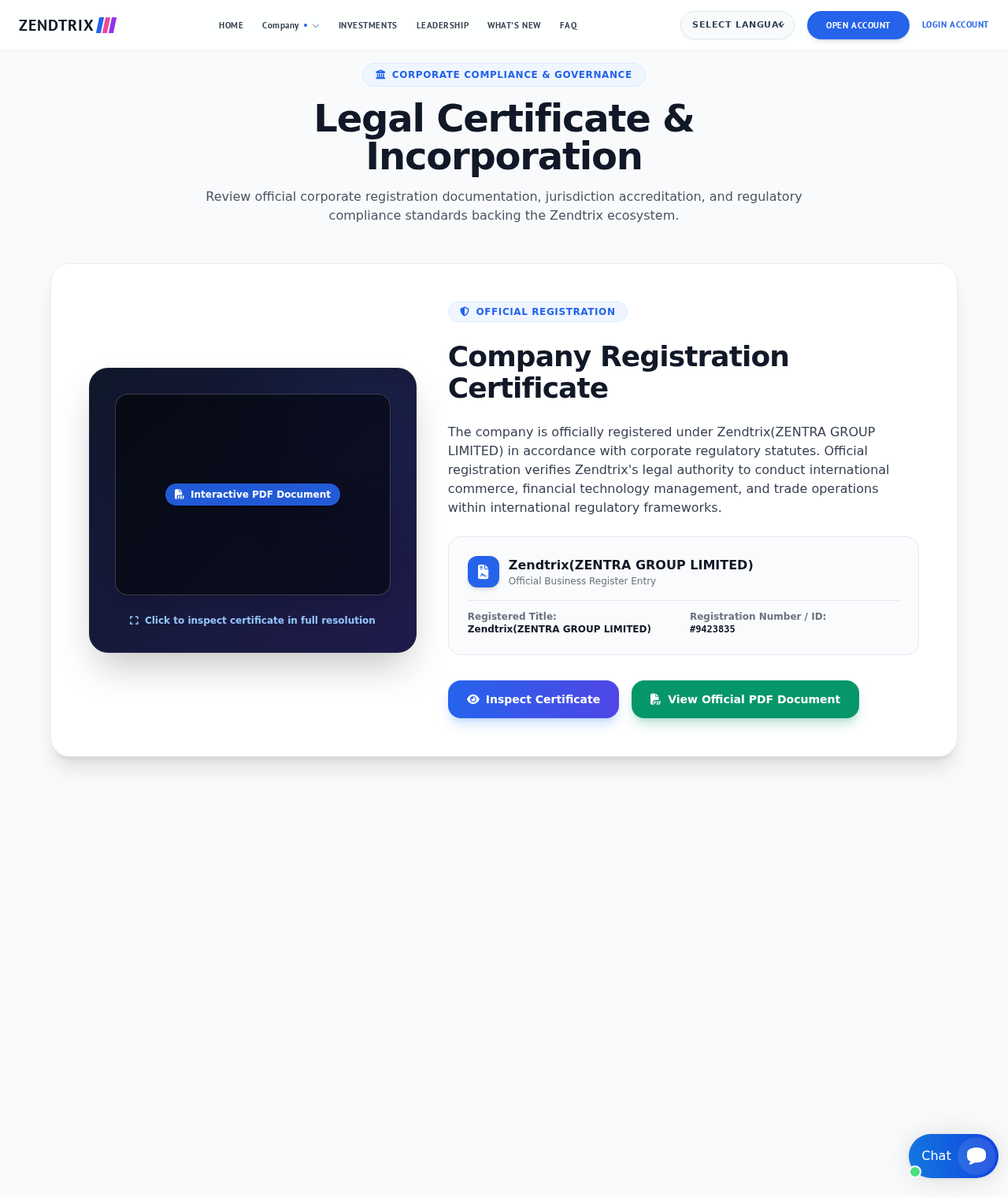
The site calls its documents page a legal certificate and incorporation page. It pairs Zendtrix with Zentra Group Limited and displays a company number, 9423835.
An incorporation certificate cannot establish that the named company controls this website, that it has relevant financial permissions or that a particular trading package is authorised.
The public pitch leaves the most important money questions unanswered
Zendtrix promotes pooled trading and daily returns with options labelled USD, BTC and ETH. Its public plans page did not show rates in the view we could verify.
Do not pay to find out whether the offer works. The public presentation does not show whose account would hold your payment or what backs the balance.
- Do not read the homepage balance as a statement of investor performance.
- Separate incorporation from the relevant financial permission and match the provider to the actual website.
- If invited by a friend, ask what they know independently rather than treating a referral as a recommendation.
- If you paid, save the transfer and contact the bank or exchange that sent it.
What Zendtrix Says Happens to Your Deposit
Step 1: The homepage gives automation a visible result
Under the trading pitch, a panel with a balance and a gain sits beside labels about optimising yields. The same page asks visitors to open an account.
Notice the two currencies. The balance is marked GBP, while the gain uses a $ symbol. That is not enough information to work out a return.
There is no identified account, starting balance, measurement period or independent statement attached to the panel. A percentage calculated from those display numbers would be guesswork.
A separate panel relays cryptocurrency prices. Public prices can be accurate and still have no connection to the trading results of the company displaying them.
Step 2: The site says deposits join a shared trading pool
Zendtrix describes new partners entering a central pool, where the operator’s traders and systems decide what to do. Users are told they do not need to trade themselves.
That is different from buying a tool that runs on an exchange account you control. The site’s description puts control of the trading activity with the operator.
Before accepting that setup, you would need a clear answer about where the assets are held, whose records reconcile deposits and who can instruct their release.
The public page offers participation packages and three currency choices, but the tier table was not visible in the view checked. Do not treat an old screenshot as today’s offer.
Some accounts may show more than the public page. Without the complete terms, a rate sheet forwarded by a promoter isn’t a basis for sending money.
Step 3: The site describes accruals inside an account
The homepage says results are recorded on the platform and allocated to members. It says regular income will appear in the partner’s account without active trading by the partner.
An accrual is what a service records as owed. A balance displayed in that service is not equivalent to a withdrawal clearing into an account you control.
That distinction matters if a promoter sends a screenshot of earnings. Their image does not show how the amount was earned, funded or withdrawn.
Who Would Actually Be Responsible for Your Funds?
The displayed number is presented as company registration
The Documents page pairs the brand and Zentra Group Limited. It presents 9423835 as a registration ID, not as a separately verified financial licence applicable to the investment.
The page goes further and says registration verifies broad legal authority for its activities. The picture of a certificate is not the part that answers that question.
Ask whether the entity identified on the register is the one taking your money and signing the agreement. Those are separate checks from recognising a name.
The New Zealand claim needs more than a date
Zendtrix’s FAQ says its operations began on January 8, 2026, and claims it is officially registered in New Zealand. That is the operator’s stated history.
The date by itself does not identify an exchange, custodian or person responsible to investors. Broad statements about operating worldwide do not substitute for those details.
New Zealand’s Financial Markets Authority explains that even appearing on the Financial Service Providers Register does not by itself mean a business is licensed or supervised by the FMA.
A support conversation cannot independently verify the seller
The site’s FAQ advertises around-the-clock support through a live chat provider. That tells you how to contact the platform, not whether somebody independent can confirm its claims.
The right test is whether a verified authority or service provider recognises the exact company and domain. Do not ask Zendtrix to confirm the integrity of its own certificate.
If a contact cites a regulator number, check what services it actually covers and for whom. The FMA’s investor scam guidance explains what to look for before investing.
Market feeds do not establish custody or trading proceeds
The homepage says a team supervises algorithms and claims to manage the effects of volatility. It doesn’t show a third-party record of who holds the money.
Ideally you should be able to distinguish custody, trade execution, performance accounting and payment. A service can describe all four without proving it operates any one of them.
Nothing on the public display can establish how earlier payments were funded. Do not use the screenshots to reach a legal conclusion about flows that haven’t been audited.
What Evidence Is Worth More Than a Dashboard
Compare the exact product name and the legal customer agreement. It matters whether you are purchasing software, lending funds or handing assets to somebody to trade for you.
Check that the agreement tells you who controls the receiving account and who holds the cash or cryptocurrency afterwards. A vague statement about proprietary trading does not answer that.
For performance, distinguish open gains from closed trades and profit after fees. A page that gives no track record cannot tell you which of those numbers you are seeing.
For withdrawals, ask where the terms set the timing, conditions and deductions. Do not send a deposit just to unlock those details or produce a test withdrawal.
A payout from a single account does not show that traders produced it. It also does not show that everybody can withdraw without further conditions.
If the person who approached you can earn from your participation, their incentives differ from yours. Ask about that independently of whether you trust them personally.
Look at what the account screens actually represent
One public Zendtrix page showed a guest sidebar with separate USD, BTC and ETH balances of zero, while the main area displayed the familiar £4,990.38.
That is a useful comparison. The large number is part of the recurring sales display. It did not appear as money credited to the guest account.
The same sidebar lists functions for adding funds and withdrawals. The existence of a withdrawal menu does not establish whether a request would clear or on what terms.
It also lists tools for partners and referrals. Don’t treat those parts of the site as an independent source of evidence about trading performance.
If a promoter sends a cropped image, ask which screen it came from. A guest view, general marketing page and signed-in account statement are not interchangeable.
Read “daily” as a schedule, not protection against a loss
Zendtrix’s public package page describes daily return generation. Its longer-term pitch elsewhere describes a stable approach. Neither statement explains how the offer handles an actual losing day.
A real trading strategy can lose money even when its process is sound. Ask whether any figure is an estimate, a contractual obligation or an example from past performance.
Also ask whether gains and losses pass through to the investor, or whether the site is promising to pay from its own resources. Those models carry different risks.
Market swings make the distinction practical. Seeing an account balance rise every day is not the same as seeing an independent statement that records losing trades as well.
Know which currency is used at each stage
The site displays a pound balance in its pitch while its investment choices list USD, Bitcoin and Ether. Those three options do not state how a final payout is denominated.
For a prior transaction, preserve both the amount sent and the asset that went out. A bank statement and an exchange conversion may represent different parts of the same payment.
If a promoted package says you can change the payment currency later, get the actual terms independently. Switching how a balance is displayed does not mean funds have been converted.
What to Do If You Already Sent Money to Zendtrix
- Stop adding to the account or moving friends into it. Do not accept a larger package to solve a withdrawal problem.
- Save the package description, any updated terms, and a dated copy of the balance and withdrawal screens. Keep the originals privately.
- Match the real outgoing payments to their bank or exchange records. Note the actual amount, currency, date and reference for each transaction.
- Contact the sending institution independently and ask what options are available. With crypto, supply the transaction hash and network to the verified exchange or reporting authority.
- Report suspected investment fraud to the appropriate authority. Don’t give a recovery contact a wallet phrase, private key or permission to carry out transactions.
If the dashboard and the payment record disagree
Keep both records. A balance that rose on a screen did not increase the amount you actually transferred. Report paid-in funds and claimed earnings separately.
If fees appear when you ask to withdraw, save the exact request and the earlier terms. Do not pay a new amount to establish whether the story is true.
If you were given several payment routes, tell the bank or exchange which one you used. A demand in the chat is not itself a completed transfer.
For help in New Zealand, the FMA’s contact guide explains which investment problems it can receive and when another organisation may be the right place to start.
If you shared details but did not pay
Check whether you reused the password. Change it on any genuine account where you used it, and review recent sign-ins. Don’t wait for a withdrawal problem.
If you already sent identity information, note what you shared and ask for advice from a verified identity-support service. Do not send a new copy to cancel registration.
There is no reason to leave an automated payment or connection in place while deciding what to do. Use the genuine bank or wallet provider to review existing permissions.
If you sent a referral link to somebody, tell them what you learned before they act on it. You don’t need to share your wallet details to explain the problem.
Don’t forward a fresh promotion as an illustration without telling them not to follow it. A copy of the text or a safe screenshot is enough.
Frequently Asked Questions
Is the Zendtrix balance real money I can withdraw?
The public homepage’s balance is visible before signup. It is not a verified withdrawal or evidence that anyone earned the number beside it.
What does the Zendtrix certificate establish?
The website presents a company registration claim. That is not independent proof the company operates the offer or holds the permissions needed for it.
Does Zendtrix show exact return rates on the public plans page?
The public view showed the package pitch and USD, BTC and ETH tabs, but no loaded rates. Don’t assume a third-party rate sheet is current.
Do visible crypto prices prove Zendtrix is trading with my money?
No. An accurate market feed can be displayed by any website. Look for independently verified execution, custody and performance records, not price movements.
Does paying with cryptocurrency offer the same remedies as paying by card?
No. Contact the provider you actually used and ask what it can do. Don’t assume a completed blockchain transfer can be reversed like a disputed card charge.
Should I pay a fee to check whether the platform will release funds?
No. Save the demand and prior terms, stop further payments and take the evidence to your provider or an appropriate reporting authority.
The Bottom Line
Do not deposit with Zendtrix. A public balance and a registration claim do not show who will hold your funds, produce returns or release money when you ask.
If you’ve already transferred funds, save the original payment record and contact the sending provider. Don’t make another payment to test a promised withdrawal.

Join the discussion
0 commentsShare your experience or ask a question about this article.
Community experiences
Did this happen to you?
Your experience could help someone recognize the same scam. Submit a private report for our team to review.
I experienced this tooReports are reviewed before publication. Sharing publicly is always your choice.
Discussion
Start the conversation
Have a question or something useful to share? Add the first comment.