

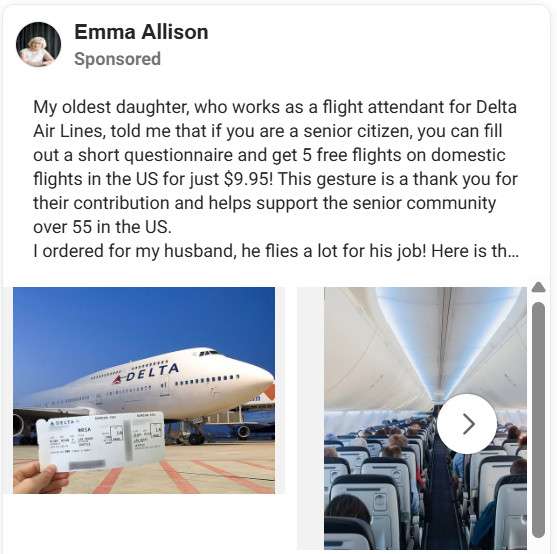
You may have seen a sponsored Facebook post claiming Delta Air Lines is offering discounted $9.95 plane tickets for seniors age 55 and over. Supposedly an insider flight attendant leaked the details on this special deal exclusively for older travelers. But caution is advised – this is a complete scam designed to rip off unsuspecting seniors under the guise of amazing discount airfare.
This article will provide an inside look at how scammers are exploiting Delta’s trusted reputation to perpetrate travel booking fraud against seniors. We’ll outline the red flags that expose their deceit, and most importantly, arm you with knowledge to protect yourself from their duplicitous tactics. Don’t get taken in by the promise of nearly free flights.
Overview of the $9.95 Delta Tickets Travel Scam
This fraudulent promotion starts with Facebook ads featuring Delta Airlines branding and details on $9.95 roundtrip tickets for senior citizen travelers 55 and older. The accompanying message urges viewers to click through quickly before the made-up deal expires or limited quantities run out.
In reality, no such $9.95 ticket offer exists with Delta Air Lines, regardless of age. The ads are a complete fabrication with fake claims of limited-time savings. They aim to dupe unsuspecting seniors searching for travel deals by dangling the lure of nearly free flights.
Clicking these deceptive Facebook ads leads users into an elaborate bait-and-switch scheme ending in stolen personal data and credit card charges through sneaky monthly subscriptions. No discounted tickets are awarded – only recurring billing for services never requested.
This scam has been also investigated by Jordan Liles on his YouTube channel, where he offers a detailed video on the subject. We recommend watching his content for a comprehensive understanding of the scam.
Next, let’s break down exactly how scammers carry out this scam from start to finish.
How the $9.95 Delta Air Lines Ticket Scam Operates
Here’s an in-depth look at how scammers employ sophisticated tricks to carry out this senior travel scam from start to finish:
Stage 1: Phony Social Media Ads
The scam starts with Facebook ads featuring Delta’s logo and images of planes, along with text proclaiming discounted $9.95 tickets for travelers 55 and older. Supposedly an anonymous flight attendant leaked the details.
Urgent language encourages swift action due to extremely limited supply. Phrases like “seats selling out fast!” create false fear of missing out to drive clicks.
Stage 2: Fake Delta Booking Site
Clicking the deceptive ad leads users to a mock Delta Air Lines booking website the scammers designed to look real. However, the URL, contact details, and security certifications reveal it’s a total fake.
This fake portal mirrors the real Delta site’s visuals like branding, colors, and fonts to fool users into entering personal details for ticket purchases.
Stage 3: Harvesting Users’ Personal and Payment Data
The fake booking site requests identifying information like full name, birth date, address, phone number, and crucially – credit card details – all under the guise of securing the $9.95 tickets.
In reality, this form data is harvested to enroll victims in costly monthly subscription plans against their will and without proper consent.
Stage 4: Charging Hidden Recurring Fees
Although users expect just tiny $9.95 ticket fees, the credit card details they provided actually authorize expensive recurring subscription charges exceeding $100 per month.
The terms disclosing these bogus costs are buried deep in the fine print, purposely obscured to avoid detection. Canceling these deceptive services is extremely difficult too.
Stage 5: No Discounted Tickets Issued
After completing the scam booking process expecting near free $9.95 tickets from Delta, users receive nothing besides exorbitant credit card charges for services they never desired.
The non-existent tickets were just bait for the switch into unauthorized subscriptions bleeding victims’ accounts monthly.
Avoiding the $9.95 Delta Ticket Booking Scam
While this senior-targeted travel scam can seem convincing, several red flags can expose their deceit:
- Too-Good-To-Be-True Fares – Prices way below normal rates from a major airline are almost always bogus. Verify special deals directly through official channels.
- Requests for Personal Data – Avoid entering sensitive identifying information or credit card numbers on questionable third-party sites. Only provide directly to trusted travel partners.
- Misleading Urgency / Limited Time Tactics – High-pressure claims of expiring discounts or dwindling inventory are a hallmark of scams. Take your time and vet remarkable flight deals thoroughly.
- Incorrect Domains / URLs – Inspect site addresses closely for subtle misspellings or other signs of impersonation. Double check security certifications.
- Difficulty Canceling Services – Services that prove impossible to cancel are a huge red flag. Legitimate offers allow subscription management.
- Unexpected Credit Card Charges – Carefully review monthly statements for unusual activity from unfamiliar companies. Dispute unrecognized or unauthorized fees ASAP.
Apply healthy skepticism when evaluating unbelievable travel discounts online. Verify remarkable promotions through official airline and travel partner websites before submitting payment data. If a deal seems questionable, trust your instincts and avoid engaging further.
What To Do If You Are Scammed
If you provided your personal information or credit card number through this $9.95 Delta tickets scam, take these actions immediately:
- Contact your credit card company to report fraudulent charges so they can be stopped and reversed. Cancel any active monthly subscriptions still linked to your account.
- Closely monitor monthly statements moving forward and dispute any charges you don’t recognize from dubious third-party companies.
- Consider enrolling in identity theft protection services to guard against misuse of your stolen personal data.
- Reset account passwords entered through the scam portal. Make them unique and complex. Enable two-factor authentication everywhere possible.
- Place fraud alerts on your credit reports with Equifax, Experian and TransUnion to help protect your credit from impacts.
- Report the scam to the FTC to aid investigations into these types of senior-targeting travel booking scams. The more complaints received, the better.
- Spread awareness in your community and social circles to prevent others from falling prey to the $9.95 Delta tickets scam. Forewarned is forearmed.
Stay persistent to contain the damage from this scam. And steer clear of unbelievable travel deals perpetrating fraud through manipulative urgency and false scarcity.
The Bottom Line
The supposed $9.95 Delta Air Lines ticket deal for seniors serves as a stark lesson in skepticism when evaluating remarkable online flight discounts. Scammers will fabricate unrealistic fares and fabricate false partnerships with trusted brands like Delta to lure consumers into traps.
Apply healthy doubt before entering any sensitive personal or financial data through third-party websites, no matter how convincing their travel offers may seem. Only book airfare directly through official airline and travel partner websites after validating deals. Avoid letting scammers hijack your next trip with their deceptive tactics.
Frequently Asked Questions
Q: How does the $9.95 Delta Air Lines ticket scam for seniors operate?
A: The scam starts by running Facebook ads proclaiming unrealistic $9.95 Delta airfares for travelers 65 and over. Users who click through are led to fake Delta booking portals harvesting personal data and credit card numbers under the guise of securing tickets. In reality, victims are signed up for recurring monthly subscription fees exceeding $100 with no discounted fares booked.
Q: Are the Facebook ads associated with Delta Air Lines?
A: No. The Facebook ads are completely unauthorized and unassociated with Delta Air Lines despite featuring Delta’s branding. They are fabricated by scammers to target seniors. Delta does not offer any $9.95 ticket promotion.
Q: How can I recognize this scam on social media?
A: Warning signs include unbelievable airfares way below normal prices, high-pressure claims of limited seats, and questionable links redirecting away from Delta’s official site. Always scrutinize remarkable travel deals and verify directly through trusted airline websites.
Q: What should I do if I was scammed by the $9.95 Delta ticket ads?
A: Immediately contact your credit card company to report any fraudulent charges so they can be stopped and reversed. Monitor statements closely for other unusual activity and cancel any unwanted subscriptions still active. Enable fraud alerts with credit bureaus.
Q: How can I avoid online travel and airline ticket scams?
A: Be wary of third-party websites featuring unbelievable fares that seem too good to be true. Only provide personal and payment data through official brand sites after validating deals. Apply healthy skepticism to protect yourself from scams exploiting urgency and false scarcity.
Q: Who can I contact about fraudulent use of an airline’s brand?
A: You can report unauthorized use of an airline’s branding and images to their official customer service channels. This helps notify the brand about imposter scams misusing their trademarks and reputation.
In Closing
We hope this in-depth look at how scammers are deceiving seniors with phony $9.95 Delta Air Lines ticket deals better equips travelers to protect themselves. When evaluating discount travel promotions, carefully verify offers through official airline sites before engagement. With knowledge and vigilance, we can avoid becoming victims to such fraud perpetrating through false urgency and deceit. Safe travels!








