Beware: “Your Costco Membership Expired” Emails Are a Scam
Written by: Thomas Orsolya
Published on:
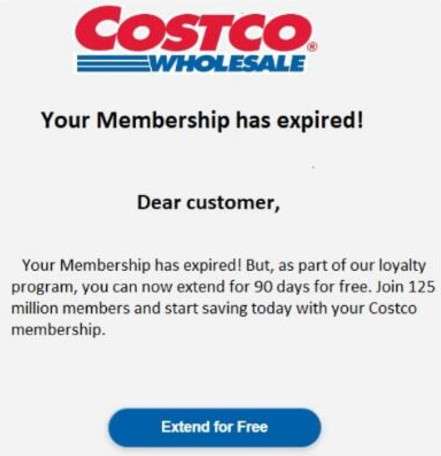
The Costco membership expired email scam is a phishing attempt targeting Costco members. Scammers send an email pretending to be from Costco, claiming your membership has expired and asking you to renew it. However, clicking any links or providing information leads to hidden fees and potential identity theft. This article reveals everything you need to know about how the Costco expired membership scam works and how to protect yourself.
Overview of the Scam
The Costco membership expiration scam is a cunning phishing tactic that takes advantage of Costco’s popularity and large membership base. Scammers send fake emails pretending to be from Costco, stating your membership needs renewed. This tricks millions of Costco members into clicking dangerous links and providing sensitive information.
These fraudulent emails closely mimic legitimate Costco messages. The deceptive design fools recipients into believing their account is expiring. Scammers leverage fear of missing out on Costco benefits you rely on for shopping. This drives urgency to click their link “renew” as soon as possible.
Upon clicking, you’re taken to convincing copycat websites that impersonate real Costco pages. You’ll be asked to verify personal and payment details, which gets directly into the hands of criminals. From there, victims are redirected to unrelated subscription services carrying hidden fees. Monthly charges ranging from $10-$40 may start appearing from unfamiliar companies you didn’t agree to.
Beyond stealing your money, the scammers now have your name, email, address, and credit card number. This highly sensitive data enables identity theft, allowing them to open fraudulent accounts or make unauthorized purchases in your name. Your entire financial life could be ruined.
These devious emails come from lookalike domains totally unrelated to Costco. Rather than @costco.com, sender addresses utilize obscure extensions like .xyz or .store to seem legitimate. Costco’s real branding and logos are copied flawlessly to arrange authenticity on first glance.
By linking to fake Costco imposter sites instead of Costco.com, scammers circumvent anti-phishing protections. They prey on human nature knowing most will click without checking the actual web address. Even savvy internet users can be duped when these emails land in trusted inboxes alongside real notifications.
With Costco serving over 63 million members in 12 countries, this scam has mass appeal for organized cybercrime rings. Reports indicate these Costco phishing attempts have ramped up in frequency, targeting more innocent victims. The result is unsuspecting people getting duped out of hard-earned money and sensitive personal data.
How the Costco Membership Expiration Scam Works
Here is a step-by-step explanation of how scammers carry out this scam:
1. You Receive an Email About Membership Expiration
The scam email comes from an address like “Costco Membership Team” rather than an official Costco domain. The subject line says “Your membership has expired.”
The email body claims Costco tried but failed to renew your membership due to an expired or invalid payment method. It provides a link to “renew” your membership and retain benefits.
2. The Link Goes to a Fake Website
If you click the link, it doesn’t go to Costco.com. Instead, it goes to a lookalike site designed to mimic a real Costco membership renewal page.
The domain name is completely different than Costco’s, often using obscure extensions like “.de.” This is a clue it’s not legitimate.
3. You’re Prompted to Take an “Online Shopper Survey”
On the fake site, you’re presented with a shopper survey offering enticing rewards like vacuums, iPhones, or gift cards. This convinces you to provide personal information.
You’re promised a “free” reward if you complete the survey. In reality, this is a ploy to capture your data. No legitimate survey would offer such expensive prizes.
4. Hidden Fees Are Buried in the Fine Print
After finishing the survey, you’re redirected to a third-party site and prompted to provide payment information to claim your reward. Hidden in the fine print are monthly subscription fees you’re auto-enrolled in.
These monthly charges are completely unrelated to Costco. The scammers profit from tricking consumers into inadvertently signing up for recurring payments.
5. Your Credit Card is Charged Unexpected Fees
Once you input payment details, you’ll start seeing monthly charges from unfamiliar third-party companies. These represent the hidden subscription fees you unknowingly agreed to.
The charges often range from $10 – $40 per month. Tracking them down to request refunds can be extremely difficult and time-consuming.
6. Your Personal Information is at Risk
Beyond financial losses, providing info exposes you to identity theft. Scammers capture your name, email, address, payment details and more. This data can be used to compromise your identity and make unauthorized purchases.
How to Identify the Fake Costco Emails and Websites
The scammers go to great lengths to replicate legitimate Costco messaging and branding. But upon closer inspection, there are often red flags that reveal the scams:
Watch for these signs in scam emails:
Sender address is slightly different than @costco.com, such as @costcomembers.xyz.
Urgent threats of account cancellation if you don’t act immediately.
Suspicious links do not match real Costco domains. Hover to preview where they really go.
Poor grammar, spelling errors, or awkward phrasing.
Requests for sensitive personal information upfront.
Here’s how to detect the fake prize/survey pages:
URLs look nothing like Costco, using obscure domains. Examples include costcorewards.xyz or costcobargains.shop.
Survey offers overly expensive prizes like brand new iPhones that would never be given for free.
Fine print and terms hide monthly subscription fees disguised as one-time payments.
Sites have no working contact information, just fake phone numbers and addresses.
The Costco logo seems blurry, distorted, or just a bit “off” upon close inspection.
Spelling and grammatical mistakes abound. Lots of bad English translations.
Page design seems amateurish or hastily thrown together unlike the real Costco site.
When in doubt, verify directly with Costco.
Go to Costco.com or your account to confirm membership status. Contact them via official channels before trusting an outside email or odd website. Deleting any questionable messages is the safest bet.
What to Do If You Get the Costco Membership Expiration Email
If you receive an email about an expired Costco membership, it’s crucial you take steps to protect yourself rather than clicking anything within it. This will reduce your risks of exposing sensitive information to scammers. Follow these best practices:
Carefully inspect the sender’s email address. It should end in @costco.com specifically. Any variations like @costco-member.com are clear red flags of a scam attempt.
Resist urgency cues demanding quick action. Scammers often use threatening language, such as “Act now or your membership will be permanently cancelled!” Real Costco emails won’t pressure you like this.
Log into your official Costco account immediately. Don’t click the link in the questionable email. Visit Costco.com directly yourself and sign in to view your real membership status. This will confirm if it has actually expired or not.
Check your upcoming renewal date in your account. Even if your membership is expiring soon, use Costco’s official site to renew. Avoid third parties offering discounted rates, which are often just scams.
Contact Costco if unsure of your status. Reach out to their customer service online or by phone to ask questions. Verify details before taking action on expiration claims.
Forward scam emails to abuse@costco.com to report them directly. This helps Costco strengthen scam detection and protect other members.
If you did input your info, call your credit card company immediately. Report any charges you don’t recognize so they can begin fraud investigation and possibly reverse the charges.
Monitor your statements diligently over the next few months. Continuing scouring for any unusual subscription fees or activities. Dispute them promptly.
Enable credit alerts to be notified of any new accounts opened in your name. This can catch identity theft stemming from your data being stolen early.
Change any passwords shared with what you entered on fake sites. Pick unique, complex passwords for every account to limit damage.
Run antivirus scans on devices used to access suspicious links. This detects any malware installed from scam sites.
Staying vigilant against scams pretending to be from trusted brands like Costco protects you in the long run. Always think before clicking and go directly to real websites to verify any claims of expired accounts or required renewals when suspicious emails arise. If impacted, take preventative measures through fraud alerts, credit monitoring and updated passwords.
Is Your Device Infected? Run a Free Malware Scan
Slow performance, constant pop-ups, or strange behavior? These are classic signs of a malware infection. The fastest way to find out is to scan your device with Malwarebytes Anti-Malware Free — one of the most trusted malware removal tools available.
The free version detects and removes the most common threats, including:
Adware — the cause of those annoying pop-ups
Browser hijackers — unwanted redirects and changed homepages
Trojans and spyware — hidden programs stealing your data
Potentially unwanted programs (PUPs) — software you never asked for
👉 Select your device below — Windows, Mac, or Android — then follow the simple steps to download Malwarebytes, scan your system, and remove any threats it finds. The whole process takes about 5 minutes.
Malwarebytes for WindowsMalwarebytes for MacMalwarebytes for Android
Run a Malware Scan with Malwarebytes for Windows
Malwarebytes is one of the most popular and trusted anti-malware tools for Windows — and it’s completely free for removing infections. It catches threats that many antivirus programs miss, including adware, browser hijackers, and trojans. Follow the steps below to scan and clean your PC in just a few minutes.
Download Malwarebytes
Click the button below to download the latest version of Malwarebytes for Windows from the official source. The free version is all you need — it will scan your computer and remove adware, browser hijackers, and other malicious software at no cost.
(The link opens in a new page where your download will start)
Install Malwarebytes
When the download finishes, open your Downloads folder and double-click the MBSetup file. If Windows shows a User Account Control pop-up, click “Yes” to allow the installation.
Follow the On-Screen Prompts to Install Malwarebytes
The setup wizard will walk you through a few quick screens:
Choose where you’re installing the program — “Personal Computer” or “Work Computer” — then click Next.
Malwarebytes will now install on your device. This usually takes under a minute.
When installation is complete, the “Welcome to Malwarebytes” screen will open automatically.
On the final screen, click Open Malwarebytes to launch the program.
Enable “Scan for Rootkits”
Before scanning, turn on rootkit detection so Malwarebytes can find even the most hidden threats. Click the Settings gear icon on the left side of the screen.
In the settings menu, find “Scan for rootkits” and click the toggle so it turns blue.
Done? Click “Dashboard” in the left pane to return to the main screen.
Start the Scan
Click the blue Scan button. Malwarebytes will automatically update its virus database and start checking your computer for malware.
Wait for the Scan to Finish
The scan checks your entire system for browser hijackers and other malicious programs, so it can take several minutes. Feel free to do something else — just check back occasionally to see the progress.
Quarantine the Detected Threats
When the scan is done, you’ll see a list of everything Malwarebytes found — malware, adware, and potentially unwanted programs. Click the “Quarantine” button to remove all of them at once.
Malwarebytes will now remove the malicious files and registry entries and move them safely into quarantine.
Restart Your Computer
Some threats can only be fully removed after a reboot. If Malwarebytes asks you to restart, click Yes. Once you’re logged back in, your PC is clean and you can continue with the next steps in this guide.
When the scan finishes, click Quarantine to remove everything Malwarebytes found. That’s it — your Windows PC is now clean of trojans, adware, and other malware, and should be back to running smoothly.
If your current antivirus allowed this malicious program on your computer, you may want to consider purchasing Malwarebytes Premium to protect against these types of threats in the future. If you are still having problems with your computer after completing these instructions, then please follow one of the steps:
Malwarebytes for Mac is a free on-demand scanner that removes the malware other security software tends to miss — adware, browser hijackers, and unwanted programs included. Cleaning an infected Mac with Malwarebytes has always been completely free, and it’s our go-to recommendation. Follow the steps below to scan and clean your Mac in just a few minutes.
Download Malwarebytes for Mac
Click the button below to download the latest version of Malwarebytes for Mac.
When the download finishes, open your Downloads folder and double-click the setup file to begin the installation.
Follow the On-Screen Prompts to Install Malwarebytes
The Malwarebytes for Mac Installer will guide you through a few quick screens. Click “Continue” and keep following the prompts until the installation completes.
When the installation is complete, Malwarebytes opens to the Welcome to Malwarebytes screen. Click “Get started“.
Select “Personal Computer” or “Work Computer”
Malwarebytes will ask what type of computer you’re installing it on. Click either Personal Computer or Work Computer, whichever applies.
Start the Scan
Click the “Scan” button. Malwarebytes will automatically update its detection database and begin checking your Mac for malware.
Wait for the Scan to Finish
Malwarebytes will scan your Mac for adware, browser hijackers, and other malicious programs. This can take a few minutes, so feel free to do something else — just check back occasionally to see the progress.
Quarantine the Detected Threats
When the scan is done, you’ll see a list of everything Malwarebytes found. Click the “Quarantine” button to remove all the threats at once.
Restart Your Mac
Malwarebytes will now remove all the malicious files it found. Some threats can only be fully removed after a reboot — if Malwarebytes asks you to restart, allow it. Once you’re logged back in, your Mac is clean.
Once the scan is done, remove every threat it detected. Your Mac is now free of adware, rogue browser extensions, and other potentially harmful software.
If your current antivirus allowed a malicious program on your computer, you might want to consider purchasing the full-featured version of Malwarebytes Anti-Malware to protect against these types of threats in the future. If you are still experiencing problems while trying to remove a malicious program from your computer, please ask for help in our Mac Malware Removal Help & Support forum.
Run a Malware Scan with Malwarebytes for Android
Malwarebytes for Android automatically detects and removes dangerous threats like malware and ransomware so you don’t have to worry about your most-used device being compromised. Aggressive detection of adware and potentially unwanted programs keeps your Android phone or tablet running smooth.
Download Malwarebytes for Android.
You can download Malwarebytes for Android by clicking the link below.
In the Google Play Store, tap “Install” to install Malwarebytes for Android on your device.
When the installation process has finished, tap “Open” to begin using Malwarebytes for Android. You can also open Malwarebytes by tapping on its icon in your phone menu or home screen.
Follow the on-screen prompts to complete the setup process
When Malwarebytes will open, you will see the Malwarebytes Setup Wizard which will guide you through a series of permissions and other setup options. This is the first of two screens that explain the difference between the Premium and Free versions. Swipe this screen to continue. Tap on “Got it” to proceed to the next step. Malwarebytes for Android will now ask for a set of permissions that are required to scan your device and protect it from malware. Tap on “Give permission” to continue. Tap on “Allow” to permit Malwarebytes to access the files on your phone.
Update database and run a scan with Malwarebytes for Android
You will now be prompted to update the Malwarebytes database and run a full system scan.
Click on “Update database” to update the Malwarebytes for Android definitions to the latest version, then click on “Run full scan” to perform a system scan.
Wait for the Malwarebytes scan to complete.
Malwarebytes will now start scanning your phone for adware and other malicious apps. This process can take a few minutes, so we suggest you do something else and periodically check on the status of the scan to see when it is finished.
Click on “Remove Selected”.
When the scan has been completed, you will be presented with a screen showing the malware infections that Malwarebytes for Android has detected. To remove the malicious apps that Malwarebytes has found, tap on the “Remove Selected” button.
Restart your phone.
Malwarebytes for Android will now remove all the malicious apps that it has found. To complete the malware removal process, Malwarebytes may ask you to restart your device.
After the scan, tap Remove Selected to delete all detected threats. Your Android phone is now clean — no more malicious apps, adware, or browser redirects.
If your current antivirus allowed a malicious app on your phone, you may want to consider purchasing the full-featured version of Malwarebytes to protect against these types of threats in the future. If you are still having problems with your phone after completing these instructions, then please follow one of the steps:
Restore your phone to factory settings by going to Settings > General management > Reset > Factory data reset.
Now that your device is clean, keep it that way. Most infections start with a malicious ad or a fake download button — so blocking them at the source is your best defense.
We recommend AdGuard, which blocks malicious ads, phishing pages, and dangerous redirects before they can reach you.
Frequently Asked Questions About the Costco Membership Expired Email Scam
1. What is the Costco membership expired email scam?
The Costco membership expired email scam is a phishing scam where fraudsters send fake emails claiming your Costco membership needs renewed. The email states your payment failed and membership was cancelled. It provides a “renew” link that actually steals your personal and payment information.
2. How does the Costco membership expiration scam email work?
The scam email looks like it’s from Costco, often using a spoofed email address. The subject line says your membership expired. The body claims billing failed so they cancelled you. A “renew” link goes to a fake website impersonating the real Costco site. You’re prompted for personal/payment data which is stolen.
3. What happens after you click the link in the Costco expiration scam email?
The fraudulent link goes to a convincing counterfeit website designed to look like a legitimate Costco renewal page. You’ll be asked to enter your name, address, credit card, etc. to “renew.” Your data is stolen and you’re redirected to shady subscription services you didn’t agree to.
4. What are the hidden monthly subscription fees in the Costco scam?
After inputting your information, recurring monthly charges from unfamiliar third-party companies may start appearing on your credit card. The fees can range from $10-$40 per month for mystery subscriptions you never signed up for or agreed to.
5. How can you identify the fake Costco membership expired emails?
Warning signs include sender addresses ending in @email.com rather than @costco.com. Links go to odd domain names completely unrelated to Costco. Poor grammar, spelling errors, or threatening urgent tones are other red flags.
6. What should you do if you get the Costco membership expiration email scam?
Do not click any links or provide personal/payment details. Log into your real Costco account to confirm status. Report the scam email to Costco. Check bank statements for mystery charges. Enable credit monitoring and fraud alerts. Change any reused passwords.
7. How can Costco members avoid falling for the expired membership scam?
Be wary of any emails claiming account issues. Verify the sender address is exactly @costco.com. Check with Costco directly if concerned about status. Do not click links or give information to any unofficial sites. Use unique strong passwords and credit monitoring to protect yourself.
8. Who is behind the Costco membership expiration phishing scam?
Cybercrime rings and scammers operate these phishing scams for financial gain, often from foreign countries. They mass target Costco’s huge member base hoping sheer volume will yield stolen data from unsuspecting victims. Billions are lost to phishing annually.
9. How can I report the Costco membership expiration scam email?
Forward any suspicious emails you receive to abuse@costco.com. File complaints with the FTC at ReportFraud.ftc.gov and IC3.gov. Contact your credit card company about any monthly fees you see. Report identity theft to the police.
10. How do I renew my real Costco membership to avoid expiration?
Check your renewal date by logging into your account at Costco.com. Costco sends legitimate renewal prompts via postal mail and email from @costco.com. Renew online, in warehouses or via their official mobile app to avoid any lapse.
The Bottom Line
The Costco membership expiration phishing scam is designed to steal your money and personal information through deception. Stay vigilant against suspicious emails and verify them directly with Costco before clicking any links or providing data. If you shared any sensitive information through one of these scams, take steps to protect yourself through fraud alerts, credit monitoring, and antivirus software.
10 Rules to Avoid Online Scams
Here are 10 practical safety rules to help you avoid malware, online shopping scams, crypto scams, and other online fraud. Each tip includes a quick “if you already got hit” action.
Stop and verify before you click, log in, download, or pay.
Most scams win by creating urgency. Verify using a trusted method: type the website address yourself, use the official app, or call a known number (not the one in the message).
If you already clicked: close the page, do not enter passwords, and run a malware scan.
Keep your operating system, browser, and apps updated.
Updates patch security holes used by malware and malicious ads. Turn on automatic updates where possible.
If you saw a scary “update now” pop-up: close it and update only through your device settings or the official app store.
Use layered protection: antivirus plus an ad blocker.
Antivirus helps block malware. An ad blocker reduces scam redirects, phishing pages, and malvertising.
If your browser is acting weird: remove unknown extensions, reset the browser, then run a full scan.
Install apps, software, and extensions only from official sources.
Avoid cracked software, “keygens,” and random downloads. During installs, choose Custom/Advanced and decline bundled offers you do not recognize.
If you already installed something suspicious: uninstall it, restart, and scan again.
Treat links and attachments as untrusted by default.
Phishing often impersonates delivery services, banks, and popular brands. If it is unexpected, do not open attachments or log in through the message.
If you entered credentials: change the password immediately and enable 2FA.
Shop safely: research the store, then pay with protection.
Be cautious with brand-new stores, “closing sale” stories, and prices that make no sense. Prefer credit cards or PayPal for dispute options. Avoid wire transfers, gift cards, and crypto payments.
If you already paid: contact your card issuer or PayPal quickly to dispute the transaction.
Crypto rule: never pay a “fee” to withdraw or recover money.
Common patterns include fake profits, then “tax,” “gas,” or “verification” fees. Another is a “recovery agent” who demands upfront crypto.
If you already sent crypto: stop paying, save evidence (wallet addresses, TXIDs, chats), and report the scam to the platform used.
Secure your accounts with unique passwords and 2FA (start with email).
Use a password manager and unique passwords for every account. Enable 2FA using an authenticator app when possible.
If you suspect an account takeover: change passwords, sign out of all devices, and review recent logins and recovery settings.
Back up important files and keep one backup offline.
Backups protect you from ransomware and device failure. Keep at least one backup on an external drive that is not always connected.
If you suspect infection: do not connect backup drives until the system is clean.
If you think you are a victim: stop losses, document evidence, and escalate fast.
Move quickly. Speed matters for disputes, account recovery, and limiting damage.
Stop payments and contact: do not send more money or respond to the scammer.
Call your bank or card issuer: block transactions, replace the card if needed, and start a dispute or chargeback.
Secure your email first: change the email password, enable 2FA, and remove unfamiliar recovery options.
Secure other accounts: change passwords, enable 2FA, and log out of all sessions.
Scan your device: remove suspicious apps or extensions, then run a full malware scan.
Save evidence: screenshots, emails, order pages, tracking pages, wallet addresses, TXIDs, and chat logs.
Report it: to the payment provider, marketplace, social platform, exchange, or wallet service involved.
These rules are intentionally simple. Most online losses happen when decisions are rushed. Slow down, verify independently, and use payment methods and account controls that give you recourse.
Thomas is an expert at uncovering scams and providing in-depth reporting on cyber threats and online fraud. As an editor, he is dedicated to keeping readers informed on the latest developments in cybersecurity and tech.