Is This Order Optimization Job Legit? Red Flags of Task Commission Scams
Written by: Thomas Orsolya
Published on:
It usually begins with a message that feels almost boring.
A “remote job.” A simple side income. A few minutes a day doing “order optimization” for a shopping platform. No experience needed. Get paid quickly.
Then the tone changes.
The moment you try to withdraw, the platform suddenly needs a “recharge.” Your account is “mid-task.” You are “one step away.” And your money is locked until you pay again.
That is the real business model behind order optimization task scam sites, and it is spreading fast.
Scam Overview
Order optimization task scam sites are part of a large, coordinated scam category that blends fake e-commerce branding with a fake “work” system. They present themselves as shopping platforms, marketing agencies, affiliate networks, or merchant support services. The promise is simple: you complete small online tasks that “help” merchants, and you earn a commission.
In reality, there is no job.
There is no real merchant work.
And there is no legitimate commission program behind the scenes.
What exists is a deposit trap built to pull victims into sending money, usually through crypto, and then keep extracting more with a never-ending series of blockers, fees, and “special tasks.”
These scams are often run by organized groups, frequently operating out of Asia and commonly described online as Chinese task-scam rings. That does not mean every victim is contacted by someone in China, or that every site is hosted there. It means the playbook, structure, and staffing patterns match the same large network style that has been documented for years: high-volume recruitment, scripted support agents, rotating domains, and heavy reliance on crypto transfers to move funds quickly and quietly.
Why this scam feels convincing
If you have never seen a task scam before, it can be surprisingly persuasive. It looks like work.
The platforms usually include:
A clean dashboard with daily tasks and progress
A “wallet” showing balance, commission, and withdrawal options
A task counter such as “30/30 orders completed”
A “training” phase that seems harmless
Customer service chat, sometimes 24/7
VIP tiers that promise higher commission rates
“Team” or “mentor” groups that cheer you on
That structure creates a feeling of legitimacy. It is designed to look like an affiliate portal, a marketing dashboard, or a gig-work platform.
Even the vocabulary is chosen carefully.
Scammers use modern terms that sound like real e-commerce operations:
Order optimization
Product boosting
Data matching
Merchant assistance
Review tasks
Rating tasks
Order processing
Traffic optimization
Platform liquidity or settlement
To someone who has seen online marketing terms before, it can sound plausible.
But here is the key truth.
Real companies do not pay strangers meaningful money to click buttons on fake orders.
And real companies do not require workers to deposit funds to do their jobs.
The “work” is a staged loop
The tasks in these scams are usually repetitive.
They may look like:
Clicking “submit” on a product order
Rating a product or merchant
Completing a set of “orders” in a batch
“Optimizing” items by processing them one by one
Confirming an order value, then completing it
There is usually a progress indicator, and each task shows a small commission.
That small commission matters psychologically.
It makes the platform feel stable. It makes the process feel like it is adding up. It creates the impression that time equals money.
Then the scam introduces the twist: you cannot complete the next step without adding money.
Why the platform demands deposits
This is where task scams differ from ordinary fake stores.
A fake store tries to steal from you once.
A task scam tries to extract money from you repeatedly, over days or weeks, in escalating amounts.
The deposit demands are framed in different ways:
“Recharge to continue”
“You must match the order amount”
“Your balance is insufficient for this order”
“You hit a combo task”
“This is a special merchant order”
“You need margin to complete the set”
The story always points to the same action: send money.
In the early phase, the deposit might be modest, like $50 or $100.
Once you pay, the platform often “rewards” you by showing a bigger balance and higher commission. That makes you feel like the deposit was worth it.
Then the next task appears, and the required deposit is higher.
This is how victims get trapped: they keep paying to “finish the set” so they can withdraw.
Why crypto is almost always involved
Order optimization task scam sites heavily prefer crypto payments for a reason.
Crypto provides:
Fast transfers
Low friction across borders
Fewer consumer protections
Limited chargeback options
Easy laundering through multiple wallets
Many victims are coached into buying USDT because it feels stable and safe.
Scammers may explain it as the platform’s “settlement method,” claiming it is used for international commerce. They may show logos like USDT, USDC, BTC, or ETH, as if those icons prove legitimacy.
They do not.
A scammer can paste logos onto a website in minutes.
The rotating domain ecosystem
These scams rarely rely on a single domain.
They rotate domains and clone the same website template repeatedly. That helps them:
Avoid being taken down quickly
Keep recruiting after complaints surface
Reset trust signals and reputation
Escape blacklists and warnings
So you might see multiple sites that look almost identical, using variations of words like global, mall, mart, shop, vip, club, or ltd.
The site names are often chosen to feel international and credible, and to look like real e-commerce brands.
Who is targeted
These scams do not have one single “type” of victim.
They tend to target:
People searching for remote work
People who are under financial pressure
People unfamiliar with crypto or online gig scams
People who trust a friendly recruiter and feel socially obligated
People willing to try “just $50” to see if it works
They also exploit something that catches almost everyone at some point: the desire to recover losses.
Once a victim deposits money, they feel compelled to finish the task to get it back. That is how the scam turns a small test into a large loss.
The emotional mechanics behind the trap
Order optimization task scams are built on three emotional engines:
Trust They often allow a small withdrawal early, to prove the system works.
Momentum They create streaks and progress bars so stopping feels like losing progress.
Urgency They claim the task must be finished today or the account will freeze.
This is why victims often say, “I knew it was suspicious, but it felt like I was so close.”
That feeling was engineered.
How to tell it is a scam even if it looks professional
Even when the design looks polished, these patterns are extremely consistent.
High-confidence red flags include:
You are asked to deposit money to complete tasks
Your withdrawal is blocked until you pay a fee
The fee keeps changing or expanding
Customer support pushes you to pay quickly
The platform uses crypto as the primary payment rail
You are guided step by step on how to send funds
You are told you are “one task away” repeatedly
The domain has no clear corporate identity or verifiable business footprint
The work requires no skill but promises strong returns
If a site matches this behavior, it is not a job platform.
It is a financial trap with a dashboard.
How The Scam Works
To understand order optimization task scam sites, it helps to view them as a funnel.
The funnel is designed to do two things:
Make the victim believe the platform is real
Turn that belief into escalating deposits
Here is how it usually unfolds.
Stage 1: Recruitment through chat, not through normal hiring
Most victims are recruited through messaging apps, not formal job listings with real company details.
Common channels include:
WhatsApp or Telegram
Instagram or Facebook DMs
SMS messages
“Work from home” ads leading to chat
Contacts from compromised accounts
The recruiter often introduces the opportunity as a partnership with a major e-commerce platform. They may say the company needs help improving merchant rankings or processing orders.
They often stress that it is easy, quick, and flexible.
Then they send you a link.
Stage 2: Fast onboarding with low friction
You register quickly.
The platform might ask for a phone number, email, or a referral code. It rarely asks for proper employment verification, contracts, or tax forms.
Instead, you are pushed into the task dashboard immediately.
That is deliberate.
The faster you start clicking, the faster you become emotionally invested.
Stage 3: Training tasks and small commissions
The platform gives you tasks that feel harmless and repetitive.
You click through “orders” and see small profits.
This creates a psychological pattern:
Action
Reward
Action
Reward
Even tiny rewards feel meaningful because they happen instantly.
Some platforms also show an “account balance” rising, with a bright button that says “Withdraw.”
This primes you to think about cashing out, and it suggests the money is real.
Stage 4: The first withdrawal, used as bait
Many victims report being allowed to withdraw a small amount early, such as $20 to $100.
This is not generosity.
It is investment.
Scammers know that one successful withdrawal can override suspicion.
It makes people think, “It paid me once, so it must be legit.”
From that moment, the scam shifts into extraction mode.
Stage 5: The first “recharge” request
Soon after, the platform introduces a task that cannot be completed with your current balance.
It might be explained as:
A high-value order
A merchant bundle
A combo task
A special commission opportunity
You are told your balance is insufficient and you must recharge.
The recruiter frames it as normal business practice. Sometimes they claim it is a deposit that will be returned immediately after completion.
They may even show you the math.
They might say: “You deposit $200, you finish the set, you withdraw $260.”
That is a trap.
The numbers are controlled by the scammers.
Stage 6: Crypto coaching and forced transfer
When it is time to pay, the scammers prefer crypto.
You might be told:
Use USDT because it is stable
Use a specific network
Copy a wallet address carefully
Send a screenshot of the transaction
This is not support. It is guidance for sending irreversible payments.
Some victims are guided step by step like a tutorial. That guidance makes it feel safe.
But it is the opposite.
The more help they give you in paying, the less likely you are to stop.
Stage 7: The lock and the escalation
After your first recharge, you often see a larger balance.
Then something happens:
Another combo task appears
The system triggers a “risk” alert
Your account is flagged for verification
Your withdrawal requires a fee
This is where the scam reveals its real shape.
The platform is not meant to be completed.
It is meant to be escalated.
The victim is kept in a loop where paying feels like progress, and stopping feels like losing everything.
Stage 8: The fee carousel
Once the victim is deep enough, the scam can introduce a long list of “fees.”
Common labels include:
Withdrawal fee
Tax payment
Verification charge
Risk control deposit
Margin requirement
Unlock fee
Liquidity fee
Security deposit
Loan repayment
The scam will often claim each fee is the final step.
It rarely is.
Every time you pay, the platform invents the next barrier.
This continues until the victim stops paying, or runs out of money.
Stage 9: Social manipulation and fake success stories
Many task scams add social proof.
You may be put into a group chat with other “workers” who:
Post screenshots of withdrawals
Encourage you to keep going
Downplay your doubts
Repeat the script: “Finish the set and withdraw”
Some of these accounts may be real victims, but many are planted.
Their role is to normalize the scam and keep you compliant.
Stage 10: The collapse and the pivot
When you stop paying, the scammers pivot.
They may:
Threaten account freezes
Claim you violated policy
Blame you for being stuck
Offer a “special recovery plan” if you pay again
Disappear entirely
Some scammers then attempt a second scam: recovery fraud.
They may contact you later claiming they can retrieve your funds for a fee.
It is another trap.
What To Do If You Have Fallen Victim to This Scam
If you have already engaged with an order optimization task scam site, the most important thing is to act calmly and decisively.
The scam relies on panic and urgency. You will win by slowing down and taking control.
1) Stop sending money, no matter what they promise
Do not pay another fee.
Not even if it is described as:
The last recharge
A tax requirement
A verification charge
A margin deposit
A security unlock
If the platform demands money to release your withdrawal, it is a scam mechanism.
2) Cut off communication and block the handlers
Block the recruiter, the trainer, and any support contacts.
Leave group chats related to the “job.”
Do not argue. Do not negotiate.
Every conversation is designed to push you back into paying.
3) Secure your financial accounts immediately
If you used any card or bank account:
Contact your bank’s fraud department
Ask about chargebacks or recall options
Freeze or replace cards if needed
Monitor for unauthorized transactions
If you used crypto exchanges:
Change passwords
Enable 2FA
Review login history
Lock withdrawals if the exchange supports it
4) Gather evidence while you still have access
Create a folder and save:
Screenshots of the website, tasks, wallet, and withdrawal errors
Chat logs with the recruiter and support
All domains used
Wallet addresses you sent funds to
Transaction IDs (TXIDs) for crypto transfers
Dates, amounts, and instructions you were given
This documentation matters for reporting and any possible action with exchanges.
5) Contact the crypto exchange you used
If you purchased USDT or other crypto on an exchange, contact them.
Provide:
The scam wallet address
TXIDs
The domains and screenshots
Evidence of coercion and fraud
Ask them to flag the address and assist investigations.
Recovery is not guaranteed, but fast reporting is your best chance.
6) Report the scam to the platforms involved
Report the recruiter accounts and any associated groups on:
Telegram
WhatsApp
Facebook
Instagram
Any ad platform used
Scammers rely on continuous recruitment. Reporting disrupts their pipeline.
7) Report to authorities and consumer protection portals
Depending on your country, file a report with:
National fraud reporting systems
Cybercrime units
Consumer protection agencies
If losses are significant, consider making a formal police report and bringing your evidence folder.
8) Watch for recovery scams
After you have been scammed, you may be contacted by someone claiming they can recover the funds.
Be careful.
Common recovery scam signals:
They demand an upfront fee
They claim guaranteed recovery
They pressure you to act fast
They ask for remote access to your device
If they want money first, it is almost certainly another scam.
9) Protect your identity
If you gave the platform personal information:
Change passwords on email accounts
Enable 2FA everywhere you can
Check email forwarding rules
Watch for suspicious login alerts
Be cautious of follow-up phishing
10) Talk to someone you trust
This is not about embarrassment.
It is about breaking the isolation that scammers exploit.
Tell a trusted person what happened so you are not dealing with it alone, and so you have support while you lock down accounts and report the fraud.
Is Your Device Infected? Run a Free Malware Scan
Slow performance, constant pop-ups, or strange behavior? These are classic signs of a malware infection. The fastest way to find out is to scan your device with Malwarebytes Anti-Malware Free — one of the most trusted malware removal tools available.
The free version detects and removes the most common threats, including:
Adware — the cause of those annoying pop-ups
Browser hijackers — unwanted redirects and changed homepages
Trojans and spyware — hidden programs stealing your data
Potentially unwanted programs (PUPs) — software you never asked for
👉 Select your device below — Windows, Mac, or Android — then follow the simple steps to download Malwarebytes, scan your system, and remove any threats it finds. The whole process takes about 5 minutes.
Malwarebytes for WindowsMalwarebytes for MacMalwarebytes for Android
Run a Malware Scan with Malwarebytes for Windows
Malwarebytes is one of the most popular and trusted anti-malware tools for Windows — and it’s completely free for removing infections. It catches threats that many antivirus programs miss, including adware, browser hijackers, and trojans. Follow the steps below to scan and clean your PC in just a few minutes.
Download Malwarebytes
Click the button below to download the latest version of Malwarebytes for Windows from the official source. The free version is all you need — it will scan your computer and remove adware, browser hijackers, and other malicious software at no cost.
(The link opens in a new page where your download will start)
Install Malwarebytes
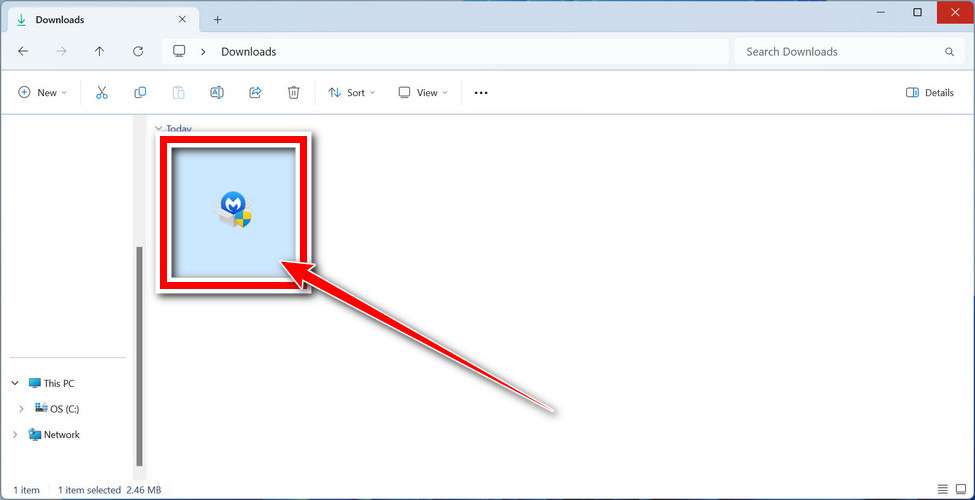
When the download finishes, open your Downloads folder and double-click the MBSetup file. If Windows shows a User Account Control pop-up, click “Yes” to allow the installation.
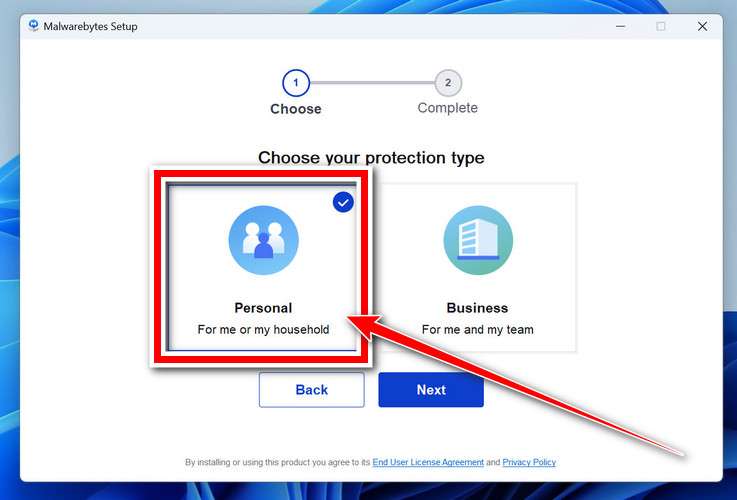
Follow the On-Screen Prompts to Install Malwarebytes
The setup wizard will walk you through a few quick screens:
Choose where you’re installing the program — “Personal Computer” or “Work Computer” — then click Next.
Malwarebytes will now install on your device. This usually takes under a minute.
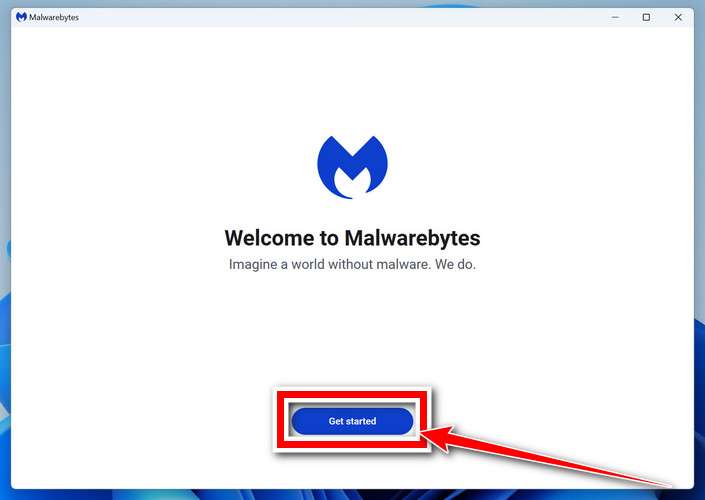
When installation is complete, the “Welcome to Malwarebytes” screen will open automatically.
On the final screen, click Open Malwarebytes to launch the program.
Enable “Scan for Rootkits”
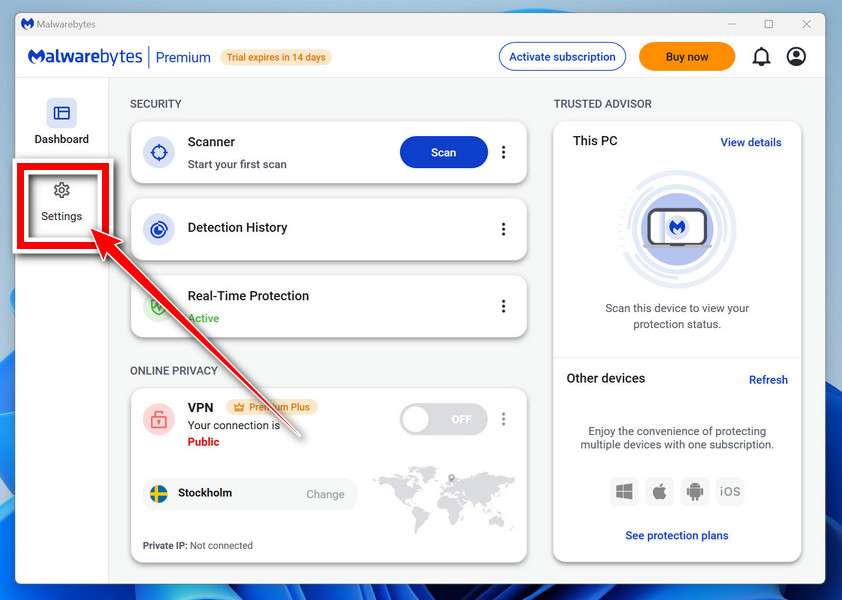
Before scanning, turn on rootkit detection so Malwarebytes can find even the most hidden threats. Click the Settings gear icon on the left side of the screen.
In the settings menu, find “Scan for rootkits” and click the toggle so it turns blue.
Done? Click “Dashboard” in the left pane to return to the main screen.
Start the Scan
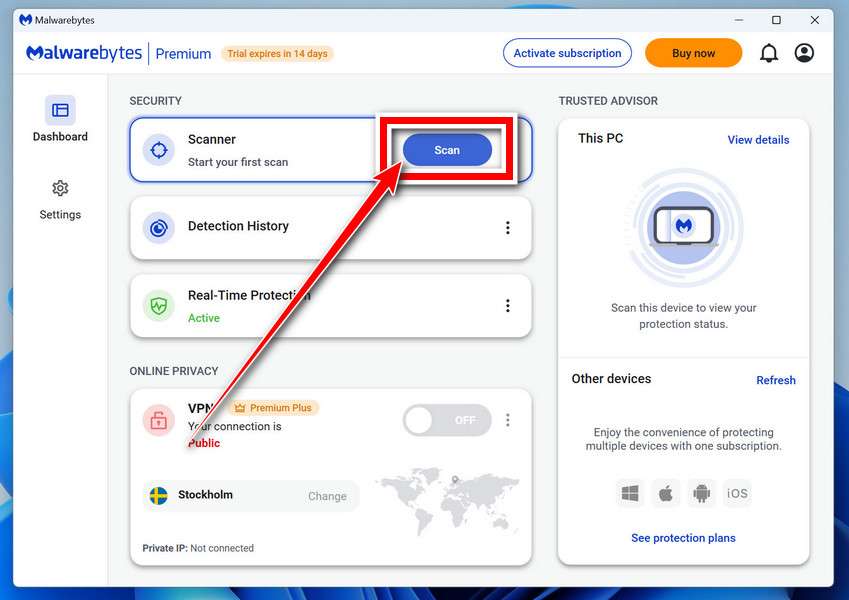
Click the blue Scan button. Malwarebytes will automatically update its virus database and start checking your computer for malware.
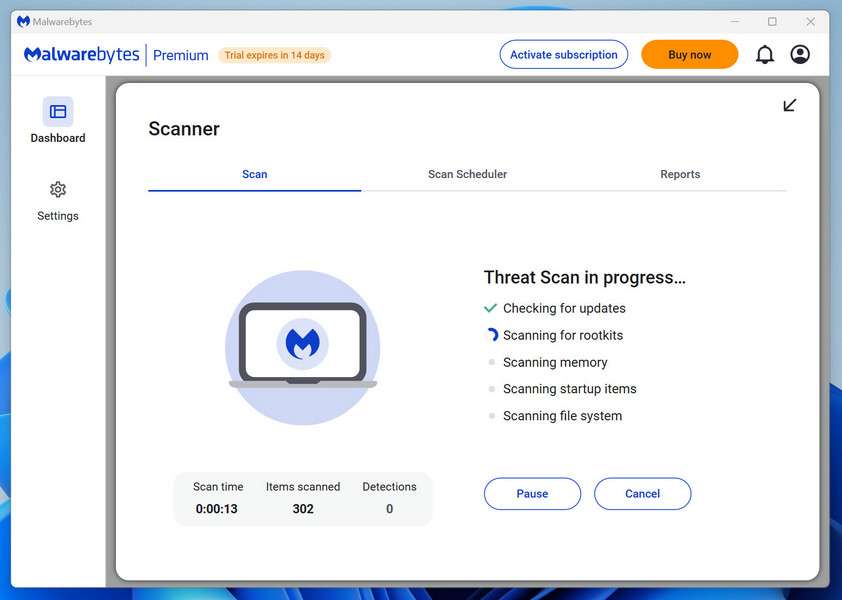
Wait for the Scan to Finish
The scan checks your entire system for browser hijackers and other malicious programs, so it can take several minutes. Feel free to do something else — just check back occasionally to see the progress.
Quarantine the Detected Threats
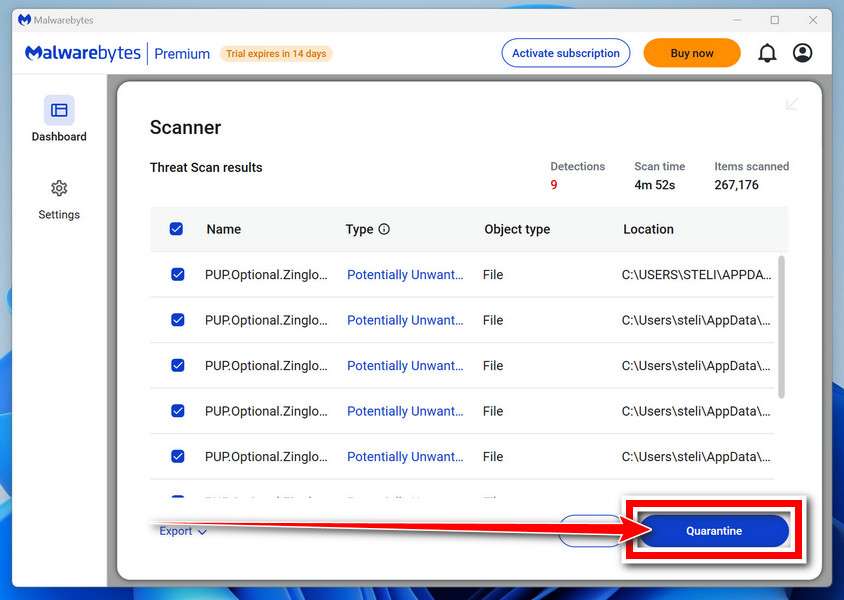
When the scan is done, you’ll see a list of everything Malwarebytes found — malware, adware, and potentially unwanted programs. Click the “Quarantine” button to remove all of them at once.
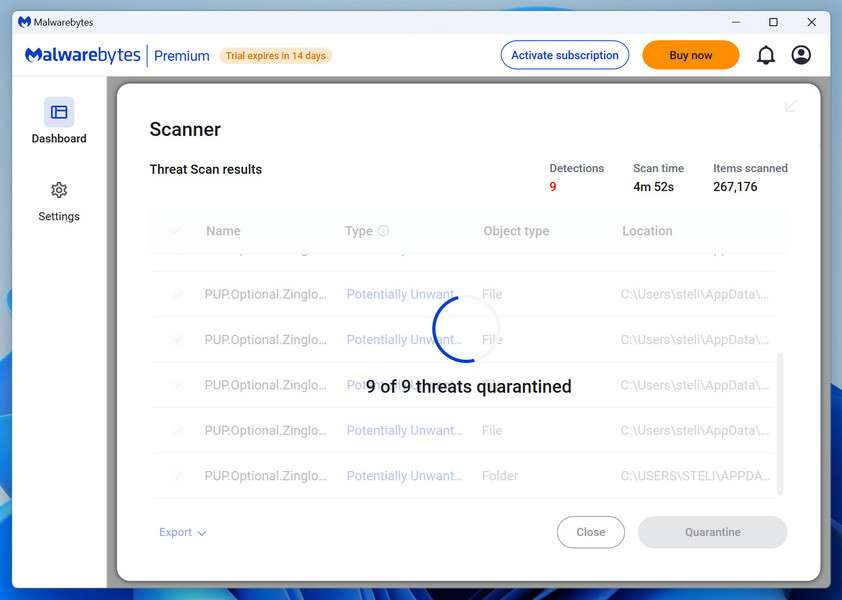
Malwarebytes will now remove the malicious files and registry entries and move them safely into quarantine.
Restart Your Computer
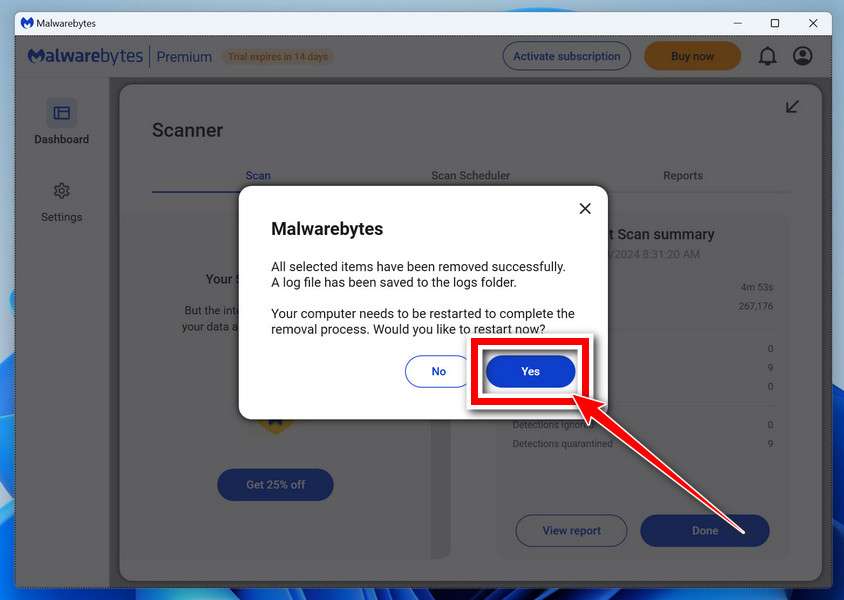
Some threats can only be fully removed after a reboot. If Malwarebytes asks you to restart, click Yes. Once you’re logged back in, your PC is clean and you can continue with the next steps in this guide.
When the scan finishes, click Quarantine to remove everything Malwarebytes found. That’s it — your Windows PC is now clean of trojans, adware, and other malware, and should be back to running smoothly.
If your current antivirus allowed this malicious program on your computer, you may want to consider purchasing Malwarebytes Premium to protect against these types of threats in the future. If you are still having problems with your computer after completing these instructions, then please follow one of the steps:
Malwarebytes for Mac is a free on-demand scanner that removes the malware other security software tends to miss — adware, browser hijackers, and unwanted programs included. Cleaning an infected Mac with Malwarebytes has always been completely free, and it’s our go-to recommendation. Follow the steps below to scan and clean your Mac in just a few minutes.
Download Malwarebytes for Mac
Click the button below to download the latest version of Malwarebytes for Mac.
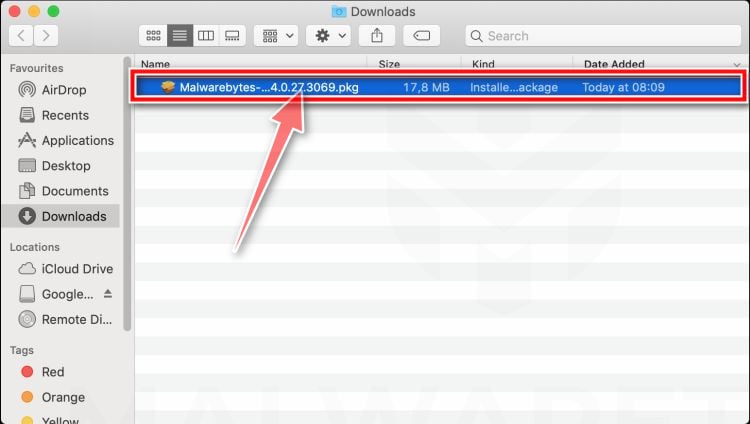
When the download finishes, open your Downloads folder and double-click the setup file to begin the installation.
Follow the On-Screen Prompts to Install Malwarebytes
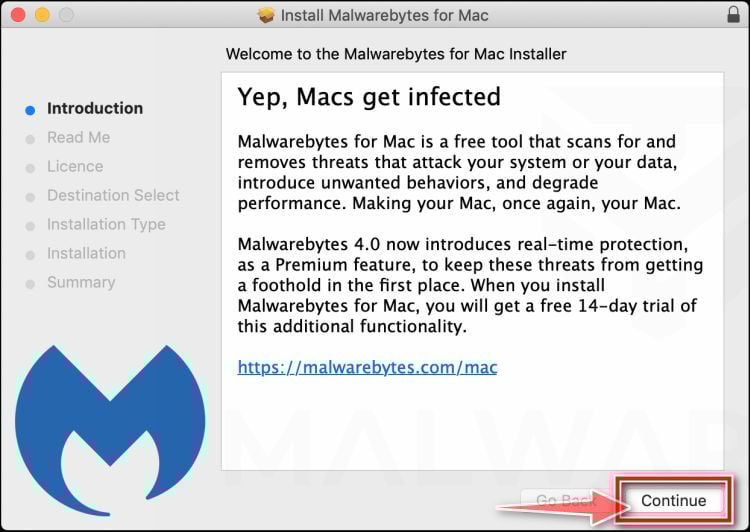
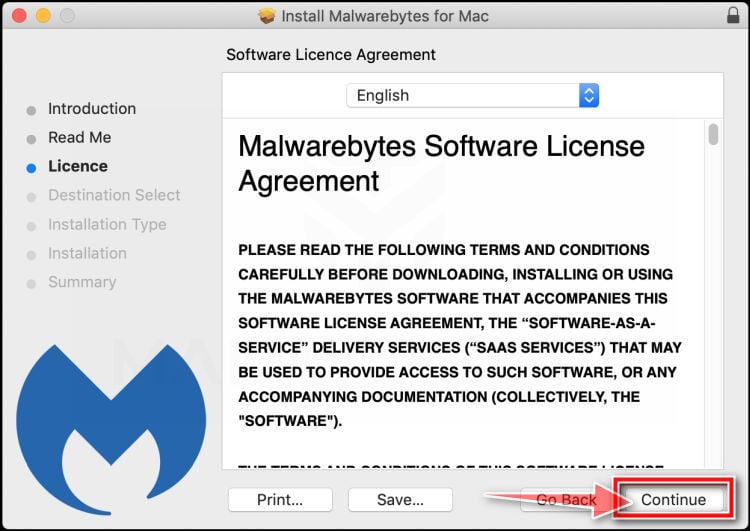
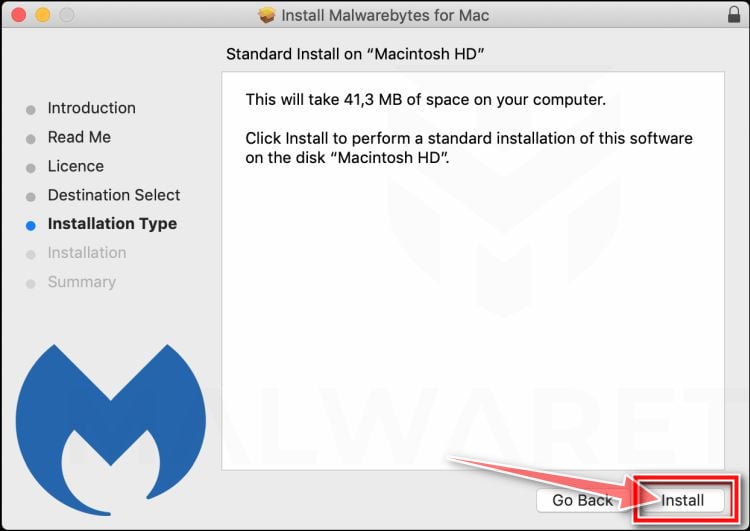
The Malwarebytes for Mac Installer will guide you through a few quick screens. Click “Continue” and keep following the prompts until the installation completes.
When the installation is complete, Malwarebytes opens to the Welcome to Malwarebytes screen. Click “Get started“.
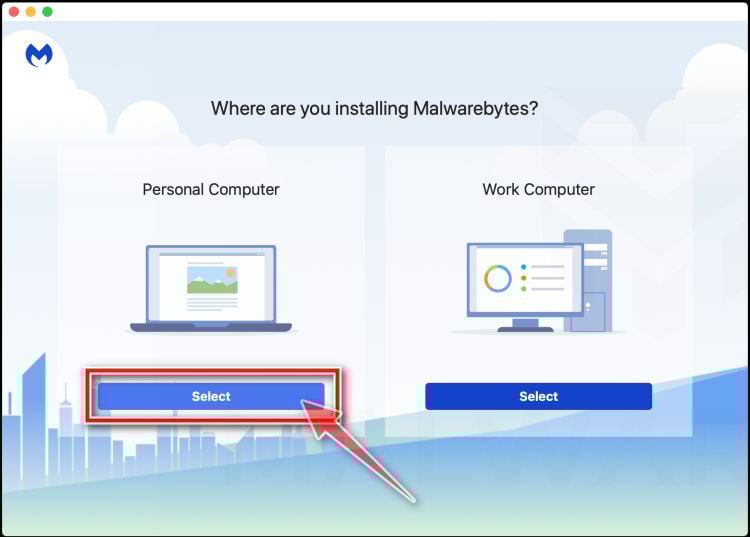
Select “Personal Computer” or “Work Computer”
Malwarebytes will ask what type of computer you’re installing it on. Click either Personal Computer or Work Computer, whichever applies.
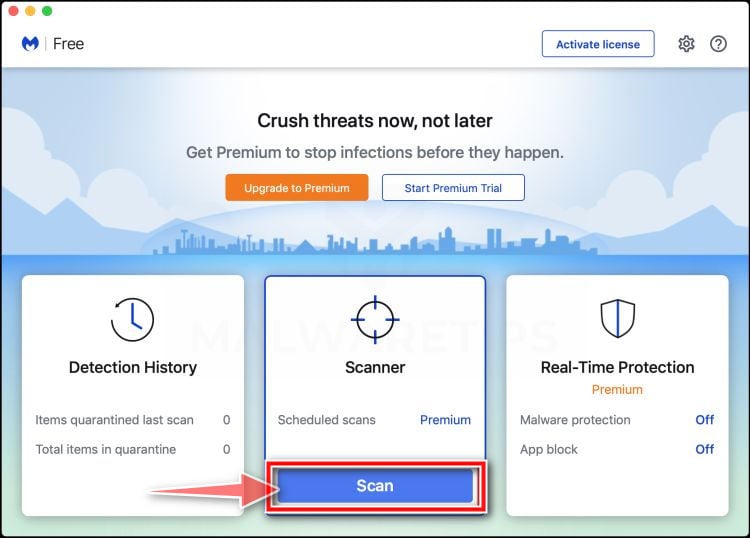
Start the Scan
Click the “Scan” button. Malwarebytes will automatically update its detection database and begin checking your Mac for malware.
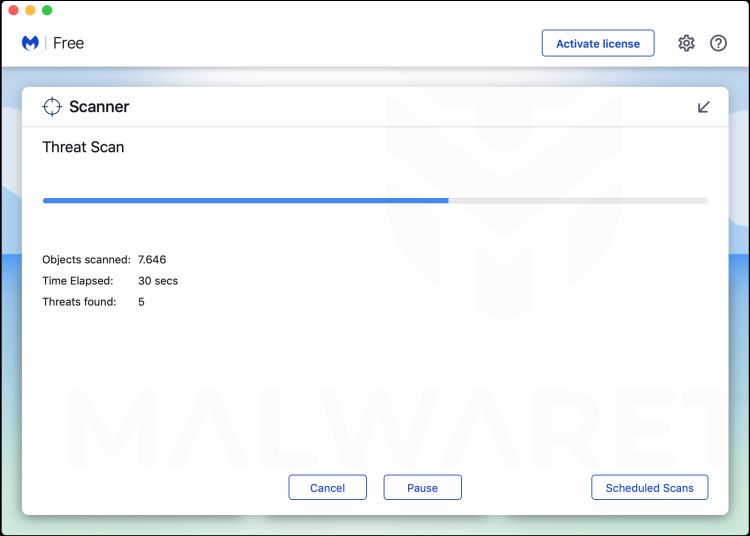
Wait for the Scan to Finish
Malwarebytes will scan your Mac for adware, browser hijackers, and other malicious programs. This can take a few minutes, so feel free to do something else — just check back occasionally to see the progress.
Quarantine the Detected Threats
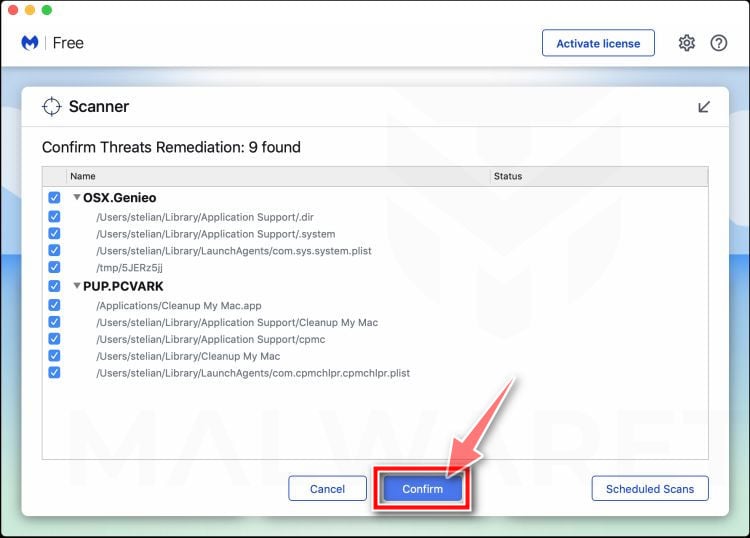
When the scan is done, you’ll see a list of everything Malwarebytes found. Click the “Quarantine” button to remove all the threats at once.
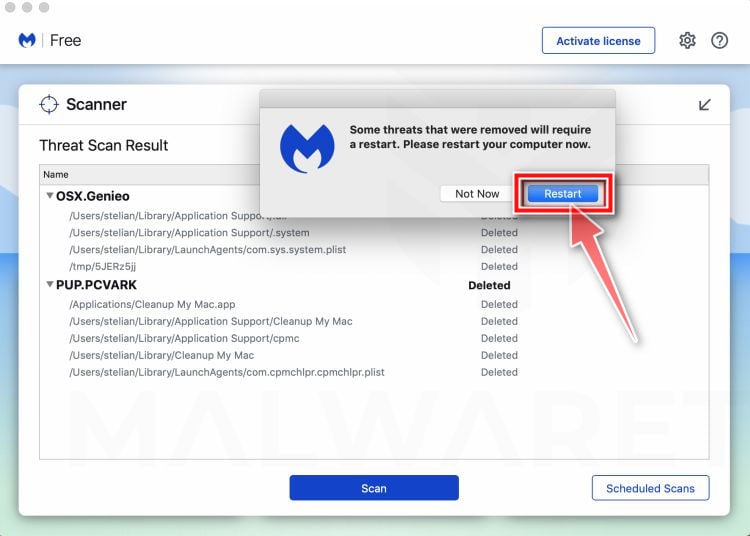
Restart Your Mac
Malwarebytes will now remove all the malicious files it found. Some threats can only be fully removed after a reboot — if Malwarebytes asks you to restart, allow it. Once you’re logged back in, your Mac is clean.
Once the scan is done, remove every threat it detected. Your Mac is now free of adware, rogue browser extensions, and other potentially harmful software.
If your current antivirus allowed a malicious program on your computer, you might want to consider purchasing the full-featured version of Malwarebytes Anti-Malware to protect against these types of threats in the future. If you are still experiencing problems while trying to remove a malicious program from your computer, please ask for help in our Mac Malware Removal Help & Support forum.
Run a Malware Scan with Malwarebytes for Android
Malwarebytes for Android automatically detects and removes dangerous threats like malware and ransomware so you don’t have to worry about your most-used device being compromised. Aggressive detection of adware and potentially unwanted programs keeps your Android phone or tablet running smooth.
Download Malwarebytes for Android.
You can download Malwarebytes for Android by clicking the link below.
In the Google Play Store, tap “Install” to install Malwarebytes for Android on your device.
When the installation process has finished, tap “Open” to begin using Malwarebytes for Android. You can also open Malwarebytes by tapping on its icon in your phone menu or home screen.
Follow the on-screen prompts to complete the setup process
When Malwarebytes will open, you will see the Malwarebytes Setup Wizard which will guide you through a series of permissions and other setup options. This is the first of two screens that explain the difference between the Premium and Free versions. Swipe this screen to continue. Tap on “Got it” to proceed to the next step. Malwarebytes for Android will now ask for a set of permissions that are required to scan your device and protect it from malware. Tap on “Give permission” to continue. Tap on “Allow” to permit Malwarebytes to access the files on your phone.
Update database and run a scan with Malwarebytes for Android
You will now be prompted to update the Malwarebytes database and run a full system scan.
Click on “Update database” to update the Malwarebytes for Android definitions to the latest version, then click on “Run full scan” to perform a system scan.
Wait for the Malwarebytes scan to complete.
Malwarebytes will now start scanning your phone for adware and other malicious apps. This process can take a few minutes, so we suggest you do something else and periodically check on the status of the scan to see when it is finished.
Click on “Remove Selected”.
When the scan has been completed, you will be presented with a screen showing the malware infections that Malwarebytes for Android has detected. To remove the malicious apps that Malwarebytes has found, tap on the “Remove Selected” button.
Restart your phone.
Malwarebytes for Android will now remove all the malicious apps that it has found. To complete the malware removal process, Malwarebytes may ask you to restart your device.
After the scan, tap Remove Selected to delete all detected threats. Your Android phone is now clean — no more malicious apps, adware, or browser redirects.
If your current antivirus allowed a malicious app on your phone, you may want to consider purchasing the full-featured version of Malwarebytes to protect against these types of threats in the future. If you are still having problems with your phone after completing these instructions, then please follow one of the steps:
Restore your phone to factory settings by going to Settings > General management > Reset > Factory data reset.
Now that your device is clean, keep it that way. Most infections start with a malicious ad or a fake download button — so blocking them at the source is your best defense.
We recommend AdGuard, which blocks malicious ads, phishing pages, and dangerous redirects before they can reach you.
Order optimization task scam sites are not job platforms.
They are deposit traps wrapped in an e-commerce costume.
They lure victims with the promise of simple tasks and easy commission, build trust with early wins, then flip the script by locking withdrawals behind “recharges,” “combo tasks,” and invented fees.
If a platform asks you to deposit money to do work, it is not work.
If it pushes crypto as the main way to “settle” and withdraw, it is a major warning sign.
And if it tells you to pay one more time to unlock your money, that is the trap closing.
The safest move is to stop paying, cut contact, save evidence, secure your accounts, and report what happened.
Once you understand this pattern, it becomes much easier to spot these scams early, warn others, and avoid the moment where curiosity turns into a costly mistake.
Frequently Asked Questions About Order Optimization Task Scam Sites
What is an “order optimization” task scam?
An order optimization task scam is a fake online job scheme that claims you can earn commissions by completing simple tasks like “optimizing orders,” “processing orders,” “boosting products,” or “rating items.” The real goal is to pressure you into depositing money, usually in crypto, and then block withdrawals with endless new fees and requirements.
Are order optimization tasks a real job in e-commerce?
Real e-commerce companies do hire for roles like marketing, catalog operations, customer support, and fraud review, but they do not pay random users to click through “orders” on a mysterious platform. Most importantly, legitimate employers never require workers to deposit money to do the job.
Why do these sites look like real shopping platforms?
Because the design is part of the trick. Scammers use an e-commerce layout, product tiles, discounts, and “wallet” dashboards to make the tasks feel connected to real commerce. It helps the scam feel familiar and trustworthy, even though the “orders” are fake.
How do people get recruited into these scams?
Most victims are contacted through Telegram, WhatsApp, SMS, or social media DMs by someone posing as a recruiter or trainer. They often advertise “remote work,” “easy commission,” or “part-time tasks,” then send a link to register on the platform.
What do the tasks usually involve?
Tasks are usually repetitive actions such as:
Clicking to “submit” or “confirm” orders
Completing a set of “orders” in a batch
“Boosting” or “optimizing” products
Rating items or merchants
Following a step-by-step workflow to “finish today’s tasks”
The tasks exist to build trust and momentum, not to produce real work.
What does “recharge to continue” mean?
It usually means you are being pushed into the deposit trap. The platform claims your balance is not enough to complete a task, so you must “recharge” or “top up.” Once you pay, the amount required often increases and the platform finds new reasons to demand more money.
Why do they ask for USDT or other crypto?
Crypto is hard to reverse and easy to move. Task scam sites often push USDT because it feels stable and “professional,” but the main reason is that victims have fewer protections compared to card payments or bank transfers.
Is the wallet balance on the site real?
In a task scam, the wallet balance is just a number displayed on a screen. Scammers can change it anytime. A large balance does not mean the money exists, and it does not guarantee you can withdraw anything.
Why do some victims receive a small withdrawal at the beginning?
Early withdrawals are often bait. Scammers may allow a small payout to prove the system “works,” which lowers suspicion and makes victims more willing to deposit larger amounts later.
What is a “combo task” or “special order”?
These are common scam triggers. The platform claims you received a special, higher-value order that requires you to deposit money to complete it. This is how the scam escalates payments and locks you into a cycle of paying to “finish the set.”
Why is my withdrawal stuck or blocked?
Task scams intentionally block withdrawals to force more deposits. They may claim you need to pay:
A verification fee
A tax payment
A risk control deposit
A margin requirement
An unlock fee
A minimum balance fee
A security review charge
These are excuses designed to keep you paying.
If I pay the fee, will I be able to withdraw?
Almost always, no. One fee typically leads to another. The “final step” is rarely final because the scam is designed to continue until you stop paying or run out of funds.
What should I do if I already sent money?
Take these steps right away:
Stop sending money, even if they pressure you
Save screenshots, chat logs, wallet addresses, and transaction IDs
Contact your bank or card issuer if you used card or bank transfer
Contact the crypto exchange you used and report the destination address
Block the recruiter and exit any related group chats
Secure your accounts with password changes and 2FA
Can I get my money back if I sent crypto?
Crypto recovery is difficult, but fast action helps. Report the scam to the exchange you used, provide transaction IDs and wallet addresses, and file a report with fraud or cybercrime authorities. Do not pay “recovery agents” who demand upfront fees.
What are the biggest red flags to watch for?
High-confidence warning signs include:
You must deposit money to complete tasks
Withdrawals are blocked until you pay fees
The platform pushes USDT or crypto settlement
“Combo tasks” appear that require larger deposits
Customer service pressures you to pay quickly
The domain or platform keeps changing
Earnings seem high for simple clicking work
Are “recovery services” that message victims legitimate?
Most are not. Recovery scams are extremely common after task scams. Be cautious with anyone promising guaranteed recovery, asking for upfront payment, or requesting remote access to your device.
How can I check if a specific domain is part of an order optimization task scam?
Look for the pattern: recruiter contact + task dashboard + wallet balance + recharge demands + blocked withdrawals. If you share the domain name and a screenshot of the “tasks” or “wallet” page, it is usually possible to identify the scam signals quickly.
10 Rules to Avoid Online Scams
Here are 10 practical safety rules to help you avoid malware, online shopping scams, crypto scams, and other online fraud. Each tip includes a quick “if you already got hit” action.
Stop and verify before you click, log in, download, or pay.
Most scams win by creating urgency. Verify using a trusted method: type the website address yourself, use the official app, or call a known number (not the one in the message).
If you already clicked: close the page, do not enter passwords, and run a malware scan.
Keep your operating system, browser, and apps updated.
Updates patch security holes used by malware and malicious ads. Turn on automatic updates where possible.
If you saw a scary “update now” pop-up: close it and update only through your device settings or the official app store.
Use layered protection: antivirus plus an ad blocker.
Antivirus helps block malware. An ad blocker reduces scam redirects, phishing pages, and malvertising.
If your browser is acting weird: remove unknown extensions, reset the browser, then run a full scan.
Install apps, software, and extensions only from official sources.
Avoid cracked software, “keygens,” and random downloads. During installs, choose Custom/Advanced and decline bundled offers you do not recognize.
If you already installed something suspicious: uninstall it, restart, and scan again.
Treat links and attachments as untrusted by default.
Phishing often impersonates delivery services, banks, and popular brands. If it is unexpected, do not open attachments or log in through the message.
If you entered credentials: change the password immediately and enable 2FA.
Shop safely: research the store, then pay with protection.
Be cautious with brand-new stores, “closing sale” stories, and prices that make no sense. Prefer credit cards or PayPal for dispute options. Avoid wire transfers, gift cards, and crypto payments.
If you already paid: contact your card issuer or PayPal quickly to dispute the transaction.
Crypto rule: never pay a “fee” to withdraw or recover money.
Common patterns include fake profits, then “tax,” “gas,” or “verification” fees. Another is a “recovery agent” who demands upfront crypto.
If you already sent crypto: stop paying, save evidence (wallet addresses, TXIDs, chats), and report the scam to the platform used.
Secure your accounts with unique passwords and 2FA (start with email).
Use a password manager and unique passwords for every account. Enable 2FA using an authenticator app when possible.
If you suspect an account takeover: change passwords, sign out of all devices, and review recent logins and recovery settings.
Back up important files and keep one backup offline.
Backups protect you from ransomware and device failure. Keep at least one backup on an external drive that is not always connected.
If you suspect infection: do not connect backup drives until the system is clean.
If you think you are a victim: stop losses, document evidence, and escalate fast.
Move quickly. Speed matters for disputes, account recovery, and limiting damage.
Stop payments and contact: do not send more money or respond to the scammer.
Call your bank or card issuer: block transactions, replace the card if needed, and start a dispute or chargeback.
Secure your email first: change the email password, enable 2FA, and remove unfamiliar recovery options.
Secure other accounts: change passwords, enable 2FA, and log out of all sessions.
Scan your device: remove suspicious apps or extensions, then run a full malware scan.
Save evidence: screenshots, emails, order pages, tracking pages, wallet addresses, TXIDs, and chat logs.
Report it: to the payment provider, marketplace, social platform, exchange, or wallet service involved.
These rules are intentionally simple. Most online losses happen when decisions are rushed. Slow down, verify independently, and use payment methods and account controls that give you recourse.
Thomas is an expert at uncovering scams and providing in-depth reporting on cyber threats and online fraud. As an editor, he is dedicated to keeping readers informed on the latest developments in cybersecurity and tech.