


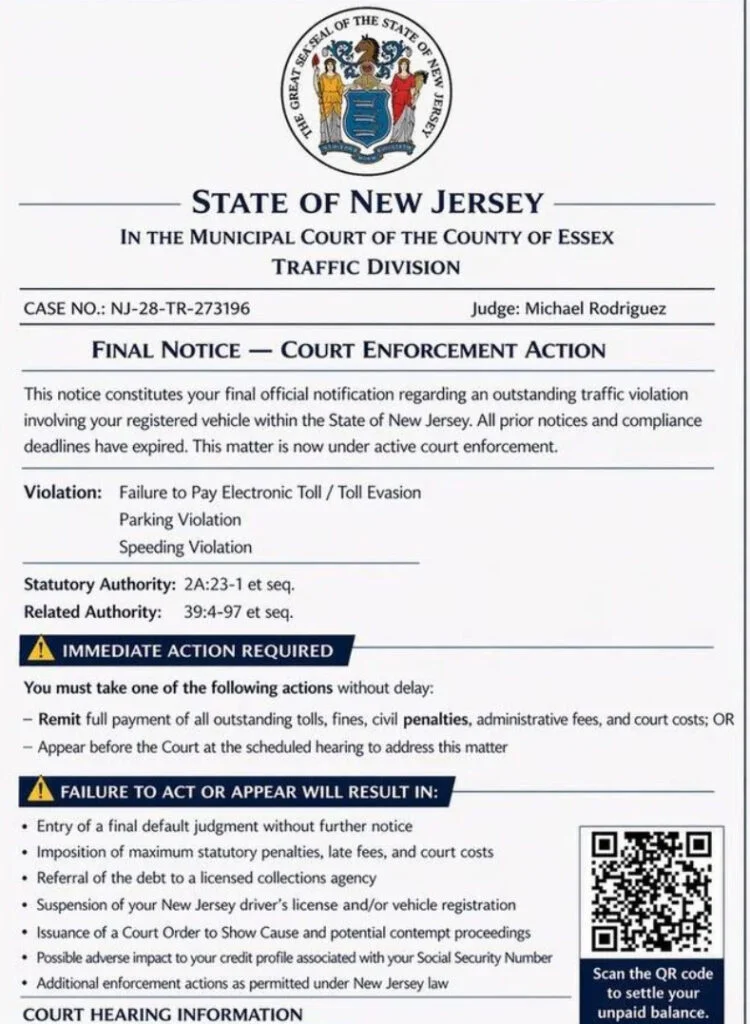
A text message arrives with what looks like an official notice from the Municipal Court of the County of Essex Traffic Division. It may include a state seal, a case number, a judge’s name, alleged toll or traffic violations, and a QR code telling you to pay.
It looks serious. It feels urgent. It is a scam designed to steal your money, credit card details, and personal information.
Scam Overview
The Essex County Municipal Court scam texts are part of a larger wave of fake traffic violation notices being sent to drivers across New Jersey and other states. These messages impersonate courts and traffic divisions, then pressure recipients to scan a QR code or click a payment link.
The New Jersey Courts have issued a phishing scam alert telling people not to scan the QR code and directing anyone with a valid traffic ticket to pay only through NJMCDirect under official online tools.
These scam texts often look like court documents. They may use:
- The State of New Jersey seal
- A fake court heading
- A “Traffic Division” label
- A case number such as NJ-28-TR-273196
- The name Judge Michael Rodriguez
- A “Final Notice” title
- Warnings about default judgments, collections, or license suspension
- A QR code to “settle your unpaid balance”
The Federal Trade Commission has also warned about this exact scam pattern: fake traffic violation texts that include QR codes, official-looking seals, fake case numbers, fake hearing dates, and threats of court action.
Why the Essex County version looks convincing
The scam works because it copies the structure of a real legal notice.
A recipient may see:
- “State of New Jersey”
- “Municipal Court”
- “County of Essex”
- “Traffic Division”
- “Final Notice”
- “Court Enforcement Action”
Those phrases create instant pressure.
Most people do not read court documents every day. If a notice looks formal and includes a court name, they may assume it is legitimate before checking the details.
That is exactly what scammers want.
What the fake notice usually claims
The Essex County version typically says you have an outstanding traffic violation involving your registered vehicle in New Jersey.
Common alleged violations include:
- Failure to pay electronic toll
- Toll evasion
- Parking violation
- Speeding violation
The notice then claims that prior notices and deadlines have expired and that the matter is now under active court enforcement.
This is meant to make you feel late, guilty, and under pressure.
The QR code is the trap
The most dangerous part of the message is the QR code.
The notice tells you to scan it to pay or settle your unpaid balance. But the QR code does not take you to a legitimate court system. It usually redirects to a fake payment website built to collect your information.
NBC New York reported that fake New Jersey traffic violation notices often include QR codes demanding payment and threatening legal action. Authorities advised recipients not to scan the QR code, click links, or provide personal or financial information
A QR code can feel safer than a suspicious link, but it is still just a hidden link. If it came from an unexpected text, treat it as unsafe.
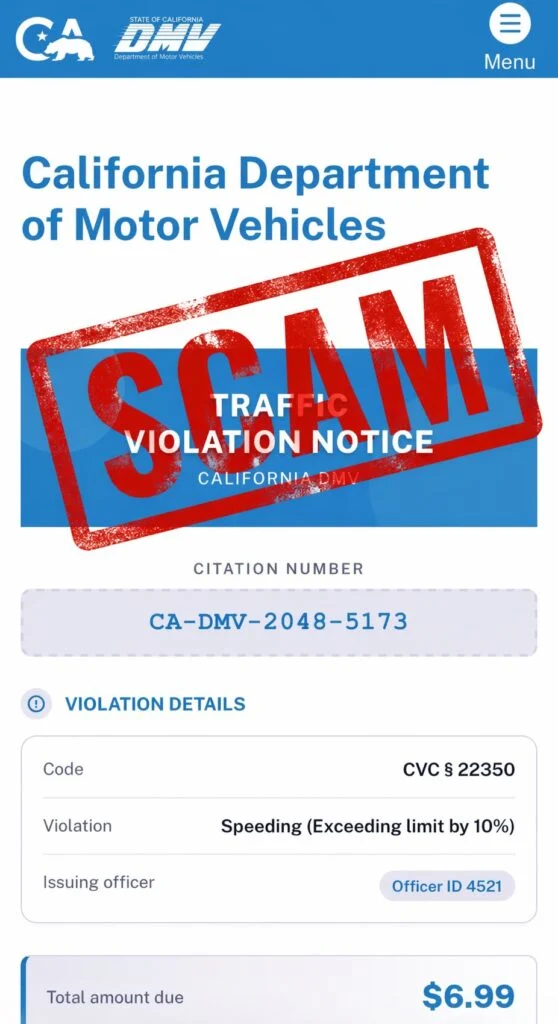
Why “Judge Michael Rodriguez” is a red flag
Many of these scam notices use the name Judge Michael Rodriguez.
That name has appeared in multiple fake traffic notice templates across different states and counties. This is a strong sign that scammers are reusing a template and swapping the location.
A real court notice should be tied to a real case, a real court process, and verifiable court records. A recycled judge name appearing across unrelated jurisdictions is a major warning sign.
Why the case number looks suspicious
The case number in the Essex County version often looks like:
NJ-28-TR-273196
This format is meant to look official, but similar versions have appeared with different state prefixes.
Scammers use case numbers because they make the notice feel specific. But a case number alone proves nothing. A real case should be verifiable through official court systems, not through a QR code sent by text.
The real goal of the scam
The fake notice is not about collecting a real court fine.
The goal is to steal:
- Credit card number
- Expiration date
- CVV
- Billing address
- Full name
- Phone number
- Email address
- Possibly vehicle or license plate details
Once scammers have that information, they can attempt unauthorized charges, sell the data, or target you with more personalized scams.
How The Essex County Municipal Court Scam Works
Step 1: The text arrives
The scam usually begins with a text message from an unknown number.
It may include an image that looks like a court document. The image may show the New Jersey state seal, a court name, a case number, a judge’s name, and a QR code.
This is not proof of a real case. It is a designed image meant to create fear.
Step 2: The message creates authority
The notice uses official-sounding wording such as:
- “Municipal Court”
- “Traffic Division”
- “Final Notice”
- “Court Enforcement Action”
- “Immediate Action Required”
This gives the message a legal tone.
Scammers know people are more likely to obey a message that appears to come from a court.
Step 3: The notice creates urgency
The scam usually says you must act immediately.
It may warn that failure to act could result in:
- Final default judgment
- Maximum statutory penalties
- Late fees
- Court costs
- Collections
- License suspension
- Registration consequences
- Credit impact
This pressure is intentional.
The FTC says these fake traffic violation messages use frightening consequences like fines, default judgments, and enforcement actions to push people into scanning a QR code or paying quickly.
Step 4: The QR code offers a fake solution
After creating fear, the message gives you a simple way out:
Scan the QR code and pay.
This is the point where the scam moves from intimidation to theft.
The QR code may take you to a fake court, DMV, or payment portal. It may look polished and official, but it is controlled by scammers.
Step 5: The fake website collects your information
The payment page may ask for:
- Name
- Address
- Phone number
- Card number
- Expiration date
- CVV
- Billing ZIP code
Some sites may also ask for vehicle details to make the process feel more legitimate.
Even if the payment amount looks small, the risk is not small. The card data is the real target.
Step 6: Fraud may happen later
After you submit payment details, scammers may:
- Run small test charges
- Attempt larger purchases later
- Sell the card data
- Send more fake court or DMV texts
- Use your information in identity-related scams
You may not see fraud immediately. That delay is why you should treat the card as compromised if you entered it on the fake site.
Red Flags in Essex County Municipal Court Scam Texts
The notice arrives by random text
A surprise court notice by text demanding quick payment is a major warning sign.
The message includes a QR code
New Jersey Courts specifically warns people not to scan QR codes in these scam notices.
It uses urgent legal threats
Scammers use fear to stop you from verifying.
It asks for payment outside official channels
Valid New Jersey traffic ticket payments should be handled through official NJ Courts tools, including NJMCDirect, not through a QR code sent by text.
The case details feel generic
Many scam notices list several possible violations at once, such as toll evasion, parking, and speeding. Real citations are usually more specific.
The judge name appears in other scam templates
The repeated use of “Judge Michael Rodriguez” across different fake notices is a strong sign of a mass-produced scam.
What To Do If You Receive One
Do not scan the QR code
Do not scan it, even out of curiosity.
Do not click any links
Do not open links in the message. A fake site may collect data or push you toward payment.
Do not reply
Replying can confirm that your phone number is active.
Do not pay
Do not enter card details through the QR code or link.
Verify independently
If you are worried that you may have a real ticket, go directly to the official New Jersey Courts website and use official tools such as NJMCDirect. Do not use any link or code from the suspicious text.
What To Do If You Fell for the Scam
1. Call your card issuer immediately
If you entered payment information, call the number on the back of your card.
Tell them:
- You entered card details on a fraudulent court payment site
- The site came from a scam text
- You need the card blocked and replaced
- You want recent transactions reviewed
2. Review your transactions
Look for:
- Small test charges
- Unknown online purchases
- New subscription charges
- Charges from unfamiliar merchants
Dispute anything you do not recognize.
3. Turn on transaction alerts
Enable alerts for every purchase or any transaction over $1.
4. Save screenshots
Keep evidence of:
- The text message
- Sender number
- Fake notice
- QR code
- Website
- Payment confirmation or error screen
5. Watch for follow-up scams
Scammers may contact you again pretending to be:
- A court clerk
- A refund department
- A fraud investigator
- A collections agency
- Your bank
Do not trust follow-up messages just because they mention the same fake case.
6. Report the scam
You can:
- Mark the message as spam or junk
- Block the sender
- Forward the text to 7726 (SPAM) if your carrier supports it
- Report fraud through official consumer reporting channels
The Borough of East Newark’s alert, citing the New Jersey Judiciary warning, also advises recipients not to scan QR codes, not to click links, and not to share personal or financial information in response to unsolicited texts, emails, or calls.
The Bottom Line
The Essex County Municipal Court scam texts are fake court-style notices designed to make you panic and pay quickly.
They may use the New Jersey seal, a case number, a traffic division heading, the name Judge Michael Rodriguez, and a QR code demanding payment. But those details are part of the deception.
New Jersey Courts has warned people not to scan QR codes in these traffic notice scams and says valid traffic ticket payments should be made through official tools like NJMCDirect.
If you receive one of these messages, do not scan, do not click, and do not pay.
Verify only through official court channels you access yourself.

Join the discussion
0 commentsShare your experience or ask a question about this article.
Discussion
Start the conversation
Have a question or something useful to share? Add the first comment.