

FitiBeats Wireless Airbuds arrive with a tempting contradiction: a familiar stem-style earbud set is promoted as premium audio at a spectacular discount.
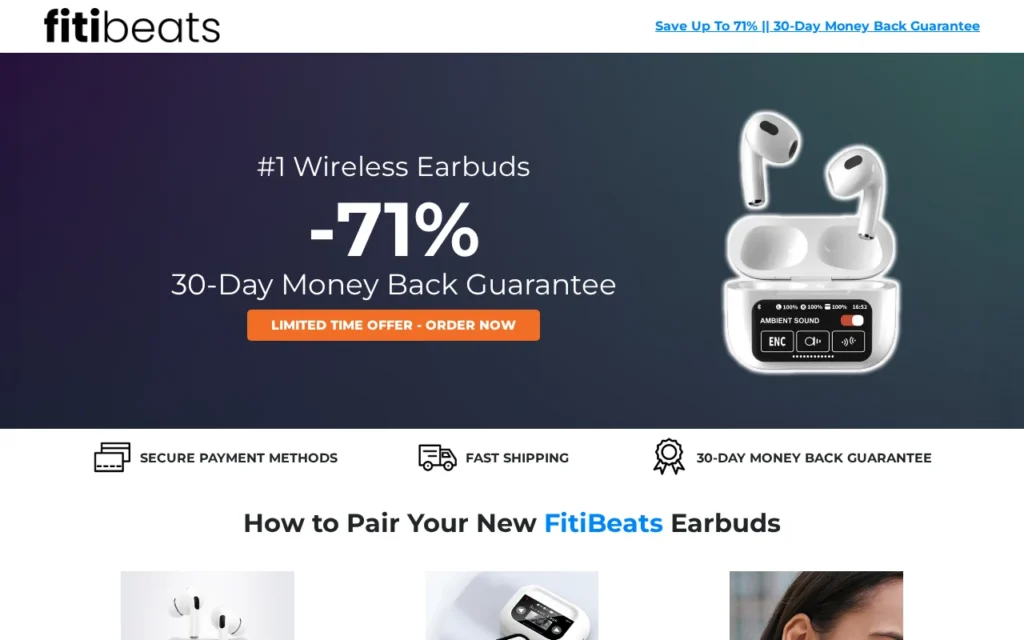
The pictures show earbuds and an LCD charging case. The marketing adds expert-style praise, noise-cancellation claims, a 48-hour message and savings of up to 71%.
Look past that presentation, and the expectation gap becomes hard to miss.
FitiBeats Wireless Airbuds Overview
FitiBeats is the name attached to a stem-style Bluetooth earbud set with an LCD charging case. The screen is designed to give buyers a quick view of charging information, while the overall shape follows a widely used wireless-earbud format.
This is a dropshipping funnel. Shoppers move through promotional content and referral pages before reaching the main sales page, where discounts, quantity choices and a limited-time offer encourage a quick order.
What gives the campaign its power is not a clearly identified manufacturer or a body of model-specific performance testing. It is the story built around the product: premium sound, noise cancellation, enthusiastic testimonials and an unusually large markdown.
The seller also advertises a 30-day money-back guarantee. That may sound reassuring, but a guarantee headline is only useful when buyers know the refund conditions, return address and process before paying.
FitiBeats should therefore be judged as the physical product shown, not as the premium identity created by the surrounding advertising. The earbuds may look polished in sales images, but appearance alone cannot demonstrate sound quality, battery endurance or effective noise cancellation.
A Premium Story Built Around an Ordinary Product Format
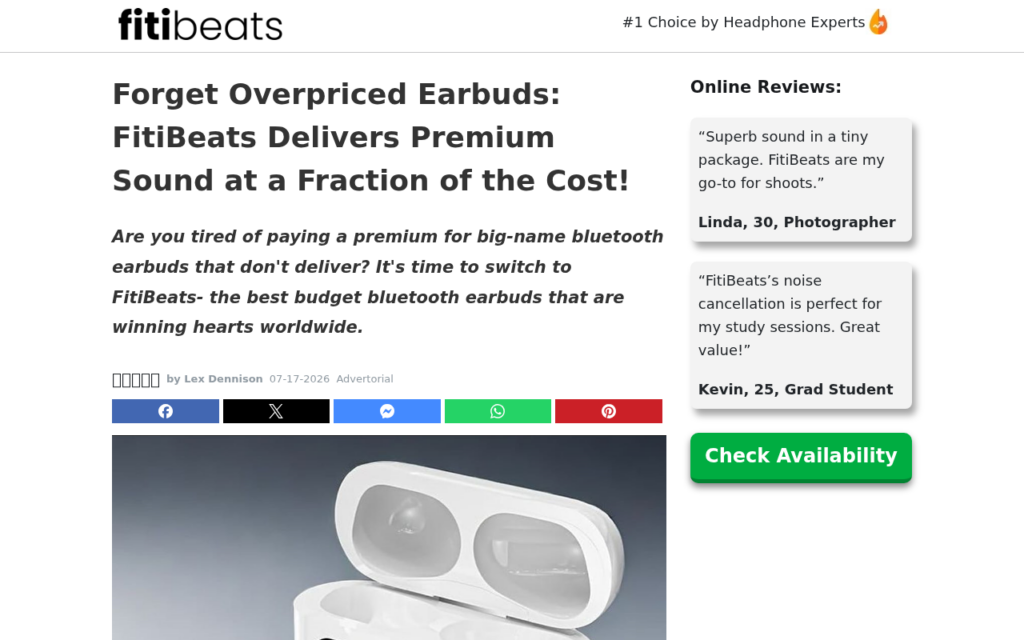
A separate FitiBeats advertorial promotes the earbuds as a premium choice and frames them as an expert selection. Promotional testimonials praise the noise cancellation, adding social proof to a page already designed to feel editorial.
That format can be persuasive because it looks less like a direct advertisement. A ranking, expert-style recommendation or customer quote may feel like outside validation even when it forms part of the same promotional ecosystem.
Meanwhile, 48-hour language creates a performance impression without giving shoppers model-specific measurements or test conditions. Does the figure refer to the earbuds, repeated charging through the case, standby time or another usage pattern? The promotional wording does not supply the kind of detail needed to make a reliable comparison.
Noise cancellation deserves similar scrutiny. There is a major difference between passive isolation from an ear tip and active noise cancellation supported by microphones and processing. The advertising uses noise-canceling language, but no model-specific test results accompany the claim.
None of those phrases tells buyers who made the hardware. They also do not identify an exact model that could be compared across retailers. The brand story is much more developed than the product documentation.
How It Works
The FitiBeats journey uses several layers, each adding a little more momentum before checkout.
- An advertorial creates authority. Premium wording, an expert-choice angle and favorable testimonials position the earbuds as a standout product rather than simply another Bluetooth set.
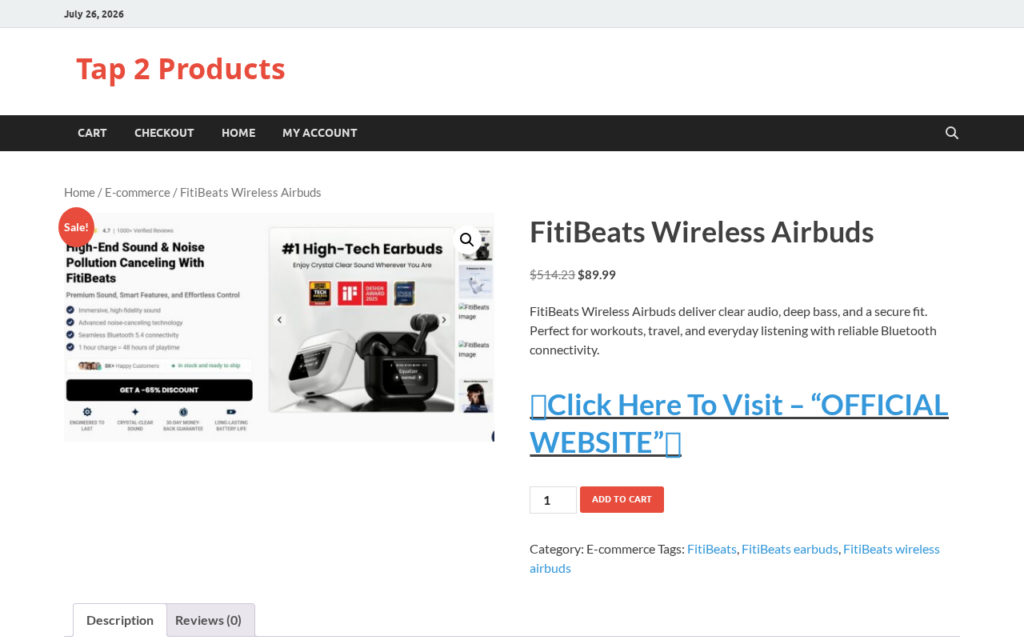
- Referral pages establish a dramatic deal. One listing shows a price of $89.99 beside a struck-through comparison figure of $514.23. The gap makes the current offer look exceptional before the buyer has established what comparable earbuds normally cost.
- The sales page adds urgency. A limited-time promotion and savings of up to 71% encourage shoppers to make the decision while the offer appears available.
- Quantity pricing increases the order size. Promotional results describe one-unit and two-unit options with different per-unit prices. Buying more can look like the better value, even though it increases the amount at risk.
- A guarantee reduces hesitation. The advertised 30-day money-back promise helps close the sale, but shoppers still need the return destination, eligibility rules and refund procedure in writing.
Each step supports the next. Editorial-looking praise creates interest, the reference price creates perceived value, urgency shortens deliberation, and the guarantee makes the decision feel reversible.
That is the dropshipping model at work here: the marketing identity carries more weight than a traceable product model or manufacturer.
The 71% Discount Needs a Reality Check
A large percentage discount only means something when the starting price reflects a genuine comparison. FitiBeats referral pages use $514.23 as a struck-through figure and list the earbuds at $89.99, while other promotional wording describes different per-unit prices for one-set and two-set options.
Nothing in that presentation turns $514.23 into an established market value for this specific hardware. It is a comparison figure on a promotional page, not proof that buyers commonly paid more than five hundred dollars for the same set.
The percentage saving inherits the same weakness. If the reference point lacks a clear retail history, “71% off” creates drama without helping shoppers judge the underlying product.
Quantity offers can make the calculation even murkier. A cheaper per-unit rate sounds economical, but two uncertain products are not automatically a better purchase than one. Buyers must check the selected quantity, shipping charges and final total rather than relying on the headline price.
A BBB Scam Tracker complainant said an extra pair was added to an order, nothing arrived and the loss reached $350. One complaint cannot describe every transaction, but its mechanics offer a clear lesson: review the cart carefully and preserve the checkout record.
What Buyers Actually Know About the Airbuds
The identifiable object is straightforward: stem-style wireless earbuds supplied with an LCD charging case. Beyond that, the product trail becomes thin.
No exact marketplace match, named manufacturer or Chinese supplier is identified. There is also no clear model designation that lets a shopper find a manual, inspect technical specifications or compare the same hardware under consistent conditions.
That missing identity sits at the heart of the expectation gap. Premium audio products usually compete through measurable features, engineering details, codec support, microphone performance, battery specifications and documented controls. FitiBeats is sold mainly through broad benefits and promotional framing.
The LCD case is visually distinctive, but a display is not a measure of audio quality. It cannot show whether calls will sound clear, connections will remain stable or noise reduction will perform as expected.
Likewise, glossy product images cannot settle comfort or battery questions. Fit varies between users, and battery performance depends on volume, calling, charging cycles and feature use. A “48-hour” phrase is not a substitute for clearly defined earbud and case capacities.
Rebranding also makes after-sale support harder to judge. Without a manufacturer and stable model number, buyers have fewer ways to locate compatible instructions, replacement parts or trustworthy troubleshooting information outside the seller’s own pages.
That does not require guessing where every unit originates. The simpler conclusion is enough: the advertising supplies a polished premium identity, while the physical product arrives with limited traceable detail.
A Closer Look at the Sales Funnel
These screenshots show how the product is presented across the sales funnel, along with a marketplace comparison when one was available.
Before You Pay, Lock Down the Details
Anyone still considering FitiBeats should slow the funnel down. Do not let the timer, percentage saving or two-unit rate make the decision.
- Ask for the exact model and manufacturer. A useful answer should identify the hardware clearly enough to locate consistent specifications and instructions.
- Get the return process in writing. Request the return address, deadline, product-condition rules, return-shipping responsibility and any deductions that may apply. “30-day guarantee” is not the complete process.
- Capture the final cart. Save screenshots showing quantity, unit price, shipping cost and total immediately before payment. Check that no additional pair or package has been selected.
- Use a payment method with dispute rights. A credit card or another protected payment option gives buyers a route to challenge non-delivery or a materially different order.
- Preserve every message. Keep the confirmation, advertisement, guarantee wording, tracking details and support correspondence together.
If an order does not arrive, contact the seller in writing and set out the requested resolution clearly. When the seller fails to resolve the issue, use the payment provider’s dispute procedure before its deadline expires.
For an unwanted or disappointing product, do not ship it back to an address found through guesswork. Obtain the seller’s written return instructions first and keep proof of postage and delivery.
Most importantly, walk away if the seller cannot identify the model or explain where returns go. A steep discount is not valuable when the product and refund route remain vague.
Final Verdict
We do not recommend ordering FitiBeats Wireless Airbuds on the strength of the premium claims, advertorial ranking or dramatic discount. This dropshipping funnel gives shoppers a strong marketing story but limited product identity, no model-specific performance results and no established basis for the $514.23 comparison figure.
The LCD case may look appealing, yet it says little about sound, battery life or noise cancellation. If you still consider buying, confirm the model, manufacturer, return address and refund rules first. Check the final quantity and total, save screenshots, and pay only with a method offering meaningful dispute rights.
